
Generalized Anxiety Disorder ICD-10 Code F41.1 Explained
The generalized anxiety disorder ICD-10 code is F41.1. It’s a billable, complete code in the FY 2027 code set, with no extra characters, and you should report it only when the provider has actually diagnosed generalized anxiety disorder (GAD). Below: how F41.1 differs from other anxiety codes, what the note needs, companion codes and common denials.
Where F41.1 Fits in the Anxiety Codes
F41.1 sits in category F41, other anxiety disorders, beside panic disorder (F41.0), other mixed anxiety disorders (F41.3), other specified anxiety disorders (F41.8) and anxiety disorder, unspecified (F41.9). Therapy and psychiatry practices code these daily, and our guide to mental health billing for psychiatrists and therapists covers the wider workflow.
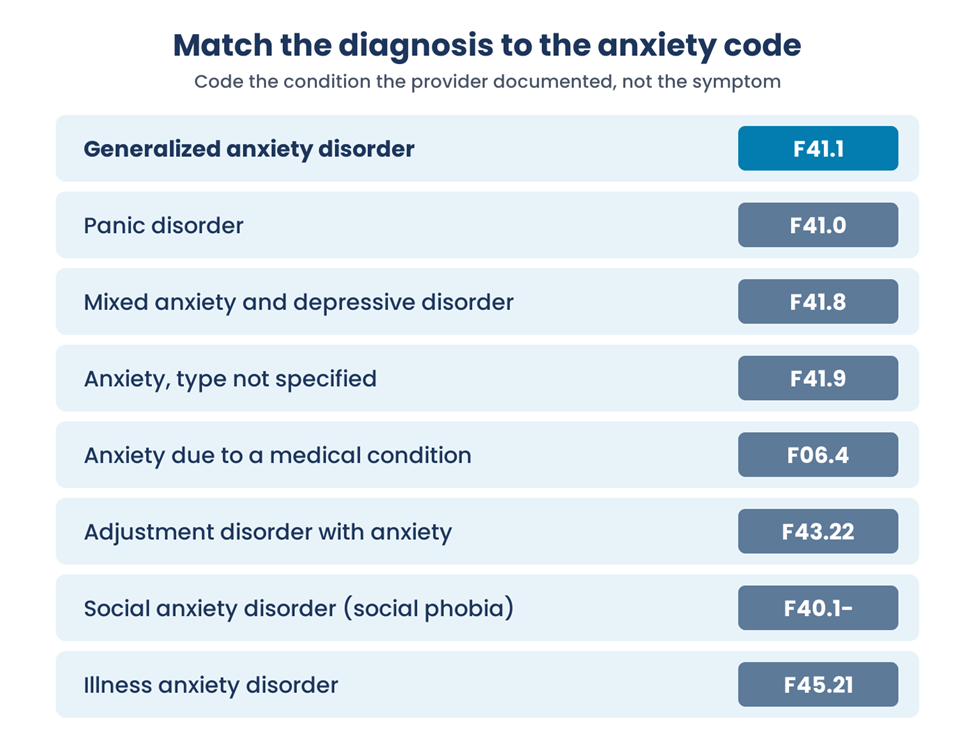
| Provider documents | Code | Note |
| Generalized anxiety disorder | F41.1 | Includes anxiety state and overanxious disorder. |
| Panic disorder | F41.0 | Can be reported with F41.1 when both are diagnosed. |
| Mixed anxiety and depressive disorder | F41.8 | Use when neither condition is diagnosed separately. |
| Anxiety with no further detail | F41.9 | Correct, but query when the note suggests more. |
| Anxiety due to a medical condition | F06.4 | Code the medical condition first. |
| Adjustment disorder with anxiety | F43.22 | Tied to an identified stressor. |
| Social anxiety disorder | F40.10 or F40.11 | Fear limited to social situations. |
| Illness anxiety disorder | F45.21 | Worry focused on having a serious illness. |
F41.1 vs F41.9
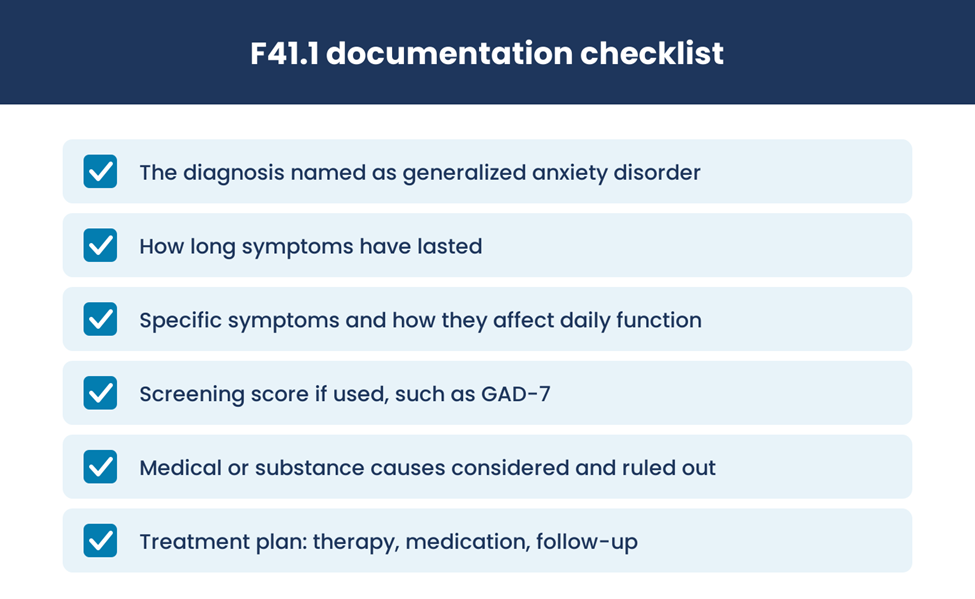
F41.9 is valid and payable when the provider writes only “anxiety.” The problem is a chart that describes months of uncontrollable worry, a GAD-7 score and a treatment plan for GAD, while the claim says F41.9. That gap is worth a provider query, because the coder can’t assign F41.1 from symptoms alone.
Documentation That Supports F41.1
Coding GAD With Other Conditions
Category F41 has an Excludes2 note for anxiety in acute stress reaction, transient adjustment reaction, separation anxiety and psychophysiologic disorders. Under the ICD-10-CM Official Guidelines for Coding and Reporting FY 2027, Excludes2 means the conditions are different and both may be coded when both are present.
- Depression: Report F41.1 with the documented depression code, such as an F32 or F33 code. Our major depressive disorder coding guide covers those choices. Use F41.8 only when the provider diagnoses mixed anxiety and depressive disorder instead.
- Panic attacks: Panic attacks within GAD stay under F41.1. Add F41.0 only when panic disorder is diagnosed as its own condition.
- Substance-induced anxiety: Use the combination code for the substance, for example F10.180 for alcohol abuse with alcohol-induced anxiety disorder, rather than F41.1.
- Medical causes: When the provider ties the anxiety to a condition such as hyperthyroidism, code that condition first and add F06.4.
Services Commonly Billed With F41.1
F41.1 supports psychotherapy (CPT 90832, 90834 and 90837 by session length), medication management visits and the initial diagnostic interview. A standardized instrument such as the GAD-7 is often reported with CPT 96127, brief emotional or behavioral assessment, per instrument. Screening rules differ from diagnosis rules, and our depression screening billing guide explains how screening codes and 96127 work together.
Sample Coding Scenario
Sample (fictional data). A 34-year-old patient has worried about work, money and family most days for eight months, with poor sleep and muscle tension. The GAD-7 score is 14. The psychiatrist diagnoses generalized anxiety disorder, starts medication and refers for therapy.
Coding: F41.1 for the diagnosis, with 96127 for the GAD-7 linked to F41.1. Had the provider written only “anxiety, will reassess,” F41.9 would be correct. Change the details to match your own patient’s record.
Common Denials and Fixes
A CARC, or claim adjustment reason code, is the code on the remittance explaining why a line was denied or reduced.
| What you see | Likely cause | Fix |
| CARC 50, not medically necessary | Therapy notes lack symptoms, impact or a plan | Document function, goals and progress each session. |
| CARC 11, diagnosis inconsistent with procedure | F41.1 on a screening line with no diagnosis yet | Use the screening code until GAD is diagnosed. |
| Records request or audit | F41.1 coded from a GAD-7 score alone | Code only the provider’s stated diagnosis. |
Frequently Asked Questions
What is the ICD-10 code for generalized anxiety disorder?
The code is F41.1, generalized anxiety disorder. It’s billable in the FY 2027 code set and needs no extra characters. Use it when the provider documents a GAD diagnosis. If the note says only “anxiety” without naming a specific disorder, F41.9, anxiety disorder unspecified, is the correct code instead.
Can F41.1 and F41.9 be billed together?
No. F41.9 means the type of anxiety isn’t specified, so it contradicts a specific GAD diagnosis on the same claim. Report F41.1 alone.
Can I code GAD and depression together?
Yes. When the provider diagnoses both, report F41.1 and the specific depression code. Use F41.8, mixed anxiety and depressive disorder, only when the provider diagnoses that mixed condition rather than two separate disorders.
Does a high GAD-7 score mean I can code F41.1?
No. A screening score supports further evaluation, not a diagnosis. Code F41.1 only after the provider documents generalized anxiety disorder. Until then, bill the screening service and any documented symptoms.
Getting GAD Claims Right
Generalized anxiety disorder ICD-10 coding is mostly about matching the provider’s words: F41.1 for a GAD diagnosis, F41.9 for unspecified anxiety, and the right companion codes for depression, medical causes or substances. The code tables are on the CMS ICD-10 code sets page. If behavioral health claims keep coming back denied, contact the EzMedPro team about medical billing and coding support.
Sources: CMS ICD-10-CM FY 2027 code set and the ICD-10-CM Official Guidelines for Coding and Reporting FY 2027 (CMS and CDC/NCHS). CPT is a registered trademark of the American Medical Association. This article explains coding and billing only and is not medical or legal advice.

