
Elevated Triglycerides and LDL ICD-10 Coding Guide
When the provider diagnoses high LDL cholesterol and high triglycerides together, the ICD-10-CM code is E78.2, mixed hyperlipidemia. It’s a billable code, valid in the FY 2027 code set that took effect October 1, 2026, and it replaces two separate codes rather than adding to them. This guide covers when E78.2 fits, the neighboring E78 codes it’s often confused with, how lab values and statin therapy affect coding, and the documentation that keeps elevated triglycerides and LDL claims paid.
Why E78.2 Is One Code, Not Two
E78.2 already includes elevated cholesterol with elevated triglycerides, along with combined hyperlipidemia and Fredrickson types IIb and III. Section I.B.9 of the ICD-10-CM Official Guidelines for Coding and Reporting FY 2027 says to use only the combination code when it fully describes the documented conditions.
So a claim with E78.00 for the LDL and E78.1 for the triglycerides tells the payer two partial stories instead of the one complete one. E78.2 sits inside the wider E78 family, which our hyperlipidemia ICD-10 coding guide maps from end to end.
Choosing the Right E78 Code
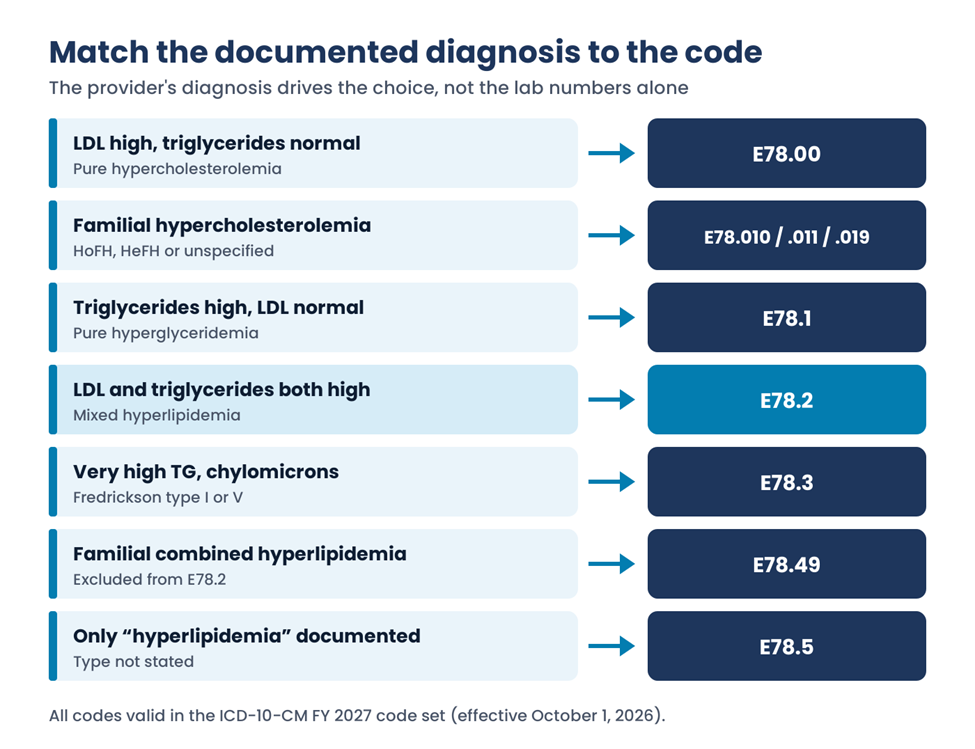
| Documented diagnosis | Code | Billable? | What to know |
| Pure hypercholesterolemia (high LDL, normal triglycerides) | E78.00 | Yes | E78.0 is a header; it needs the fifth character. |
| Familial hypercholesterolemia | E78.010, E78.011 or E78.019 | Yes | Homozygous, heterozygous or unspecified. E78.01 became a header on October 1, 2025. |
| Pure hyperglyceridemia (high triglycerides, normal LDL) | E78.1 | Yes | Includes elevated fasting triglycerides and Fredrickson type IV. |
| Mixed hyperlipidemia (both high) | E78.2 | Yes | Also covers combined hyperlipidemia NOS. |
| Hyperchylomicronemia | E78.3 | Yes | Fredrickson type I or V and mixed hyperglyceridemia. |
| Elevated lipoprotein(a) | E78.41 | Yes | Can sit beside E78.2 when both are documented. |
| Familial combined hyperlipidemia | E78.49 | Yes | Excludes1 at E78.2, so never report both. |
| Hyperlipidemia, type not stated | E78.5 | Yes | Use only when the record gives nothing more specific. |
Find the provider’s wording in the left column, and the code follows. If the note says only “hyperlipidemia,” E78.5 is correct until the provider says more; our comparison of unspecified vs mixed hyperlipidemia walks through that query.
Can You Code E78.1 and E78.2 Together?
No, not for the same patient on the same claim. E78.2 already means cholesterol and triglycerides are both elevated, so adding E78.1 repeats part of the diagnosis. The same applies to E78.00 with E78.2. Report E78.2 alone, then add a separate code only for a different disorder, such as E78.41 for elevated lipoprotein(a).
If therapy later brings LDL down while triglycerides stay high, the provider may change the diagnosis, and the code follows. Our guide to hypercholesterolemia vs hypertriglyceridemia codes covers E78.00 and E78.1 in depth.
E78.2 or E78.49 for Familial Combined Hyperlipidemia?
Familial combined hyperlipidemia goes to E78.49, other hyperlipidemia. E78.2 carries an Excludes1 note for it, which means the two codes describe conditions that can’t be reported together. Use E78.49 only when the provider documents the familial or genetic form. Older guides that point to E78.81 are wrong, because E78.81 is lipoid dermatoarthritis.
Lab Values Don’t Choose the Code
A lipid panel showing high LDL and high triglycerides isn’t a diagnosis on its own. Coders can’t assign E78.2 from the numbers; the provider has to document mixed hyperlipidemia or an equivalent term. If the results are abnormal but the note is silent, query the provider before coding anything.
A typical case: the panel comes back high, E78.2 gets added to the follow-up visit from the lab feed, and the chart doesn’t support it. That’s an audit finding, even if the diagnosis later proves true.
Statins, Lab Monitoring and Screening
When the patient takes a statin or another lipid-lowering drug long term, add Z79.899, other long-term (current) drug therapy, after E78.2. ICD-10-CM has no statin-specific Z79 code.
For a monitoring lipid panel (CPT 80061, which bundles total cholesterol, HDL and triglycerides), link the test to E78.2. Under Medicare’s NCD 190.23 for lipid testing, a yearly panel is usually adequate once a patient is stable on therapy, with more frequent testing supported in the first year or after a change in treatment.
Screening is a separate path. Medicare covers cardiovascular screening blood tests once every five years with Z13.6 and no cost sharing, as described on the CMS cardiovascular disease screening tests page. Commercial plans often use Z13.220 for lipid screening. Once a patient carries an E78 diagnosis, the panel is monitoring, not screening. Our lipid panel and cholesterol screening codes guide covers screening claims in detail.
Related Conditions on the Same Claim
- Type 2 diabetes. Hyperlipidemia isn’t listed under “with” in the ICD-10-CM Index, so the link isn’t presumed. Code the diabetes and E78.2 separately unless the provider documents a cause-and-effect link.
- Hypothyroidism or kidney disease. Code the underlying condition and E78.2 when both are documented and addressed.
- Pancreatitis from very high triglycerides. Code the acute pancreatitis from category K85 by type, then E78.1 or E78.3 for the triglyceride disorder.
Documentation That Supports E78.2
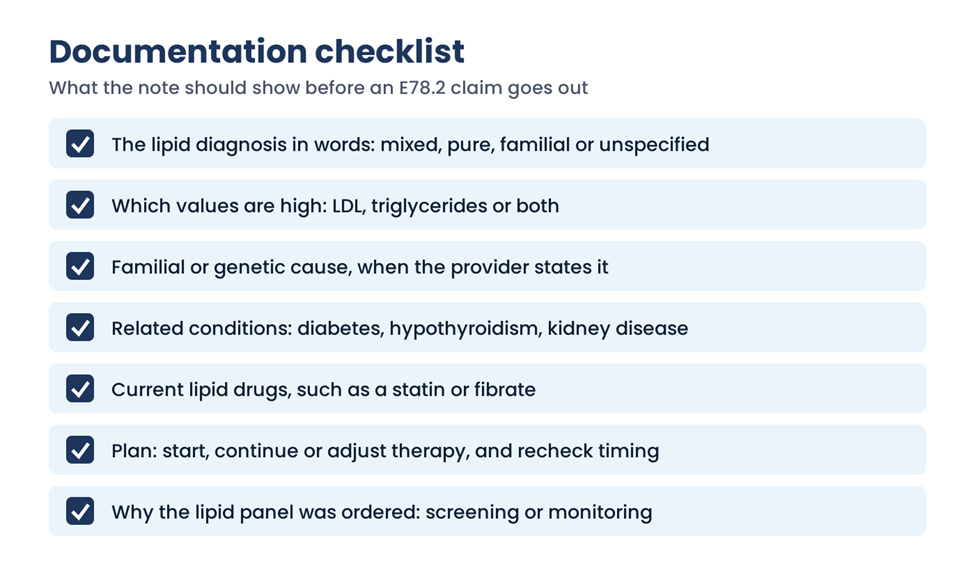
Of the seven items above, the reason the panel was ordered is the one most often missing, and it decides whether the test is billed as screening or monitoring.
Sample Coding Scenario
Sample (fictional data). A 58-year-old established patient returns to review lab work. LDL and triglycerides are both elevated. The provider documents “mixed hyperlipidemia, continue atorvastatin, recheck lipid panel in 12 months.”
Coding: E78.2 and Z79.899 on the office visit, and E78.2 linked to 80061 for the follow-up panel. If the provider had written only “hyperlipidemia,” the correct code would be E78.5. Change the details to match your own patient’s record.
Common Mistakes
| Mistake | Better approach |
| Reporting E78.0 or E78.01 | Both are headers. Use E78.00 or a six-character E78.01- code. |
| E78.1 plus E78.00 for both values high | Report E78.2 alone. |
| E78.81 for familial combined hyperlipidemia | Use E78.49; E78.81 is a different condition. |
| Coding E78.2 from lab results only | Query the provider for a documented diagnosis. |
| Z13.220 on a monitoring panel | Link the panel to the E78 diagnosis. |
| An old code set in the billing system | Load the new files every October 1. |
Checking your E78 codes each fall against the files on the CMS ICD-10 code sets page prevents most header-code rejections.
Frequently Asked Questions
What is the ICD-10 code for elevated triglycerides and LDL?
The code is E78.2, mixed hyperlipidemia, when the provider diagnoses both high LDL cholesterol and high triglycerides. It’s billable and valid for FY 2027. Don’t report E78.00 and E78.1 together for the same picture, because E78.2 already captures both lipid problems in one code.
Which is more specific, E78.1 or E78.2?
Neither is more specific; they describe different conditions. E78.1 means only the triglycerides are high, while E78.2 means LDL and triglycerides are both high. Pick the one that matches the provider’s documented diagnosis. When both values are high and the provider calls it mixed hyperlipidemia, E78.2 is the accurate code.
Is E78.2 a billable code?
Yes. E78.2 is a complete, billable ICD-10-CM code with no further characters. It had no changes for FY 2027. Payers usually accept it to support lipid panels, office visits for lipid management and drug therapy, as long as the provider’s note documents the diagnosis.
What code goes with E78.2 for statin therapy?
Add Z79.899, other long-term (current) drug therapy, when the patient takes a statin or other lipid-lowering drug long term. There’s no statin-specific Z79 code. List E78.2 first because it’s the condition being treated, and keep Z79.899 as a secondary code.
When should I use E78.5 instead of E78.2?
Use E78.5 only when the provider writes “hyperlipidemia” without saying which type, and nothing else in the record clarifies it. If the note or the provider’s assessment says mixed or combined, E78.2 is the better code. A short query usually resolves it.
Getting Elevated Triglycerides and LDL Claims Right
Elevated triglycerides and LDL ICD-10 coding is simple once the provider’s diagnosis is clear: E78.2 for mixed hyperlipidemia, Z79.899 for long-term drug therapy, and the right link between the lipid panel and either screening or monitoring. If lipid claims keep coming back or your team is coding from lab feeds, EzMedPro can review your coding and documentation workflow through our medical billing and coding services.
Sources: CMS ICD-10-CM FY 2027 code set and Official Guidelines; CMS NCD 190.23, Lipid Testing; CMS cardiovascular screening tests. CPT is a registered trademark of the American Medical Association. This guide explains coding and billing only and is not medical advice.

