
E78.5 vs E78.2: Coding Unspecified and Mixed Hyperlipidemia
The difference between hyperlipidemia unspecified and mixed comes down to documentation: E78.5 (hyperlipidemia, unspecified) is used when the provider doesn’t name the type, while E78.2 (mixed hyperlipidemia) is used when both cholesterol and triglycerides are documented as elevated. Both are billable in the FY 2027 code set.
This guide compares the two codes, shows how pure, familial and mixed codes fit, answers common “which is more specific” questions and covers history and pregnancy coding. Codes are checked against the release on the CDC ICD-10-CM files page. For the whole E78 category, see our hyperlipidemia ICD-10 coding guide.
E78.5 vs E78.2 at a Glance
| Feature | E78.5 | E78.2 |
| Title | Hyperlipidemia, unspecified | Mixed hyperlipidemia |
| Use when | The provider documents hyperlipidemia without a type | Elevated cholesterol and elevated triglycerides are both documented |
| Inclusion terms | None beyond the title | Combined hyperlipidemia NOS; elevated cholesterol with elevated triglycerides NEC; Fredrickson type IIb or III; xanthoma tuberosum |
| Excludes1 | None at this code | Familial combined hyperlipidemia (E78.49); cerebrotendinous cholesterosis (E75.5) |
| Billable | Yes | Yes |
How to Choose the Right E78 Code
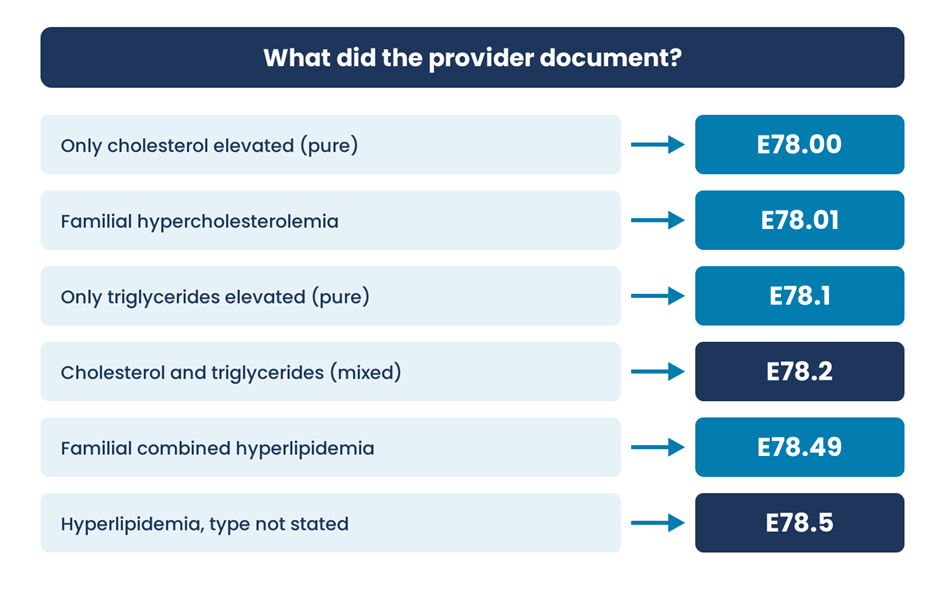
The short version: pure high cholesterol is E78.00, familial hypercholesterolemia is E78.01, pure high triglycerides is E78.1, both together is E78.2, familial combined hyperlipidemia is E78.49, and hyperlipidemia with no type stated is E78.5.
E78.5 isn’t wrong, but it tells the payer little. When the provider’s assessment or lab review clearly describes both lipids as elevated, query for the type so the record supports E78.2. Don’t pick E78.2 from lab values alone; the provider has to document the diagnosis. Our guide to hypercholesterolemia vs hypertriglyceridemia codes covers the pure codes in more detail.
Which Is More Specific?
Can E78.1 and E78.2 be coded together?
No. E78.2 already includes elevated cholesterol with elevated triglycerides, so adding E78.1 for the triglycerides is redundant. The same goes for E78.00 plus E78.1: when the provider documents both as elevated, E78.2 is the single code that describes the combination.
E78.2 vs E78.00 and E78.1
E78.2 isn’t more specific than E78.00 or E78.1; it describes a different pattern. Pick the code that matches what the provider documented. If triglycerides are the main concern but cholesterol is also documented as high, the combined picture still codes to E78.2. For elevated values without a lipid diagnosis, see our guide to coding elevated triglycerides and LDL.
E78.2 vs E78.49
Familial combined hyperlipidemia is an Excludes1 at E78.2, so it goes to E78.49 instead. Use E78.49 only when the provider documents the familial form.
History and Pregnancy Coding
| Situation | Code |
| Current hyperlipidemia controlled on medication | The E78 code for the type, because it’s still being treated |
| Personal history, no longer treated or present | Z86.39 |
| Family history of hyperlipidemia | Z83.42 |
| Hyperlipidemia during pregnancy | O99.28- with the trimester character first, then the E78 code |
Under the FY 2027 ICD-10-CM Official Guidelines for Coding and Reporting, pregnancy codes take sequencing priority, which is why O99.28- comes first. The family history code is covered in our family history of hyperlipidemia ICD-10 guide.
What the Note Should Show
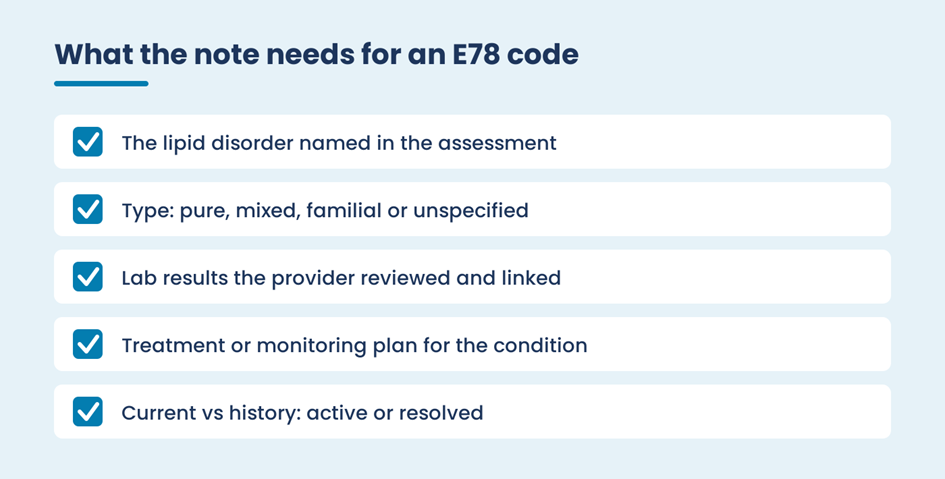
The note should name the lipid disorder in the assessment, state the type, link the lab results the provider reviewed, give the treatment or monitoring plan and make clear whether the condition is current or resolved.
Sample Coding Scenario
Sample (fictional data). A 58-year-old patient’s lipid panel shows high LDL and high triglycerides. The provider documents “mixed hyperlipidemia, continue atorvastatin, recheck lipids in three months.”
Report E78.2. Don’t add E78.00 or E78.1, because E78.2 covers both. If the note had said only “hyperlipidemia, continue statin,” you’d report E78.5, or query the provider for the type.
Frequently Asked Questions
What is the difference between hyperlipidemia unspecified and mixed?
Hyperlipidemia, unspecified (E78.5) is used when the provider documents hyperlipidemia without saying which lipids are elevated. Mixed hyperlipidemia (E78.2) is used when both cholesterol and triglycerides are documented as elevated. The choice depends on what the provider writes, not on the coder’s reading of the lab results.
Can we code E78.1 and E78.2 together?
No. E78.2 already describes elevated cholesterol with elevated triglycerides, so adding E78.1 for pure hyperglyceridemia would be redundant and contradictory. When the provider documents both lipids as high, report E78.2 alone. Use E78.1 only when triglycerides are the only lipid documented as elevated.
Is E78.2 more specific than E78.5?
Yes. E78.2 identifies a defined pattern, both cholesterol and triglycerides elevated, while E78.5 means the type wasn’t documented. Payers and risk models get more information from E78.2. Still, only report E78.2 when the provider documents mixed or combined hyperlipidemia; otherwise query or use E78.5.
What is the ICD-10 code for history of hyperlipidemia?
For a personal history of hyperlipidemia that’s no longer present or treated, use Z86.39, personal history of other endocrine, nutritional and metabolic disease. If the patient still takes a statin for it, the condition is usually current, so code the E78 type instead. Family history goes to Z83.42.
Get Help With Lipid and Chronic Care Coding
Hyperlipidemia unspecified vs mixed is a small choice that adds up across a busy primary care panel. If you’d like help tightening chronic care coding, our medical billing and coding services can review your claims, or contact the EzMedPro team to talk it through.
Sources: CDC/NCHS ICD-10-CM FY 2027 files and Official Guidelines for Coding and Reporting. Coding and billing information only, not medical advice.

