
California Medical Billing and the New 30-Day Payment Rule
California medical billing changed on January 1, 2026. Health plans must now reimburse, contest or deny a complete claim within 30 calendar days of receiving it, instead of the older working-day deadlines. Late payments accrue interest. This guide explains what the rule covers, how to build a follow-up routine around it, and how to fix the denials and delays it exposes. For the wider A/R picture, see our guide to reducing A/R days in medical billing.
| Key takeaways The deadline is 30 calendar days from the plan’s receipt of a complete claim, for claims received on or after January 1, 2026.Late complete claims accrue 15% annual interest, which plans must add automatically.Contested and denied claims need a written notice naming the procedure or revenue code and the reason.Track each claim’s receipt date, because the clock starts with the plan, not with your submission. |
What the California 30-day rule requires
The Department of Managed Health Care (DMHC) explains the change in its guidance on Assembly Bill 3275. Plans must reimburse a complete claim as soon as practicable, and no later than 30 calendar days after receiving it. Contesting or denying a claim carries the same 30-day limit.
The guidance says the rule applies to all commercial and Medi-Cal plans, including specialized plans, and excludes Medicare Advantage plans with no commercial or Medi-Cal business. Plans must also hold delegated entities, such as capitated providers and claims processing organizations, to the same standard.
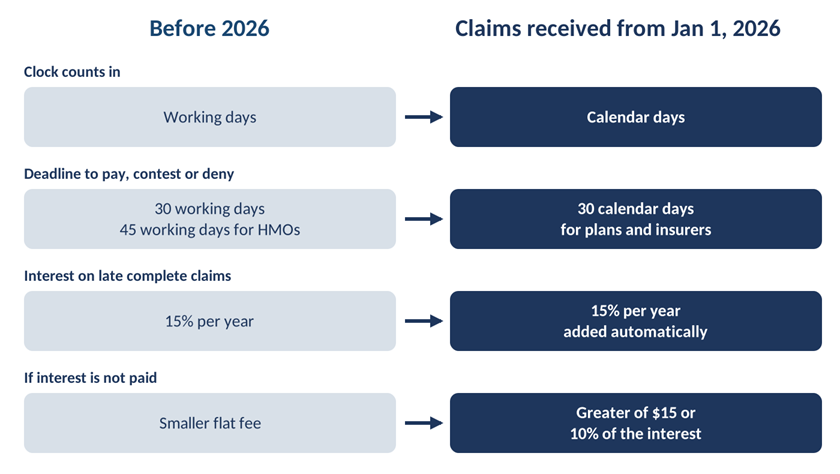
In short: the deadline moved from working days to 30 calendar days, and interest must now arrive with the late payment.
Interest, notices and disputes
Unpaid complete claims accrue interest at 15% per year, starting the day after the 30-day period ends. Plans must include the interest automatically. If they do not, they owe the greater of $15 or 10% of the accrued interest on top.
A plan that contests a claim must say in writing which portion is contested, by procedure or revenue code, and what information it needs. A denial notice must give the specific reasons, including any defect. Keep these notices with the claim record, because they support an appeal. Our guide to appealing a denied medical claim shows how to use them.
Provider disputes have their own clock. Plans must issue a written determination within 45 working days of receiving the dispute, and pay any amount owed within five working days after that.
What it does not settle
The guidance does not define a complete claim, and it points to Rule 1300.71(a) in Title 28 of the California Code of Regulations for that definition. It also does not address insurers regulated by the California Department of Insurance, and Medicare Advantage-only plans are excluded.
Self-funded employer plans may fall under federal rules instead. Your payer contracts can also set other terms, so read the provider manual before assuming the 30-day clock applies to a given payer.
A 30-day follow-up routine for every claim
The rule only helps if you know when each plan received the claim. Build the routine below into your work queue. The check-ins on days 10 and 20 are a suggested practice, not part of the law.
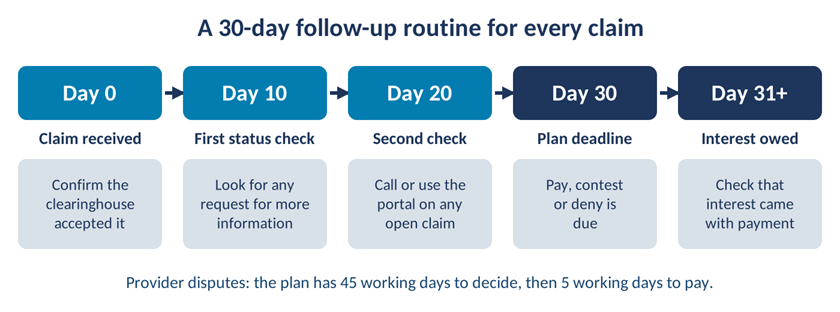
Text summary: confirm acceptance on day 0, check status on days 10 and 20, expect a decision by day 30, and look for interest from day 31.
- Record the date the plan received each claim, using the clearinghouse acceptance report.
- Check status on days 10 and 20, and answer any request for information the same day.
- On day 30, flag every claim with no payment, contest or denial.
- Compare each late payment with the interest due, and ask the plan for any shortfall.
- Track fully contested claims separately and send what the plan requested right away.
A clean first submission matters most, so review your clean claim rate as well.
Common problems and fixes
Sample (fictional data): a plan receives a $1,000 claim on February 2 and pays it on March 24. The 30-day deadline passed on March 4, so the payment was 20 days late. At 15% a year, interest is about $8, and the plan should include it automatically with a payment.
| Problem | Likely cause | Fix and prevention |
| Late payment with no interest | Payment posted without a check | Compare each payment date with the deadline. |
| Vague denial | Notice lacks code or reason | Request the procedure or revenue code and reason in writing. |
| Clock disputed | Receipt date not on file | Save the clearinghouse acceptance report. |
| Contest never answered | Request for information missed | Assign an owner and reply within days. |
| Delegated group pays late | Claims sent to the wrong entity | Confirm who processes claims for each member. |
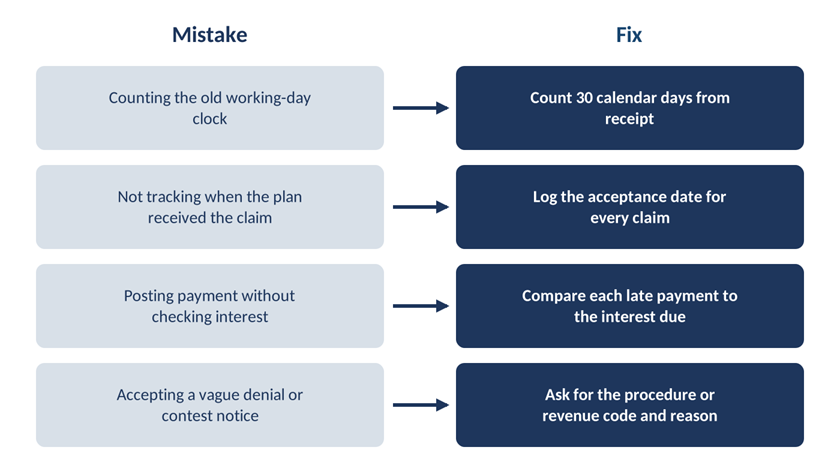
For broader denial work, see our denial management best practices. Behavioral health clinics can also read our mental health billing guide.
Frequently asked questions
How long do California health plans have to pay a claim?
For complete claims received on or after January 1, 2026, plans must reimburse, contest or deny within 30 calendar days of receipt. Earlier rules counted working days. Claims that are not complete, or that a plan contests, follow the notice and information-request process, so keep the plan’s request and your reply on file.
What interest do California plans owe on late claims?
Late complete claims accrue interest at 15% per year, starting the day after the 30-day period. Plans must automatically include the interest when they pay. If they do not, they owe the greater of $15 or 10% of the accrued interest as an additional amount.
Does the California rule cover Medi-Cal plans?
DMHC guidance says the rule applies to all commercial and Medi-Cal plans, including specialized plans. It excludes Medicare Advantage plans that have no commercial or Medi-Cal business. Plans must also ensure delegated entities comply. Check the payer manual for any other contract terms.
How long do plans have to decide a provider dispute?
Plans must issue a written determination within 45 working days of receiving a provider dispute. If the plan owes money after a favorable determination, it must pay within five working days. Interest and penalties can also apply to dispute payments not made within 30 calendar days of receipt of a complete claim.
Putting California medical billing on a 30-day clock
California medical billing now rewards practices that log receipt dates, follow up early and audit late payments for interest. EZMedPro is a US-based medical billing, coding, credentialing and revenue cycle management company with transparent reporting and no hidden fees. Results vary by practice.
You can review our billing, coding, credentialing and revenue cycle management services or talk with the team about your practice.
Sources: California Department of Managed Health Care All Plan Letter 25-007 on Assembly Bill 3275, and 28 CCR section 1300.71. General information, not legal advice.

