
Arizona Workers’ Compensation Medical Billing: Practice Guide
Arizona workers’ compensation medical billing follows its own rulebook: the treating provider files an injury report within 8 days, bills the employer’s carrier under the Industrial Commission of Arizona (ICA) fee schedule, and the payer must decide and pay on a 30-day clock. The injured worker owes nothing on an accepted claim. This guide covers intake, Form 102, bill contents, payment timelines, reductions and the mistakes that stall work-injury claims.
| Key takeaways The treating provider files Form 102, the Worker’s and Physician’s Report of Injury, within 8 days of first treatment.The ICA fee schedule sets maximum payment unless a separate contract or network agreement applies.Payers decide within 30 days of receipt or claim acceptance, then pay within 30 more days; late payments carry interest.Payers are not responsible for bills received more than 24 months after the service date. |
How workers’ comp billing differs from health insurance
When an injury happens at work, the employer’s workers’ compensation carrier or the self-insured employer pays, not the patient’s health plan. There are no copays or deductibles, and payment rules come from Arizona statute and ICA rules rather than a health plan contract. Many of the slow-pay problems described in our guide to workers’ compensation billing delays start with treating a work injury like a routine visit.
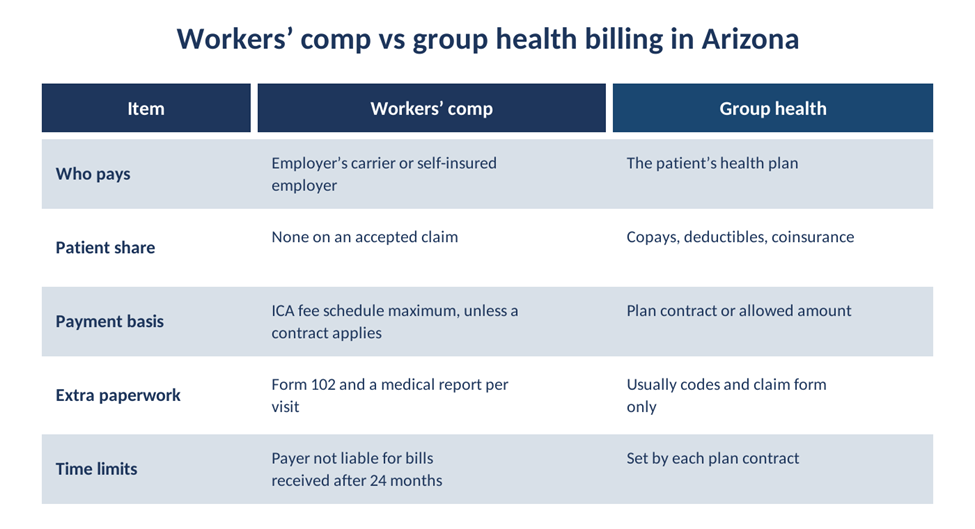
In short, the payer, the patient’s share, the fee basis, the paperwork and the time limits all change. Your front desk needs to flag work injuries at scheduling, not after the claim bounces from the health plan.
The Arizona workers’ comp billing workflow
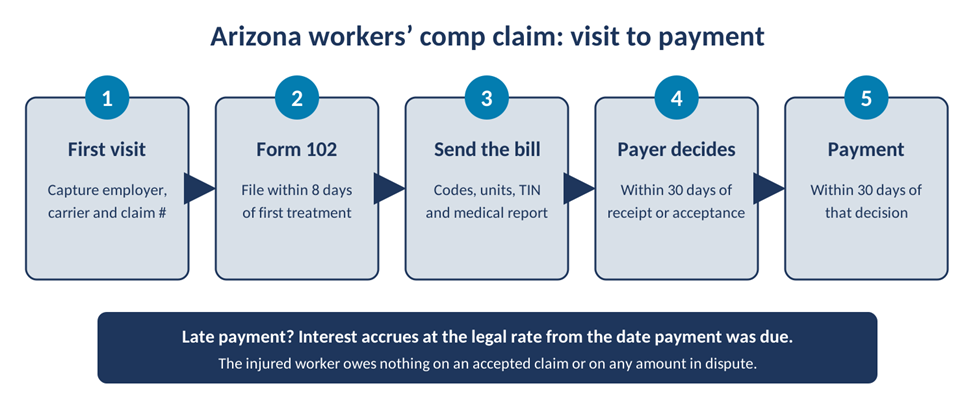
Step 1: Capture the claim details at intake
Record the employer, the date and description of the injury, the carrier or third-party administrator (TPA) and the claim number if the worker has one. If the patient is unsure the injury is work-related, note it and confirm with the employer or carrier before the bill goes out. Injuries caused by another party may also involve third-party liability billing later.
Step 2: File Form 102 within 8 days
Arizona requires the treating physician to complete the physician’s portion of the ICA Worker’s and Physician’s Report of Injury form within eight days after first treating the worker. The original goes to the Industrial Commission, with copies to the employer and to the carrier or TPA. A late or missing report can hold up claim acceptance, and payers do not have to decide on a bill until the claim is accepted.
Step 3: Send a complete bill
Bill the carrier, not the worker. Include the claim number and a legible medical report for each date of direct treatment. Missing reports are one of the most common reasons a work-injury bill sits unpaid.
What every Arizona workers’ comp bill must include
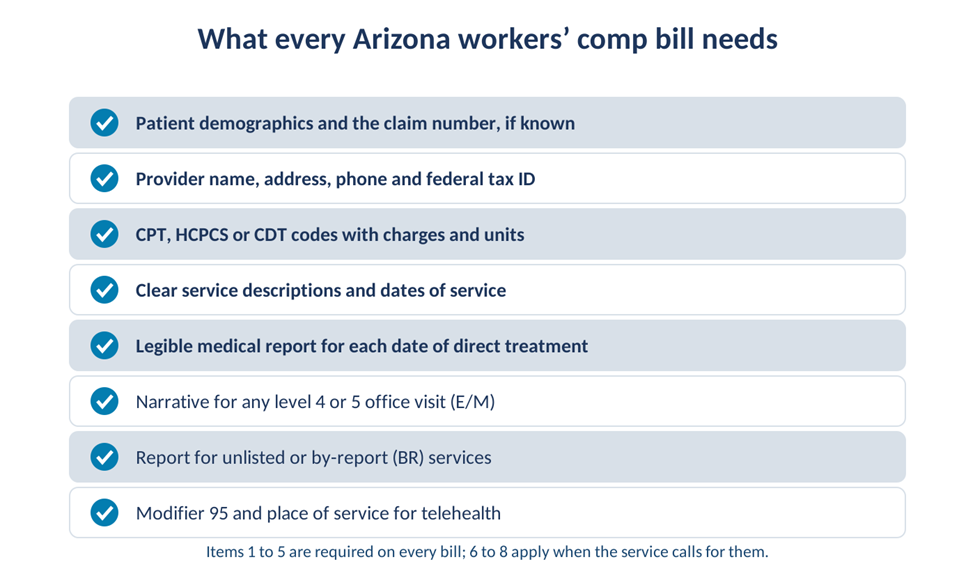
The ICA 2026 Physicians’ and Pharmaceutical Fee Schedule introduction and guidelines lists the required bill contents: patient demographics with the claim number if known; provider name, address, phone and federal taxpayer ID; correct codes with charges and units; clear service descriptions and dates; and a legible report for each treatment date. The same guidelines add service-specific rules.
| Service | Arizona rule |
| Level 4 or 5 office visit (E/M) | The treating physician submits a narrative that justifies the level |
| Unlisted or by-report (BR) service | Use only when no specific CPT or HCPCS code exists; attach a report on the nature, need, time and skill involved |
| Telehealth | Add modifier 95 and a place-of-service code; paid at the non-facility rate |
| Carrier-requested forms (return-to-work, restrictions) | Arizona code AZ005, with the form attached; no more than once in 30 days |
| Copies of records | Up to 25 cents per page plus $10 per hour per person for clerical time |
Strong visit notes matter here as much as anywhere; the habits in our guide to audit-proof documentation for higher-level office visits apply directly to the Arizona narrative rule.
ICA fee schedule and payment timelines
The ICA updates its fee schedule each year; the current edition took effect May 1, 2026. It sets the maximum the payer must pay, except where a separate contract or network agreement sets different rates. If a payer reduces a bill under a contract you dispute, it must produce a valid copy of that contract within 30 days of your appeal or pay at fee schedule rates.
| Event | Deadline |
| Physician’s report (Form 102) | Within 8 days of first treatment |
| Payer decision to pay or deny | 30 days from receipt, or from claim acceptance if the bill arrived first |
| Payment of the approved amount | 30 days after the decision |
| Late payment | Interest at the legal rate from the date payment was due |
| Payer liability limit | Bills received more than 24 months after the service date; corrected bills do not restart the clock |
Read every remittance closely. The payer’s explanation of review works like an EOB (explanation of benefits), and the skills in our guide to reading EOBs and ERAs help you spot reductions that do not match the fee schedule.
Reductions, disputes and patient balances
A payer that adjusts a bill must document the reason and explain how to appeal. Many carriers run an internal dispute process, so send a written appeal with the bill, the fee schedule citation and supporting records, using the same structure you would use to appeal a denied medical claim. The ICA does not rule on private contract disputes, so contract terms matter.
Do not bill the worker. On an accepted claim, the injured worker owes no part of the bill, and that protection also covers any amount under dispute between you and the payer. If the carrier denies the claim as not work-related, review the patient’s other coverage and its rules before billing anyone.
Common mistakes and how to prevent them
| Mistake | Prevention |
| Billing the health plan for a work injury | Ask about work injuries at scheduling and check-in |
| Form 102 filed late or not at all | Assign one owner and track the 8-day date for every new injury |
| Bill sent without a medical report | Attach a legible report for each date of direct treatment |
| Level 4 or 5 visit billed with no narrative | Add the narrative before the bill leaves |
| Following up only after months | Track the 30-day decision and payment dates and chase on day 31 |
Sample (fictional data): an urgent care work injury
A warehouse worker visits an urgent care center in Mesa on June 2 with a hand laceration. The front desk records the employer and carrier, the provider completes Form 102 on June 4, and the bill goes to the carrier on June 6 with the visit note. The carrier accepts the claim on June 20, so its 30-day decision clock runs from that date. Replace the dates, employer and service with your own case. Centers that see frequent work injuries can build this into their urgent care billing workflow.
Frequently asked questions
How long do I have to bill workers’ comp in Arizona?
The ICA guidelines say a carrier or self-insured employer is not responsible for a bill received more than 24 months after the service date, or after the date the provider knew or should have known of the service, if later. Corrected or repeat bills do not restart that period. Billing within days of the visit avoids the risk entirely.
How fast must an Arizona workers’ comp payer pay?
The payer must decide whether to pay or deny within 30 days of receiving the bill, or within 30 days of accepting the claim if the bill arrived first. It must then pay the approved amount within 30 days of that decision. Late payments accrue interest at the legal rate from the date payment was due.
Can I bill the injured worker for the balance?
No, not on an accepted claim. Arizona’s fee schedule guidelines state that the injured worker is not responsible for any part of a bill on an accepted claim, including any amount in dispute between the provider and the payer. Send disputes to the payer through its appeal process instead of transferring the balance to the patient.
Who files Form 102 in Arizona?
The treating physician completes the physician’s initial report section of Form 102, the Worker’s and Physician’s Report of Injury, within eight days after first treating the injured worker. The original goes to the Industrial Commission of Arizona, and copies go to the employer and to the employer’s carrier or third-party administrator.
Getting Arizona workers’ comp claims paid
Arizona workers’ compensation medical billing rewards discipline at the front end: flag work injuries at intake, file Form 102 inside 8 days, send complete bills with reports and track the 30-day clocks. Most delays trace back to one of those steps.
EZMedPro’s US-based team provides billing, coding, credentialing and revenue cycle management services with transparent reporting and no hidden fees. If work-injury claims are stalling your cash flow, talk with our team about your workers’ comp claims. Results vary by practice.
Sources: Industrial Commission of Arizona 2026 Physicians’ and Pharmaceutical Fee Schedule introduction and guidelines and Arizona-specific codes guidelines, ICA Worker’s and Physician’s Report of Injury form, Arizona Administrative Code R20-5-112, and A.R.S. 23-1062.01. This article is general billing information, not legal advice.

