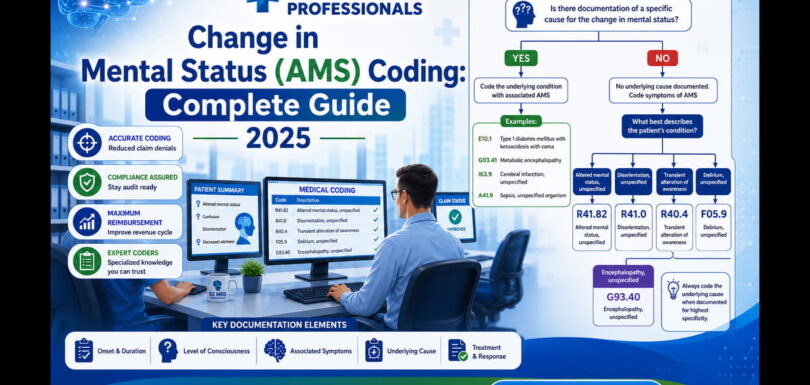
change in mental status AMS coding decision tree R41.82 vs G93.41 vs F05

Change in Mental Status (AMS) Coding: Complete Guide 2025

The correct change in mental status (AMS) coding starts with R41.82 (altered mental status, unspecified) when the cause is unknown. Once a specific cause is identified, upgrade to G93.41 (metabolic encephalopathy), G93.40 (encephalopathy unspecified), or F05.0/F05.1 (delirium). Always code the underlying etiology such as sepsis (A41.9 + G93.41) or UTI (N39.0 + R41.82). Do not use R41.82 once encephalopathy is confirmed. Change in mental status […]
Continue Reading
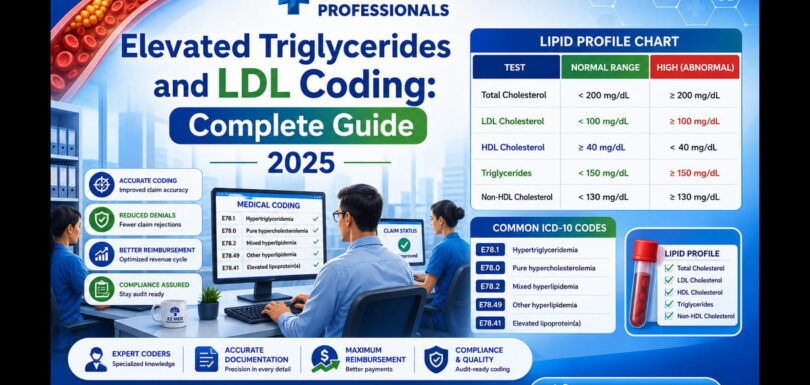
elevated triglycerides and LDL coding E78.2 mixed hyperlipidemia lipid profile chart with normal and high ranges

Elevated Triglycerides and LDL Coding: Complete Guide 2025

The correct elevated triglycerides and LDL coding uses E78.2 for mixed hyperlipidemia. Use this code when both lipid fractions are elevated. For isolated elevated LDL (normal triglycerides), use E78.0. Isolated elevated triglycerides (normal LDL), use E78.1. For long-term statin therapy, add Z79.899. Screening without diagnosis, use Z13.220. Do not use E78.5 (unspecified) when specific lipid data is available? Elevated […]
Continue Reading
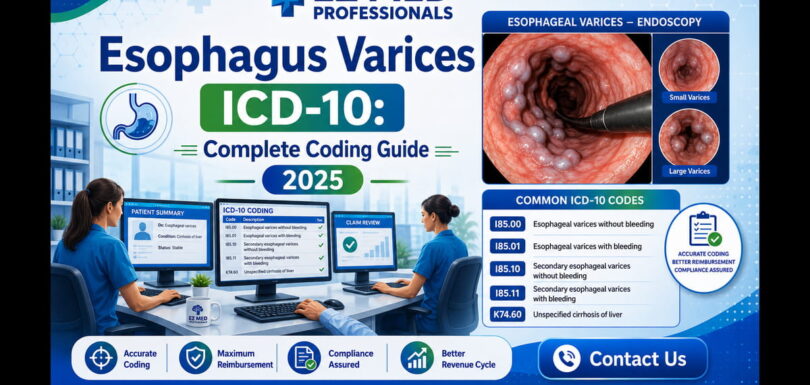
esophagus varices ICD-10 I85.00 endoscopic view of large tortuous esophageal varices grade III

Esophagus Varices ICD-10: Complete Coding Guide 2025

The correct esophagus varices ICD-10 code depends on bleeding status. Use I85.00 for esophageal varices without bleeding (stable varices). Use I85.01 for esophageal varices with bleeding (active hemorrhage). For secondary varices, use I85.10 (without bleeding) or I85.11 (with bleeding). Always code the underlying liver disease (e.g., alcoholic cirrhosis K70.30) and portal hypertension (K76.6) as secondary codes. Esophageal varices are a serious […]
Continue Reading
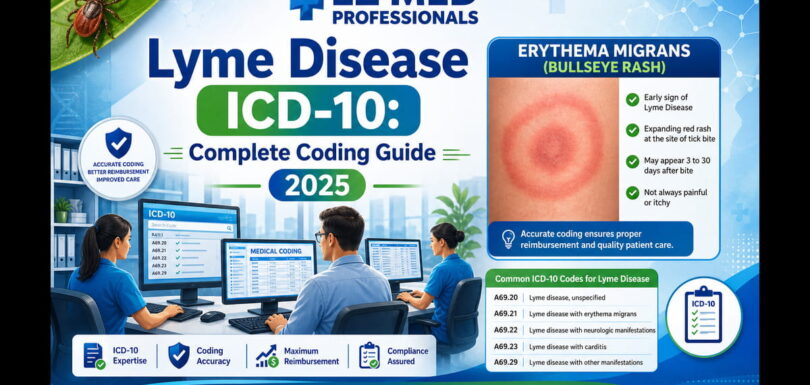
Lyme disease ICD-10 A69.20 early localized erythema migrans bullseye rash on skin

Lyme Disease ICD-10: Complete Coding Guide 2025

The correct Lyme disease ICD-10 code depends on the clinical manifestation. Use A69.20 for unspecified Lyme disease (early localized with rash). Use A69.21 for Lyme meningitis, A69.22 for Lyme neuroborreliosis (facial palsy, radiculopathy, encephalitis), A69.23 for Lyme arthritis, and A69.29 for other manifestations including Lyme carditis. Never use A69.20 for specific manifestations. Lyme disease is the most common tick-borne illness in North America. It affects over 30,000 […]
Continue Reading
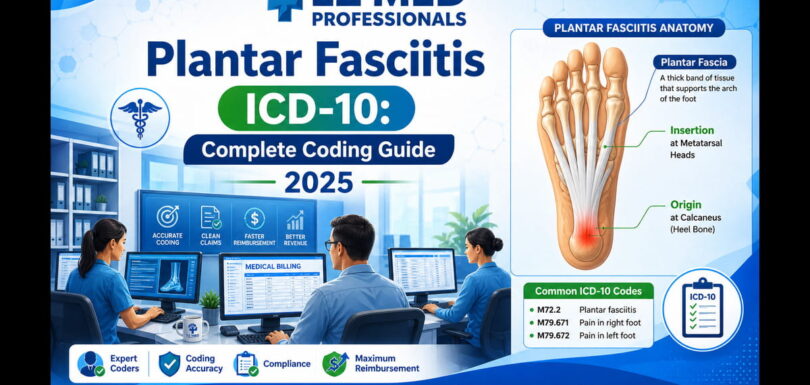
plantar fasciitis ICD-10 anatomy showing plantar fascia origin at calcaneus and insertion at metatarsal heads

Plantar Fasciitis ICD-10: Complete Coding Guide 2025

The correct plantar fasciitis ICD-10 code is M72.2. This code represents plantar fascial fibromatosis and plantar fasciitis. Unlike many musculoskeletal codes, M72.2 does NOT specify laterality (right vs. left) or chronicity. For heel spurs, use separate codes M77.30-M77.32. For bilateral involvement, document “bilateral” in clinical notes but continue using M72.2. Plantar fasciitis is the most common cause of […]
Continue Reading
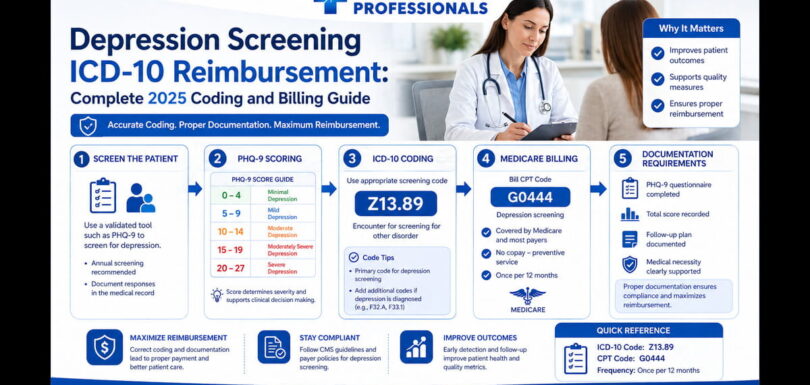
Depression screening ICD-10 reimbursement workflow showing Z13.89 coding, PHQ-9 scoring, and Medicare G0444 billing

Depression Screening ICD-10 Reimbursement: Complete 2025 Coding and Billing Guide

Depression screening ICD-10 reimbursement requires understanding of specific codes, coverage policies, and documentation standards. The primary screening code is Z13.89 (encounter for screening for depression). For diagnosed depression, use F32.x (major depressive disorder, single episode) or F33.x (recurrent). The CPT code for Medicare depression screening is G0444. For commercial payers, use 96127 (brief emotional assessment). […]
Continue Reading
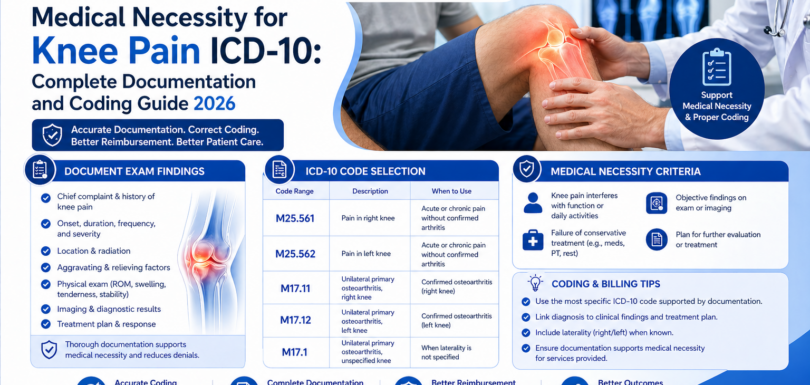
Medical necessity for knee pain ICD-10 documentation showing exam findings and code selection M25.561 to M17.1

Medical Necessity for Knee Pain ICD-10: Complete Documentation and Coding Guide 2026

Medical necessity for knee pain ICD-10 requires accurate coding and thorough documentation. The primary codes for knee pain are M25.561 (right), M25.562 (left), and M25.569 (unspecified). For osteoarthritis, use M17.0 (primary) or M17.1 (post-traumatic). Medical necessity documentation must include history of present illness, physical examination findings, and functional limitations. Red flag symptoms like swelling, instability, […]
Continue Reading
x

We always support in emergencies, contact us immediately if you are experiencing any serious health problems.

Contact With Us!

Address: 625 Sullivan Dr NE, Columbia Heights, MN 55421

Support mail: info@ezmedpro.com

Opening Hours: Mon -Sat: 9.00am – 6.00pm

Phone Number: (763) 244-1500