
Orthopedic Billing and Coding: CPT Codes and Modifiers
Orthopedic billing and coding comes down to three things: knowing what the global surgery package already pays for, coding fractures, injections and surgery to the right level, and using location and surgical modifiers that match the record. This guide covers global periods, fracture and cast coding, joint injections, the modifiers orthopedic claims rely on, the 2025 Medicare change on post-op care, and the denials that show up most often.If you’d rather hand this work to a team, EzMedPro supports orthopedic practices as part of our medical billing and RCM services.
Global Surgery Periods in Orthopedic Billing and Coding
Most orthopedic procedures carry a global period: 0 or 10 days for minor procedures and 90 days for major ones. Under Medicare, a 90-day package includes pre-op visits from the day before surgery, the surgery itself, routine post-op care, and complications that don’t need a return to the operating room. CMS lays this out in the MLN Global Surgery Booklet.
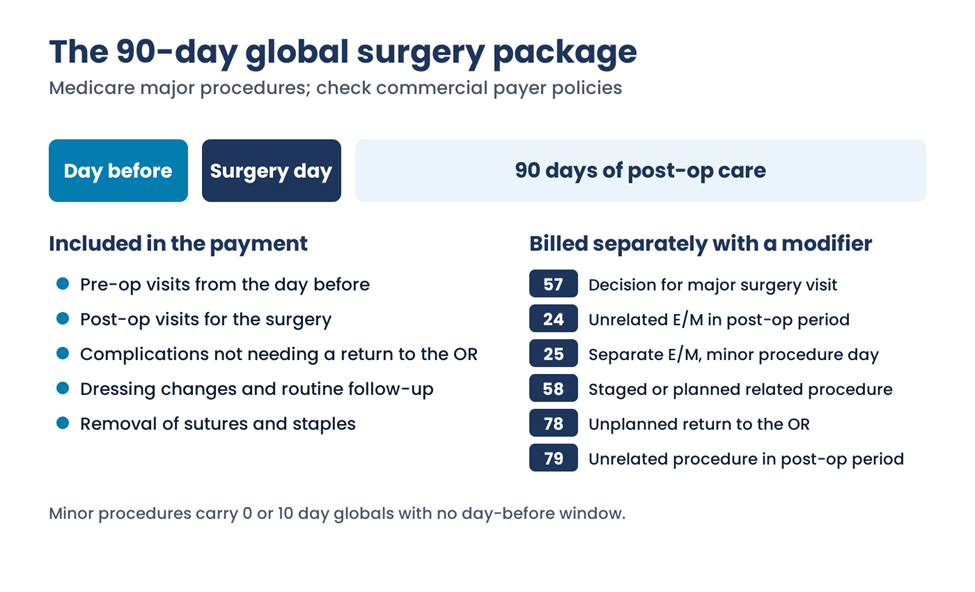
The left side of the graphic lists what the package pays for; the right side lists the six modifiers that let you bill outside it.
| Modifier | Use it when |
| 57 | An E/M visit on the day before or day of a major surgery resulted in the decision to operate |
| 25 | A significant, separate E/M service happened on the same day as a minor procedure |
| 24 | An unrelated E/M service happens during the post-op period |
| 58 | A staged, planned or more extensive related procedure happens during the global period |
| 78 | The patient returns to the OR for a related problem during the global period |
| 79 | An unrelated procedure is performed during the global period |
The 2025 Change: Modifiers 54 and 55
Since January 1, 2025, Medicare expects a surgeon who won’t provide the post-op care for a 90-day procedure to bill the surgery with modifier 54, even when the handoff is informal and undocumented. The practitioner who takes over post-op care bills with modifier 55. CMS also created G0559, a once-per-global add-on for a post-op visit by a practitioner outside the surgeon’s group. The CMS global surgery payment accuracy FAQ explains both.
Fracture Care and Casting
Fracture treatment codes describe closed treatment without manipulation, closed treatment with manipulation, or open treatment, sometimes with fixation. They include the first cast or splint and normal follow-up during the global period, so the initial cast isn’t billed separately.
- Replacement casts. Cast and strapping codes (29000 to 29799) can be billed when a cast is replaced during the global period, or when casting is done without a fracture care code.
- Initial stabilization only. If the patient is sent elsewhere for definitive care, report the casting or splinting service and an E/M rather than the fracture code.
- Supplies. Cast and splint supplies may be reported with HCPCS Level II codes when the payer allows separate payment.
Joint Injections and Arthrocentesis
Injection and aspiration codes 20600 to 20611 are chosen by joint size and whether ultrasound guidance was used and documented with a permanent image. Small joints such as fingers and toes use 20600 or 20604, intermediate joints such as the wrist or elbow use 20605 or 20606, and major joints such as the knee or shoulder use 20610 or 20611.
Bilateral knee injections are a common case: report the code with modifier 50 or with RT and LT, as your payer requires. The diagnosis matters as much as the code; our guide to bilateral knee osteoarthritis coding covers the ICD-10 side.
Orthopedic Modifiers at a Glance
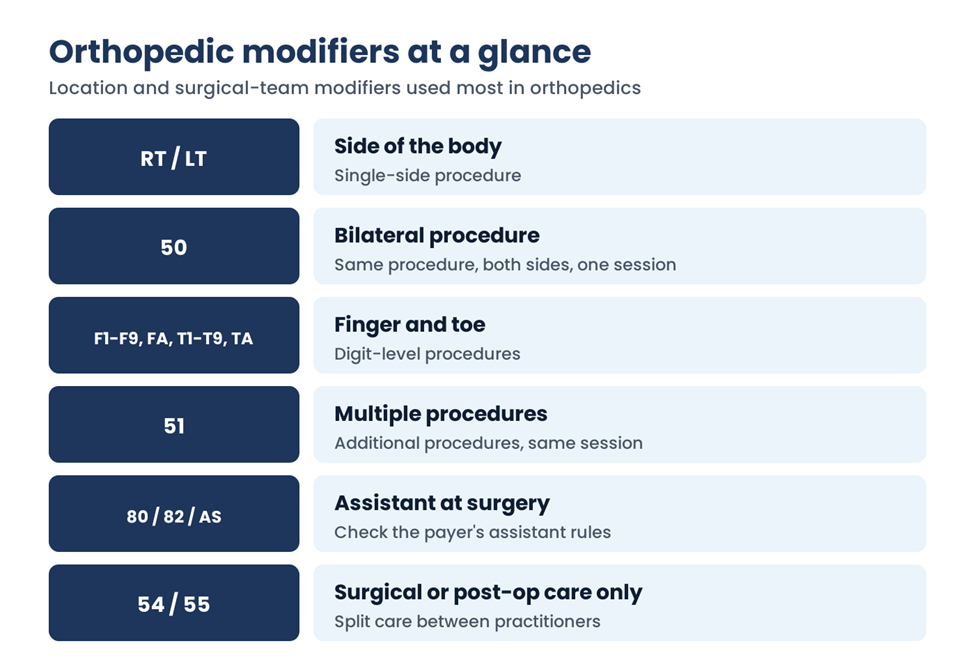
The graphic summarizes six groups: RT and LT for side, 50 for bilateral, F and T modifiers for digits, 51 for multiple procedures, 80, 82 and AS for assistants, and 54 and 55 for split care.
Anatomic modifiers come before 59 or the X modifiers when two procedures are on different sites, as CMS explains in MLN1783722 on modifiers 59, XE, XP, XS and XU.
For the bundling side, see our guide on how to bundle and unbundle CPT codes, and for modifiers in general, our CPT modifiers guide.
Common Orthopedic Denials
| Denial cause | Prevention |
| E/M billed inside a global period | Check the global days; use 24, 25 or 57 only when the record supports it. |
| Initial cast billed with fracture care | Bill casting only for replacements or when no fracture code is reported. |
| Bilateral service billed wrong | Follow the payer’s preference: modifier 50 on one line or RT and LT on two. |
| Missing laterality or digit modifier | Add RT, LT, F or T modifiers on every site-specific procedure. |
| Post-op care billed by two practitioners | Use 54 and 55 when care is split. |
| Injection with guidance not documented | Keep the ultrasound image and report when guidance codes require it. |
When these denials do come back, our guide to claim denial codes explains how to read the reason codes.
Documentation That Supports Orthopedic Claims
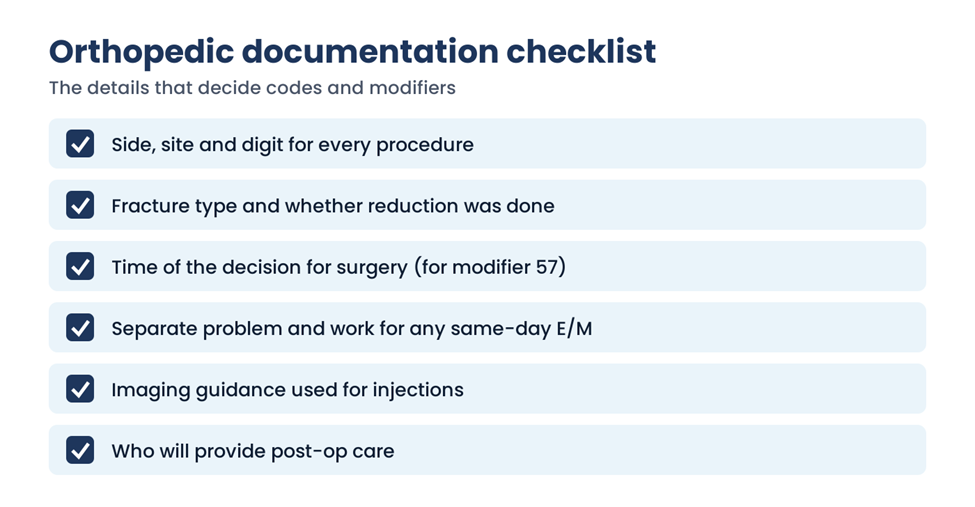
The checklist above covers side and digit, fracture type and reduction, timing of the surgery decision, separate E/M work, injection guidance, and who will provide post-op care.
Frequently Asked Questions
What is the global period for orthopedic surgery?
It depends on the code. Major procedures such as joint replacements usually have a 90-day global period that includes the day before surgery, the surgery day and 90 days after. Minor procedures have 0 or 10 days. Check the global indicator for each code in the Medicare fee schedule and your payer contracts.
When should I use modifier 57 instead of 25?
Use 57 on an E/M visit that resulted in the decision for a major surgery with a 90-day global period, on the day before or day of surgery. Use 25 for a significant, separately identifiable E/M on the same day as a minor procedure with a 0 or 10-day global period.
Can I bill a cast with fracture care?
Not the first one. Fracture care codes include the initial cast or splint. You can bill a replacement cast during the global period, or casting when you provide only initial stabilization and another provider does the definitive fracture care.
How do I bill bilateral knee injections?
Report the major joint code once with modifier 50, or on two lines with RT and LT, depending on the payer. Use 20610 without ultrasound guidance or 20611 with guidance that’s documented with a permanent recorded image.
Making Orthopedic Billing and Coding Predictable
Orthopedic billing and coding gets easier when every claim answers three questions: is it inside a global period, which code level does the record support, and which side or site modifier applies. EzMedPro also works with orthopedic practices regionally, including orthopedics billing in Texas and orthopedics billing in Florida.
Sources: CMS MLN907166 Global Surgery Booklet; CMS FAQ on strategies for improving global surgery payment accuracy (January 2025); CMS MLN1783722. CPT is a registered trademark of the American Medical Association. Payer rules vary. This guide is general billing information, not legal advice.

