
How to Bundle and Unbundle CPT Codes Using NCCI Edits
To bundle and unbundle CPT codes correctly, check every code pair against the NCCI procedure-to-procedure edits, read the modifier indicator, and add a distinct-service modifier only when the record shows the services were truly separate. This guide explains what bundling means, how to read an edit, the five-step check before you report two codes together, how 59 and the X modifiers differ, and the denials that follow when unbundling goes wrong.
What Bundling and Unbundling Mean
Bundling means some services are already part of a larger one. The incision, the approach and the closure of a surgery belong to the surgery code, so they aren’t billed on their own. Unbundling is reporting those parts separately, or splitting one service into several codes, when a single code already describes the work.
Unbundling is sometimes an honest mistake and sometimes deliberate. Either way the payer recovers the money, and a pattern of it can lead to an audit or a fraud referral. Getting the code pairs right is one of the clearest examples of why accurate medical coding matters to the revenue cycle.
How NCCI Edits Work
The National Correct Coding Initiative (NCCI) is the CMS program that publishes the code-pair rules Medicare uses. Its procedure-to-procedure (PTP) edits list pairs that shouldn’t normally be reported together for the same patient, provider and date. Medicaid has its own NCCI edit files, and many commercial payers run similar edits through their claim systems.
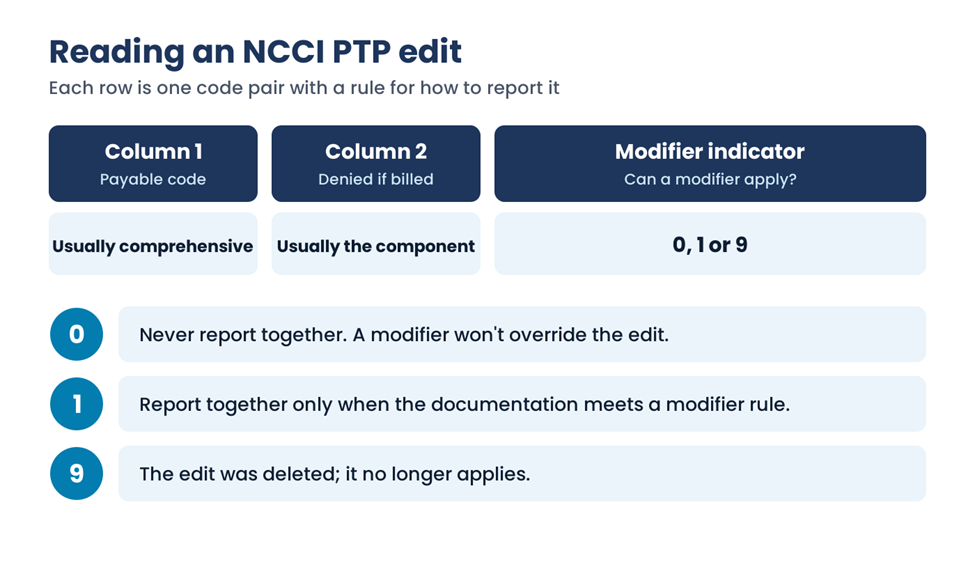
In each edit, the Column 1 code is paid and the Column 2 code is denied if both are billed without an allowed modifier. The modifier indicator decides what happens next:
| Indicator | Meaning | What you do |
| 0 | The codes can’t be reported together | Bill the Column 1 code only. No modifier changes this. |
| 1 | A modifier may apply in limited circumstances | Add a distinct-service modifier only if the record supports it. |
| 9 | The edit has been deleted | The edit no longer applies to that pair. |
Some PTP pairs are mutually exclusive: two services that can’t reasonably happen together, such as two different repair methods for the same organ. They’re handled through the same edit tables. The CMS NCCI edits page posts the PTP and medically unlikely edit (MUE) files, which are updated every quarter, so check the current version rather than a saved copy.
MUEs: The Unit Limits
A medically unlikely edit sets the most units of a code that a provider would report for one patient on one date under most circumstances. A line that exceeds it is denied as a coding error, not as a coverage decision. MUEs are a separate check from PTP edits, so a claim can pass one and fail the other.
Five Steps Before You Report Two Codes Together
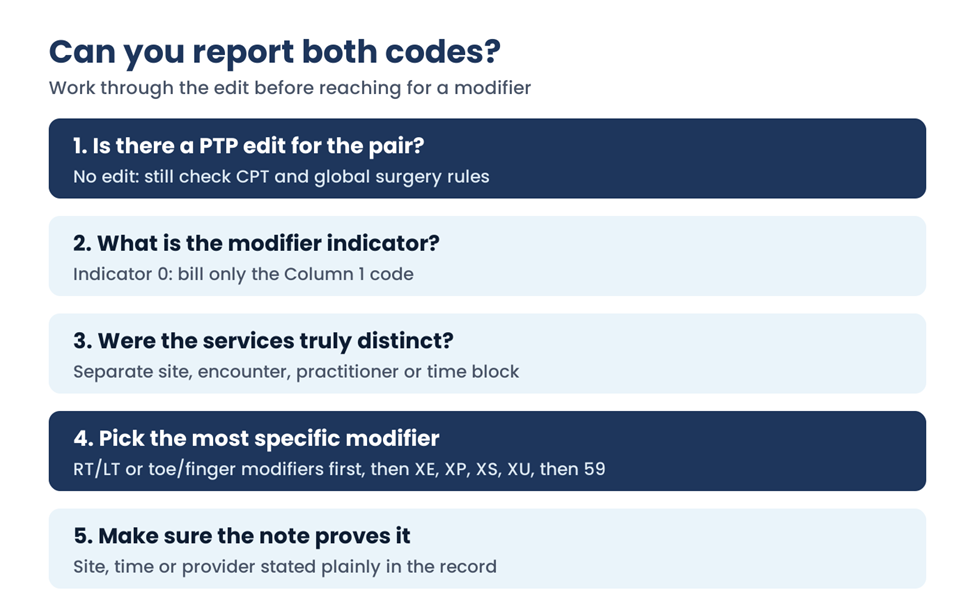
- Check for a PTP edit. If none exists, the pair isn’t blocked by NCCI, but CPT instructions and global surgery rules still apply.
- Read the modifier indicator. With a 0, stop: only the Column 1 code is billed.
- Confirm the services were distinct. A different site, a separate encounter, a different practitioner, or non-overlapping time blocks for timed codes are the usual reasons. Different diagnoses alone aren’t enough.
- Choose the most specific modifier. Anatomic modifiers such as RT, LT or toe and finger modifiers come first, then XE, XP, XS or XU, and modifier 59 only when nothing more specific fits.
- Check the record. The note must state the site, time or provider that makes the service separate, in words an auditor can find.
A claim scrubber catches many edits before submission, but it can’t judge the documentation. Our article on the role of claim scrubbing in reducing denials covers how to set those rules up.
Modifier 59 and the X Modifiers
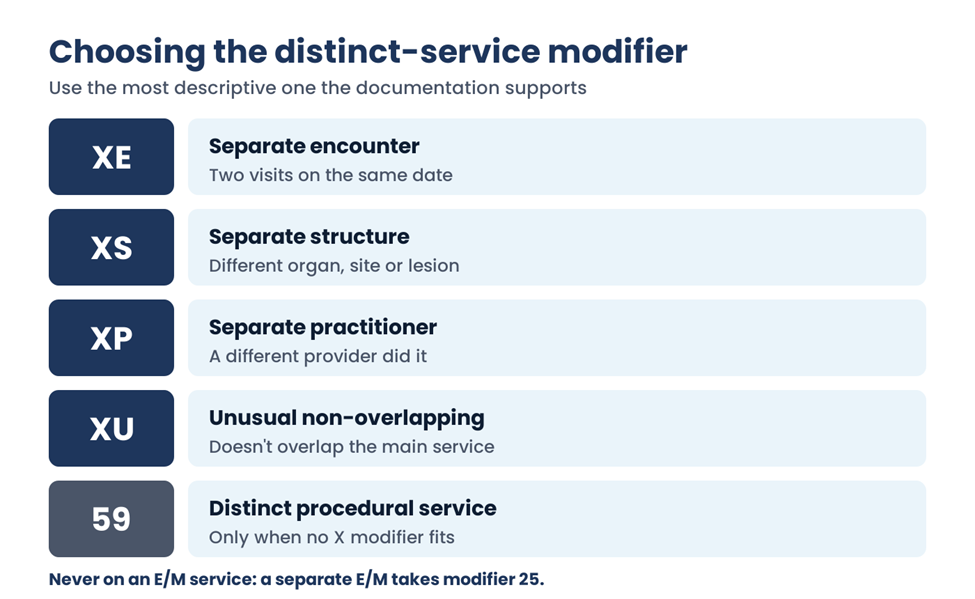
CMS guidance in MLN1783722, Proper Use of Modifiers 59, XE, XP, XS and XU asks providers to use the X modifiers instead of 59 whenever one fits. Modifier 59 is never added to an E/M service; a separately identifiable E/M visit uses modifier 25. For a wider look at modifiers beyond bundling, see our guide to CPT modifiers and when to use them.
| Modifier | Use it when |
| XE | The service happened at a separate encounter on the same date |
| XS | It was performed on a separate organ, structure or lesion |
| XP | A different practitioner performed it |
| XU | It doesn’t overlap the usual components of the main service |
| 59 | The service is distinct but no X modifier describes why |
Examples From Daily Coding
- Same toe. Debriding a nail and paring a corn on the same toe, distal to the last joint, aren’t reported together. Paring a lesion on a different toe can be, with the right toe modifier. Our foot callus coding guide covers the paring codes.
- Biopsy and destruction. A biopsy of one lesion and destruction of a different lesion on the same side may support 59 or XS when no anatomic modifier applies.
- Timed therapy codes. Two 15-minute services in separate, non-overlapping time blocks may be reported with a distinct-service modifier. Services in the same block can’t.
- Imaging guidance. Guidance that’s part of the procedure isn’t billed separately, even if it has its own CPT code.
Bundling Denials and How to Prevent Them
A bundling denial usually carries CARC 97 (the service is included in payment for another service) or CARC 236 (the code pair isn’t compatible under NCCI or similar rules). CARC is the claim adjustment reason code on the remittance. Our list of common claim denial codes and fixes explains others you’ll see.
| Problem | Prevention |
| Modifier added to an indicator 0 pair | Check the indicator before coding; bill Column 1 only. |
| 59 used out of habit | Use XE, XS, XP or XU when one fits, and anatomic modifiers first. |
| Different diagnoses used to justify a modifier | Look for a separate site, encounter, provider or time block instead. |
| Old edit files in the billing system | Load the quarterly NCCI updates on schedule. |
| Units over the MUE | Review the units against the MUE before submission. |
If you’re unsure how often modifiers are being used in your practice, a focused review of distinct-service modifiers is a sensible part of any medical billing audit.
Frequently Asked Questions
What is a CPT bundling edit and why does it cause denials?
A bundling edit is an NCCI rule that pairs two codes that shouldn’t normally be billed together for the same patient, provider and date. When both are billed without an allowed modifier, the Column 2 code is denied. Denials happen when the edit is missed or a modifier is added without documentation showing distinct services.
Is there a list of bundled CPT codes?
Yes. CMS publishes the NCCI procedure-to-procedure edit tables, which list every bundled code pair with its modifier indicator, and updates them quarterly. Medicaid has separate NCCI files. Most billing systems load these tables, but check that yours runs the current quarter’s version.
When can I use modifier 59?
Use 59 only when the edit’s modifier indicator is 1, the services were truly distinct, and no more specific modifier fits. CMS asks for XE, XS, XP or XU instead of 59 whenever possible, and for anatomic modifiers such as RT or LT first. Never add 59 to an E/M service.
What is the difference between bundled and mutually exclusive codes?
Bundled codes describe a component that’s already part of a more extensive service. Mutually exclusive codes describe two services that can’t reasonably happen together, such as two different repair methods for the same organ. Both are enforced through NCCI procedure-to-procedure edits, and both deny the Column 2 code.
What happens if a practice unbundles codes on purpose?
Intentional unbundling to increase payment can be treated as a false claim under federal law, which can lead to repayment, penalties and exclusion from federal programs. Even accidental patterns trigger audits and recoupment. Regular internal reviews of modifier use help catch problems early.
Keeping Bundled Codes Clean
When you bundle and unbundle CPT codes by the edit, the indicator and the record, modifier use stops being a guess. If bundling denials keep showing up in your A/R, EzMedPro’s coders can review your edits and modifier patterns through our medical billing and coding services.
Sources: CMS National Correct Coding Initiative edits; CMS MLN1783722, Proper Use of Modifiers 59, XE, XP, XS and XU; CMS Medicaid NCCI educational materialsCPT is a registered trademark of the American Medical Association. This guide is general coding information, not legal advice.

