
Foot Callus ICD-10 Code L84: Coding and Billing Guide
The ICD-10-CM code for a callus is L84, Corns and callosities, a billable code that needs no extra characters. It covers a corn or callus on any part of the foot, and it remains valid in the FY 2027 code set that took effect on October 1, 2026. Below you’ll find when L84 fits and when another code does, how to pair it with CPT 11055 to 11057, what Medicare needs before it pays for callus paring, and the denials that show up most often.
Callus ICD-10 Code L84 at a Glance
| Item | What applies |
| Code and title | L84, Corns and callosities |
| Billable | Yes, complete as a three-character code |
| Code-set year | Valid for FY 2027 (October 1, 2026 to September 30, 2027) |
| Laterality | None. One code for the right foot, left foot or both |
| Terms that lead to L84 | Callus, callosity, clavus, corn, heloma, tyloma |
| Chapter | Chapter 12, Diseases of the skin and subcutaneous tissue |
Some lookup sites list L84.0 or similar subcodes, but they don’t exist in ICD-10-CM, and a claim carrying one rejects. L84 sits with other high-volume codes in our roundup of ICD-10 codes every biller should know, but its payment rules are stricter than most because Medicare treats callus care as routine foot care.
Right Foot, Left Foot or Bilateral: Why L84 Has No Laterality
There’s no separate left, right or bilateral foot callus code. Report L84 once; ICD-10-CM doesn’t split it by side, site or lesion count.
Laterality still belongs in the note. Ask the provider to record the foot, the exact site (for example, under the second metatarsal head), and how many lesions were pared. The count drives CPT selection, and the site supports medical necessity if records are requested.
Don’t add M79.671 or M79.672 (foot pain) just to show the side. Pain from a callus is part of the condition, and Section I.B.5 of the ICD-10-CM Official Guidelines for Coding and Reporting FY 2027 says signs and symptoms that routinely come with a confirmed diagnosis aren’t coded separately.
When a Different Code Fits Better
Most encounters stay on L84. The exceptions come from the provider’s wording, so read the assessment first.
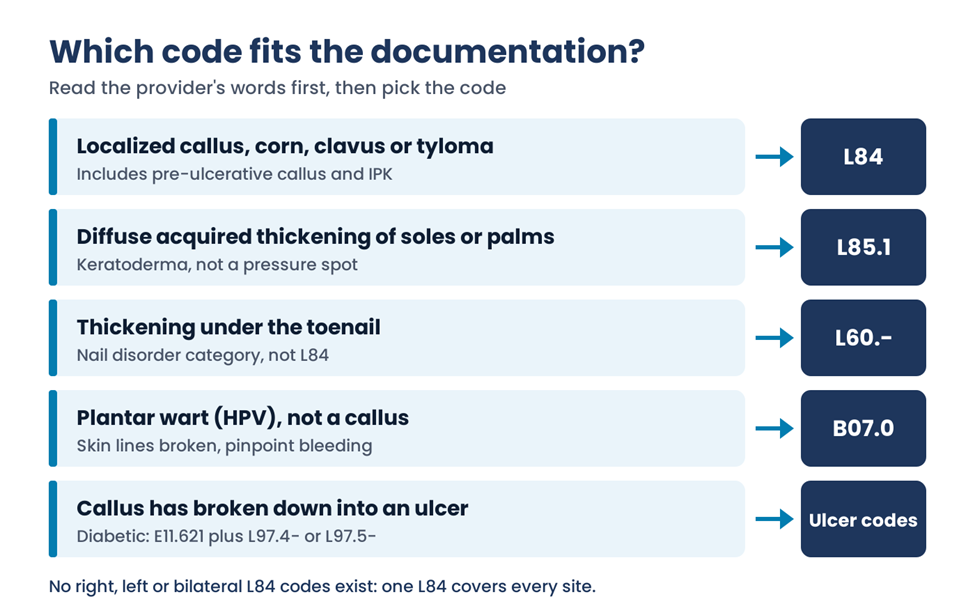
| Documentation says | Code | Why |
| Callus, corn, clavus, tyloma or pre-ulcerative callus | L84 | A localized pressure lesion. ICD-10-CM has no separate pre-ulcerative callus code. |
| Intractable plantar keratosis under a metatarsal head | L84 | A discrete, deep pressure lesion, generally reported with L84 unless the provider documents a different diagnosis. |
| Acquired keratoderma or diffuse thickening of the soles | L85.1 | Covers acquired keratoderma of the palms and soles, not a single pressure spot. |
| Thickening under the toenail | L60.- category | A nail disorder. Code it from the nail category using the provider’s exact term, not L84. |
| Plantar wart | B07.0 | A viral lesion. Paring a wart as a callus misstates the diagnosis. |
| Callus broken down into a diabetic foot ulcer | E11.621 plus L97.4- or L97.5- | The ulcer becomes the focus. E11.621 instructs you to add the L97 code for site and depth. |
When a callus ulcerates or gets infected in a patient with diabetes, our guide to diabetic foot infection ICD-10 coding covers the sequencing.
Pairing L84 With CPT 11055, 11056 and 11057
These codes describe paring or cutting benign hyperkeratotic lesions such as corns and calluses, chosen by the total lesions treated in the session.
| Lesions pared at the visit | CPT code | Diagnosis |
| One | 11055 | L84 |
| Two to four | 11056 | L84 |
| Five or more | 11057 | L84 |
- Count across both feet. Three calluses on the left foot and one on the right is four lesions, so one unit of 11056, not 11056 plus 11055.
- Separate E/M only when earned. A significant, separately identifiable evaluation gets modifier 25; a routine look at the foot before paring doesn’t.
Medicare Rules for Callus Paring
Medicare excludes routine foot care, and cutting or removing corns and calluses falls inside that exclusion. Payment is possible only when a systemic condition, such as diabetes with neuropathy or peripheral vascular disease, makes the care risky for anyone but a professional.
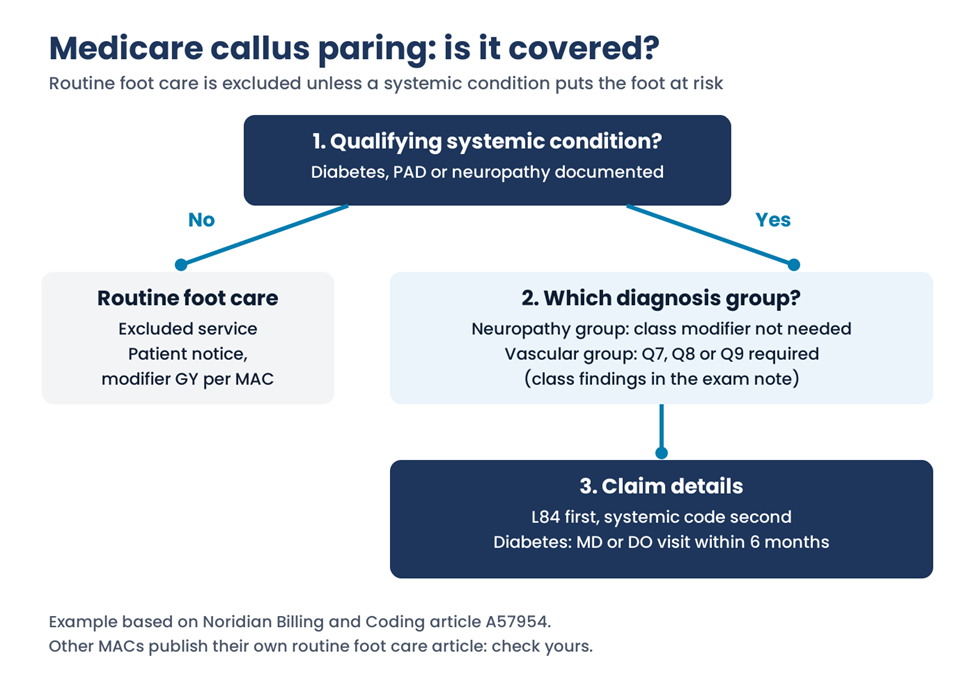
The flow above shows the three checks in order: systemic condition, diagnosis group, claim details.
Each MAC (Medicare Administrative Contractor) spells out the details in its own article. In Noridian’s Billing and Coding: Routine Foot Care article A57954, L84 must be the first-listed diagnosis, followed by a code for the systemic condition. Neuropathy diagnoses such as E11.42 don’t need class findings modifiers. Vascular diagnoses such as E11.51 do, using Q7 (one Class A finding), Q8 (two Class B findings) or Q9 (one Class B and two Class C findings).
For conditions such as diabetes, the claim also needs the treating MD or DO’s name and a last-visit date within the prior six months. Our E11.42 coding guide for type 2 diabetes with polyneuropathy covers the documentation behind that secondary code.
When none of this applies, the paring isn’t covered. MACs typically direct modifier GY for statutorily excluded services, and a written notice before the visit keeps patient billing clean. Other MACs publish their own articles, so use the one for your jurisdiction.
Common Denials and How to Prevent Them
These denials usually carry a CARC (Claim Adjustment Reason Code, the payer’s standard reason for not paying) for a non-covered service or missing medical necessity. Our denial codes reference guide explains the common ones.
| What went wrong | How to prevent it |
| L84 billed alone for a Medicare patient | Add the documented systemic condition code after L84. |
| Vascular diagnosis billed without Q7, Q8 or Q9 | Have the exam note record pulses and trophic findings, then append the matching modifier. |
| Treating physician name or last-visit date missing | Capture both at check-in for every routine foot care patient. |
| Units billed per foot | Total all lesions and report a single paring code. |
| Invalid code such as L84.0 | Lock L84 in your charge master; it has no subcodes. |
Sample Coding Scenario
Sample (fictional data). A 71-year-old Medicare patient with type 2 diabetes and documented diabetic polyneuropathy is seen for painful calluses. The podiatrist pares two plantar calluses on the right foot and one on the left. The note records the neuropathy findings, the treating internist’s name and a visit date four months earlier.
Coding: CPT 11056 for three lesions, L84 first and E11.42 second, with no Q modifier because neuropathy doesn’t need one under this MAC’s article. Change the codes to match your own patient’s documentation and MAC.
Frequently Asked Questions
What is the ICD-10 code for a callus on the foot?
The code is L84, Corns and callosities. It covers calluses and corns anywhere on the foot, including the heel, the ball of the foot and the toes. It is billable as written, needs no fourth character, and is valid for the FY 2027 code set. Record the exact site and lesion count in the note, since the code itself does not capture them.
Is there an ICD-10 code for a left or right foot callus?
No. L84 has no laterality, so a right foot, left foot or bilateral callus is reported with the same single code. Put the side and site in the documentation instead. Avoid adding foot pain codes just to show the side, because pain that comes with a callus is part of the diagnosis and is not coded separately.
Does Medicare pay for callus removal?
Only when a qualifying systemic condition puts the foot at risk. Medicare treats corn and callus paring as routine foot care, which is excluded. With a covered condition, bill L84 first and the systemic code second, add class findings modifiers when your MAC requires them, and include the treating physician details. Commercial payers set their own rules, so check your payer’s manual.
Which CPT code do I use with L84?
Use 11055 for one lesion, 11056 for two to four and 11057 for five or more, counting every lesion pared in the session across both feet. Bill one paring code per session rather than multiple units. If a separate, significant evaluation also takes place, the E/M service carries modifier 25.
Getting Foot Callus ICD-10 Claims Paid
L84 is simple; the payment depends on the details around it. Getting the lesion count, systemic condition and modifier rules right the first time keeps callus ICD-10 claims out of the denial queue. If routine foot care claims keep coming back, EzMedPro’s team can review your coding and claim workflow through our medical billing and revenue cycle services.
Sources: CMS ICD-10-CM FY 2027 code set and the ICD-10-CM Official Guidelines for Coding and Reporting FY 2027; Noridian Billing and Coding: Routine Foot Care article A57954 in the CMS Medicare Coverage Database. CPT is a registered trademark of the American Medical Association. This guide explains coding and billing only and is not medical or legal advice.

