
Diabetic Foot Infection ICD-10 Coding: Which Codes to Pair
There is no single ICD-10-CM code for a diabetic foot infection. You report a diabetes complication code from E11.6- (or E10.6- for type 1) together with a second code for the actual problem, such as cellulitis, an ulcer or osteomyelitis, and that second code is usually where right and left are captured. This guide shows the code pairs for each situation, how laterality and ulcer depth work, how to sequence, and the documentation and CPT details that keep these claims paid.
Why Diabetic Foot Infection ICD-10 Has No Single Code
ICD-10-CM codes diabetes by the complication it causes, not by a body part. “Diabetic foot infection” can mean cellulitis, an abscess, an infected ulcer or a bone infection, and each points to a different code pair. So the first job is reading what the provider actually found, then building the pair.
This is also why so many searches for a right or left diabetic foot infection code come up empty: the E11.6- codes don’t carry laterality. The side lives in the infection, ulcer or osteomyelitis code. Diabetic foot coding sits among the high-volume diagnoses in our list of top ICD-10 codes every biller should know, and it’s one of the easiest to get wrong.
Code Pairs by Clinical Situation
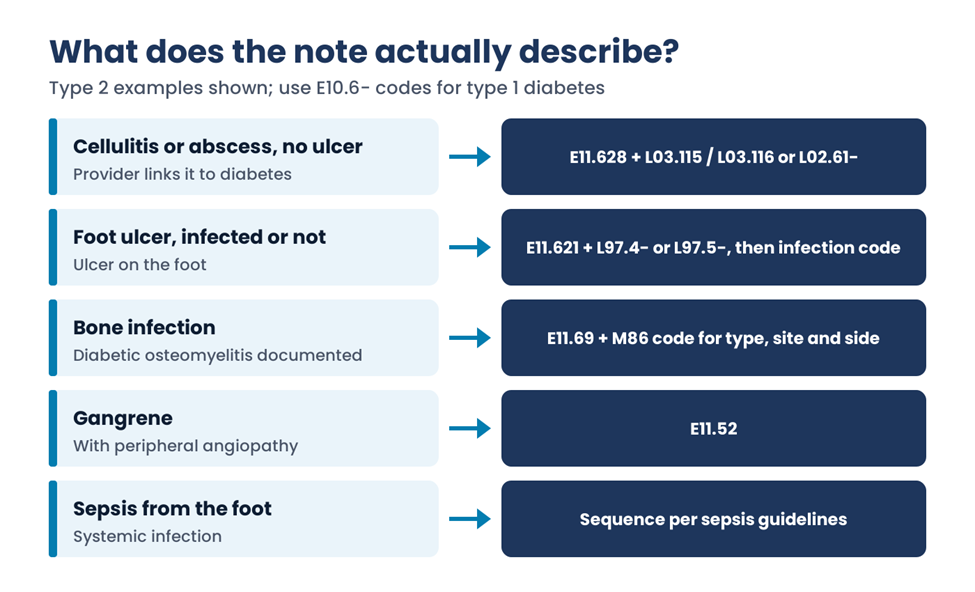
| What the provider documents | Type 2 code pair | Notes |
| Cellulitis of the foot, no ulcer, linked to diabetes | E11.628 plus L03.115 (right) or L03.116 (left) | Use L03.03- instead when the cellulitis is on a toe. |
| Abscess of the foot linked to diabetes | E11.628 plus L02.611 (right) or L02.612 (left) | If cellulitis is also documented, code both. |
| Diabetic foot ulcer, with or without infection | E11.621 plus L97.4- or L97.5- | Add the infection code too when the ulcer is infected. |
| Diabetic osteomyelitis of the foot | E11.69 plus an M86 code for type, site and side | Requires documentation that ties the bone infection to diabetes. |
| Gangrene with peripheral angiopathy | E11.52 | One combination code; add the ulcer code if an ulcer is also present. |
For type 1 diabetes, swap in the matching E10 codes, such as E10.621 or E10.628. For all E11 codes, add Z79.4 for insulin or Z79.84 for oral diabetes drugs when the provider documents current use.
Foot Ulcers: E11.621 and the L97 Code
E11.621 means type 2 diabetes with a foot ulcer. It has no right or left version, and it instructs you to add an L97 code that identifies the ulcer’s site, side and depth. E11.622, which older guides sometimes label as a left foot ulcer, actually means a skin ulcer somewhere other than the foot, such as the lower leg.
The L97 sixth character records severity, from skin breakdown only through fat layer exposed to necrosis of muscle or bone. A biller who sees only “diabetic foot ulcer” in the note can’t pick that character, so ask for the depth in every wound note.
Infection Without an Ulcer: E11.628
When cellulitis or an abscess develops on the foot without an ulcer and the provider documents it as a diabetic complication, E11.628 (other skin complications) plus the infection code is the usual pairing. If the note doesn’t connect the infection to diabetes, don’t assume it. Query the provider, or code the diabetes and the infection on their own merits.
Under Section I.A.15 of the ICD-10-CM Official Guidelines for Coding and Reporting FY 2027, conditions listed under “with” in the Index are presumed linked to diabetes, which covers a foot ulcer and gangrene. Cellulitis isn’t listed there, which is why the provider’s linking statement matters for E11.628.
Where Right and Left Go
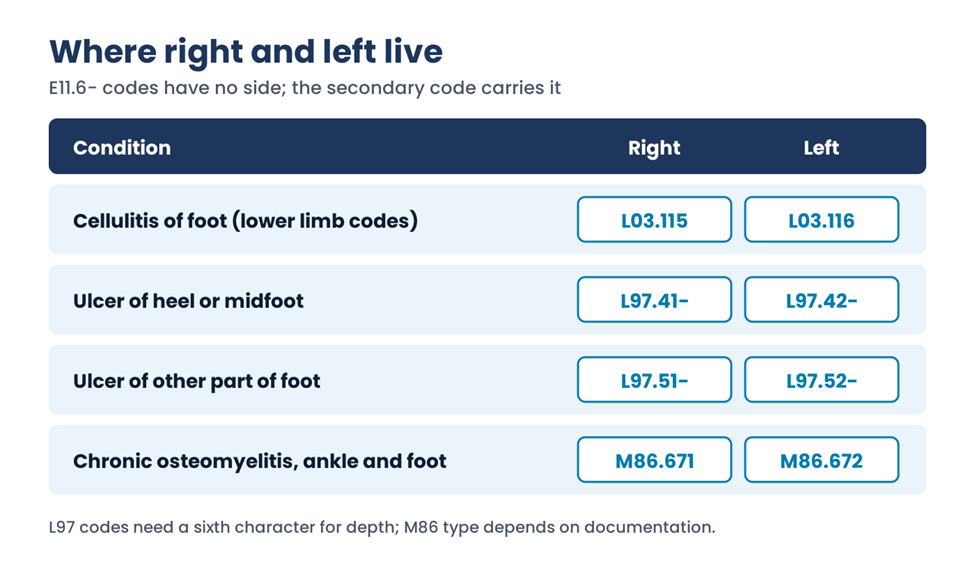
The chart above lists the right and left codes for foot cellulitis, heel and midfoot ulcers, other foot ulcers and chronic osteomyelitis of the ankle and foot.
If both feet are involved, report the right and left secondary codes separately. Bilateral codes don’t exist for these categories.
Sequencing the Codes
- Ulcer encounters. List E11.621 first, then the L97 code, then any infection code.
- Cellulitis or abscess focus. Sequence by the reason for the encounter. When the visit is for the infection, many facilities list the infection first, followed by E11.628; follow the provider’s focus and your facility’s guidance.
- Sepsis. If the foot infection has led to sepsis, the sepsis guidelines in Section I.C.1.d decide what comes first.
- Neuropathy and vascular disease. Add them when documented, for example E11.42 for polyneuropathy. Our E11.42 coding guide covers that code in detail.
Documentation That Supports the Claim
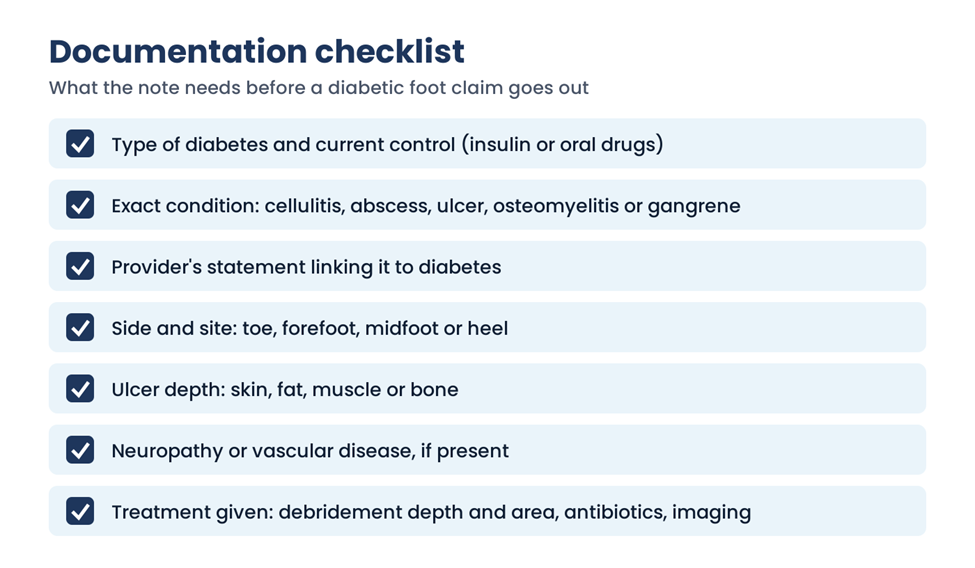
The checklist above covers seven items: diabetes type and treatment, the exact condition, the link to diabetes, side and site, ulcer depth, neuropathy or vascular disease, and the treatment given. Missing depth or side is the most common reason a coder has to hold the chart.
CPT Codes Billed With These Diagnoses
Wound debridement is the procedure most often paired with these codes. Surgical debridement codes 11042 to 11047 are chosen by the deepest tissue removed (subcutaneous tissue, muscle or bone) and by surface area, with add-on codes for each additional 20 square centimeters. Selective debridement uses 97597 and 97598. The procedure note must state the tissue removed and the area, because the diagnosis code’s ulcer depth alone doesn’t set the CPT level.
Pre-ulcerative calluses in the same patients are a separate service; see our foot callus ICD-10 and paring guide for L84 and CPT 11055 to 11057.
Common Mistakes
| Mistake | Better approach |
| Using E11.621 for the right foot and E11.622 for the left | Use E11.621 for any foot ulcer and put the side in the L97 code. |
| Reporting E11.628 alone | Add the cellulitis or abscess code that names the site and side. |
| Unspecified L97 depth | Ask for depth in the wound note so the sixth character is specific. |
| Coding diabetic osteomyelitis without a documented link | Query the provider before using E11.69. |
| Using an old code set | Load the current ICD-10-CM files from CMS every October 1. |
The current files are posted on the CMS ICD-10 code sets page. Specificity problems like these are a common source of medical necessity denials, which our guide to how accurate coding reduces claim denials covers in more depth.
Frequently Asked Questions
What is the ICD-10 code for diabetic foot infection?
There isn’t one code. Pair a diabetes complication code with a code for the condition. Cellulitis without an ulcer, documented as diabetic, is usually E11.628 plus L03.115 or L03.116. An infected foot ulcer is E11.621 plus an L97 code and the infection code. Diabetic osteomyelitis is E11.69 plus an M86 code.
What is the ICD-10 code for a right diabetic foot infection?
The E11 code stays the same for either foot. The side goes in the secondary code: L03.115 for cellulitis of the right lower limb, L97.41- or L97.51- for a right foot ulcer, or an M86 code ending in 1 for right foot osteomyelitis, such as M86.671 for chronic osteomyelitis.
Is E11.622 the code for a left foot ulcer?
No. E11.622 means type 2 diabetes with a skin ulcer other than a foot ulcer, such as an ulcer on the lower leg. All diabetic foot ulcers use E11.621, regardless of side, with an L97.4- or L97.5- code to show the foot, the exact site and the depth.
How do I code a diabetic foot ulcer with osteomyelitis?
Report E11.621 with the L97 code that shows bone involvement, plus E11.69 and an M86 code for the osteomyelitis when the provider documents it as diabetic. The M86 code should reflect the type, such as acute or chronic, and the ankle and foot site with the correct side.
Do diabetic foot codes need a code for insulin use?
Yes, when the provider documents it. E11 codes instruct you to add Z79.4 for current insulin use, Z79.84 for oral diabetes drugs, or Z79.85 for injectable non-insulin drugs. These describe current treatment and don’t change the complication code you choose.
Getting Diabetic Foot Infection Claims Right
Diabetic foot infection ICD-10 coding comes down to two codes working together: the E11 complication code and a specific code that carries the site, side and depth. When the note gives the coder those details, the claim tells a clear medical necessity story. If your team keeps querying the same missing details, EzMedPro can review your coding and documentation workflow through our medical billing and coding services.
Sources: CMS ICD-10-CM FY 2027 code set; ICD-10-CM Official Guidelines for Coding and Reporting FY 2027. CPT is a registered trademark of the American Medical Association. This guide explains coding and billing only and is not medical advice.

