
Handling Retroactive Claim Denials and Recoupments
A retroactive claim denial happens when a payer reverses a claim it already paid and takes the money back, usually by offsetting it against future payments. Your practice can often stop or reverse the recoupment if you act within the payer’s deadlines and the record supports the original claim. This guide covers why paid claims get reversed, how a takeback appears on your remittance, Medicare’s recoupment timeline, what to check with commercial payers, a five-step response, a sample appeal, and ways to prevent repeats.
What Causes Retroactive Claim Denials
Retroactive claim denials are different from front-end denials. The claim passed every edit and was paid, then something the payer learned later changed its decision. That’s why they belong in your wider denial management process rather than being handled as one-off surprises.
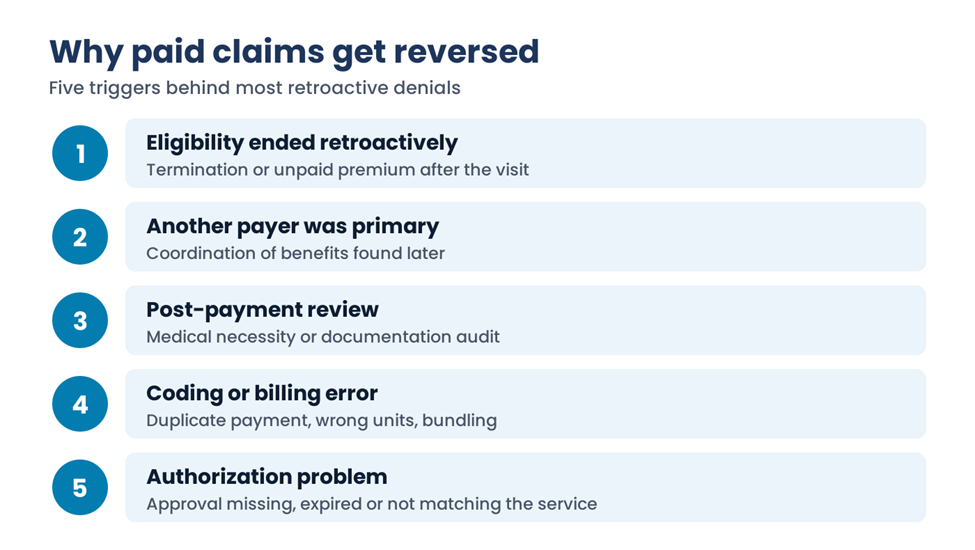
The chart above lists the five usual triggers: retroactive loss of eligibility, another payer found to be primary, post-payment review, a coding or billing error, and an authorization problem.
Eligibility is the most frequent. Employers terminate coverage back to an earlier date, and Marketplace enrollees receiving premium tax credits get a three-month grace period for unpaid premiums. During the second and third months of that grace period, the plan can hold claims and deny them if the premium is never paid. A strong eligibility verification routine helps you spot grace-period patients before the visit.
How a Takeback Shows Up on the Remittance
A reversal usually appears on the 835 electronic remittance (ERA) in two places. The original claim comes back with claim status 22, a reversal of a previous payment, carrying CARC and RARC codes that explain why. The money then often leaves through a provider-level adjustment (PLB) with reason WO, overpayment recovery, which reduces the check for unrelated claims.
That second step is where practices lose track. The deduction lands on a different payment date and sometimes a different patient, so posting staff must match each offset to the original claim. Our guide to EOBs and ERAs in the billing process covers how to read both documents.
Medicare Recoupment: The Deadlines That Matter
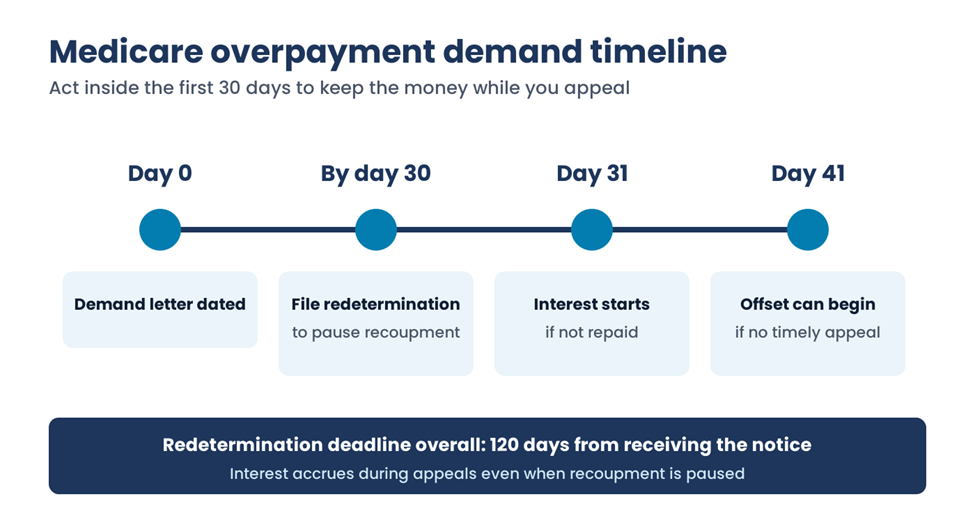
Medicare overpayments start with a demand letter. Interest begins on day 31 if the overpayment isn’t repaid, and without a timely appeal the contractor can begin offsetting future payments on day 41. Filing a redetermination within 30 days of the demand letter pauses that recoupment under the limitation on recoupment rules; a timely reconsideration request pauses it again.
First Coast’s limitation on recoupment page explains the process in a MAC’s own words, including that interest keeps accruing during the appeal and is recalculated if the amount changes. The overall deadlines still apply: 120 days to request redetermination and 180 days for reconsideration.
Recovery Audit Contractors (RACs) can generally review claims up to three years after the claim was paid, and they must allow a 30-day discussion period before sending a finding for adjustment, as the CMS Recovery Audit Program improvements summary describes. Medicare Advantage plans follow their own contracts and appeal rules, not these fee-for-service timelines.
Commercial Payers: Contract and State Limits
Commercial recoupment rules come from two places. Your contract may set a lookback window, a notice period and a dispute process, and many states set limits on how far back insurers can reverse payments and how much notice they must give. Those state rules generally apply to fully insured plans, while self-funded employer plans fall under federal ERISA rules instead.
Before you accept an offset, check the contract and your state insurance department’s prompt-pay and recoupment rules. If you’re negotiating a new agreement, recoupment terms deserve a line in your medical billing contract review checklist.
Five Steps to Respond to a Recoupment Notice
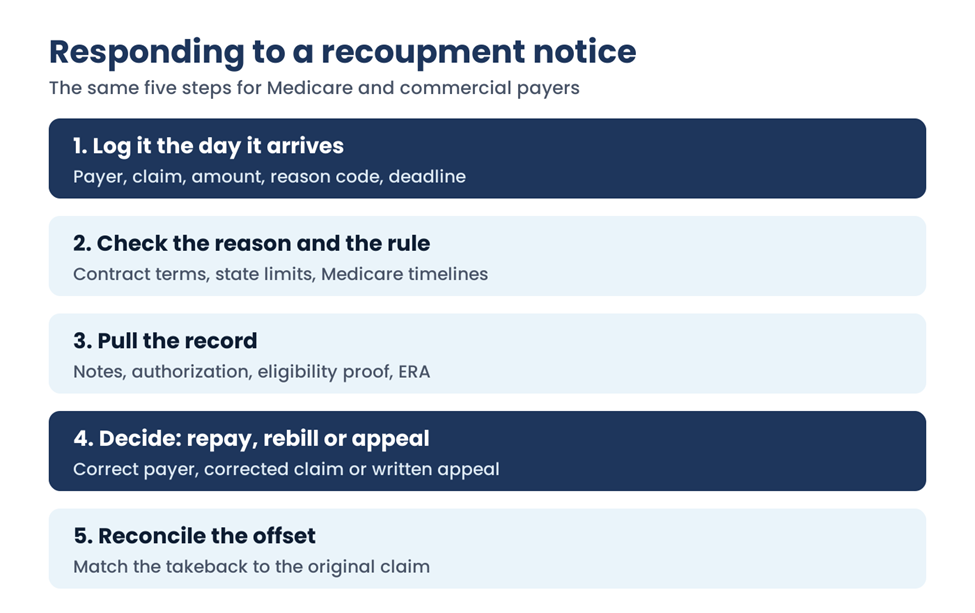
A fixed routine keeps recoupment deadlines from slipping.
- Log it the day it arrives. Record the payer, claim, amount, reason code and every deadline, including the date that stops an offset.
- Check the reason against the rules. Compare it with your contract, your state’s limits and, for Medicare, the timelines above.
- Pull the record. Gather the visit note, authorization, eligibility response from the date of service and the original ERA.
- Decide: repay, rebill or appeal. If another payer was primary, bill that payer quickly before its filing limit passes. If the denial is wrong, appeal in writing.
- Reconcile the offset. Match the takeback to the original claim and patient so A/R and the patient balance stay accurate.
For the mechanics of the written appeal itself, our step-by-step guide on appealing a denied medical claim covers the full process.
Sample Appeal Letter
Sample (fictional data). Replace the payer, names, numbers and dates with your own, and attach the documents you list.
To: Provider Appeals Department, Northfield Health Plan
Re: Request to reverse recoupment. Patient: Jordan Avery. Member ID: NHP448201. Claim: 2026-0415-7781. Date of service: March 12, 2026. Amount recouped: $186.40.
Northfield Health Plan paid this claim on April 2, 2026 and recouped it on August 14, 2026 with the reason that coverage ended February 28, 2026. Our eligibility response on the date of service showed active coverage, and the member presented a current card.
Our agreement with Northfield requires written notice 30 days before recoupment, and we received none. We request that the recoupment be reversed. If coverage did terminate, please provide the termination notice and the date the plan learned of it.
Attached: eligibility response dated March 12, 2026; ERA for the original payment; ERA showing the offset; contract section on recoupment notice.
Sincerely, Billing Manager, Lakeside Family Medicine
Preventing Retroactive Denials
| Risk | Prevention |
| Retroactive loss of coverage | Verify eligibility at every visit and save the response with the encounter. |
| Grace-period Marketplace patients | Flag patients in months two and three and collect or delay elective services. |
| Unknown primary payer | Update coordination of benefits questions at check-in, at least yearly. |
| Post-payment audits | Keep notes complete and signed; audit your own high-volume codes. |
| Authorization mismatches | Match the service, dates and units to the authorization before billing. |
When You Find the Overpayment Yourself
Retroactive denials aren’t only payer-driven. If your team identifies a Medicare overpayment, federal rules require you to report and return it within 60 days of identifying it. Since January 1, 2025, a good-faith investigation can pause that clock for up to 180 days. Build a simple refund log so these don’t sit in credit balances.
Frequently Asked Questions
What is a retroactive claim denial?
It’s a payer’s decision to reverse payment on a claim it already paid, usually because of a retroactive coverage change, another primary payer, a post-payment review or a billing error. The payer then recoups the money, often by deducting it from later payments. You can usually appeal if you believe the original payment was correct.
How far back can insurance companies recoup payments?
It depends on the payer. Medicare Recovery Audit Contractors generally look back up to three years from the claim’s paid date. Commercial payers follow their contract terms and, for fully insured plans, state laws that often limit how far back they can go and require advance notice. Self-funded plans follow federal rules instead.
How do I stop a Medicare recoupment?
File a valid redetermination within 30 days of the demand letter. Under the limitation on recoupment rules, the contractor then pauses offsets while the appeal is decided, and a timely reconsideration pauses them again. Interest still accrues, so repay promptly if the appeal is unlikely to succeed.
Can a payer take back money for a claim it authorized?
Sometimes. An authorization doesn’t always guarantee payment if eligibility ended or the service billed didn’t match what was approved. Check your contract for language on authorization reliance, and appeal with the approval letter when the service matched it exactly and the patient was eligible.
How should we post a recoupment?
Post the reversal to the original claim, not as a general adjustment, and match any provider-level deduction to that claim and patient. Then decide whether to rebill another payer, appeal or move the balance to the patient. Clean posting keeps A/R reports accurate and stops duplicate refunds.
Keeping Retroactive Claim Denials Under Control
Retroactive claim denials are easier to handle when every takeback is logged, checked against the rules and matched to the original claim within days, not months. If recoupments are piling up in your A/R, EzMedPro’s team can help with denial management and payment posting through our medical billing and RCM services.
Sources: First Coast Service Options, Limitation of Recoupment Process; CMS Recovery Audit Program improvements; Medicare appeals and overpayment rules. State and contract rules vary. This guide is general billing information, not legal advice.

