
Switching Medical Billing Companies: A Six-Phase Playbook That Protects Your Open Claims
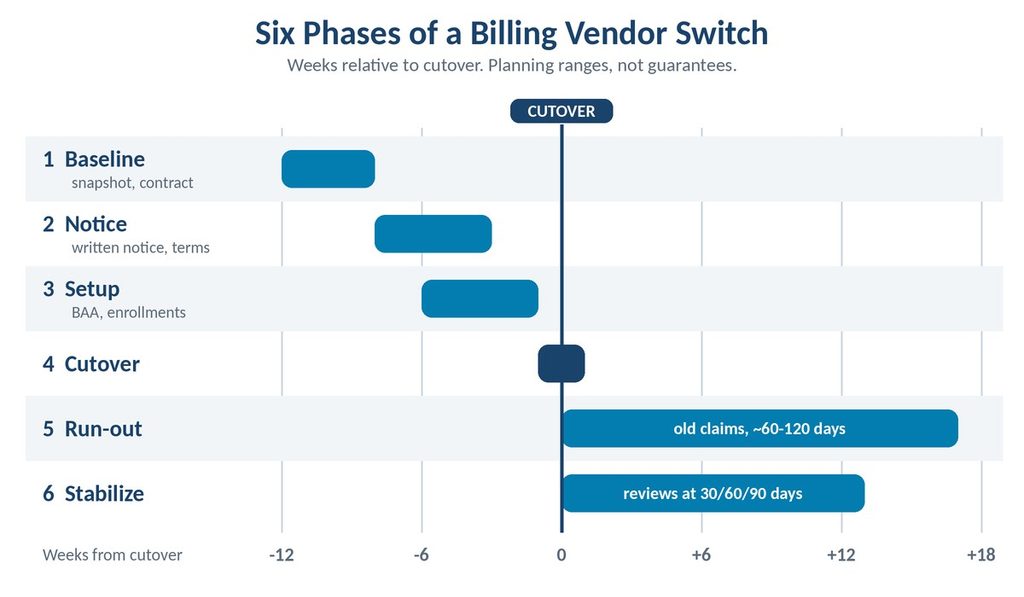
Switching medical billing companies is the process of moving a practice’s claims, open accounts receivable, payer connections and patient data from one billing vendor to another without interrupting submissions or collections. Practical planning for a safe switch runs about 60 to 120 days from notice to stable results, depending on contract terms, data export and how old claims are finished.
A practice that decides to change billing vendors usually has a clear reason, such as slow collections or silent reporting, and an unclear plan. The risk sits in the gap: claims the old vendor never finished, remittances routed to the wrong place and records that never arrive. This guide walks through the switch in six phases, with deadlines, worked examples and a self-assessment checklist near the end.
It is written for practice owners, office managers and billing decision-makers at small and mid-size US practices. Figures reflect information available in October 2026. Each number carries a source label, and anything that varies by payer, state or contract is flagged so you can confirm it before acting.
Switching at a glance: the deadlines and targets that matter
Ten numbers shape most billing switches: four legal deadlines, two contract terms and four practical targets. Use the table as a planning reference. Only the filing limits, the appeal window and the enrollment-change rule come from published rules. The rest are common conventions that vary by contract, so confirm them in your own documents.
| Metric | Practical target or range | Review frequency | Source type |
| Contract notice period | Commonly 30–90 days; confirm in your agreement | Before any decision | L |
| Medicare Part B filing limit | 12 months from the date of service | Weekly backlog check | S |
| Medicaid filing limit | Federal ceiling of 12 months; your state may set less | Per state schedule | S, K |
| Medicare redetermination window | 120 days from receipt of the notice; receipt presumed 5 days after the notice date | Per denial | S |
| Medicare enrollment changes | 30 days for ownership, legal action or location; 90 days for other changes | At each change | S |
| Old claims left with outgoing vendor | About 60–120 days after cutover | Weekly during run-out | C |
| Heavy go-live support | First 2–4 weeks | Daily at first | C |
| Close monitoring after go-live | About 30–60 days | Weekly | C |
| Share of A/R older than 90 days at switch | Record it; aim for no rise during run-out | Weekly | P |
| Days in A/R after cutover | Within about 10% of your pre-switch baseline by about 90 days | Monthly, by payer | P |
Source types: S = published rule from a named government body. K = set by your own payer contract or state fee schedule, so check it. C = commonly reported across industry sources, mostly vendor guides that cite no underlying data. P = practical planning target used in this guide, not a standard. L = law-firm commentary on typical contract terms. Medicare enrollment timing applies to most physician practices; confirm with your Medicare Administrative Contractor.
A threshold is a prompt to investigate, not a verdict. Your own twelve-month baseline matters more than any published average, so capture it before giving notice. Ask both vendors to define days in A/R and denial rate in writing, because definitions differ and a switch can change the math without changing real performance.
Is switching the right fix, or is the cause on your side?
Switching helps when the vendor is the cause: late submissions, weak follow-up or no reporting. It does not help when low collections trace to payer mix, missing documentation or registration errors that the next vendor will inherit. Diagnose first, because a switch costs time and a wrong diagnosis repeats the loss under a new name.
| Symptom | Common cause | Does switching help? |
| Claims leave weeks after the visit | Vendor capacity or workflow | Often, if the new vendor commits to a submission window in writing |
| Denials for eligibility or missing data | Front-desk registration or EHR data entry | Partly; fix intake first |
| Denials for missing documentation | Provider notes and templates | No; training and templates come first |
| No payer-level reports | Vendor reporting limits | Yes, when reporting is in scope for the next contract |
| Revenue fell after a payer-mix or fee-schedule change | Contract rates or patient mix | No; renegotiate or adjust services |
| Aged A/R grows and nobody works it | Vendor follow-up capacity | Often, once old-claim ownership is settled |
Illustrative: actual causes vary by practice, and a mix of causes is common.
In billing audits, a common pattern is that the largest denial categories start at registration or documentation, which a new vendor cannot fix alone. Before giving notice, request A/R aging, posting procedures and performance reports from the current vendor; Physicians Practice advises that a refusal to provide them is itself a warning sign. When you are weighing a return to staff-run billing instead, the outsource vs in-house billing comparison sets out the cost and staffing trade-offs.
Who should finish the old claims? Four options compared
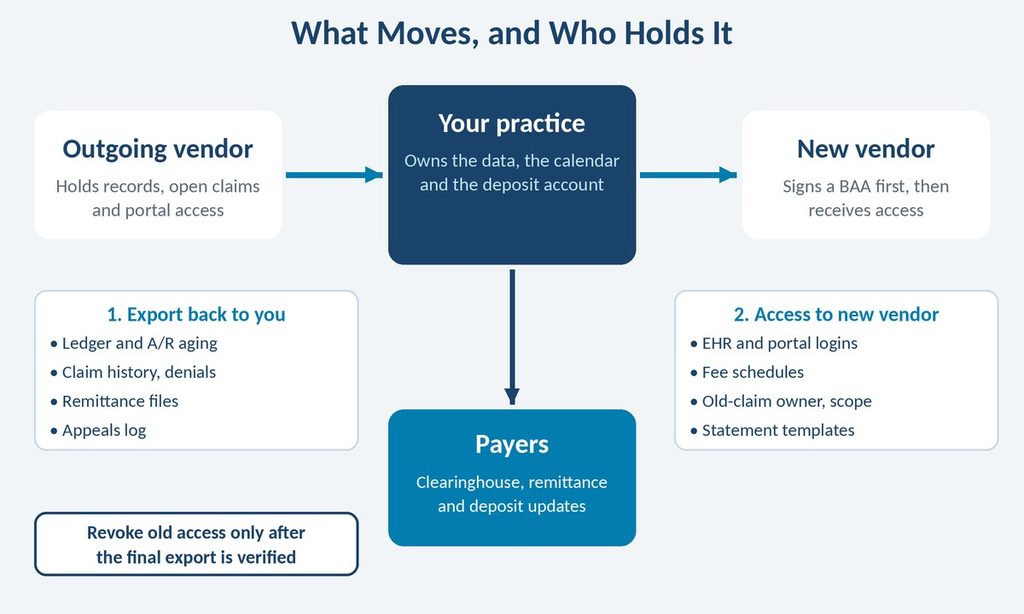
Four options exist for claims submitted before cutover: the outgoing vendor works them, the new vendor takes them, an internal owner handles them, or the work is split by claim age. Choose by age and by who still has portal access and payer history. Whichever option wins, put the owner, scope and fee in writing before cutover.
| Option | How it works | Best when | Watch for |
| Outgoing vendor run-out | Old vendor keeps working claims sent before cutover, often for about 60–120 days | Claims are recent and the contract already provides for it | Fee rate, reduced attention, final reports |
| New vendor takes legacy A/R | New vendor works all open claims from day one | The new vendor accepts it in writing and has payer access | Some vendors decline older balances or price them higher |
| Internal owner | Practice staff work old claims with new vendor guidance | Balances are small or staff know the payers | Capacity; the work competes with front-desk tasks |
| Split by claim age | Recent claims stay with the old vendor; aged claims move to the new vendor | Balances are large and aging is uneven | Coordination, and two people touching one claim |
Illustrative summary of patterns described in vendor guides (Revele 2017, OmniMD 2026, UrgentIQ 2026, PracticeEHR 2026). Fees, scope and willingness to take older balances vary by vendor.
When the outgoing vendor will not agree to a run-out, a billing partner can take the aged balances if it agrees in writing. For example, EZMedPro’s billing and follow-up services can be scoped to include old-claim follow-up, though any vendor should state what it will and will not accept.
How do payer deadlines decide which claims come first?
Claims closest to a filing or appeal deadline get worked first, whoever owns them. Medicare, Medicaid and commercial payers each set different limits, and a claim that misses its limit is usually unrecoverable. Rank the open A/R by days remaining, not only by dollar amount, and check each payer’s contract for its own windows.
| Payer type | Filing rule | Appeal rule | Source type |
| Medicare Part B | 12 months from the date of service | Redetermination within 120 days of receipt of the notice | S |
| Medicare Advantage | Set in the plan’s provider contract | Set in the plan contract and its appeal steps | K |
| Medicaid | Federal ceiling of 12 months; state may be shorter | Set by the state program | S, K |
| Commercial | Set in each payer contract | Set in each payer contract | K |
Rejected Medicare claims are not treated as filed, so a rejection near the limit can end the claim. See the Medicare timely filing guide and the appeal walkthrough. The federal rules are in 42 CFR 447.45 for Medicaid and 42 CFR 405.942 for Medicare redeterminations. When any claim sits within 90 days of its limit, name an owner that week.
What data and access must change hands, and what must be shut off?
The outgoing vendor must return the practice’s records in a usable form, and the practice must revoke the vendor’s access once the final export is verified. The HIPAA rule for a business associate agreement requires return or destruction of protected health information at termination when feasible. It sits in 45 CFR 164.504(e). The export, the check and a written destruction confirmation therefore belong in the plan.
What should the data export contain?
- Patient demographics and insurance details.
- The full ledger of charges, payments and adjustments.
- A/R aging by payer, with claim status and denial reasons.
- Remittance files and explanations of benefits for the period requested.
- The appeals log and any correspondence with payers.
- Fee schedules and the payer contracts the vendor holds.
- Patient statement history and payment plans.
In records reviews, a common pattern is that an export arrives as printed-style reports rather than usable data, which makes reconciliation slow. Request a sample two to three weeks before cutover and match record counts and balances to your own snapshot. Frier Levitt notes that vendors can restrict data access, so the contract should state format and timing; see also the data security and privacy guide.
Which payer connections change?
Credentialing belongs to your providers and group, so changing the vendor does not by itself restart it; the credentialing process guide explains what that covers. What usually changes is the clearinghouse, the submitter ID, the electronic remittance advice feed described in the ERA and EOB explainer and the deposit destination.
PracticeEHR (July 2026) reports that most payers accept dual enrollment but few allow more than one clearinghouse for remittances, so plan for a gap and a manual fallback. For Medicare, 42 CFR 424.516(e) sets 30 days for ownership, legal-action and location changes. It sets 90 days for other changes. Ask your MAC whether your enrollment record lists a billing agency that needs updating.
What does switching cost, and when does it pay back?
Switching costs three things: one-time transition effort, a temporary cash-flow gap and any difference in fees. It pays back only when collections improve by more than those costs. The four worked examples below use illustrative numbers so each formula can be reused with your own figures.
Cash timing versus permanent loss
Cash delayed = average daily collections × days of delay. Illustrative scenario (not an actual client record): a practice collects $200,000 per month, about $6,667 per day. If new claims leave two weeks late, about $93,333 of cash arrives later (14 × $6,667). That is a timing gap, and it becomes a permanent loss only when delayed claims pass a payer’s filing deadline.
Run-out economics for aged claims
Net recovery = open balance × expected recovery rate − run-out fee. Illustrative scenario (not an actual client record): $110,000 is older than 90 days. Assume a 40% recovery rate ($44,000) and an 8% run-out fee on collections ($3,520), for a net of $40,480. Writing the balance off recovers $0. Recovery rates and fees are assumptions; real values vary by payer and claim age.
A blended days in A/R figure that hides one payer
Days in A/R = total A/R ÷ average daily charges. Illustrative scenario (not an actual client record): the blended figure below is 40.0 days, which looks acceptable, yet Medicaid sits at 90.0. A blended average can hide a problem in one payer group, so always request the split.
| Payer group | Open A/R | Average daily charges | Days in A/R |
| Medicare | $90,000 | $3,000 | 30.0 |
| Commercial | $135,000 | $4,500 | 30.0 |
| Medicaid | $135,000 | $1,500 | 90.0 |
| Blended | $360,000 | $9,000 | 40.0 |
Illustrative: actual figures vary by payer mix and specialty.
In payer-level reviews, a common pattern is that Medicaid and secondary claims lag first after a switch, because their remittance feeds are set up last. For tactics on bringing numbers like these down, see the guide to reducing days in A/R.
Payback period of a switch
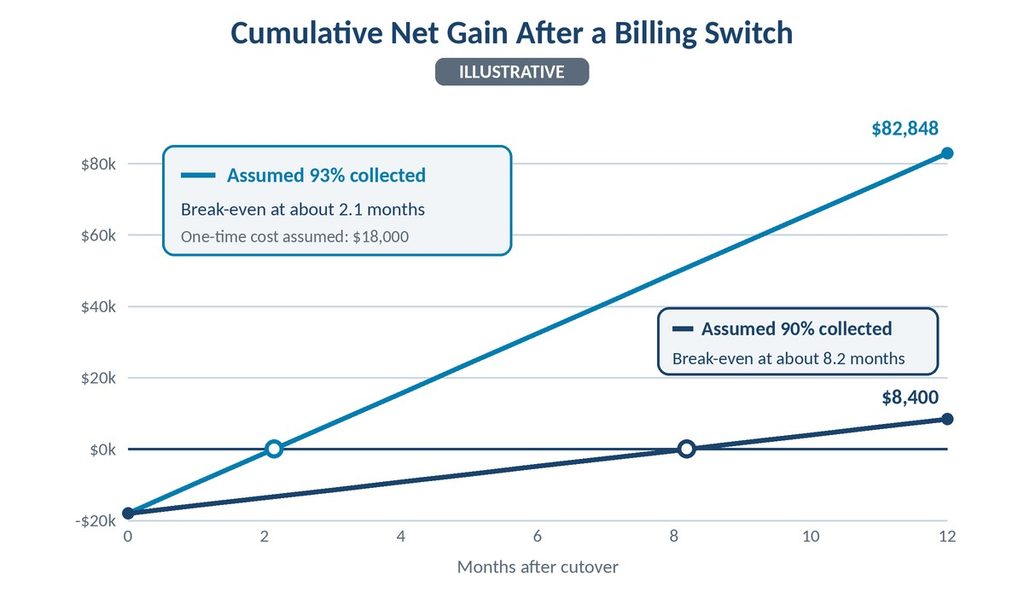
Payback months = one-time switching cost ÷ monthly net gain, where net gain = extra collections − extra fees. Illustrative scenario (not an actual client record): a practice has $220,000 per month in collectible charges and an assumed one-time switching cost of $18,000. The collection rates below are assumptions, not predictions, and no vendor can guarantee them.
| Scenario | Collected per month | Fee | Net after fee | Gain vs current | Payback |
| Current vendor: 88% collected, 5% fee | $193,600 | $9,680 | $183,920 | n/a | n/a |
| New vendor: assumed 93%, 6% fee | $204,600 | $12,276 | $192,324 | $8,404 | 2.1 months |
| New vendor: assumed 90%, 6% fee | $198,000 | $11,880 | $186,120 | $2,200 | 8.2 months |
Illustrative: fee levels and collection rates are assumptions for the example only.
The same switch pays back in about two months or about eight, depending on how much collections actually improve. Ask the new vendor for payer-level evidence from comparable practices before relying on an assumed gain, and re-run the formula after 90 days with your real numbers.
How should you read the numbers after the switch?
Compare like for like: the same payer mix, the same period and the same written definitions, measured against the baseline taken before notice. A dip in the first 30 to 60 days is reasonable to plan for as claims move through new workflows. A slide that continues past 90 days points to a real problem.
- Report two groups separately: claims submitted before cutover and claims the new vendor submitted.
- Judge each metric over at least two to three months, and break it out by payer.
- Treat one missed benchmark as a signal to investigate, not a verdict on the vendor.
- Expect late adjustments on pre-switch claims; the retroactive denials guide explains recoupments that can arrive after cutover.
How long does switching medical billing companies take?
Plan for about 60 to 120 days from notice to stable results, with partial results earlier and full results later. These are general planning ranges, not guarantees, and they shift with contract notice terms, the number of payers and how many old claims remain open.
- Partial results, weeks 0 to 4: the new vendor submits its first claims, remittance routes are confirmed and support is at its heaviest.
- Further progress, weeks 4 to 8: close monitoring continues, and first payments on new-vendor claims arrive on each payer’s normal payment cycle.
- Fuller results, about 60 to 120 days: most old claims are finished and metrics are back near your baseline.
- Slower items: appeals on the oldest claims can run beyond 120 days, because each appeal level has its own decision period.
Which mistakes make a switch more expensive?
Most costly switching mistakes are procedural: unread contract terms, no baseline, unowned old claims and untested exports. Each has a direct fix, and most take a few hours of planning rather than new spending. Review the list below before you send notice, and again one week before cutover:
- Giving notice before reading the termination clause. Confirm the notice method and start date first, because a defective notice can restart the clock under some contracts.
- Skipping the baseline. Take the dated snapshot before notice so every later number has a reference.
- Assuming the new vendor works old claims. Get a written statement of scope, fee and end date.
- Letting remittances split between two vendors. Plan the single remittance feed and a manual fallback.
- Trusting an export you never tested. Match record counts and balances to your own reports.
- Cutting access too early or too late. Revoke it when the final export is verified, not on a guess.
- Forgetting patient statements. Align the statement and payment-address change with cutover.
- Switching to fix a practice-side problem. Fix registration and documentation first when they drive the denials.
Quick summary
- Diagnose the cause first; switching fixes vendor problems, not registration or documentation gaps.
- Capture a dated baseline and A/R snapshot before giving notice.
- Count the notice period from the contract’s stated method; about 30 to 90 days is commonly seen.
- Name an owner, scope and fee for every claim submitted before cutover.
- Prioritize claims by days left before Medicare, Medicaid or commercial deadlines.
- Test the data export, then revoke access once it is verified.
- Review at 30, 60 and 90 days against your own baseline, by payer.
Self-assessment: is your practice ready to switch?
Answer yes or no for your own practice, using documents rather than assumptions. Questions 1, 2, 3 and 5 carry the most weight, since a no on any of them is the most common source of avoidable loss during a switch.
- Have you saved a twelve-month baseline of clean claim, denial, net collection and days in A/R rates by payer?
- Do you hold a dated snapshot of open A/R by payer and age bucket?
- Do you know your contract’s notice period, notice method and any early-exit fee?
- Is a business associate agreement signed with the incoming vendor before any records move?
- Is the owner of claims submitted before cutover named in writing, with scope and fee?
- Have you listed every claim within 90 days of its Medicare or Medicaid filing limit and assigned an owner?
- Have you tested a sample data export against your own balances and record counts?
- Do you know how each payer’s remittances, clearinghouse and deposit account change at cutover?
- Is the date for revoking the old vendor’s access tied to final data delivery?
- Is a 90-day review against your baseline already on the calendar?
| Yes answers | Readiness | What to do |
| 9–10 | Ready | Give notice on schedule and keep the cutover checklist current. |
| 6–8 | Partly ready | Close the gaps in writing before giving notice; start with questions 1, 2, 3 and 5. |
| 0–5 | Not ready | Delay notice. Complete the baseline, contract review and old-claim ownership first. |
When should you bring in outside help with a switch?
Outside help makes sense when the switch outgrows the capacity or experience of your own team. Five signals suggest the in-house approach has reached its limit. When two or more apply at once, a structured handoff with an experienced partner is usually safer than a do-it-yourself cutover:
- The outgoing vendor will not agree in writing to a run-out scope or an export date.
- Open A/R older than 90 days is more than your staff can work alongside daily duties.
- Several payers, locations or clearinghouses must change at the same time.
- No one on staff has set up remittance or electronic enrollment before.
- The export arrives incomplete, or in a form that cannot be reconciled.
When evaluating a replacement, look for a written transition plan with a named owner. Look also for a signed business associate agreement before data moves, payer-level reporting, a stated position on old claims and payments that land in a practice-owned account. Ask for the fee structure in a table, with exclusions listed.
EZMedPro is one example. It delivers medical billing, coding, credentialing, denial management and compliance support through a US-based team, with an emphasis on transparent reporting and no hidden fees. Results vary by practice, so request a sample report and a written scope from any vendor, including through EZMedPro’s revenue cycle management service.
Expert Insights
Switching medical billing companies is less about the new vendor than about the handoff: the baseline, the notice terms, the owner of old claims and the data that returns to you. Practices that settle those four items in writing tend to avoid the avoidable losses.
Only a few figures here are firm published rules: the Medicare 12-month filing limit, the Medicaid federal 12-month ceiling, the 120-day Medicare redetermination window and the enrollment-change deadlines. The 30 to 90 day notice range, the 60 to 120 day run-out, the support windows and every worked example are practical or illustrative targets.
The natural next question is which of your open claims are closest to a deadline. Start there. Then compare how your current and shortlisted vendors would handle those claims in practice, beginning with a conversation with EZMedPro’s revenue cycle management team.
Frequently asked questions
What is a good notice period for ending a billing contract?
A notice period of about 30 to 90 days is the range a July 2025 law-firm review suggests looking for, and shorter is easier to plan around. Nothing mandates it. Read the clause for the notice method, the start date of the clock and any early-exit fee before deciding.
What is a good days in A/R after switching billing companies?
A practical goal is returning to within about 10% of your own pre-switch baseline by roughly 90 days. No published standard sets that figure. Compare by payer, not only blended, and separate claims submitted before cutover from claims the new vendor submitted.
What is a good run-out period for old claims?
About 60 to 120 days after cutover is the range a 2026 urgent care checklist reports as common practice for leaving older claims with the outgoing vendor. It is not a mandated period. Set the end date on or after your latest payer deadline and put it in writing.
How much does switching medical billing companies cost?
No reliable published average exists. Costs fall into three buckets: one-time staff and setup effort, a temporary cash-flow gap, and any fee difference or run-out fee. Add them up for your own practice, then divide by the expected monthly net gain to estimate payback.
Do I need to re-credential my providers when I switch billing companies?
Credentialing belongs to your providers and group, so changing the billing vendor does not by itself restart it. What usually changes is electronic claim and remittance enrollment, and some payers ask for updated billing contact details. Confirm the exact steps with each payer before cutover.
Can my old billing company keep my data?
Not without a basis. Under the HIPAA business associate rule, the vendor must return or destroy protected health information at termination when feasible, or extend the contract’s protections if it cannot. Get the export, a verification step and a written destruction confirmation before final payment.
Sources and methodology
(a) Published standards, rules and definitions from named bodies
- 42 CFR 424.44 (Medicare timely filing), as described by Noridian JE Part B, Claim Submission Timeliness (med.noridianmedicare.com/web/jeb/topics/claim-submission/timely-filing).
- 42 CFR 447.45(d)(1), Medicaid timely claims filing and payment (law.cornell.edu/cfr/text/42/447.45).
- 42 CFR 405.942, time for filing a request for redetermination (law.cornell.edu/cfr/text/42/405.942).
- 42 CFR 424.516(e), reporting of changes to Medicare enrollment (law.cornell.edu/cfr/text/42/424.516).
- 45 CFR 164.504(e), business associate contract requirements (law.cornell.edu/cfr/text/45/164.504).
(b) Named benchmarking data providers
No proprietary benchmarking dataset was used. MGMA and HFMA publish revenue cycle benchmarks. One vendor guide cites an MGMA first-submission denial range, but the thresholds in this article are not drawn from those datasets and are not attributed to them. Practices needing specialty-specific benchmarks should obtain them from a named provider.
(c) Practical or illustrative targets from general industry sources
- UrgentIQ (Patrice Pash), RCM transition checklist for urgent care (April 21, 2026; updated April 22, 2026): about 60–120 days of legacy A/R with the incumbent, 2–4 weeks of heavy go-live support, 30–60 days of close monitoring. Vendor publication.
- OmniMD, switching billing companies and legacy A/R (September 30, 2026): run-out ownership, records to request and snapshotting open A/R. Vendor publication.
- PracticeEHR, how to switch medical billing providers (updated July 17, 2026): dual enrollment and remittance clearinghouse limits. Vendor publication.
- Revele (Keith Lage), how to switch medical billing services (May 1, 2017): three options for old A/R. Vendor publication, dated.
- Physicians Practice (P.J. Cloud-Moulds), five steps for switching billing companies (article dated 2012): reports to request and a 90-day follow-up.
(d) Survey, study and legal commentary
- Day Pitney LLP, Where There’s a Bill, There’s a Way: Understanding Key Nuances of Medical Billing Contracts Before You Sign (July 21, 2025), on termination notice and final reports.
- Frier Levitt, Can EHR Vendors Block or Terminate a Medical Practice’s Access to Patient Information? (originally 2016; last modified December 2025).
- Accountable, Offboarding Checklist for Ending Your Medical Billing Company Relationship (August 18, 2026), on data transfer, access revocation and destruction certification.
Methodology: the SERP and AI-source review was a research-based approximation of live US results, not rank-tracking data from a paid tool. Results vary by practice, and figures reflect information available at the time of research (October 2026). This article is general information, not legal or financial advice; confirm contract terms and deadlines with counsel and each payer.

