
Medicare Timely Filing Rules: How to Meet Every Deadline
The Medicare timely filing limit is one calendar year after the date of service: Medicare must receive a fee-for-service claim by the same date one year later, or it denies the claim with no appeal rights. For services billed as a span, the clock runs from the “through” date.
This guide shows how to count the deadline, the few exceptions Medicare allows, what happens when a claim is late, how Medicare Advantage and other payers differ, and how to prevent late claims. If deadlines are slipping, our medical billing and revenue cycle services can take over claim submission and follow-up.
| Key takeaways Medicare’s limit is one calendar year from the date of service, set by 42 CFR 424.44.Span claims count from the through date; a deadline on a weekend or federal holiday moves to the next workday.Late claims deny with CARC 29 and RARC N211, and they can’t be appealed.Only three narrow exceptions apply, and each needs documentation. |
What Is the Medicare Timely Filing Limit?
Under 42 CFR 424.44 on time limits for filing claims, a Medicare claim must be filed by the end of the period that ends one calendar year after the date of service. The rule applies to Part A and Part B fee-for-service claims, and corrected or adjusted claims must also arrive within that same window. What counts is the date Medicare receives the claim, not the date you created it.
How to Calculate Your Deadline
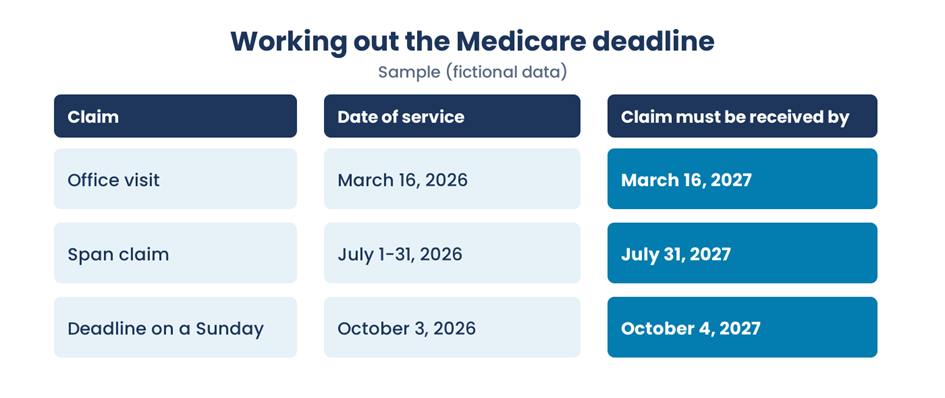
In short, a visit on March 16, 2026 must be received by March 16, 2027. A span from July 1 to July 31, 2026 runs from July 31, so it’s due July 31, 2027, which matches how Medicare contractor CGS explains the through-date rule on its timely filing page. When the deadline falls on a weekend or federal holiday, it moves to the next workday, so a deadline of Sunday, October 3, 2027 becomes Monday, October 4, 2027.
The Exceptions Medicare Allows
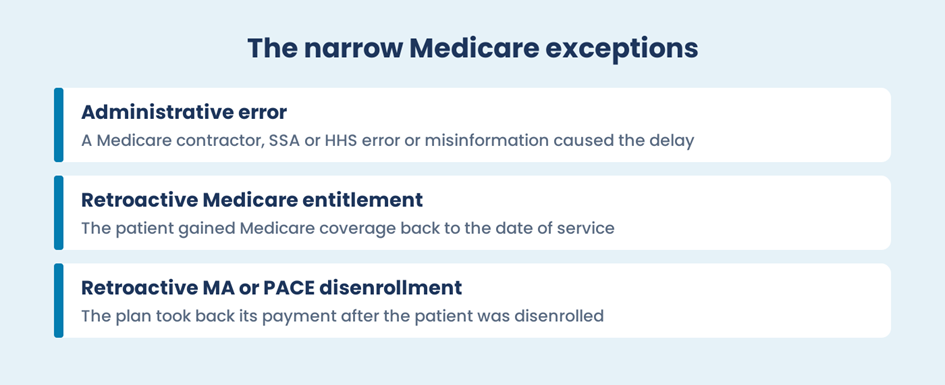
Medicare extends the deadline only in three situations: an error or misinformation by a Medicare contractor, the Social Security Administration or HHS caused the delay; the patient received Medicare entitlement retroactive to the date of service; or a Medicare Advantage or PACE plan recouped its payment after a retroactive disenrollment. Each needs proof, such as a letter from the agency or the plan’s recoupment notice.
A late filing caused by your own system or staff problems doesn’t qualify. Billing another insurer first doesn’t stop Medicare’s clock either, so send primary claims quickly; our guide to third-party liability claims covers accident cases where this often comes up.
What Happens When a Claim Is Late
Medicare denies late claims with CARC (claim adjustment reason code) 29, meaning the filing limit has expired, usually with RARC (remittance advice remark code) N211, which says the decision can’t be appealed. Medicare contractor Noridian confirms on its timely filing denial guidance page that these denials have no appeal rights. If the date of service on the claim was simply wrong, send a new claim with the correct date; if an exception applies, follow your Medicare contractor’s reopening process with the supporting proof. Otherwise, the balance usually becomes a write-off.
Medicare Advantage, Medicaid and Commercial Payers
Medicare Advantage plans, state Medicaid programs and commercial insurers set their own filing limits in the provider contract and manual, and many are much shorter than Medicare’s year. Keep a payer-by-payer table of limits in your billing system, and check your payer’s manual whenever a contract renews. For denials that arrive long after payment, see our guide to handling retroactive claim denials.
How to Prevent Timely Filing Denials
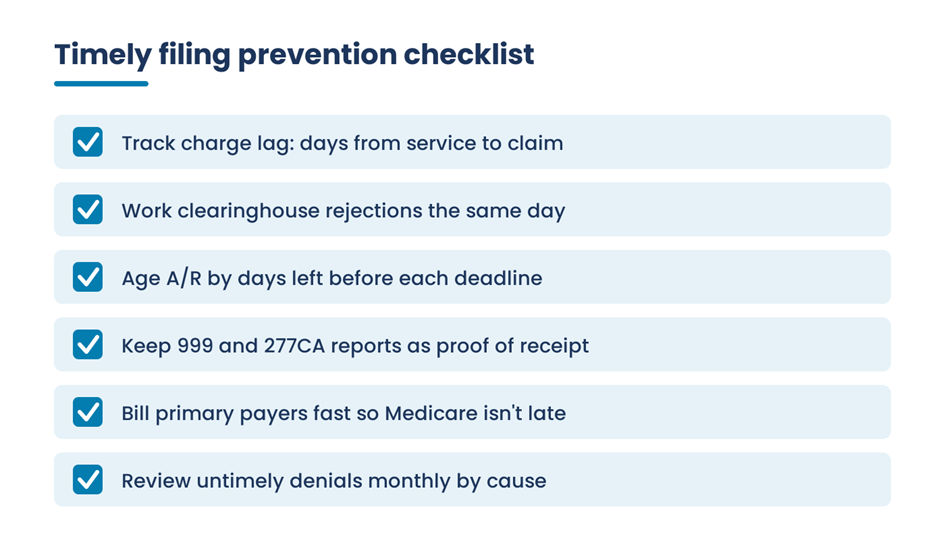
- Track charge lag. Measure the days between service and claim submission by provider and location, and fix the slowest point first.
- Work rejections the same day. A claim rejected by the clearinghouse was never received, so the clock keeps running.
- Age A/R by deadline. Sort open claims by days left before each payer’s limit, not only by days since service.
- Keep proof of receipt. Save 999 and 277CA acknowledgment reports, which show the payer accepted the claim.
- Bill primary payers quickly. Delays with another insurer won’t extend Medicare’s deadline.
- Review late denials monthly. Group CARC 29 denials by cause and fix the pattern; a strong clean claim rate keeps resubmissions rare.
Our step-by-step claim submission guide covers the full process from charge entry to payment, and our guide to common claim denial codes explains other codes you’ll see.
Frequently Asked Questions
What is the Medicare timely filing limit?
The Medicare timely filing limit is one calendar year after the date of service. Medicare must receive the claim within that window, and for span claims the deadline counts from the through date. If the last day falls on a weekend or federal holiday, the deadline moves to the next workday.
Can I appeal a Medicare timely filing denial?
No. A claim denied because it was filed late isn’t treated as an initial determination, so it has no appeal rights. The remittance usually shows CARC 29 with RARC N211. If one of the narrow exceptions applies, ask your Medicare contractor to reopen the claim and include the proof it requires.
What are the exceptions to Medicare timely filing?
Medicare allows extensions only when a Medicare contractor, SSA or HHS error caused the delay, when the patient received retroactive Medicare entitlement, or when a Medicare Advantage or PACE plan recouped payment after a retroactive disenrollment. Each exception needs documentation, and problems inside your own practice don’t qualify.
Do corrected claims have to meet the timely filing limit?
Yes. Corrected and adjusted claims must still reach Medicare within one calendar year of the date of service. That’s why it pays to fix rejections and errors quickly; a claim corrected in month eleven leaves very little time if it needs another fix.
Get Help Meeting Filing Deadlines
Medicare timely filing denials are almost always preventable with steady charge entry, same-day rejection work and an aging report built around deadlines. If late claims keep turning into write-offs, contact the EzMedPro team to talk through your claim workflow.
Sources: 42 CFR 424.44; CGS Medicare timely filing guidance; Noridian Medicare timely filing denial guidance; X12 claim adjustment and remark codes. Sample dates are fictional. Billing information only, not legal advice.

