
Medicare Provider Enrollment Guide for New Providers and Groups
Medicare provider enrollment is the process of registering a physician, nonphysician practitioner or group with Medicare so it can bill and be paid for Part B services. Most practices enroll online in PECOS (the Provider Enrollment, Chain, and Ownership System) using the CMS-855 forms. This guide covers who needs which form, the steps in order, how the effective date limits billing, reassignment for new hires, keeping enrollment current and the mistakes that delay payment.
| Key takeaways Individual providers use CMS-855I, groups use CMS-855B, and ordering-only providers use CMS-855O.Reassignment of benefits to a group is now reported on the CMS-855I.Medicare can be billed for services up to 30 days before the effective date, but not earlier.Location, ownership and adverse legal action changes must be reported within 30 days; most other changes within 90. |
What Medicare Provider Enrollment Covers
Enrollment is separate from commercial credentialing. Credentialing verifies a provider’s education, license and history for a health plan’s network. Medicare enrollment gives the provider billing privileges with a Medicare Administrative Contractor (MAC). Most practices handle both at the same time, as our step-by-step guide to the medical credentialing process explains.
Medicare enrollment usually comes first because many other payers ask for the provider’s Medicare status. Medicare Advantage plans, Medicaid programs and commercial insurers each run their own credentialing after that.
Which CMS-855 Form Do You Need?
The CMS Medicare Learning Network guide to Medicare provider enrollment lists the forms by provider type. For physician practices, three matter most.
| Form | Who uses it | Notes |
| CMS-855I | Individual physicians and nonphysician practitioners | Also used to reassign benefits to a group; the former CMS-855R reassignment form was merged into it. |
| CMS-855B | Group practices, clinics and other Part B organizations | Enrolls the group itself, with its own tax ID and practice locations. |
| CMS-855O | Providers who only order, refer or certify | Allows orders and referrals to be accepted; cannot be used to bill Medicare. |
Physicians, nonphysician practitioners and physician groups are exempt from the Medicare enrollment application fee. The fee applies mainly to institutional providers and certain suppliers.
Medicare Provider Enrollment Step by Step
Here is the usual sequence for a physician joining a group that is not yet enrolled. If the group is already enrolled, skip the group step.
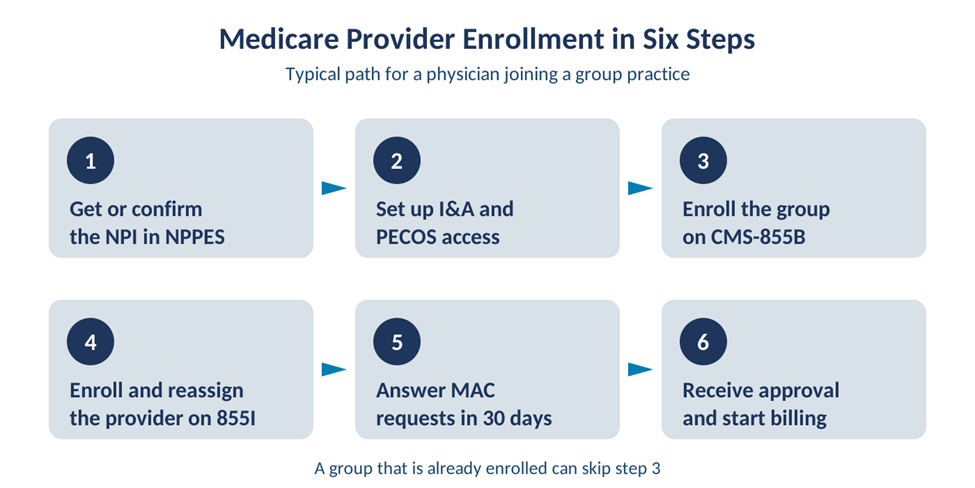
- Confirm the provider has an NPI (National Provider Identifier) from NPPES, and that the name, taxonomy and address are correct.
- Set up access in the CMS Identity and Access (I&A) system so the right people can sign in to PECOS for the group and the provider.
- Enroll the group on the CMS-855B with its tax ID, legal business name, practice locations and authorized official.
- Enroll the provider on the CMS-855I and reassign benefits to the group so payments go to the group.
- Set up electronic funds transfer with the CMS-588 form if the group is new, and respond to any MAC development request within 30 days.
- Once approved, record the PTAN (Provider Transaction Access Number) and effective date in your billing system before submitting claims.
Effective Dates and the 30-Day Retro Billing Rule
The effective date controls which services Medicare will pay. Under 42 CFR 424.520, it is generally the later of the date the MAC receives a processable application or the date the provider first began furnishing services at the location.
Under 42 CFR 424.521, a provider may bill Medicare for services up to 30 days before the effective date when circumstances prevented earlier enrollment, or up to 90 days after a Presidentially declared disaster. Services before that window cannot be billed to Medicare.
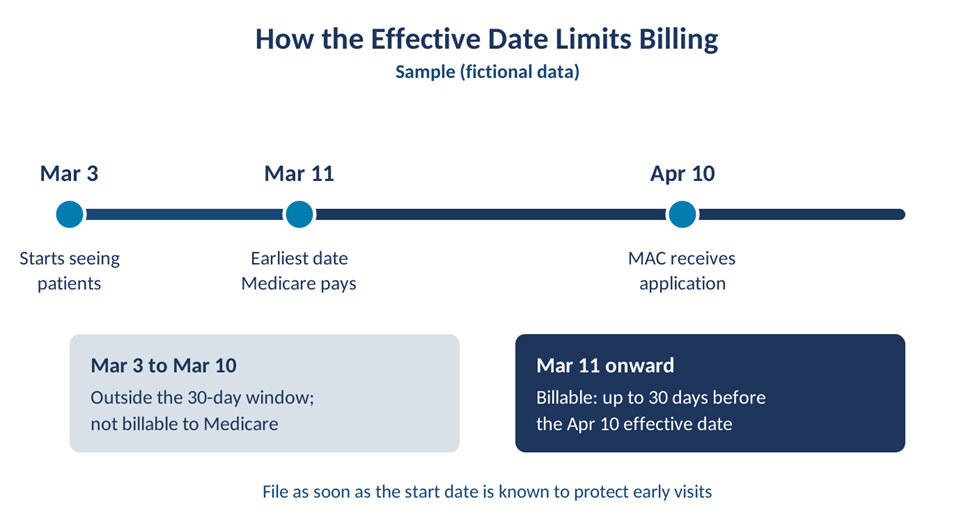
Sample (fictional data). A physician starts seeing patients on March 3, but the application reaches the MAC on April 10. The effective date is April 10, and retro billing reaches back to March 11. Medicare visits from March 3 to March 10 cannot be billed. To apply this to your own hire, count 30 days back from the date your application is received.
The lesson for practice owners: submit enrollment as soon as a start date is set, not after the provider begins seeing patients. If you need to speed up multiple payers at once, our quick payer guide to fast provider credentialing covers ways to shorten the wait.
Reassignment When a Provider Joins or Leaves a Group
Reassignment lets a group bill and collect Medicare payments for a provider’s services. It is now reported on the CMS-855I rather than a separate form. A provider who works for more than one group needs a reassignment to each one.
Nurse practitioners and physician assistants follow the same reassignment steps when they bill under their own NPI. Our guide to billing for nurse practitioners and physician assistants explains how their claims and payment rates differ.
When a provider leaves, end the reassignment promptly. A leftover reassignment can send payments to the wrong group and create overpayment problems for both.
Keeping Your Medicare Enrollment Current
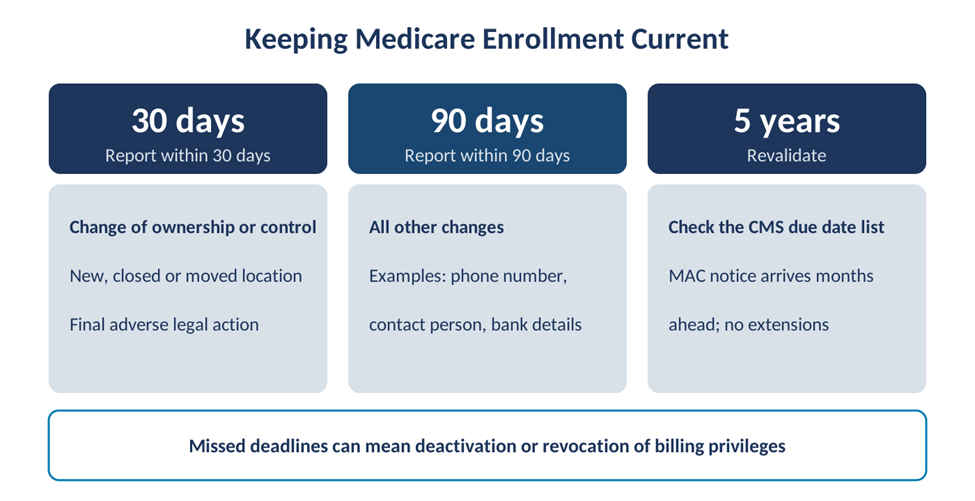
Physicians, nonphysician practitioners and groups must report a change of ownership or control, a change in practice location or a final adverse legal action within 30 days, and all other changes within 90 days. Noridian’s page on making changes to Medicare provider information notes that missing the 30-day deadline can lead to revocation of billing privileges.
Providers and groups generally revalidate every five years. The CMS revalidation page for renewing Medicare enrollment explains that due dates are posted in advance, extensions are not granted, and Medicare does not pay for services furnished while billing privileges are deactivated.
Common Medicare Enrollment Mistakes
| Mistake | What happens | How to prevent it |
| Applying after the provider starts | Early visits fall outside the 30-day retro window | Submit as soon as the start date is confirmed. |
| Name or address mismatch with NPPES or IRS | Application is returned or delayed | Match the legal name and addresses across all records. |
| Missing reassignment | Claims deny or pay the wrong entity | Reassign benefits on the CMS-855I for each group. |
| Ignoring MAC development letters | Application is rejected | Answer within 30 days and track every request. |
| Unreported location change | Billing privileges can be revoked | Report within 30 days and update all payers. |
| Missed revalidation | Payment hold or deactivation | Check the CMS due date list and calendar each provider. |
Claims sent before enrollment is approved will deny, so hold them and file once approved. Medicare generally allows 12 months from the date of service to file, as our Medicare timely filing rules guide explains, so a long enrollment wait can still put older claims at risk.
Frequently Asked Questions
How long does Medicare provider enrollment take?
Processing time varies by MAC, application type and how complete the application is. Online PECOS applications are usually faster than paper, and quick responses to MAC requests prevent delays. Because only 30 days of retro billing are allowed, practices should submit applications as soon as a start date is set rather than waiting for approval timelines.
Can a new provider bill Medicare before enrollment is approved?
Claims cannot be paid until enrollment is approved, but services can be covered back to 30 days before the effective date. Hold claims for those visits and submit them once the PTAN is issued. Services more than 30 days before the effective date cannot be billed to Medicare.
Is there a fee for Medicare provider enrollment?
Physicians, nonphysician practitioners and physician groups do not pay the Medicare application fee. The fee applies mainly to institutional providers and certain suppliers, and CMS updates the amount each year. If your organization type does require the fee, the MAC expects payment before it will fully process the application.
How often do providers revalidate Medicare enrollment?
Most providers and groups revalidate every five years, and CMS can request an off-cycle revalidation at any time. Due dates are posted on the CMS revalidation list in advance, and the MAC sends a notice beforehand. Missing the deadline can lead to a payment hold or deactivation of billing privileges.
Getting Help With Medicare Provider Enrollment
Medicare provider enrollment rewards early filing, matching records and steady upkeep. Most delays come from late submissions, mismatched details and missed MAC requests, all of which a clear checklist can prevent. EZMedPro offers credentialing and contracting services for medical practices handled by a US-based team. If you are adding providers or opening a location, contact the EZMedPro team to talk through your enrollment plan. Timelines and results vary by practice and payer.
Sources: CMS Medicare Learning Network, Medicare Provider Enrollment (MLN9658742); CMS consolidated CMS-855I bulletin; CMS Revalidations page; Noridian Medicare provider changes guidance; 42 CFR 424.516, 424.520 and 424.521. This article is general information, not legal advice; enrollment rules change, so confirm current requirements with your MAC.

