
Family Practice Billing: Codes, Workflow and Denial Fixes
Family practice billing is the process of coding, submitting and collecting payment for the mix of preventive, chronic and acute care a family medicine office delivers every day. Most lost revenue in this specialty comes from same-day preventive and problem visits, missed add-on codes and eligibility gaps, not from rare procedures. This guide walks through the daily workflow, the core code sets, modifier 25, G2211, vaccines, care management, a sample claim, common denials and how to decide between in-house and outsourced billing.
| Key takeaways Treat a same-day preventive exam and problem visit as two services, each documented and coded on its own.Medicare does not pay for a routine physical; it pays for the Welcome to Medicare visit and the annual wellness visit instead.Since January 2025, Medicare pays G2211 with a modifier 25 visit only when an AWV, vaccine administration or Part B preventive service is billed the same day.Check eligibility at every visit, because coverage and plan changes drive many primary care denials. |
What Makes Family Practice Billing Different
A family medicine office sees newborns, teenagers, working adults and Medicare patients in the same afternoon. That variety means one front desk and one billing team must handle pediatric preventive schedules, adult chronic care, Medicare wellness rules and dozens of commercial plans at once.
Volume adds pressure. Family practices bill many low-dollar office visits, so a small error repeated across hundreds of claims adds up fast. If you are comparing how this specialty differs from cardiology, behavioral health or surgery, our specialty medical billing guide for every practice type covers each one side by side.
Three traits set family practice apart:
- Preventive and sick care often happen in one visit, which creates most of the specialty’s coding questions.
- Payer mix is wide, from Medicaid and Medicare Advantage to employer plans with very different preventive benefits.
- Revenue depends on longitudinal care: chronic disease follow-ups, care management and the relationship-based G2211 add-on.
The Family Practice Billing Workflow, Step by Step
Every clean claim starts before the patient arrives. The workflow below is the order most small and mid-size family practices follow.
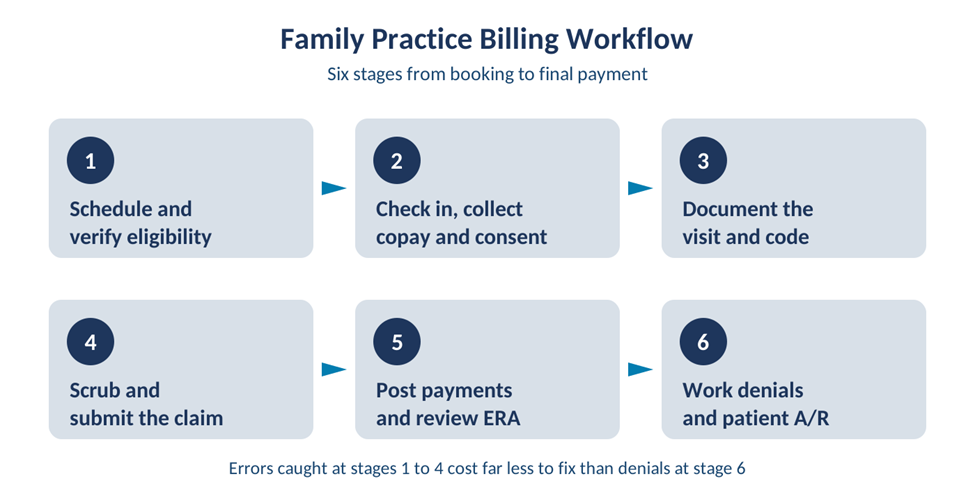
In short, the six stages are eligibility, check-in, documentation and coding, claim submission, payment posting and follow-up.
- Check eligibility and benefits when the visit is booked and again at check-in. Confirm the plan, the primary care provider assignment for HMO plans and the patient’s preventive benefit. A repeatable patient eligibility verification process catches most coverage problems before they become denials.
- Collect the copay, update demographics and insurance cards, and get any consent forms the visit needs, such as consent for chronic care management.
- Document the visit so the record supports every code. Separate the preventive portion from any problem-oriented work in the note.
- Code and scrub the claim. Check modifiers, diagnosis pointers, frequency limits and payer-specific edits before submission.
- Post payments from the ERA (electronic remittance advice) and EOB (explanation of benefits), and compare each payment to the contracted rate.
- Work denials using the CARC (claim adjustment reason code) and RARC (remittance advice remark code) on the remittance, then follow up on open patient balances.
Medicare generally allows 12 months from the date of service to file a claim, while commercial payers set their own filing limits in the contract and provider manual. Check each payer’s manual and build those limits into your follow-up queue.
Core Code Sets a Family Practice Bills Every Day
Family medicine uses a fairly stable set of CPT (Current Procedural Terminology) and HCPCS (Healthcare Common Procedure Coding System) codes. Knowing which family each service belongs to prevents most code-selection errors.
| Service family | Common codes | Billing notes |
| Office visits, new patient | 99202 to 99205 | New means no professional service from the same specialty in the same group in the past three years. |
| Office visits, established patient | 99211 to 99215 | Level chosen by medical decision making or total practitioner time on the date of the visit. |
| Preventive medicine, commercial and Medicaid | 99381 to 99387 (new), 99391 to 99397 (established) | Codes are selected by the patient’s age band. |
| Medicare preventive visits | G0402 (Welcome to Medicare), G0438 (initial AWV), G0439 (subsequent AWV) | Medicare does not cover routine physicals under 99381 to 99397. |
| Vaccine administration | 90460 to 90474; Medicare G0008 (flu) and G0009 (pneumococcal) | Bill the vaccine product code on a separate line. |
| Care management | 99490 (CCM), 99495 and 99496 (TCM) | Time, consent and timing rules apply. |
| Visit complexity add-on | G2211 | Medicare add-on to office visit codes for ongoing care relationships. |
Since 2021, office visit levels are chosen by medical decision making or by total time spent by the practitioner on the date of the encounter, not by counting history and exam elements. The CMS Medicare Learning Network booklet on Evaluation and Management Services explains how Medicare applies these rules.
Higher levels draw more payer scrutiny, so the note has to show the problems addressed, the data reviewed and the risk of management. Our guide to audit-proof documentation for higher-level office visits shows what auditors look for in 99214 and 99215 notes.
Billing Preventive and Problem Visits on the Same Day
A same-day preventive and problem visit can be billed as two services when the practitioner performs significant, separately identifiable work for a problem beyond the preventive exam. You report the preventive code, then the office visit code with modifier 25 on the E/M (evaluation and management) line.
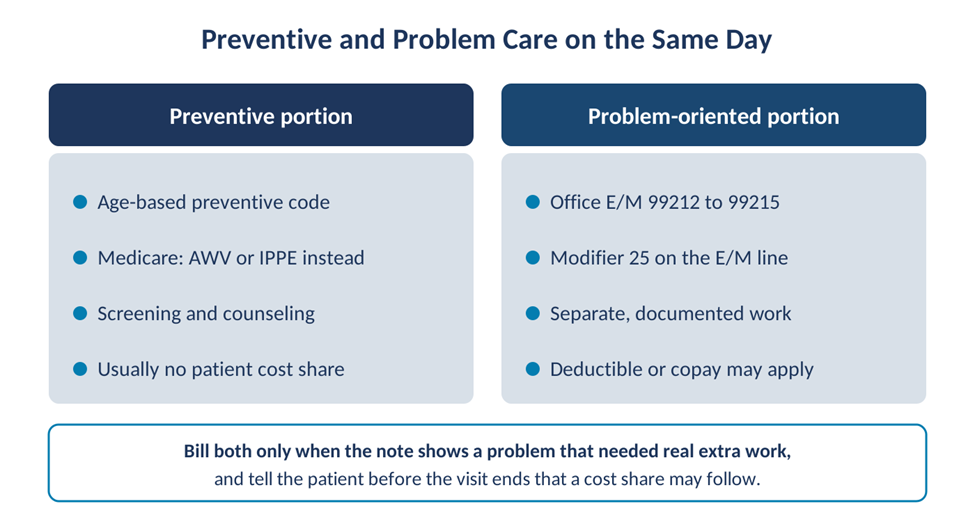
The test is the work, not the complaint. Refilling a stable medication or noting a minor issue that the preventive exam already covers does not support a separate visit. Managing a worsening chronic condition, working up a new symptom or changing a treatment plan usually does. The difference between the two benefit types is covered in more depth in billing for preventive vs diagnostic services.
Modifier 25 is one of the most audited modifiers in primary care, and some commercial payers apply extra review or payment reductions to it. For when the modifier is and is not appropriate across other services, see our guide to CPT modifiers and when to use them.
Medicare: Welcome to Medicare visit and annual wellness visit
Medicare does not pay for a routine physical exam. Instead, it covers the Welcome to Medicare preventive visit (G0402) during the first 12 months of Part B coverage, an initial annual wellness visit (AWV, G0438) once per lifetime and a subsequent AWV (G0439) each year after that.
The AWV focuses on a health risk assessment and a personalized prevention plan rather than a hands-on exam. Under the Noridian annual wellness visit coverage rules for Part B, the patient pays no deductible or coinsurance for the AWV, and it cannot be paid within 12 months of a prior AWV or Welcome to Medicare visit.
When a problem-oriented visit is added the same day, the Part B deductible and coinsurance apply to that E/M line. Tell the patient before checkout so the bill does not come as a surprise.
Commercial plans and Medicaid: age-based preventive codes
Commercial plans and Medicaid usually pay preventive medicine codes 99381 to 99397, chosen by age band and by whether the patient is new or established. Many plans cover one preventive exam per plan year or per rolling 12 months, so a visit booked a few days early can deny. Check the frequency rule in each payer’s manual and confirm the last preventive date during scheduling.
G2211: Billing the Visit Complexity Add-On
G2211 is a Medicare add-on code reported with office and outpatient visit codes 99202 to 99205 and 99211 to 99215. It recognizes the work of being the patient’s continuing focal point for care, or of managing a single serious or complex condition over time. That makes it a natural fit for family medicine.
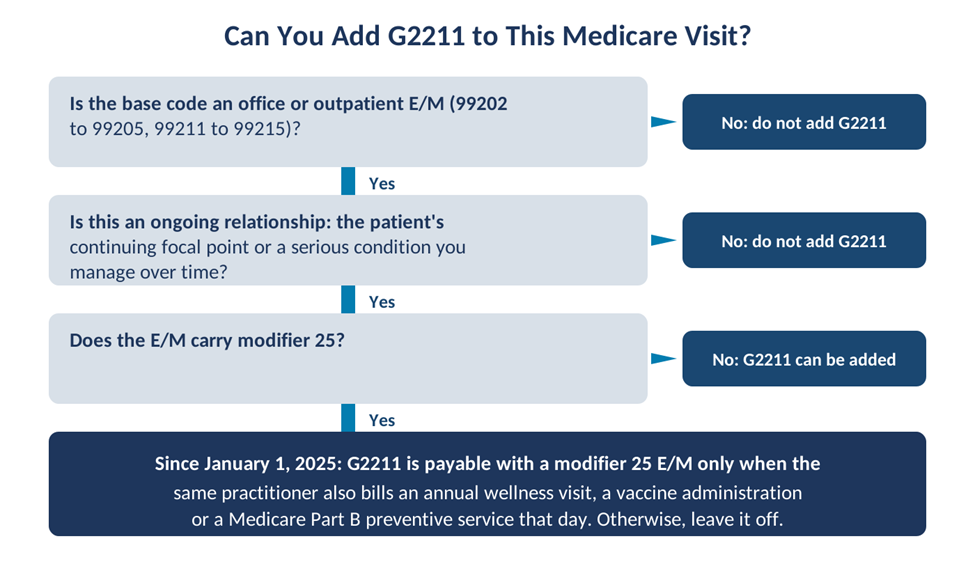
The three checks are the base code, the ongoing relationship and whether modifier 25 is on the visit.
The main restriction is modifier 25. Under the CMS change request allowing payment for HCPCS code G2211, for services on or after January 1, 2025, Medicare pays G2211 with a modifier 25 visit only when the same practitioner also bills an annual wellness visit, a vaccine administration or a Medicare Part B preventive service that day. With a modifier 25 visit tied to a minor procedure, G2211 stays off the claim.
Commercial and Medicare Advantage plans decide for themselves whether to recognize G2211. Check each plan’s coding policy before adding it to non-Medicare claims.
Vaccines, In-Office Tests and Other Ancillary Services
Vaccines and point-of-care testing add steady revenue but carry their own rules. Each vaccine needs two lines: the product code and the administration code. Medicare Part B covers a short list of vaccines, such as flu, pneumococcal and COVID-19, and uses its own administration codes for flu and pneumococcal shots. Vaccines covered under Part D, such as shingles, are not billed to the Part B contractor.
In-office lab tests require a CLIA (Clinical Laboratory Improvement Amendments) certificate that matches the tests you run. Many waived tests need the QW modifier on Medicare claims. Our guide to billing for ancillary services in primary care covers labs, EKGs and other add-on services in detail.
Chronic Care and Transitional Care Management
Care management codes pay for work family practices often already do between visits. Chronic care management (CCM, 99490) covers non-face-to-face care coordination for patients with two or more chronic conditions expected to last at least 12 months. The patient must give consent, and clinical staff must spend at least 20 minutes in the calendar month.
Transitional care management (TCM, 99495 and 99496) covers the 30 days after a hospital or facility discharge. It requires interactive contact with the patient within two business days of discharge and a face-to-face visit within 14 days for moderate complexity or 7 days for high complexity. The CGS reminder on CCM and TCM billing requirements notes that only one practitioner can report TCM for the period, and the note should record the discharge date, contact date, visit date and decision-making level.
For time thresholds, add-on codes and documentation, see our chronic care management billing guidelines.
Sample: Coding a Same-Day Medicare Visit
Sample (fictional data). A 72-year-old established Medicare patient comes in for her yearly annual wellness visit. During the visit, she reports rising home blood sugar readings. The physician reviews her logs, orders labs, adjusts her diabetes medication and schedules a follow-up. She also receives a flu shot.
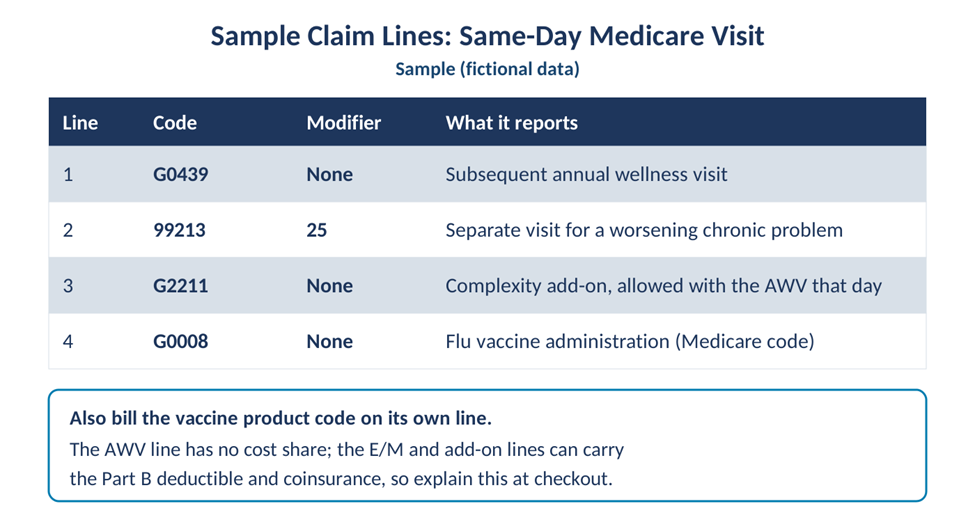
The claim carries four service lines: G0439 for the subsequent AWV, 99213 with modifier 25 for the separate diabetes visit, G2211 because an AWV is billed the same day, and G0008 for the flu vaccine administration, plus the flu vaccine product code on its own line. To adapt this example, change the visit level to match your own note and use the product code for the vaccine you actually gave.
Before submission, confirm her last AWV was more than 12 months ago and that the note clearly separates the wellness portion from the diabetes work.
Common Family Practice Billing Denials and How to Fix Them
Most denials in this specialty repeat the same few patterns. Track them by reason code each month and fix the upstream step, not just the claim.
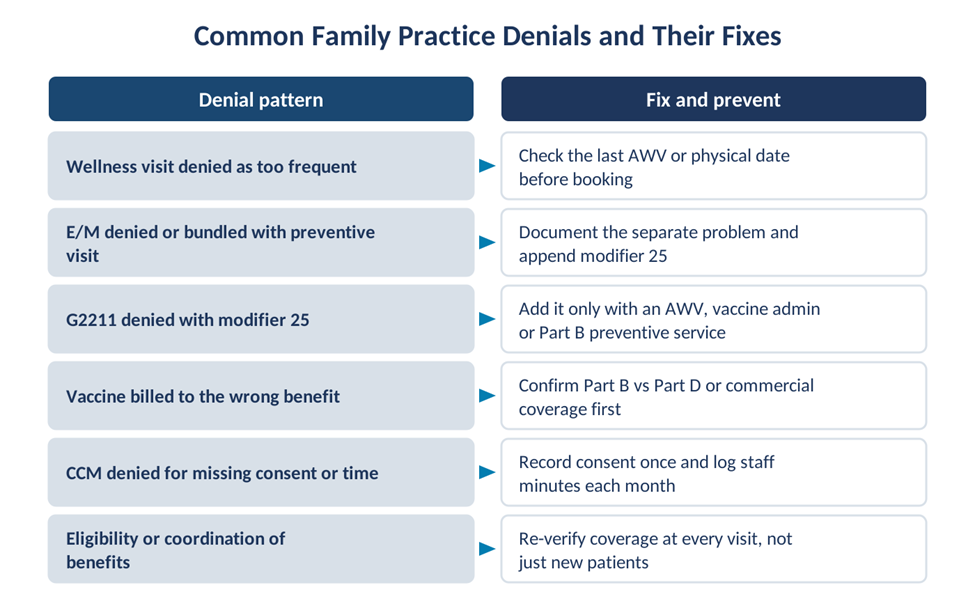
| Denial pattern | Likely cause | Fix and prevention |
| Preventive visit denied for frequency | Exam booked before the plan’s waiting period ended | Check the last preventive date at scheduling and rebook if needed. |
| E/M denied as included in preventive visit | Note does not show separate problem work | Document the problem separately and append modifier 25 only when supported. |
| G2211 denied | Billed with a modifier 25 visit and no qualifying service, or billed to a plan that does not recognize it | Follow the Medicare rule and check commercial plan policies. |
| Vaccine denied | Wrong benefit, missing product line or wrong administration code | Confirm coverage and bill product and administration together. |
| CCM denied | Missing consent, time below threshold or overlapping service | Record consent once and log staff minutes monthly. |
| Eligibility or coordination of benefits denial | Coverage changed or wrong primary payer | Recheck coverage at every visit and update the coordination of benefits. |
Common mistakes to avoid: billing every preventive visit with an extra E/M, adding G2211 to every Medicare claim, and resubmitting denied claims without changing anything. Each one invites repeat denials and, over time, payer audits.
In-House or Outsourced Family Practice Billing?
Small family practices often start with a single in-house biller. That works until volume, staff turnover or payer changes outpace one person. The trade-offs include cost, control, coverage during absences and access to coding expertise. Our comparison of outsourced and in-house medical billing lays out the pros and cons in detail.
If you are weighing outside help, look for clear reporting, a defined denial follow-up process and pricing without hidden fees. EZMedPro provides revenue cycle management services for medical practices with a US-based team and transparent reporting. Results vary by practice, payer mix and starting point.
Frequently Asked Questions
What is family practice billing?
Family practice billing is the coding, claim submission and payment collection for the preventive, chronic and acute care a family medicine office provides. It covers office visits, preventive exams, Medicare wellness visits, vaccines, in-office tests and care management. Because one office serves every age group and many payers, the billing team must track a wide range of coverage and frequency rules.
Can a family practice bill a physical and a sick visit on the same day?
Yes, when the practitioner performs significant, separately identifiable work for a problem beyond the preventive exam. Bill the preventive code and the office visit code with modifier 25, and document each part separately. Minor issues handled within the preventive exam do not support a second code. The patient may owe a copay or deductible for the problem portion.
Does Medicare pay for an annual physical?
No. Medicare does not cover routine physical exams. It covers the Welcome to Medicare visit during the first 12 months of Part B and the annual wellness visit after that. The AWV focuses on a health risk assessment and prevention plan. Problem-oriented care during the same visit is billed separately and carries normal Part B cost sharing.
When can G2211 be billed with modifier 25?
For Medicare services on or after January 1, 2025, G2211 is payable with a modifier 25 office visit only when the same practitioner also bills an annual wellness visit, a vaccine administration or a Medicare Part B preventive service that day. If the modifier 25 visit is tied to a minor procedure instead, G2211 should not be billed.
How often should a family practice check insurance eligibility?
Check eligibility when the visit is scheduled and again at check-in for every patient, not only new ones. Plans, primary care assignments and coordination of benefits change often, especially at the start of a plan year. Checking the preventive benefit and last preventive date at the same time prevents frequency denials.
Getting Help With Family Practice Billing
Strong family practice billing comes down to a steady workflow, accurate same-day coding, careful use of modifier 25 and G2211, and fast follow-up on the denials that slip through. Small fixes at the front desk and in documentation often matter more than any single code. If you would like a second set of eyes on your claims or workflow, talk with the EZMedPro team about where your process stands. Results vary by practice.
Sources: CMS Change Request 13705 on HCPCS code G2211, CMS Medicare Learning Network Evaluation and Management Services booklet, Noridian Medicare annual wellness visit guidance, CGS Medicare CCM and TCM reminder, AMA CPT code set. This article is general billing information, not legal or medical advice; payer rules change, so confirm current policies in each payer’s manual.

