
Emergency Medicine Billing: ED Codes, Rules and Denial Fixes
Emergency medicine billing is the coding and collection of payment for the professional services emergency physicians and advanced practice providers deliver in a hospital emergency department (ED). It runs on its own rules: ED visit levels set by medical decision making alone, time-based critical care, split/shared visits and federal surprise billing protections. This guide covers professional versus facility claims, ED E/M levels, critical care, procedures and modifiers, out-of-network claims, a coding scenario, common denials and how ED groups manage the work.
| Key takeaways ED visit codes 99281 to 99285 are chosen by medical decision making only; time does not set the level.Medicare reports 99291 for 30 to 74 minutes of critical care and adds 99292 only from 104 minutes.Split/shared ED visits go under the clinician who did the substantive portion, with modifier FS.Out-of-network emergency claims with most commercial plans follow No Surprises Act rules, not balance billing. |
Why Emergency Medicine Billing Is Different
An ED group cannot choose its patients, schedule visits or collect payment before care. Federal EMTALA rules (the Emergency Medical Treatment and Labor Act) require hospitals to screen and stabilize anyone with a possible emergency, regardless of ability to pay. Billing teams work with whatever insurance details registration captured, often after the patient has left.
That creates a payer mix and workflow unlike office-based specialties. Our specialty medical billing guide for every practice type compares emergency medicine with other specialties side by side. Four traits stand out for ED groups:
- High volume of uninsured, self-pay and out-of-network patients.
- Many accident and injury visits that involve auto, workers’ compensation or liability coverage.
- Physicians and advanced practice providers often share the same patient.
- Payers review high ED levels and apply downcoding policies more often than in most specialties.
It also differs from walk-in clinics. Urgent care centers bill office or urgent care codes from their own location, while ED groups bill hospital-based ED codes. Our guide to billing for urgent care centers covers that setting.
Professional vs Facility Billing in the ED
Each ED visit produces two separate claims. The physician group bills the professional claim for the clinician’s work. The hospital bills a facility claim for the room, nursing, supplies and equipment.
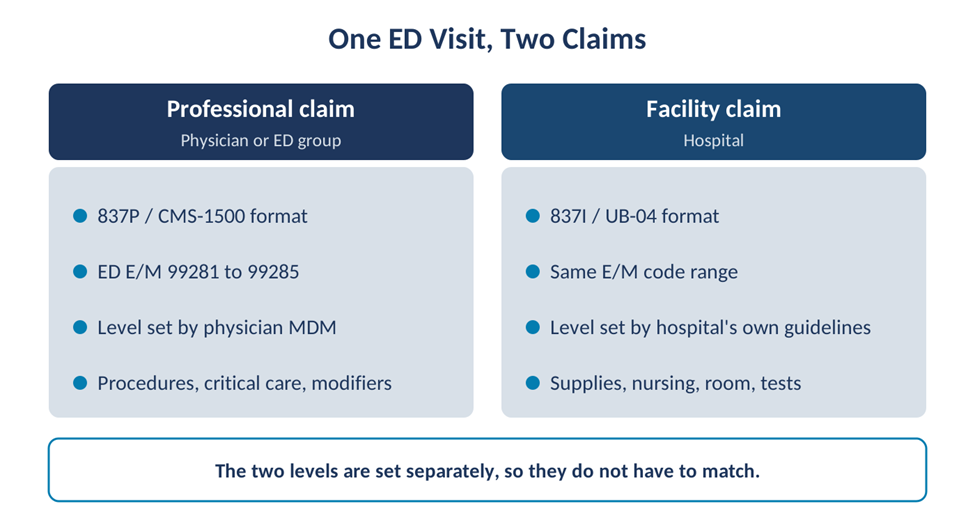
In short, the professional claim reflects the clinician’s decision making, while the facility claim reflects hospital resources.
Both claims use the same ED code range, 99281 to 99285, but the levels are set independently. The physician level comes from the clinician’s documented medical decision making. The hospital assigns its facility level using its own internal guidelines. A level 4 professional visit can sit beside a level 3 facility visit without any error on either claim.
Most ED physician groups never see the facility claim. Their billing depends on accurate demographics and insurance data from hospital registration, so a reliable data feed from the hospital matters as much as coding accuracy.
ED Evaluation and Management Codes, 99281 to 99285
Since January 1, 2023, ED visit levels are chosen based only on medical decision making (MDM). Time does not determine the level, and history and exam only need to be medically appropriate. The American College of Emergency Physicians explains these rules in its FAQ on the 2023 emergency department E/M guidelines.
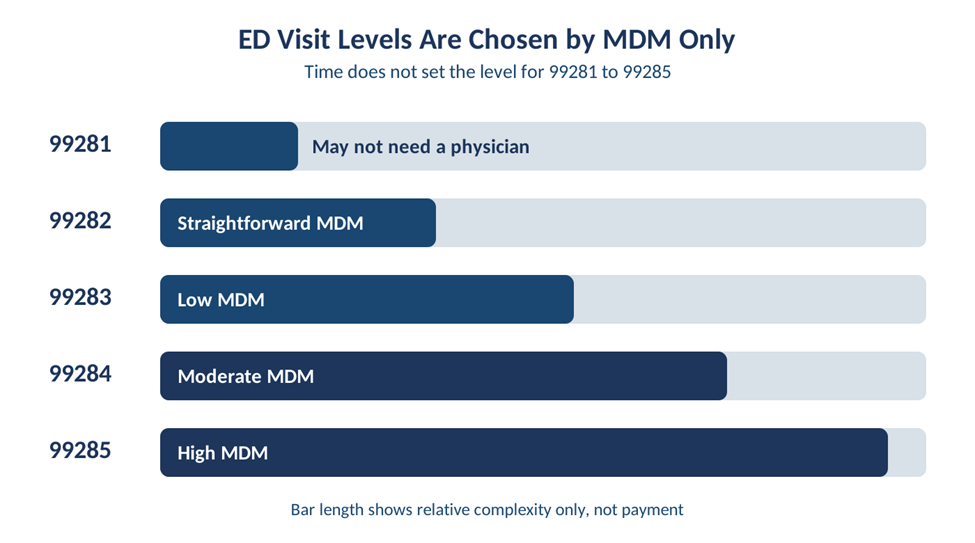
| Code | MDM level | What the note usually shows |
| 99281 | None required; may not need a physician | A very minor problem, often handled by clinical staff under supervision. |
| 99282 | Straightforward | One self-limited or minor problem with minimal data and risk. |
| 99283 | Low | An acute uncomplicated illness or injury, limited data, low risk. |
| 99284 | Moderate | An acute illness with systemic symptoms or a new problem with uncertain prognosis, moderate data or risk such as prescription drug management. |
| 99285 | High | A threat to life or bodily function, extensive data review or a decision about hospitalization. |
ED codes apply to both new and established patients, so there is no new-versus-established split. MDM is scored on three elements: the number and complexity of problems addressed, the amount and complexity of data reviewed, and the risk of patient management. Two of the three must meet or exceed the level billed.
Notes from outside sources, such as EMS run sheets or records from another facility, can count as data. An independent historian also counts when the patient cannot give a reliable history. Documenting these details is often what separates a 99284 from a 99285.
Critical Care Billing in the Emergency Department
Critical care codes pay for the direct care of a patient with an illness or injury that acutely impairs one or more vital organ systems, with a high probability of life-threatening deterioration. Unlike ED levels, critical care is based on time.
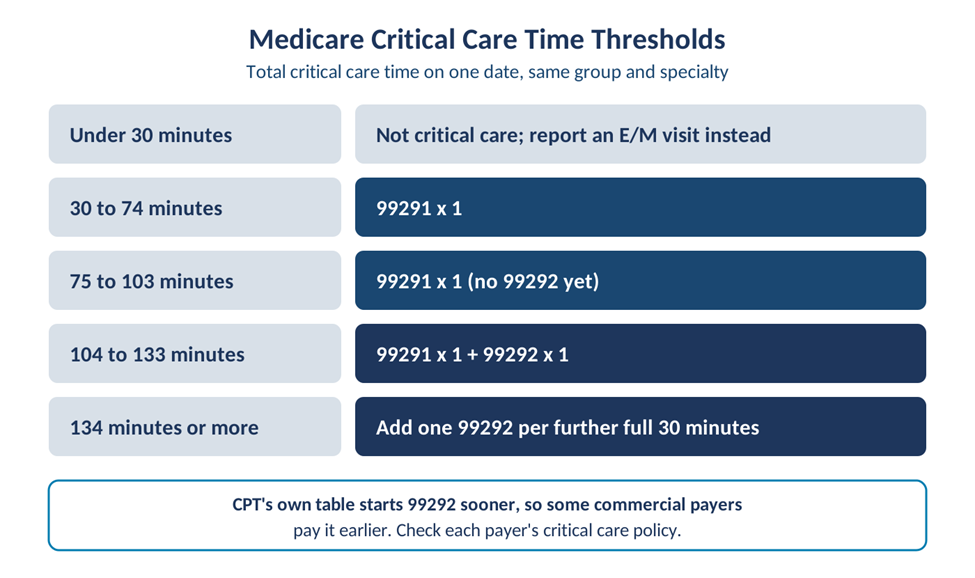
The CMS Medicare Learning Network booklet on Evaluation and Management Services sets the Medicare rules. Report 99291 once per date for the first 30 to 74 minutes, and add 99292 only when total time reaches 104 minutes, with one more 99292 for each further 30 minutes. Clinicians of the same specialty in the same group combine their time on one claim.
Several services are bundled into critical care and are not billed separately, including ECG and chest x-ray interpretation, blood gases, ventilator management and certain vascular access procedures. Time spent on separately billable procedures, such as intubation or central line placement, must be subtracted from critical care minutes.
If the patient received an ED visit before becoming critically ill, Medicare allows both the ED visit and critical care on the same date when the visit was separate and came first. Append modifier 25 to the ED visit code.
Procedures and Modifiers ED Groups Use Most
ED physicians often perform procedures during a visit: laceration repairs, splinting, fracture reductions, incision and drainage, intubation and point-of-care ultrasound. Each has its own CPT code and, for many procedures, a global period.
When the clinician also performs a significant, separately identifiable evaluation beyond the usual pre-procedure assessment, the ED visit is billed with modifier 25. A minor laceration repaired without any other workup usually supports the procedure code alone. For when to use 25, 59 and other modifiers, see our guide to CPT modifiers and when to use them.
Interpretations need care too. If a radiologist bills the official read of an x-ray, the ED physician generally should not bill a second interpretation of the same study. A separately documented ECG interpretation may be billable when the payer allows it outside critical care.
Split/Shared Visits With Physicians and APPs
Many EDs use nurse practitioners and physician assistants, together called advanced practice providers (APPs). When a physician and an APP from the same group both see an ED patient, the visit can be billed as split/shared under the clinician who performed the substantive portion.
For Medicare ED visits, the substantive portion means more than half of the total time or a substantive part of the MDM. Add modifier FS to show two clinicians performed the visit. As Noridian’s guidance on split or shared services notes, the record must identify both clinicians and be signed by the one who bills. For split/shared critical care, the substantive portion must be time: the clinician who spent more than half the combined time bills it.
If the APP bills under their own NPI (National Provider Identifier), Medicare pays a reduced percentage of the physician fee schedule. Our guide to billing for nurse practitioners and physician assistants explains credentialing and payment rules for APPs.
Out-of-Network Claims and the No Surprises Act
ED groups often treat patients whose plans they do not contract with. For most commercial health plans, the No Surprises Act changed how those claims work. The CMS No Surprises Act overview for assisters and advocates summarizes the main protections.
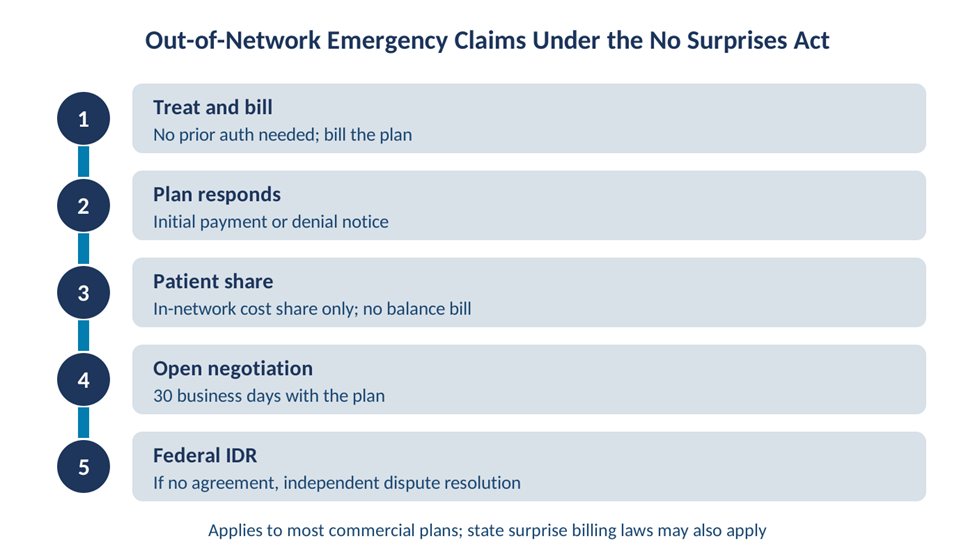
The five steps are billing, plan response, in-network patient cost share, open negotiation and federal dispute resolution.
- Emergency services must be covered without prior authorization, whether or not the ED group is in network.
- The patient owes only in-network cost sharing, and the group cannot balance bill for the rest.
- If the group disagrees with the plan’s payment, it has a 30-business-day open negotiation period, then may use the federal independent dispute resolution (IDR) process.
Federal rules also bar plans from deciding whether a visit was an emergency based only on the final diagnosis code. This builds on the prudent layperson standard: a visit qualifies when a person with average health knowledge would reasonably expect serious harm without immediate care. Many states have their own surprise billing laws, so check which rules apply to each plan type.
Sample: Coding an ED Visit That Turns Critical
Sample (fictional data). A 58-year-old commercially insured patient arrives with chest pain. The physician takes a history, orders labs and an ECG and reviews the EMS rhythm strip. About an hour later, the patient becomes hypotensive and develops respiratory failure. The physician provides 85 minutes of critical care, including 15 minutes for an intubation.
Coding steps for this scenario:
- Report the earlier ED visit, such as 99285, with modifier 25, because the evaluation happened before critical care and was separate.
- Subtract the 15 intubation minutes from 85 minutes, leaving 70 minutes of critical care, and report 99291 once.
- Report the intubation code separately.
- Do not bill the ECG interpretation done during critical care; bill it only if it was separate from critical care and the payer allows it.
To adapt this example, change the minutes and codes to match your note, and check the payer’s critical care policy, since commercial plans may count 99292 time differently from Medicare.
Common Emergency Medicine Billing Denials and Fixes
ED denials follow repeat patterns. Track them by CARC (claim adjustment reason code) each month and fix the cause upstream.
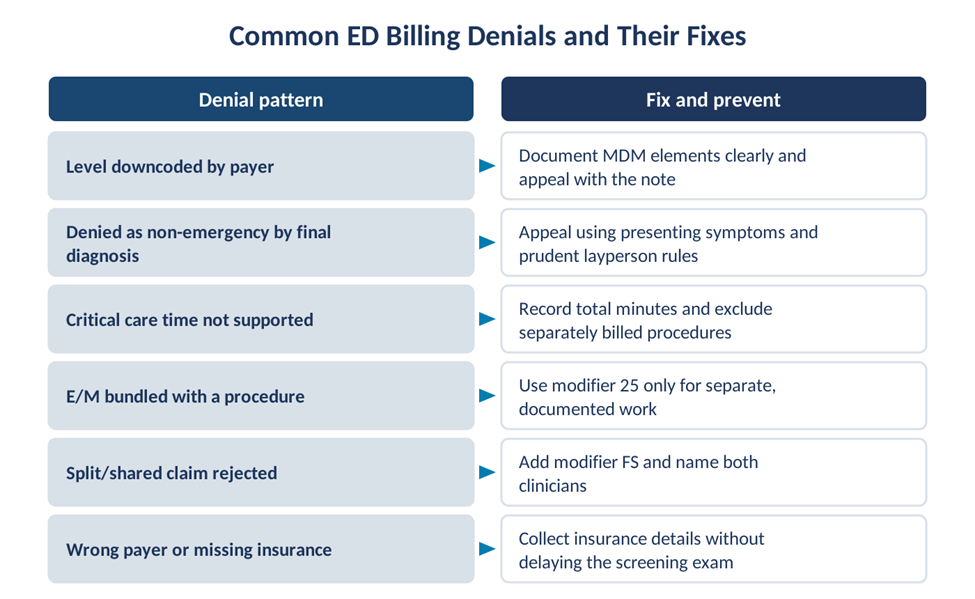
| Denial pattern | Likely cause | Fix and prevention |
| Level downcoded | Payer ED level policy or thin MDM documentation | Document all three MDM elements and appeal with the full note. |
| Denied as non-emergency | Plan used the final diagnosis code alone | Appeal with presenting symptoms and the prudent layperson standard. |
| Critical care denied or reduced | Minutes missing, or procedure time not subtracted | Record total minutes and the time excluded for procedures. |
| E/M bundled with procedure | Modifier 25 missing or not supported | Use modifier 25 only when a separate evaluation is documented. |
| Wrong payer or no coverage found | Incomplete registration data | Rework demographics with the hospital, and check for auto or liability coverage. |
| Timely filing denial | Late registration data or slow follow-up | Track each payer’s filing limit from the date of service. |
Accident visits are a frequent source of coverage confusion. Our guide to third party liability claims covers coordination with auto and liability carriers. Medicare generally allows 12 months from the date of service to file, and our Medicare timely filing rules guide covers exceptions. Commercial payers set their own filing limits in the contract and provider manual, so check each payer’s manual.
For a broader process, see our denial management best practices.
Managing ED Billing In-House or With a Partner
Hospital-based ED groups face high volume, many payers and thin margins on self-pay visits. Whether the work stays in-house or goes to a billing partner, look for certified coders who know ED MDM and critical care rules, a reliable data feed from hospital registration, IDR experience for out-of-network claims and clear monthly reporting.
EZMedPro offers revenue cycle management services for medical groups with a US-based team, transparent reporting and no hidden fees. Results vary by group, payer mix and starting point.
Frequently Asked Questions
What codes are used for emergency medicine billing?
ED groups bill visit codes 99281 to 99285, chosen by medical decision making. Critical care uses 99291 and 99292, based on time. Procedures such as laceration repair, splinting and intubation have their own CPT codes. Modifiers such as 25 and FS show separate evaluations and split/shared visits. The hospital bills a separate facility claim using its own guidelines.
Can time be used to choose an ED visit level?
No. Since January 1, 2023, levels for 99281 to 99285 are based only on medical decision making. Time spent with an ED patient does not change the visit level. Time matters for critical care codes 99291 and 99292, which are reported by total minutes of critical care on a date.
Can you bill an ED visit and critical care on the same day?
Yes, for Medicare, when the ED visit happened before the patient became critically ill and was separate from the critical care. Append modifier 25 to the ED visit code and document both services clearly. Commercial payers may apply their own rules, so check the payer’s critical care policy before billing both.
Can an ED group balance bill an out-of-network patient?
For most commercial health plans, no. Under the No Surprises Act, patients owe only in-network cost sharing for emergency services, and the group cannot bill them for the remaining balance. Payment disputes go through open negotiation with the plan and, if needed, the federal independent dispute resolution process. State laws may add further protections.
Why do payers downcode ED visits?
Some payers compare the billed level with the diagnosis and other claim data, then pay a lower level when the codes suggest a less complex visit. Clear MDM documentation, including data reviewed and risk of management, gives the best basis for appeal. Review downcoding trends by payer each month and check each payer’s published ED level policy.
Getting Help With Emergency Medicine Billing
Strong emergency medicine billing depends on clear MDM documentation, accurate critical care time, careful modifier use and steady follow-up on out-of-network and denied claims. Most revenue leaks come from a handful of repeat issues that a good process can catch early. If you would like to review how your ED group’s billing performs, reach out to the EZMedPro team to talk it through. Results vary by group.
Sources: CMS Medicare Learning Network Evaluation and Management Services booklet (MLN006764), CMS No Surprises Act overview, ACEP 2023 ED E/M guidelines FAQ, CMS EMTALA guidance, AMA CPT code set. This article is general billing information, not legal or medical advice; payer rules change, so confirm current policies in each payer’s manual.

