
Rejected vs Denied Claims: Tell Them Apart and Fix Each
A rejected claim never entered the payer’s adjudication system, while a denied claim was processed and refused payment. That one difference decides your next move: fix and resubmit a rejection, but correct or appeal a denial. Mix them up and you can lose weeks, trigger duplicate-claim denials or miss a filing deadline. This guide shows how to tell rejected vs denied claims apart in under a minute, what each fix looks like and how to keep both from piling up.
| Key takeaways A rejection stops before adjudication, the payer’s review and payment decision. A denial is the decision itself. A payer claim number means the claim got in. An ERA or EOB with adjustment codes means it was decided. Medicare gives no appeal rights for unprocessable claims, and commercial payers set their own rules. Work rejections the same day, because the filing clock keeps running. |
Rejected vs Denied Claims at a Glance
Early checkpoints check format and required data. The later review checks coverage, medical necessity and contract rules. Fail an early checkpoint and the claim is rejected. Fail the review and it is denied.
Denials get most of the attention, and our guide to how to reduce claim denials and speed up reimbursements covers prevention in depth. Rejections are easier to overlook, because they often produce no remittance at all.
| Rejected claim | Denied claim | |
| Where it stops | At the clearinghouse or the payer front end, before review | After adjudication, when the payer reviews the claim |
| Payer claim number | Usually none | Assigned |
| Where you see it | Clearinghouse report, 999 or 277CA acknowledgment | ERA (electronic remittance advice) and paper EOB (explanation of benefits) |
| Typical cause | Missing or invalid data, such as an ID or NPI | Coverage, authorization, necessity, coding or contract rules |
| Appeal rights | Generally none; Medicare treats them as non-appealable | Yes, within the deadline printed on the notice |
| Fix | Correct the data and resubmit | Corrected claim, appeal or both, depending on the cause |
How a Claim Moves and Where It Gets Stopped
A claim passes a scrubber, a clearinghouse and the payer’s front end before adjudication, and each step can stop it. Our overview of the claim submission process walks through those steps in detail.
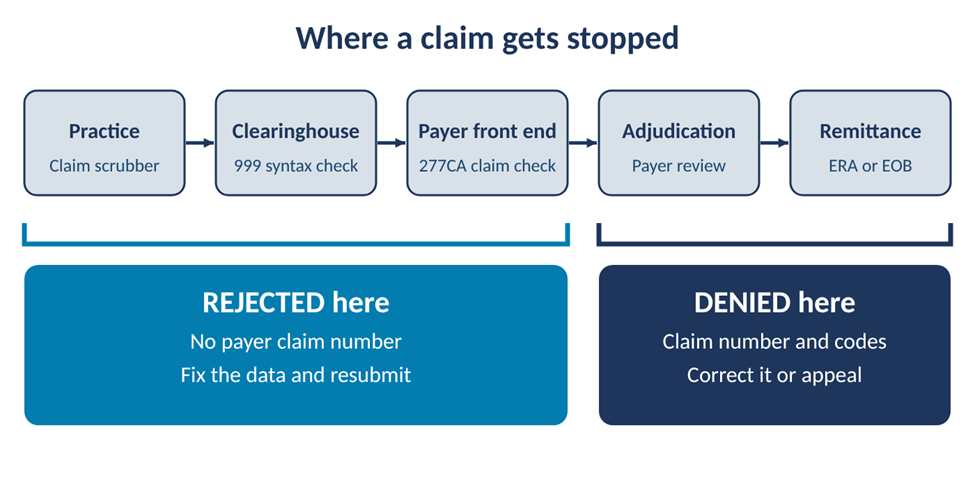
In short: a claim can be rejected at the clearinghouse, the 999 syntax check or the 277CA claim check, but it can be denied only after adjudication.
The 999 reports whether the file passed technical checks. The 277CA reports on each claim, and accepted claims carry a payer claim number, as the CMS overview of acknowledgment transactions explains.
The 60-Second Triage: Rejection or Denial?
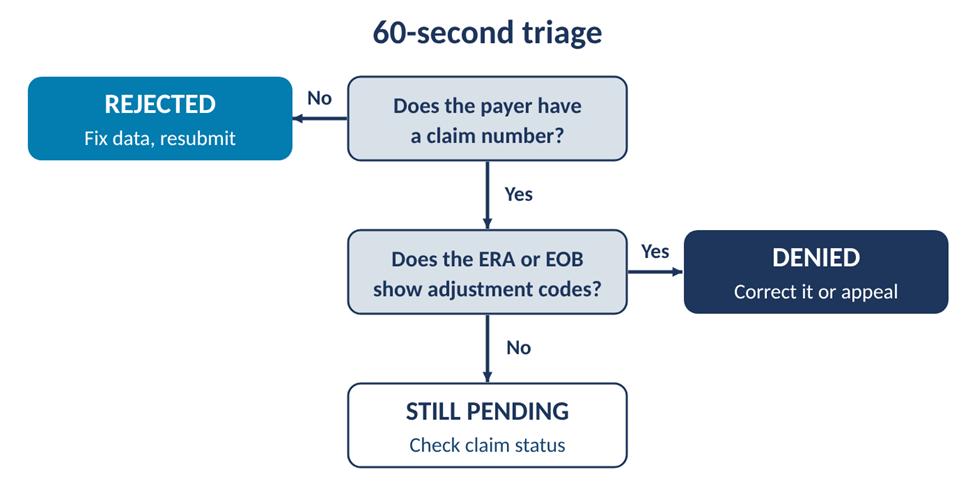
Use these steps on any unpaid claim before you decide what to do.
- Look for a payer claim number. Check the 277CA or the payer portal. No number and no record means the claim was rejected.
- Look for an ERA or EOB. If a remittance shows adjustment codes, the payer adjudicated the claim, so it is a denial.
- Read the codes. A CARC (claim adjustment reason code) explains why payment changed, and a RARC (remittance advice remark code) adds detail. The X12 code lists define both.
When the labels blur
Some payers use the word denial for data problems. A CARC 16 on an ERA signals missing information or a billing error, so treat it as a fixable defect and follow the payer’s instructions for a corrected claim. Medicare is stricter: its Claims Processing Manual, Chapter 29 says claims returned or rejected as incomplete or invalid are not appealable, and a Medicare remark code of MA130 marks an unprocessable claim. Decide by what the notice tells you to do, not by the label.
Common Rejection Reasons and Fixes
Rejections almost always trace back to front-desk or charge-entry data.
| Rejection cause | Fix |
| Subscriber ID or name does not match the payer file | Recheck eligibility, copy the ID exactly from the card and resubmit |
| Wrong or missing billing provider NPI or taxonomy | Match the claim to the provider’s NPPES record |
| Invalid diagnosis or procedure code format | Correct the entry and resubmit |
| Wrong payer ID, or claim sent to the wrong payer | Confirm the payer ID and send to the correct payer |
Common Denial Reasons and the Right First Response
Denials need a decision, not just a fix. Our guide to common claim denial reasons and fixes covers more codes; these four come up often.
| Denial reason (CARC example) | First response |
| CARC 197: authorization absent | Confirm whether an authorization existed. If so, send the approval with a corrected claim or appeal. If not, ask about retroactive authorization. |
| CARC 50: not medically necessary | Compare the visit note with the payer’s policy, then appeal with documentation. |
| CARC 18: exact duplicate | Check the first claim’s status before resending. Resubmitting a denied claim as new is a common cause. |
| CARC 29: timely filing | Gather proof of your first submission, such as an acceptance report, and appeal with it. |
Corrected Claim or Appeal: Which Path to Take
Send a corrected claim when the denial came from a mistake on your claim, such as a wrong modifier or a missing authorization number. File an appeal when the claim was accurate and you disagree with the decision, such as a medical necessity ruling. Follow the denial notice, because some payers want one path only.
Many commercial payers want a replacement claim marked with frequency code 7 and the original claim number, but rules differ. For an appeal, our step-by-step appeal process covers letters and documentation.
For Medicare, CMS says you have 120 days from receipt of the initial determination to request a redetermination, and it presumes receipt five days after the notice date. The CMS redetermination page lists what the request must include. Commercial payers set their own windows.
Sample Scenario: Two Claims, Same Morning
Sample (fictional data). A small family practice sends two claims on Monday. Change the details to match your own payers.
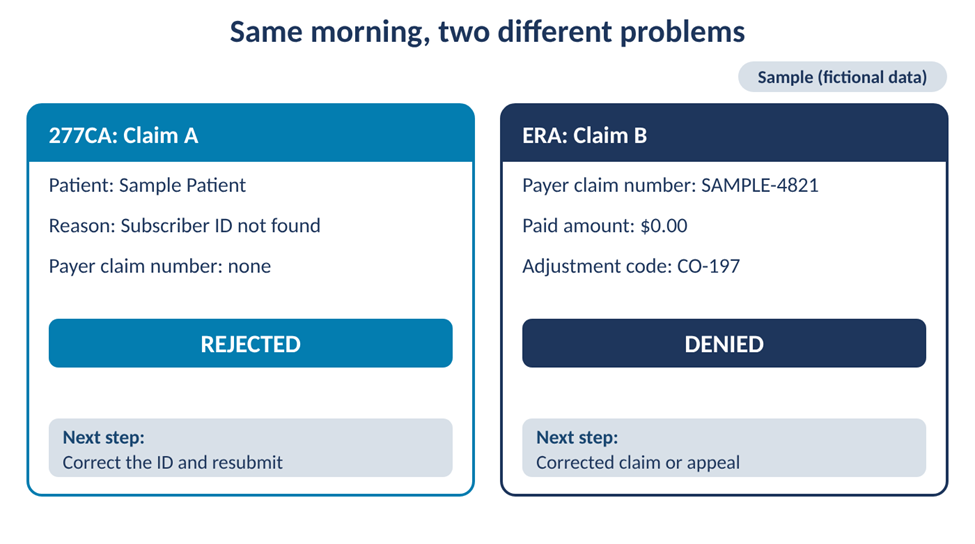
Claim A returns a 277CA rejection: the subscriber ID was not found. The front desk finds two transposed digits, corrects the ID and resubmits that day.
Claim B is accepted and gets a payer claim number. Weeks later the ERA shows CO-197. The approval existed but never made it onto the claim, so the team sends a corrected claim with the authorization number, or appeals with the approval letter if the payer requires it.
Prevent Both: A Simple Routine
- Check at the front desk. Confirm eligibility and copy the member ID exactly at every visit.
- Scrub before sending. Edits catch data errors early, as we explain in claim scrubbing and denial reduction.
- Read acknowledgments daily. Clear rejections the same business day.
- Track the two separately. Rejections point to intake data quality, and denials point to coverage, coding or documentation. Your clean claim rate shows how often claims pass the first time.
- Keep proof of filing. Medicare generally expects claims within one year of the date of service, and our Medicare timely filing rules guide covers it. Commercial windows vary by contract.
Common mistakes
- Appealing a rejection that needed a simple data fix.
- Resubmitting a denied claim as a brand-new claim and triggering a duplicate denial.
- Letting rejections sit because no remittance arrived.
Results vary by practice.
Frequently Asked Questions
What is the difference between a rejected and a denied claim?
A rejected claim fails front-end checks, at the clearinghouse or the payer, so it never reaches adjudication and usually has no payer claim number. A denied claim was processed and refused payment, and the remittance lists adjustment codes. You fix and resubmit a rejection, while you correct or appeal a denial.
Can you appeal a rejected claim?
Usually not. Medicare treats claims returned or rejected as incomplete or invalid as non-appealable, so the fix is a new, correct submission. Commercial payers set their own rules, so read the provider manual. If a payer labels a data problem a denial, follow the instructions printed on that notice.
How long do I have to fix a rejected claim?
The filing clock keeps running while a claim is rejected, so treat it as urgent. Medicare generally expects claims within one year of the date of service, and commercial contracts set their own windows. Keep the acceptance or rejection reports from your first attempt as proof of when you filed.
Who should watch for rejections, the clearinghouse or the practice?
The practice or its billing team should. A clearinghouse generates the reports, but a rejection produces no payment and no remittance, so nothing alerts you unless someone reads the acknowledgment reports. Review them every business day and clear each rejection before it ages.
Get Help Sorting Rejections and Denials
Telling rejected vs denied claims apart is the first step to getting paid. EZMedPro is a US-based medical billing, coding, credentialing and revenue cycle management company with transparent reporting and no hidden fees. If rejections or denials keep piling up, explore our revenue cycle management services or contact the team to talk through your claims workflow.
Sources: CMS Medicare Claims Processing Manual, Chapter 29; CMS guidance on Medicare redetermination; CMS overview of acknowledgment transactions; X12 claim adjustment reason code list. This article is general education, not legal advice, and payer rules vary, so check your payer’s provider manual.

