
Claim Follow-Up in Medical Billing: A Practical Workflow
Claim follow-up is the routine of checking every unpaid claim at set intervals, finding out why it is stuck and taking the next step until it pays or is closed out. Done on a schedule, it catches lost claims, silent rejections and stalled denials before filing deadlines pass. This guide gives you a status-check workflow, a follow-up calendar, a payer call routine and a way to decide which claims to work first.
| Key takeaways Check status on a schedule, not when cash feels slow.Wait for the payer’s payment floor before the first check, and never resubmit while a claim is still processing.End every touch with a documented next action and a date.Work the oldest, largest and deadline-sensitive claims first. |
Claim Follow-Up in Medical Billing: Why a Schedule Matters
Most unpaid claims are not mysteries. They were rejected and nobody read the acknowledgment, they are waiting on a records request, or they were denied and the remittance sat unread. A schedule turns those problems into routine work instead of month-end surprises.
Follow-up is also the daily work behind your A/R days. Our guide to how to reduce A/R days in medical billing covers the metric, and the overview of accounts receivable in medical billing explains aging buckets.
Where to Check Claim Status
Use the fastest channel that gives a clear answer, and keep the phone for claims that need a person.
| Method | Best for | What to know |
| Payer portal | Single claims and quick answers | For Medicare, the MAC secure portal is the fastest way to check one claim. |
| 276/277 electronic status | Many claims at once from your system | The 276 asks for status and the 277 returns it. Medicare responses can take up to 24 hours. |
| Phone or IVR | Pended, unclear or high-value claims | Always get a call reference number before you hang up. |
| Clearinghouse or billing software | Batch status and acknowledgments | Ask your vendor which status checks it offers and whether it charges. |
Timing matters. Medicare claims pass two edit levels, which can take up to three days, before a claim number exists, and resubmitting during editing creates a duplicate. A claim that fails editing has no number, so read the 277CA or 999 instead, as the CMS guide to checking Medicare claim status explains.
Electronic status checks are also standardized. The CAQH CORE claim status rule sets a 20-second real-time response expectation for entities that follow it, plus a next-business-morning batch standard, so automate status checks wherever your payers support them.
A Follow-Up Calendar You Can Start With
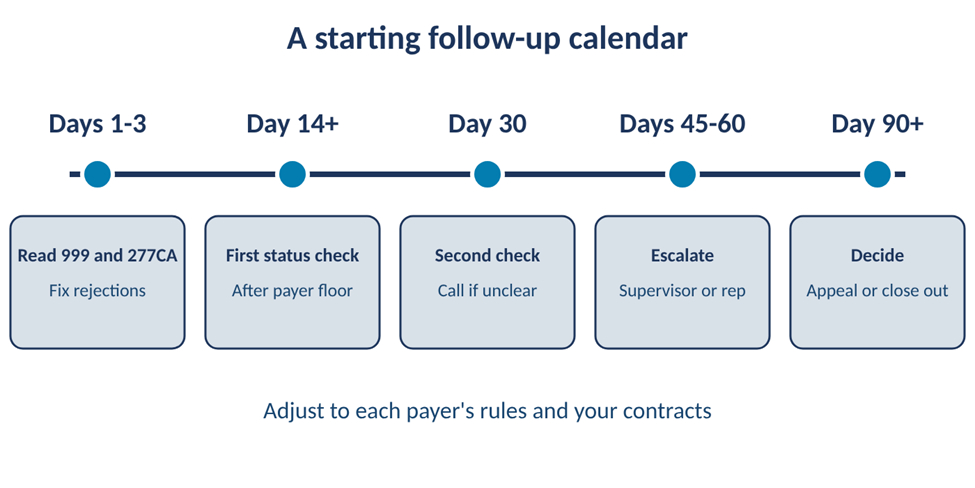
Treat this as a starting point and adjust it to each payer’s rules and your contracts.
| When | Action |
| Days 1 to 3 | Read the 999 and 277CA reports and fix every rejection the same day. |
| After the payer’s payment floor | First status check on claims with no payment or remittance. Medicare’s floor is 14 days for clean electronic claims. |
| Day 30 | Second check. Call if the status is unclear. Medicare must pay interest on clean claims left unpaid after 30 days. |
| Days 45 to 60 | Escalate to a supervisor or payer representative, and confirm the payer has the claim before resubmitting. |
| Day 90 and later | Decide: corrected claim, appeal, patient billing or write-off, and check every deadline first. |
What to Do for Each Status
| Status you find | Next action |
| No record at the payer | Check the 277CA and 999. Resubmit only after the payer confirms it has no record. |
| Processing or pended | Note the expected date and recheck. Do not resubmit, because that creates a duplicate. |
| Pended for records | Send the records the same day and quote the reference number. |
| Denied | Classify the cause, then send a corrected claim or appeal. Our guide to claim denial codes decodes reasons, and the appeal process covers the next step. |
| Paid below the contract rate | Compare the payment with your contract using fee schedule analysis and file a payment dispute. |
| Paid with a patient balance | Move the balance to your patient statement workflow. |
How to Make an Effective Payer Call
- Prepare. Have the claim number, date of service, billed amount, billing NPI and the date of your last check.
- Ask four things. Current status, the reason if unpaid, what the payer needs from you and when to expect a result.
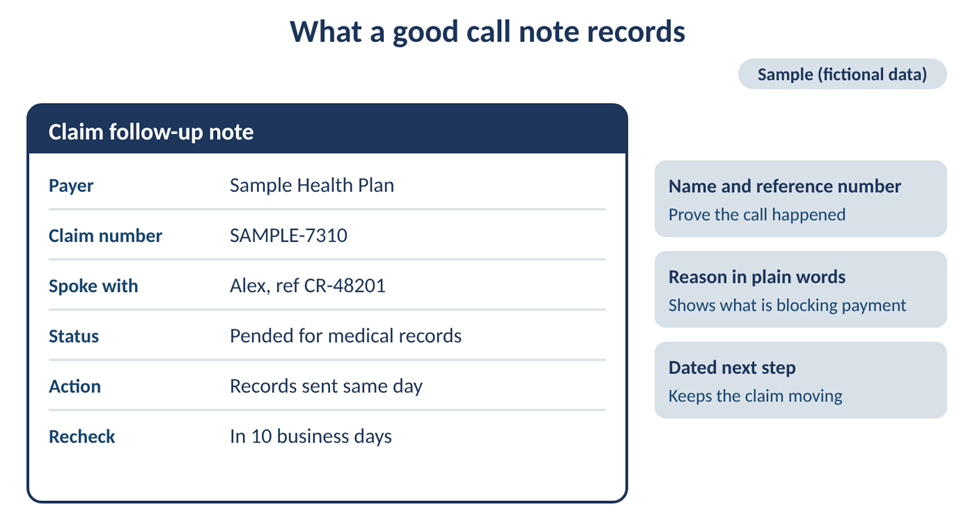
- Record the details. Write down the representative’s name, the call reference number and the date.
- Act the same day. Do what the payer asked and diary the next check.
Sample (fictional data). The note below shows the level of detail that protects you in a dispute. Change the details to match your own payers.
Which Claims to Work First
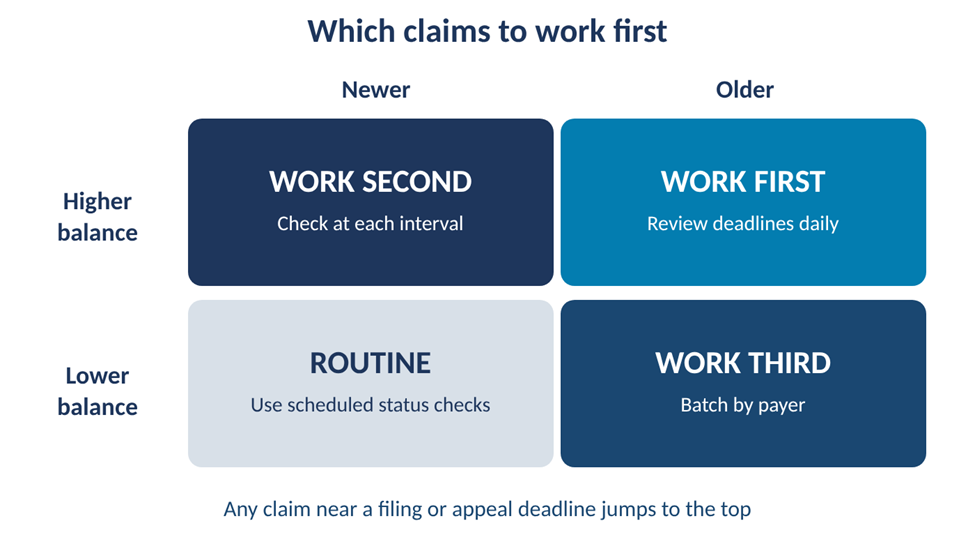
You cannot touch every claim every day, so rank the worklist.
- Deadlines first. Claims near filing or appeal limits come first. Our Medicare timely filing rules guide covers filing limits, and CMS says you have 120 days from receipt of the initial determination to request a Medicare redetermination, as the CMS redetermination page states.
- Age and balance. Work older, larger claims before newer, smaller ones.
- Payer patterns. If many claims from one payer stall, escalate with a list instead of calling claim by claim.
Common follow-up mistakes
- Resubmitting while the claim is still processing, which creates a duplicate.
- Checking only when cash is slow.
- Calling without a claim number, or hanging up without a reference number.
- Skipping small balances instead of batching them by payer.
Results vary by practice.
Frequently Asked Questions
When should I first follow up on an unpaid claim?
Read the acknowledgment reports within the first few days, then make your first status check after the payer’s payment floor. For Medicare, that is 14 days for clean electronic claims, and commercial payers set their own timing in the contract or provider manual. Checking earlier mostly shows a claim still in process and wastes staff time.
How often should I check claim status?
Run a scheduled check at each step of your calendar, such as after the payment floor, at day 30 and again by day 45 to 60, and call when the status is unclear. Many practices automate electronic status checks so staff only work exceptions. Adjust the cadence to each payer and to claim value.
Should I resubmit a claim that shows no payment?
Not until the payer confirms it has no record of the claim. Resubmitting a claim that is still processing creates a duplicate, which can trigger a duplicate denial. If it was rejected, correct the data and send it again. If it was denied, use a corrected claim or an appeal.
What information do I need to call a payer?
Have the claim number, patient name and ID, date of service, billed amount and billing NPI ready. Ask for the status, the reason, what the payer needs and when to expect a result. Then record the representative’s name and the call reference number, which protects you if the payer later disputes the call.
Does a rejected claim need follow-up too?
Yes. A rejection produces no payment and no remittance, so only the 999 or 277CA reports show it. Review those reports daily, fix the error and resubmit, because the filing clock keeps running while the claim sits unnoticed. A daily check keeps rejections from quietly aging into write-offs.
Get Help With Unpaid Claims
Consistent claim follow-up in medical billing is what keeps good claims from turning into old A/R. EZMedPro is a US-based medical billing, coding, credentialing and revenue cycle management company with transparent reporting and no hidden fees. If unpaid claims are piling up, explore our revenue cycle management services or contact the team to talk through your follow-up workflow.
Sources: CMS guide to checking Medicare claim status; CAQH CORE claim status infrastructure rule; CMS guidance on Medicare redetermination. This article is general education, not legal advice, and payer rules vary, so check your payer’s provider manual.

