
Arizona Prompt Pay Law: A Guide for Medical Practices
Arizona’s prompt pay law, A.R.S. 20-3102, gives state-regulated health insurers 30 days to adjudicate a clean claim and 30 more days to pay the approved amount, with 10% annual interest when they miss the deadline. It also sets rules for claims that need more information, for adjustments and for provider grievances. This guide explains who the law covers, how each clock runs, how to calculate interest and how to use the grievance process.
| Key takeaways Clean claims must be adjudicated within 30 days of receipt and paid within 30 days of adjudication.Late payments earn interest at 10% a year from the due date; a contract can change the rate but cannot waive interest.Self-funded employer plans, Medicare, AHCCCS and workers’ comp claims fall outside the state law.Neither insurer nor provider may adjust a claim more than one year after payment or denial, except for fraud. |
Which plans the Arizona prompt pay law covers
The law applies to state-regulated payers: fully insured group and individual health plans, health care services organizations (HMOs), service corporations and prepaid dental plans. It covers claims from contracted, non-contracted and out-of-state providers alike. Knowing which claims qualify is the first step in managing your accounts receivable against the right deadline.
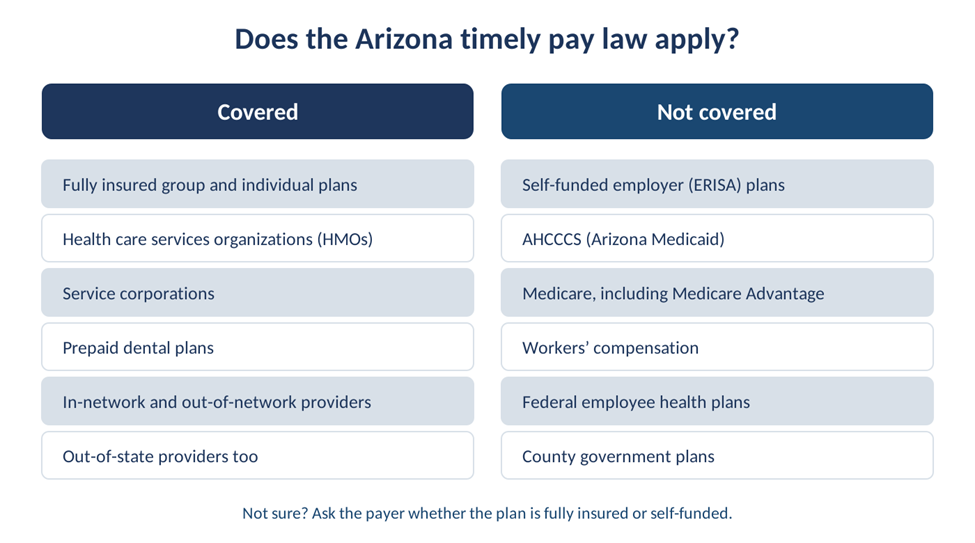
Some commercial ID cards belong to self-funded employer plans, which follow federal ERISA rules instead. The Department of Insurance and Financial Institutions (DIFI) also excludes AHCCCS, county government plans, workers’ compensation, federal employee plans and Medicare. Federal law preempts the state timely pay rules for Medicare Advantage claims too, so use the strategies in our Medicare Advantage billing guide for those.
The 30-day clocks for clean and unclean claims
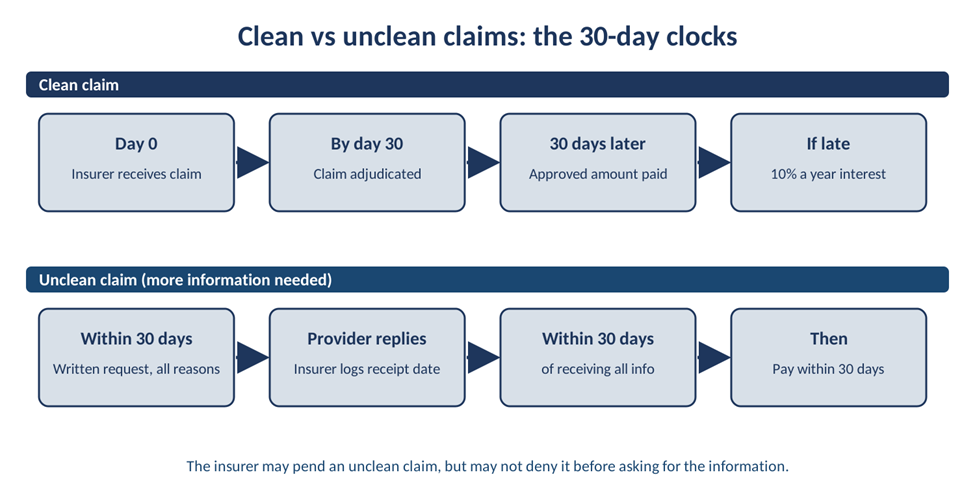
In short: a clean claim must be adjudicated, meaning approved or denied, within 30 days of receipt, and any approved amount paid within 30 days after that. A contract may change those periods but cannot merge them into one receipt-to-payment window, according to DIFI Regulatory Bulletin 2025-01.
When the insurer says the claim is not clean
A claim is not clean if the insurer needs more information, such as coordination of benefits details, to decide it. In that case the insurer must send a written request within 30 days of receiving the claim, listing every specific reason for the delay. Once you send everything requested, it has 30 days to adjudicate.
Two protections matter in practice. The insurer may pend an unclean claim but may not deny it before asking for the information, and it may not make you resubmit information you already sent. Complete claims avoid most of these requests, so tighten your claim submission process first.
Late-payment interest
If the insurer pays late, interest runs from the date payment was due at the legal rate of 10% a year. The insurer and provider can agree in writing to a different reasonable rate, but they cannot waive interest altogether.
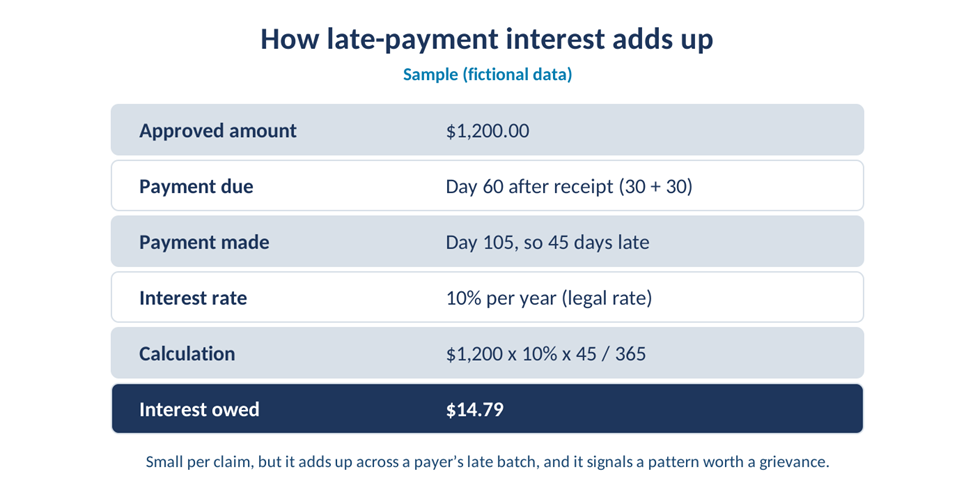
Check whether the payer added interest on the remittance. Missing interest is easy to overlook when each amount is small, and it is a common grievance topic. Tracking payer-level turnaround also supports the work in our guide to reducing A/R days.
Adjustments, recoupments and the one-year limit
Neither the insurer nor the provider may adjust a claim, or ask for an adjustment, more than one year after it was paid or denied. A denial counts as a payment of zero. A contract may set a different period only if it applies equally to both sides and is not unreasonably short. Fraud is the only exception, and late coordination of benefits information does not reopen a closed claim.
| Situation | Rule |
| Insurer finds an underpayment | No interest owed if paid in full within 30 days of the adjustment |
| Insurer finds an overpayment | No interest owed by the provider if repaid within 30 days of the adjustment |
| Recoupment request after one year | Not allowed unless fraud is involved or the contract sets an equal, reasonable period |
| Provider asks for a correction after one year | Same one-year limit applies to the provider |
Our guide to handling retroactive claim denials covers how to respond when a payer reaches back on paid claims.
Filing a grievance with the insurer
A provider grievance is any written complaint you send to the insurer, including delays in adjudication. Grievances go to the insurer first, not to the state. Each insurer must publish a grievance policy that states the information required and how many days it takes to resolve, and a neutral person outside the original decision chain must decide it.
Keep each grievance factual: claim numbers, dates received, the deadline missed and the interest owed. Disputes over medical necessity follow the insurer’s appeal process instead, which works much like the steps to appeal a denied medical claim.
When to contact DIFI
DIFI does not decide payment amounts or contract disputes, and there is no state appeal of an insurer’s grievance decision. It can look into other Title 20 violations, such as an insurer that ignores grievances or has no grievance policy. The DIFI health care providers page explains how to submit a complaint as a provider.
Practical checklist for Arizona commercial claims
| Step | What to do |
| 1 | Confirm the plan is fully insured, not self-funded, at eligibility check |
| 2 | Keep proof of the date each claim was received (clearinghouse acceptance report) |
| 3 | Flag claims with no decision at day 30 and no payment at day 60 |
| 4 | Answer information requests completely, and log the date you sent them |
| 5 | Compare remittances against expected interest on late payments |
| 6 | File grievances in writing, citing A.R.S. 20-3102 and the dates |
Sample (fictional data): a late batch
A Scottsdale family practice notices that one fully insured plan has paid 18 clean claims between 50 and 70 days past receipt, with no interest added. The billing team pulls the clearinghouse acceptance dates, calculates interest for each claim and files one written grievance listing all 18. Use your own claim list and dates; the point is to group late claims by payer rather than chasing them one by one.
Frequently asked questions
What is the Arizona prompt pay deadline?
Under A.R.S. 20-3102, a state-regulated health insurer must adjudicate a clean claim within 30 days of receiving it and pay any approved amount within 30 days after adjudication. A contract can set different periods but cannot combine them into a single window. If the claim needs more information, separate 30-day rules apply.
What interest rate applies to late claims in Arizona?
Late payments earn interest at the legal rate of 10% a year, starting on the date payment was due. The insurer and the provider can agree in writing to a different reasonable rate, but the contract cannot waive interest entirely. The insurer owes no interest on an underpayment it corrects in full within 30 days of the adjustment.
Does the Arizona prompt pay law apply to self-funded plans?
No. Self-funded employer plans are excluded, along with AHCCCS, county government plans, workers’ compensation, federal employee plans and Medicare. Federal law also preempts the timely pay rules for Medicare Advantage claims. For those payers, follow the plan’s own rules and any federal requirements, and check with the payer whether a commercial plan is fully insured.
How long can an Arizona insurer take back a payment?
Neither the insurer nor the provider may adjust a claim more than one year after it was paid or denied, unless fraud is involved. A contract may set a different period only if it is the same for both sides and not unreasonably short. Coordination of benefits information found later does not reopen the claim.
Can I file a prompt pay complaint with the state?
Grievances about payment go to the insurer first, under its written grievance policy. DIFI does not decide claim amounts or contract disputes and does not hear appeals of grievance decisions. It can investigate other violations, such as an insurer that fails to respond to grievances or lacks a grievance policy.
Using the Arizona prompt pay law to protect cash flow
The Arizona prompt pay law only helps practices that track it: confirm the plan type, keep proof of receipt, watch the 30- and 60-day marks, check interest and file grievances in batches. Those habits shorten the time commercial claims sit in A/R.
EZMedPro’s US-based team provides billing, coding, credentialing and revenue cycle management services with transparent reporting and no hidden fees. If late commercial payments are piling up, contact our team to review your Arizona claims. Results vary by practice.
Sources: A.R.S. 20-3101 and 20-3102, Arizona Department of Insurance and Financial Institutions Regulatory Bulletin 2025-01 (Timely Pay and Grievance), and the DIFI health care providers page. This article is general billing information, not legal advice.

