
Knee Pain ICD-10 Codes for Right, Left and Both Knees
The knee pain ICD-10 codes are M25.561 for the right knee, M25.562 for the left knee and M25.569 for an unspecified knee. All three are billable in the FY 2027 code set. There is no bilateral knee pain code, so pain in both knees is reported with M25.561 and M25.562 together. Below: laterality rules, when to add a G89 pain code, and when not to code pain at all.
Choosing the Knee Pain Code by Side
Knee pain codes sit in subcategory M25.56, pain in knee, under M25.5, pain in joint. The sixth character carries the side, which is why getting laterality right matters so much on these claims. Knee pain is one piece of the wider musculoskeletal workflow in our orthopedic billing guide for CPT codes and modifiers.
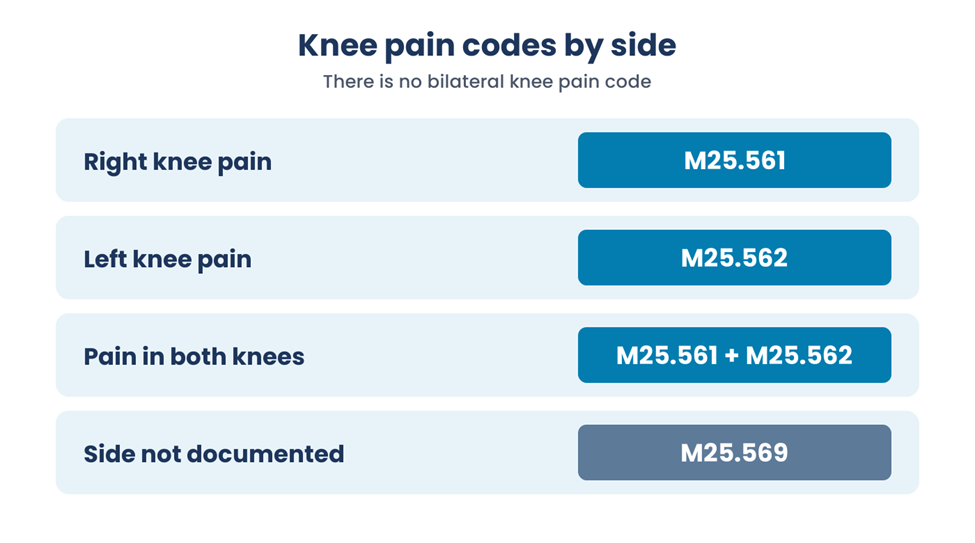
| Documentation | Code | Note |
| Pain in the right knee | M25.561 | Billable. |
| Pain in the left knee | M25.562 | Billable. |
| Pain in both knees | M25.561 and M25.562 | No bilateral code exists, so report both. |
| Side not documented | M25.569 | Means unspecified knee, not both knees. |
Bilateral Knee Pain: Why M25.569 Is Wrong
A common error, repeated in many older guides, is using M25.569 for pain in both knees. M25.569 means the record doesn’t say which knee. The ICD-10-CM Official Guidelines for Coding and Reporting FY 2027 say that when no bilateral code exists, you report the right and left codes separately. For knee pain, that means M25.561 plus M25.562.
The guidelines also say unspecified-side codes should rarely be used. Laterality is one detail you may take from another clinician’s note, such as a nurse or therapist, but query the provider if the notes conflict.
When Not to Code Knee Pain
Pain is a symptom. Once the provider diagnoses the cause, code the diagnosis and drop the pain code, because pain is a routine part of conditions like osteoarthritis or a meniscus tear.
- Osteoarthritis: code the M17 code instead; our bilateral knee osteoarthritis coding guide covers M17.0 and the unilateral codes.
- Injury: a fall, twist or blow is coded from the S80 to S89 injury block with a seventh character for the encounter, plus external cause codes as needed.
- Effusion: fluid in the knee has its own codes, M25.461 (right), M25.462 (left) and M25.469 (unspecified), and both knees take both side codes.
- Patellofemoral pain: when the provider diagnoses a patellofemoral disorder, use the M22.2- code with the right side.
Chronic Knee Pain and G89 Codes
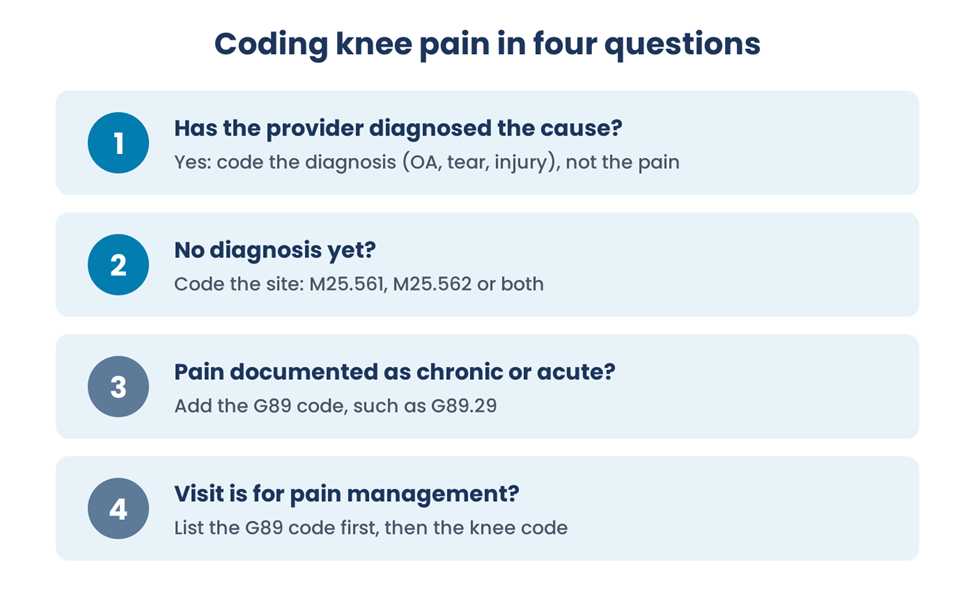
Category G89 codes, such as G89.29 for other chronic pain, can be added to the knee pain code when the provider documents the pain as chronic or acute. ICD-10-CM sets no time frame for “chronic”; the provider’s wording decides, so don’t assign G89 from the length of time alone.
Sequencing depends on why the patient came in. If the visit is for pain control or pain management, list the G89 code first and the knee pain code second. For other visits with no established diagnosis, list the knee pain code first and the G89 code after it.
Knee Pain Codes and Medical Necessity
A bare pain code is weak support for imaging, injections or therapy. Payers want the exam findings, function, prior treatment and red flags behind the order, which our knee pain medical necessity guide covers in detail.
Sample Coding Scenario
Sample (fictional data). A 52-year-old patient reports aching in both knees for several months with no injury. The provider documents chronic bilateral knee pain, orders standing X-rays and has not made a diagnosis yet.
Coding: M25.561 and M25.562, plus G89.29 because the provider documented chronic pain, listed after the knee codes since the visit is a work-up rather than pain management. If the X-rays later show osteoarthritis of both knees, the follow-up visit uses M17.0 instead. Change the details to match your own patient’s record.
Common Denials and Fixes
| Problem | Why it fails | Fix |
| M25.569 for both knees | It means unspecified, not bilateral | Report M25.561 and M25.562. |
| Pain code with an established diagnosis | The symptom is part of the diagnosis | Code the diagnosis, such as M17.0. |
| G89 code without the word chronic or acute | Guidelines need that documentation | Query the provider or leave G89 off. |
| Injection side doesn’t match the diagnosis | RT line linked to M25.562 | Match each procedure line to its side. |
Frequently Asked Questions
What is the ICD-10 code for bilateral knee pain?
There isn’t a single bilateral code. Report M25.561, pain in right knee, and M25.562, pain in left knee, together. M25.569 is not a bilateral code; it means the record doesn’t say which knee. If the provider later diagnoses a cause, code that diagnosis instead.
What is the ICD-10 code for right knee pain?
Right knee pain is M25.561, a billable code in the FY 2027 code set. Left knee pain is M25.562. Use these only while no underlying cause has been diagnosed, and add a G89 code if the provider documents the pain as chronic or acute.
What is the ICD-10 code for chronic pain of both knees?
Report M25.561 and M25.562 for the site, plus G89.29, other chronic pain, when the provider uses the word chronic. List the G89 code first only if the visit is for pain management. Otherwise list the knee codes first.
What is the ICD-10 code for bilateral knee effusion?
Knee effusion uses M25.461 for the right knee and M25.462 for the left. There’s no bilateral effusion code, so report both when fluid is present in both knees. If the provider identifies the cause, such as osteoarthritis or injury, code that condition too or instead.
Getting Knee Pain Claims Right
Knee pain ICD-10 coding is simple once three rules stick: one code per side, no bilateral shortcut through M25.569, and a diagnosis code replaces the pain code once there is one. The current code tables are on the CMS ICD-10 code sets page. If orthopedic or therapy claims keep coming back for laterality or necessity reasons, contact the EzMedPro team about medical billing and coding support.
Sources: CMS ICD-10-CM FY 2027 code set and the ICD-10-CM Official Guidelines for Coding and Reporting FY 2027 (CMS and CDC/NCHS). CPT is a registered trademark of the American Medical Association. This article explains coding and billing only and is not medical or legal advice.

