
How to Prepare for a Medical Coding Audit: A Checklist
A medical coding audit preparation checklist covers two jobs: keeping your charts audit-ready all year, and responding step by step when a payer or Medicare contractor asks for records. Read the letter, assign one owner, pull complete records, review each chart against its codes, submit on time and act on the results.
This guide covers the audits you may face, the checklist for responding, what to check in every chart, deadlines and appeals, and the mistakes that turn small findings into large ones. If you’d like an outside team to handle reviews, our medical billing and coding services can help.
| Key takeaways Run your own coding audits so you find problems before an outside auditor does.Medicare contractors generally give 45 days to answer a records request; UPICs give 30.Never change a record after an audit request; late entries must be clearly marked and dated.File a Medicare redetermination within 30 days of an overpayment demand to stop recoupment. |
Types of Coding Audits
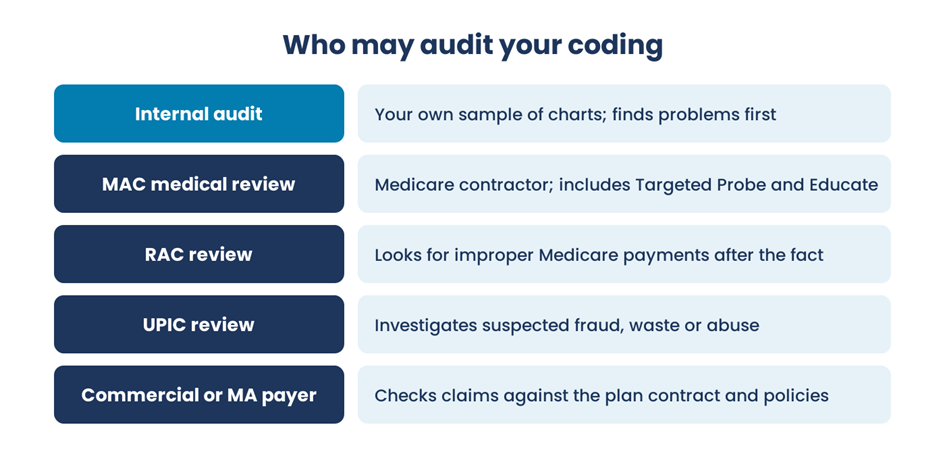
In short, internal audits are your own chart reviews, Medicare Administrative Contractor (MAC) reviews include Targeted Probe and Educate (TPE), Recovery Audit Contractors (RACs) look for improper Medicare payments after the fact, Unified Program Integrity Contractors (UPICs) investigate suspected fraud, waste and abuse, and commercial and Medicare Advantage plans audit against their own contracts and policies.
Under TPE, a MAC typically reviews 20 to 40 claims per round, offers education after each round and repeats the process for up to three rounds, according to the Medicare Program Integrity Manual, Chapter 3. Providers still having problems after three rounds can be referred to CMS for further action.
Get Audit-Ready Before Any Letter Arrives
The practices that handle audits well review their own coding first. Pull a sample of charts for each provider on a regular schedule, compare the codes with the notes, and track error rates over time. Focus on high-risk areas such as high-level E/M visits, modifier 25 and 59 use, time-based services and anything newly added to your services.
Fold those reviews into a written compliance program built on the seven elements in the HHS Office of Inspector General’s General Compliance Program Guidance, including auditing and monitoring. Our guides to setting up a medical billing compliance program and medical billing audits that prevent revenue leakage cover the structure.
The Checklist: When an Audit Letter Arrives
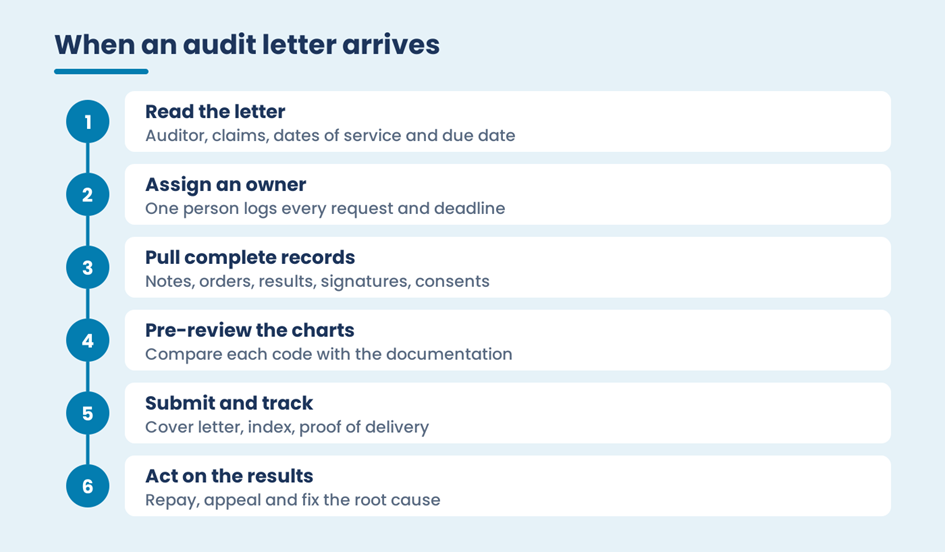
- Read the letter carefully. Note who sent it, which claims and dates of service it covers, what records it wants and the due date. Medicare MACs, RACs and the Supplemental Medical Review Contractor generally allow 45 days for an additional documentation request (ADR), while UPICs allow 30.
- Assign one owner. That person logs every request, deadline and contact, and keeps a copy of everything sent.
- Pull complete records. Include the notes, orders, test results, signatures and consents for each service, not just the main visit note.
- Pre-review the charts. Compare each billed code with the documentation and note any gaps so you know what to expect.
- Don’t alter the record. If something is missing, a late entry or addendum must be clearly labeled and dated when it was written; never backdate or rewrite notes.
- Submit and track. Send a short cover letter and an index of the records, use the submission method the letter specifies, and keep proof of delivery.
What to Check in Every Chart
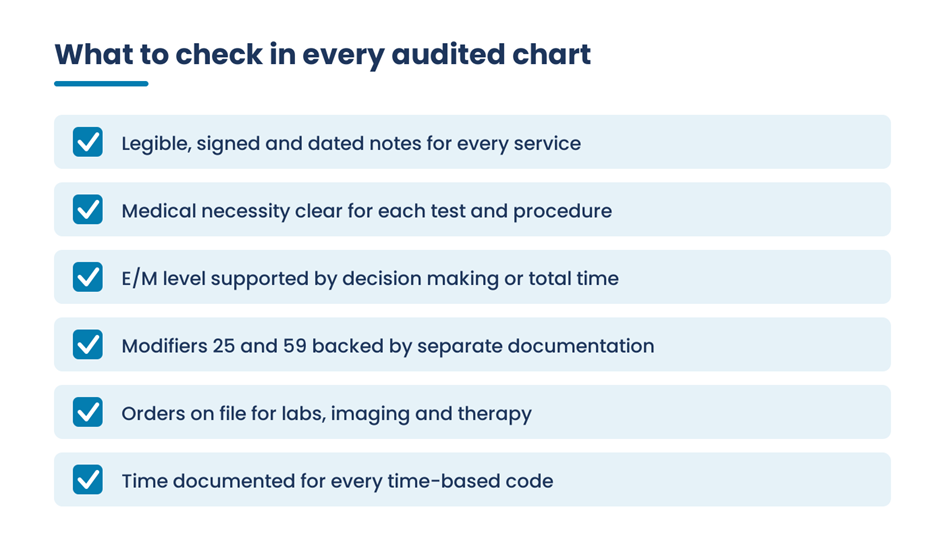
Each chart should have legible, signed and dated notes; clear medical necessity for every test and procedure; an E/M level supported by medical decision making or total time; separate documentation behind modifiers 25 and 59; orders for labs, imaging and therapy; and time documented for every time-based code. Our guides on audit-proof documentation for higher-level office visits and when to use CPT modifiers go deeper on the two most common problem areas.
After the Audit: Overpayments and Appeals
If an audit finds a Medicare overpayment, timing matters. According to the CMS Medicare overpayments fact sheet (MLN006379), filing a redetermination request within 30 days of the demand letter keeps recoupment from starting on day 41, interest begins on day 31 if the debt isn’t paid, and the last day to request a redetermination is day 120.
When your own review finds money you were overpaid, Medicare requires you to report and return it within 60 days of identifying it. Commercial and Medicare Advantage plans set their own audit and appeal rules in the contract, so check your payer’s manual. Our step-by-step guide to appealing denied claims covers building an appeal.
Common Mistakes and How to Prevent Them
| Mistake | Result | Prevention |
| Missing the response deadline | Claims denied for lack of documentation | Log the due date the day the letter arrives |
| Sending only the visit note | Orders, results or signatures look missing | Pull every document tied to each service |
| Editing notes after the request | Credibility and compliance problems | Use dated, clearly labeled addenda only |
| Ignoring the findings | The same errors repeat in the next review | Turn each finding into training and a follow-up audit |
| Waiting past day 30 on a demand | Recoupment starts and interest builds | Decide on an appeal right away |
Frequently Asked Questions
What should a medical coding audit preparation checklist include?
It should cover reading the audit letter for scope and deadline, naming one owner, pulling complete records, reviewing each chart against its codes, never altering documentation, submitting with an index and proof of delivery, and acting on results through repayment, appeal and training. It should also schedule your own regular internal audits.
How long do I have to respond to a Medicare records request?
Medicare Administrative Contractors, Recovery Audit Contractors and the Supplemental Medical Review Contractor generally allow 45 days to respond to an additional documentation request, and Unified Program Integrity Contractors generally allow 30. Always follow the due date printed on the letter itself, and send records early enough to keep proof of delivery.
Can I add to a note after receiving an audit request?
You shouldn’t rewrite or backdate a note. If information is genuinely missing and the provider remembers it, any late entry or addendum must be clearly marked as such and dated when it was actually written. Auditors may give little weight to entries made after a request, so the best fix is better documentation going forward.
How often should practices run internal coding audits?
Most practices benefit from reviewing a sample of each provider’s charts on a regular schedule, with more frequent checks for new providers, new services and high-risk codes. The right frequency depends on your size, specialty and past findings. What matters most is that results lead to education and a follow-up review.
Get Help Preparing for Coding Audits
A medical coding audit preparation checklist works best when it’s used all year, not only when a letter arrives. If you’d like help reviewing charts or responding to a records request, contact the EzMedPro team to talk it through.
Sources: CMS Medicare Program Integrity Manual, Chapter 3; CMS Medicare Overpayments fact sheet MLN006379; HHS-OIG General Compliance Program Guidance. Billing and compliance information only, not legal advice.

