
New York Prompt Pay Law: A Guide for Medical Practices
New York runs two separate prompt-pay clocks for medical claims, and mixing them up is one of the most common billing-queue mistakes. Commercial health insurance follows Insurance Law §3224-a: clean electronic claims must be paid or denied within 30 days, paper claims within 45 days, with interest owed automatically on late payments. No-fault (PIP) claims for auto-accident injuries follow a separate regulation, 11 NYCRR 65-3.8, with its own 30-day clock and a steeper 2%-per-month interest penalty. This guide walks through both tracks, how disputed claims and late filings are handled, and how to escalate an unpaid claim to the Department of Financial Services (DFS).
Key takeaways
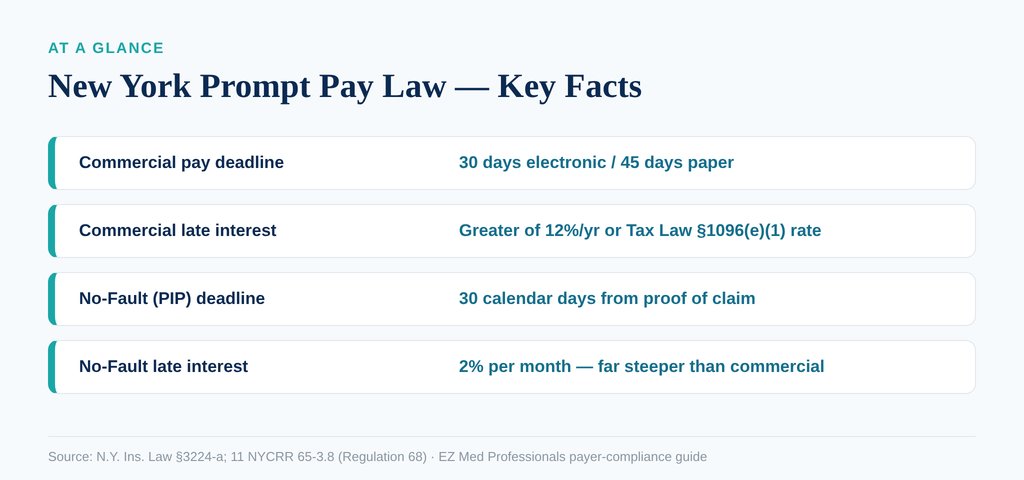
- Commercial health insurers in New York must pay or deny clean electronic claims within 30 days and paper claims within 45 days, under Insurance Law §3224-a.
- Late commercial claims accrue interest at the greater of 12% per year or the corporate tax rate set under Tax Law §1096(e)(1); no interest is owed if it totals less than $2.
- No-fault (auto-accident) claims follow a separate 30-day deadline under 11 NYCRR 65-3.8, with a much higher 2%-per-month interest rate on overdue benefits.
- Providers generally must submit commercial claims within 120 days of the date of service (90 days is allowed by agreement for some managed-care and Medicaid contracts); claims filed 365+ days late can be denied outright.
- Disputed claims require a detailed written notice within 30 days explaining what’s missing or why the claim was denied or partially approved — vague denials don’t satisfy the statute.
Which claims follow which clock
New York’s prompt-pay rules split along claim type, not payer type. Commercial health insurance — HMO, PPO, and most employer-sponsored plans regulated by the state — follows Insurance Law §3224-a, administered by DFS. No-fault claims for injuries from car accidents follow 11 NYCRR 65-3.8 (the “Regulation 68” framework), regardless of whether the same insurer also writes commercial health policies. A practice that treats both accident and non-accident patients needs to track both clocks separately, since they have different deadlines, different interest rates, and different dispute procedures.
Self-funded ERISA employer plans are not covered by either New York rule; those run on federal timelines instead. Medicaid managed care and certain other state-contracted plans may use a shorter 90-day filing window by agreement, in place of the general 120-day standard.
The commercial claim clock: 30 days electronic, 45 days paper
Under §3224-a(a), a health insurer must pay or deny a clean claim within 30 days of receiving it electronically (by internet or email) or within 45 days if it arrives on paper or by fax. These deadlines don’t apply where liability isn’t “reasonably clear” or where the claim shows specific signs of fraud — but a routine clean claim with no such flag is expected to resolve within one of these two windows.
If the insurer disputes all or part of a claim in good faith — over eligibility, coordination of benefits, billed amount, covered services, or medical necessity — it must still pay the undisputed portion, and it has 30 calendar days to send written notice explaining the denial or partial approval, the specific reasons, and exactly what additional information would resolve it. The statute is specific about formatting: a denial notice must carry the heading “NOTICE OF DENIAL OF MEDICAL COVERAGE” in 14-point bold type, and a partial approval the equivalent “NOTICE OF PARTIAL APPROVAL” heading, with body text no smaller than 12-point. Once the insurer receives the requested information or a provider’s appeal and determines payment is due, it has 15 days to pay.
Interest and penalties for late commercial payments
A commercial claim paid late automatically owes interest from the original due date, at the greater of 12% per year or the corporate tax rate the state Commissioner of Taxation and Finance sets under Tax Law §1096(e)(1). Interest under $2 isn’t owed. Each individual claim paid in violation counts as a separate violation under the Insurance Law, on top of any other applicable penalty.
There’s a safe harbor worth knowing: if DFS finds a violation through its own examination rather than an individual complaint, no civil penalty applies as long as the insurer processed at least 98% of that year’s claims in compliance. That 98% threshold doesn’t protect an insurer against a complaint-driven finding on a specific claim, which is exactly the lever an individual practice has when a payer is chronically late.
| Claim type | Pay-or-deny deadline | Interest on late payment | Governing rule |
|---|---|---|---|
| Commercial clean claim, electronic | 30 days | Greater of 12%/year or Tax Law §1096(e)(1) rate | Insurance Law §3224-a(a) |
| Commercial clean claim, paper/fax | 45 days | Same as above | Insurance Law §3224-a(a) |
| No-fault (auto-accident) claim | 30 calendar days from proof of claim | 2% per month, pro-rated on a 30-day month | 11 NYCRR 65-3.8, 65-3.9 |
| Disputed claim notice | 30 days to send written denial/partial-approval notice | — | Insurance Law §3224-a(b) |
| Payment after appeal/new info resolves dispute | 15 days | Interest accrues from original due date | Insurance Law §3224-a(b) |
Filing deadlines and late-claim penalties
Providers generally must submit a commercial claim within 120 days of the date of service. For certain managed-care and Medicaid-related contracts, the insurer and provider may agree to a shorter window, no less than 90 days. A participating provider can request reconsideration of a claim denied solely for being late if it can show an unusual occurrence and a consistent record of timely filing — otherwise, an insurer may cut payment on an untimely claim by up to 25%, and can deny a claim outright if it’s submitted 365 days or more after the date of service.
Hospitals have a separate narrow window for coding disputes: after a payer adjusts payment based on a coding review, the hospital has 30 days to submit supporting medical records, and the insurer must then process the reconsidered claim within the same §3224-a(a) timeframes, with interest on any increased payment.
No-fault (PIP) claims: a different, stricter clock
No-fault claims — medical treatment for injuries from a motor vehicle accident, billed to the auto insurer rather than health insurance — run on 11 NYCRR 65-3.8 instead of §3224-a. The insurer must pay or deny the claim, in whole or in part, within 30 calendar days of receiving proof of claim. If the claim is overdue, interest accrues at 2% per month, calculated pro rata on a 30-day month — a materially higher rate than the commercial 12%-per-year standard, which is why no-fault billing teams track aging separately from commercial AR. If an applicant doesn’t request arbitration or file suit within 30 days of a denial, interest stops accumulating on the disputed portion until that step is taken.
Escalating to the Department of Financial Services
When a commercial insurer misses its §3224-a deadline or pays without the required interest, a provider can file a complaint directly with DFS through its online consumer and provider complaint portal, or by phone. DFS has fined insurers for prompt-pay violations identified through both individual complaints and its own market-conduct examinations, so a documented pattern — claim number, date received, date paid, interest owed — strengthens a complaint considerably. No-fault disputes instead go through arbitration (the standard route for no-fault payment disputes in New York) or the courts, not a DFS consumer complaint.
Sample scenario (fictional data): a slipped commercial claim
A New York radiology group submits a clean electronic claim to a commercial PPO on March 1. Under §3224-a, the insurer owes payment or denial by March 31 (day 30). It pays on April 20, 20 days late. At a 12% annual rate, interest on a $2,400 claim for 20 days works out to roughly $15.80, which the insurer must add automatically without the practice having to ask. If that interest doesn’t show up on the remittance, it’s a second violation on the same claim — worth flagging in the same complaint if the pattern repeats across a payer’s claims.
Practical checklist for New York claims
- Tag every claim by type at intake — commercial health vs. no-fault — since they run on entirely different clocks and interest rates.
- Log the actual receipt date, not the submission date, for every commercial claim; the 30/45-day clock runs from receipt.
- Flag any commercial payment that lands after day 30 (electronic) or 45 (paper) and confirm interest was included before posting it as paid in full.
- Watch no-fault aging separately; a no-fault claim overdue for even a few weeks accrues interest far faster than a commercial one.
- Keep denial and partial-approval notices on file — a notice missing the required heading or specific reasons may not satisfy the statute, which strengthens an appeal.
- Don’t let a commercial claim sit past 120 days unfiled, and watch for the 365-day cutoff where a late claim can be denied in full.
Frequently asked questions
How long does a New York health insurer have to pay a claim?
Under Insurance Law §3224-a, a commercial health insurer must pay or deny a clean electronic claim within 30 days and a paper claim within 45 days of receipt.
What interest rate applies to a late commercial claim in New York?
Interest accrues at the greater of 12% per year or the corporate tax rate set under Tax Law §1096(e)(1), running from the original due date. Interest totaling less than $2 isn’t owed.
Does New York’s prompt-pay law apply to no-fault (auto-accident) claims?
No — no-fault claims follow a separate rule, 11 NYCRR 65-3.8, with its own 30-day payment deadline and a 2%-per-month interest rate on overdue benefits, which is higher than the commercial 12%-per-year standard.
How long do providers have to file a claim in New York?
Generally 120 days from the date of service for commercial claims, though managed-care and Medicaid-related contracts may set a shorter period of no less than 90 days by agreement. Claims filed 365 or more days late can be denied in full.
How do I report a late-paid claim to the state?
Commercial prompt-pay complaints go to the Department of Financial Services through its consumer and provider complaint channels. No-fault payment disputes are generally resolved through arbitration or the courts rather than a DFS complaint.
Using New York’s prompt-pay rules to protect cash flow
New York’s two-track system — a 30/45-day commercial clock with 12% interest, and a stricter 30-day, 2%-monthly no-fault clock — rewards practices that track both carefully rather than lumping all aging claims together. EZ Med Professionals builds that payer-by-payer, claim-type-aware tracking into the revenue cycle management work we do for New York practices, so a missed deadline turns into recovered interest instead of a quiet write-off.

