
Pennsylvania Prompt Pay Law: A Guide for Medical Practices
Pennsylvania’s prompt-pay rule for commercial health insurance is simpler than most states on paper — one 45-day deadline covers every clean claim, with no separate electronic-vs-paper split — but the interest rate and complaint process have their own quirks worth knowing. Under Act 68 (the Quality Health Care Accountability and Protection Act, 40 P.S. §991.2166) and its implementing regulation at 31 Pa. Code §154.18, insurers must pay a clean claim within 45 days or add 10% annual interest automatically. Medical Assistance (Medicaid) providers follow a separate 180-day filing deadline under 55 Pa. Code §1101.68. This guide covers both tracks and how to escalate an unpaid claim to the Pennsylvania Insurance Department.
Key takeaways
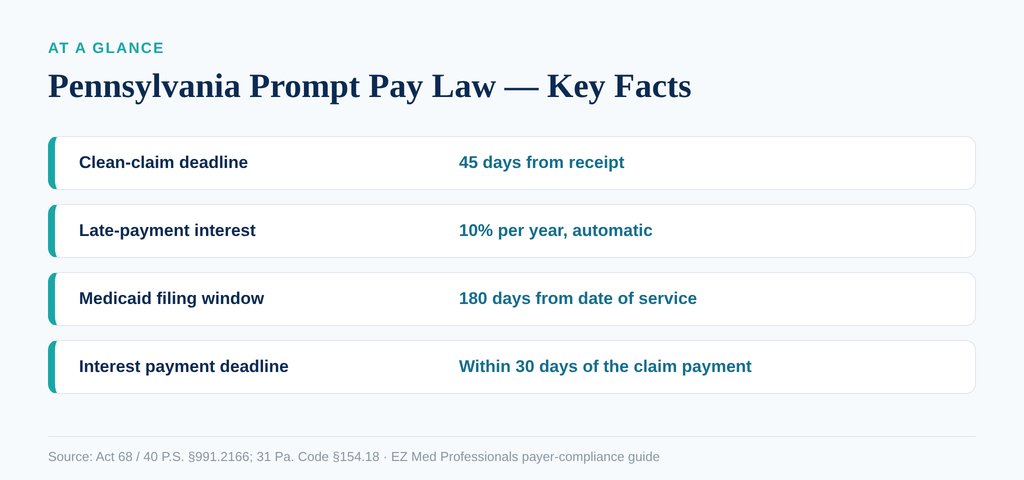
- Commercial insurers and managed care plans in Pennsylvania must pay a clean claim, or the uncontested portion of a contested claim, within 45 days of receipt — one deadline, with no separate electronic/paper split.
- Late payment adds 10% annual interest automatically, running from the day after the due date through the date actually paid; interest under $2 isn’t owed.
- Interest must be paid within 30 days of the claim payment itself, and combined interest checks must itemize which claim each amount belongs to.
- Medical Assistance (Medicaid) providers must submit claims within 180 days of the date of service under a separate rule, 55 Pa. Code §1101.68.
- Providers must contact the insurer directly about an unpaid claim before filing a complaint with the Pennsylvania Insurance Department.
Which claims the rule covers
Act 68’s prompt-pay provisions apply to commercial health insurance and managed care plans — HMOs, PPOs, and similar products regulated by the state. The same 45-day standard also applies to Medical Assistance (Medicaid) and CHIP managed care plans paying provider claims, under a parallel subsection of the statute. The rule does not cover automobile insurance medical claims or workers’ compensation, which run on their own fee schedules and deadlines under separate Pennsylvania law (motor vehicle financial responsibility law and the workers’ compensation fee schedule respectively).
Self-funded ERISA employer plans fall outside Pennsylvania’s prompt-pay rule, as in most states, since those are governed by federal law instead.
The 45-day clean claim deadline
Under 31 Pa. Code §154.18(a), an insurer or managed care plan must pay a clean claim — or the undisputed portion of a claim it’s contesting — within 45 days of receiving it. A claim counts as paid on the date a check is mailed or an electronic funds transfer is made, not the date the provider deposits it. If a paid claim is later readjudicated because new information comes in, a fresh 45-day clock starts from the date that information is provided, rather than running from the original claim date.
The regulation also requires insurers to answer a provider’s status inquiry on a claim within 45 days of the original submission, or 30 days of the inquiry itself, whichever applies — a useful hook for a billing team that hasn’t heard back on a claim nearing the deadline.
Interest on late payments
If a clean claim isn’t paid within 45 days, the statute adds interest at 10% per year automatically, calculated from the day after the required payment date through the date the claim is actually paid. That interest must reach the provider within 30 days of the claim payment itself — either on the same check or a separate one. If an insurer combines interest from several late claims into one check, it must itemize each claim and its interest amount rather than sending a lump sum. Interest totaling less than $2 on a single claim isn’t required.
| Situation | Rule | Governing authority |
|---|---|---|
| Commercial clean claim, pay-or-contest deadline | 45 days from receipt | 40 P.S. §991.2166; 31 Pa. Code §154.18(a) |
| Late payment interest | 10% per year, from day after due date to date paid | 40 P.S. §991.2166 |
| Interest payment deadline | Within 30 days of the claim payment | 31 Pa. Code §154.18(c) |
| Readjudicated claim | New 45-day period from date new information is provided | 31 Pa. Code §154.18(d) |
| Medical Assistance (Medicaid) claim filing | Within 180 days of date of service | 55 Pa. Code §1101.68(b)(1) |
| Status inquiry response | 45 days of submission, or 30 days of inquiry | 31 Pa. Code §154.18(f) |
Medical Assistance filing deadlines run separately
Medicaid (Medical Assistance) claims in Pennsylvania follow their own filing rule rather than the Act 68 payment deadline: providers generally must get the original invoice to the Department within 180 days of the date of service. Nursing facility and ICF-type providers count that 180 days from the last day of the billing period instead of the date of service. This filing deadline is separate from, and runs alongside, the 45-day payment clock that applies once a Medicaid managed care plan actually has the claim.
Filing a complaint with the Pennsylvania Insurance Department
Before filing a complaint, a provider must first contact the insurer directly about the unpaid or late claim — that initial contact is a prerequisite under the regulation. If the insurer doesn’t respond to a status inquiry within the required window, or otherwise fails to comply with the prompt-pay rule, the provider can submit a complaint to the Pennsylvania Insurance Department under 31 Pa. Code §69.26, which specifies what information the complaint must include (claim number, dates, amounts, and the insurer’s response or lack of one). The Department can investigate a prompt-pay issue on its own initiative even if a provider skipped the initial contact step, so a documented pattern across many claims from the same payer is worth flagging even without a perfect paper trail on each one.
Sample scenario (fictional data): a late clean claim
A Pennsylvania radiology practice submits a clean claim to a commercial PPO on March 1. Under Act 68, the insurer owes payment by April 15 (day 45). It pays on May 5, 20 days late. At 10% annual interest, a $1,800 claim run 20 days late works out to roughly $9.86 in interest, which must reach the practice within 30 days of that May 5 payment — either on the same check or a separate, itemized one. If the interest check never arrives, that’s worth raising directly with the insurer first, then escalating to the Insurance Department if it’s part of a larger pattern.
Practical checklist for Pennsylvania claims
- Log the actual receipt date for every claim, not the submission date — the 45-day clock runs from receipt.
- Track Medical Assistance (Medicaid) claims against the separate 180-day filing deadline, distinct from the 45-day payment clock.
- Flag any commercial payment that lands after day 45 and confirm the 10% interest arrived within 30 days of that payment — on its own line, not folded silently into the claim total.
- Use the status-inquiry right (45 days post-submission, or 30 days post-inquiry) to flag claims that are going quiet before they become a prompt-pay dispute.
- Contact the insurer directly first on any unpaid claim before filing a Pennsylvania Insurance Department complaint — that step is required, not optional.
- Keep auto-accident and workers’-compensation claims on their own separate tracking; Act 68’s 45-day/10% rule doesn’t apply to either.
Frequently asked questions
How long does a Pennsylvania insurer have to pay a clean claim?
Under Act 68 (40 P.S. §991.2166) and 31 Pa. Code §154.18, insurers and managed care plans must pay a clean claim, or the undisputed portion of a contested one, within 45 days of receiving it.
What interest rate applies to a late-paid claim in Pennsylvania?
Interest accrues at 10% per year, running from the day after the payment was due through the date it’s actually paid, and must reach the provider within 30 days of that payment. Interest under $2 isn’t required.
Does Pennsylvania’s prompt-pay law cover Medicaid claims?
The 45-day payment deadline also applies to Medical Assistance and CHIP managed care plans. Separately, providers generally must file Medicaid claims within 180 days of the date of service under 55 Pa. Code §1101.68.
Does the 45-day rule apply to auto-accident or workers’ compensation claims?
No — Act 68’s prompt-pay rule covers commercial health insurance and managed care only. Motor vehicle and workers’-compensation medical claims follow their own separate Pennsylvania fee-schedule and deadline rules.
How do I report a late-paid claim in Pennsylvania?
Contact the insurer directly first — that’s required before a complaint. If the issue isn’t resolved, a provider can file a complaint with the Pennsylvania Insurance Department under 31 Pa. Code §69.26, including the claim number, dates, amounts, and the insurer’s response.
Using Pennsylvania’s prompt-pay rules to protect cash flow
Pennsylvania’s single 45-day, 10%-interest standard for commercial claims is more straightforward than many states, but the separate Medicaid filing deadline and the auto/workers’-comp carve-outs mean a claim-type-aware tracking process still matters. EZ Med Professionals builds that payer-by-payer tracking into the revenue cycle management work we do for Pennsylvania practices, so a missed interest payment turns into recovered revenue instead of a quiet write-off.

