
Payer Policy Compliance Guide for Medical Practices
Payer policy compliance means billing each claim the way that payer’s own rules require: its coverage and payment policies, prior authorization lists, coding edits and filing limits. Practices that keep those rules in one tracked place and build them into daily work avoid most policy-driven denials.
This guide explains where payer rules live, the Medicare rules most payers build on, how to set up a policy tracker, how to handle policy changes and how to use denials to find gaps. If you’d rather hand this work off, our medical billing and revenue cycle services cover it.
| Key takeaways Payer rules sit in layers: law, your contract, the provider manual, policies and bulletins.A simple tracker with an owner, sources and effective dates prevents most surprises.Every policy change needs a log, an impact check, updates, a staff briefing and a claim check.Denial codes show which rule your process missed. |
What Counts as a Payer Policy
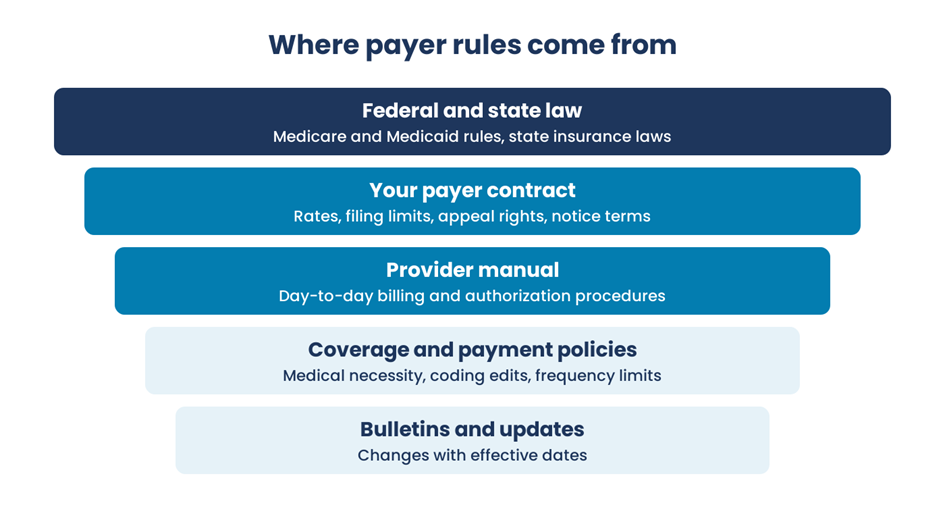
In short, the contract sets the terms, the provider manual explains procedures, and individual policies set coverage, coding and frequency rules that bulletins then change.
| Rule source | What it controls | Where to find it |
| Payer contract | Rates, filing limits, appeal rights, how policy changes are announced | Your signed agreement and amendments |
| Provider manual | Claim submission, authorization steps, appeals | Payer website or provider portal |
| Coverage (medical) policies | Which services are covered and the documentation that proves need | Payer policy library; for Medicare, NCDs and LCDs |
| Payment (reimbursement) policies | Modifier use, bundling, frequency and site-of-service rules | Payer policy library and bulletins |
| Prior authorization lists | Services that need approval before they’re done | Provider portal, often by plan type |
The Medicare Rules Most Payers Build On
Medicare coverage rules come from National Coverage Determinations (NCDs), which apply nationwide, and Local Coverage Determinations (LCDs), which your Medicare Administrative Contractor (MAC) sets with companion billing and coding articles. All of them are in the CMS Medicare Coverage Database.
Coding edits come from the National Correct Coding Initiative. Its procedure-to-procedure (PTP) edits block code pairs that shouldn’t be billed together, and its medically unlikely edits (MUEs) cap units per day. CMS updates both files quarterly on its Medicare NCCI edits page, so your scrubber needs the same schedule.
Medicare claims must be filed within one calendar year of the date of service under 42 CFR 424.44 on time limits for filing claims; our Medicare timely filing guide covers the exceptions. Commercial payers set their own limits in the contract and provider manual, and many write their own edits, so check your payer’s manual rather than assuming it follows Medicare.
How to Build a Payer Policy Tracker
A tracker doesn’t need special software. A shared spreadsheet works if it has an owner and a schedule.
- Name an owner. One person, usually the billing manager, keeps the tracker current and signs off on changes.
- Start with volume. List your top payers and the services that bring in the most revenue or the most denials.
- Record the rule and its source. For each payer and service, note authorization needs, documentation, codes and modifiers, frequency limits and the filing limit, with a link to the policy and its effective date.
- Set a review rhythm. Check payer bulletins on a fixed schedule and line up Medicare reviews with the quarterly NCCI release.
- Keep old versions. Claims are judged by the policy in effect on the date of service, so archive superseded versions instead of overwriting them.
Sample (fictional data). Replace these plan names, services and dates with your own payers and policies.
| Payer | Service | Rule | Source checked | Effective |
| Northgate Health Plan | Lumbar spine MRI | Prior authorization through the plan’s imaging vendor | Provider portal policy page, 10/05/2026 | 01/01/2026 |
| Summit PPO | E/M with minor procedure | Modifier 25 claims reviewed for separate documentation | Payment policy bulletin, 06/12/2026 | 07/01/2026 |
| Riverbend Medicaid Plan | Outpatient physical therapy | Authorization needed after the yearly visit limit | Provider manual, therapy chapter, 09/20/2026 | 10/01/2026 |
Build the Rules Into Daily Work
A tracker only helps when each team uses it at the right moment. At scheduling and check-in, staff confirm coverage and authorization needs; our guides to streamlining eligibility verification and tracking prior authorizations cover those steps.
Providers need short, specific notes on what a payer’s coverage policy expects in the record. Coders and billers load payer edits into the claim scrubber; this look at claim scrubbing explains how it catches errors before submission. Then the filing queue is worked against each payer’s limit.
When a Payer Changes a Policy
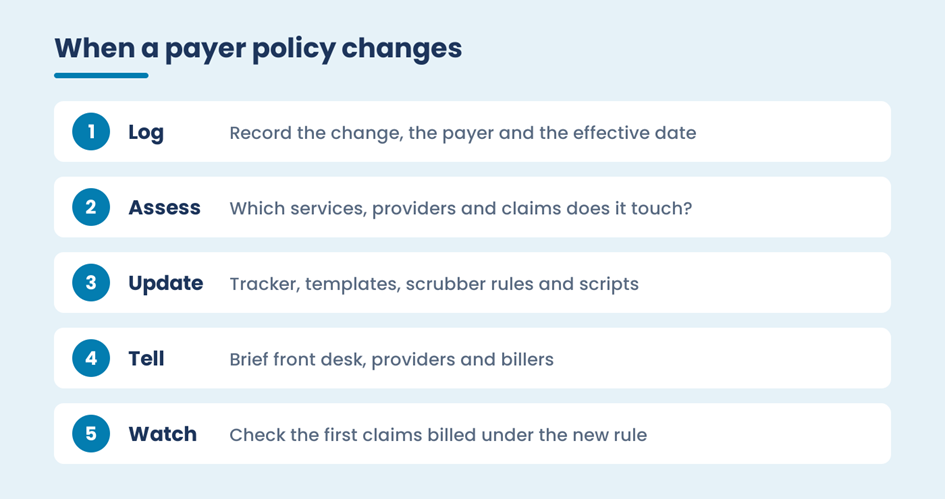
Handle every change the same way: log it with the payer and effective date, assess which services and claims it touches, update the tracker, templates, scrubber rules and scripts, brief the staff affected, then check the first claims billed under the new rule.
Turn Denials Into Policy Fixes
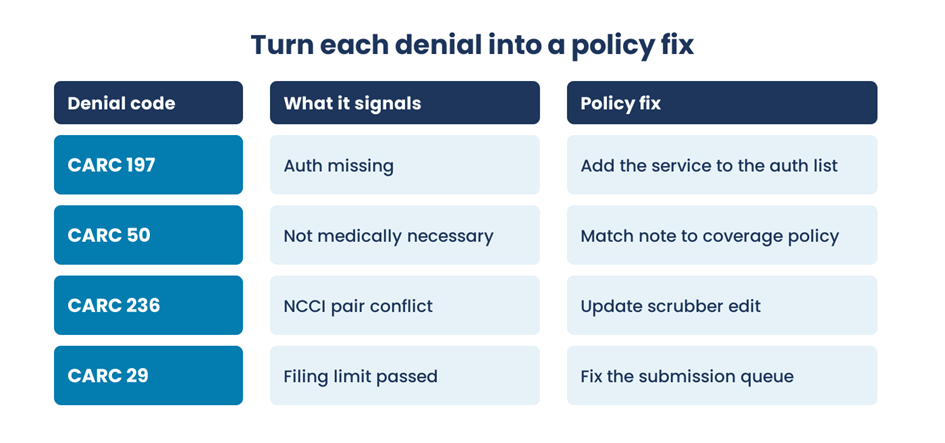
Each denial carries a CARC (claim adjustment reason code) on the remittance, and patterns in those codes show which rule your process missed.
| CARC | What it usually means | Policy fix |
| 197 | Authorization or precertification was missing | Add the service to that payer’s authorization list |
| 50 | Payer found the service not medically necessary | Compare the note with the coverage policy; update provider guidance |
| 236 | The code pair conflicts with an NCCI edit | Update the scrubber with the current quarter’s edits |
| 29 | The filing limit passed | Track each payer’s limit in the filing queue |
| 4 | The modifier doesn’t fit the procedure code | Update modifier rules in the tracker |
Our guide to common claim denial codes covers more codes and how to appeal them.
Getting Ready for a Payer Audit
Auditors judge claims against the policy in effect on the date of service. Keep the archived policy versions, your change log, training records and internal audit results together, so you can show which rule you followed and when. These records fit inside a broader program; our guide on setting up a medical billing compliance program covers that structure.
Frequently Asked Questions
What is payer policy compliance?
Payer policy compliance means following each insurer’s billing rules on every claim: its coverage policies, payment policies, authorization lists, coding edits and filing limits. It sits alongside legal compliance with HIPAA and fraud laws, but focuses on the contract and policy terms that decide whether a specific payer pays a specific claim.
How often do payer policies change?
Changes come throughout the year. Medicare updates NCCI edits quarterly and coverage documents as needed, while commercial payers post bulletins on their own schedules. Many contracts say how much notice a payer must give, so check yours, and review bulletins on a fixed schedule rather than waiting for denials to reveal a change.
Who should own payer policy compliance in a practice?
One named person should own the tracker, usually the billing manager or revenue cycle lead. Front desk staff, providers and coders each own their part of the workflow, but a single owner makes sure changes are logged, staff are told and the first claims under a new rule get checked.
Is payer policy compliance the same as a compliance program?
No. A compliance program covers your legal duties, such as fraud and abuse laws, privacy and internal reporting. Payer policy compliance is narrower: following each payer’s contract and billing policies. A strong compliance program usually includes payer policy tracking as part of its auditing and monitoring work.
Get Help Staying on Top of Payer Rules
Payer policy compliance gets easier once rules live in one tracker, changes follow a routine and denials feed back into your process. If keeping up with payer rules is pulling your team away from patients, contact the EzMedPro team to talk through where your claims are getting stuck.
Sources: CMS Medicare NCCI edits; 42 CFR 424.44; CMS Medicare Coverage Database. Sample tracker data is fictional. This guide is billing information, not legal advice.

