
How to Appeal a Denied Medical Claim, Step by Step
To appeal a denied medical claim, read the denial reason, confirm the denial is really a dispute and not a billing error, gather the records that prove your case, and file a written appeal before the payer’s deadline. If the first appeal fails, move to the next level. This guide covers each step, Medicare and commercial deadlines, a complete sample appeal letter and the mistakes that sink appeals.
| Key takeaways Fix billing errors with a corrected claim or reopening; appeal only real disagreements.Medicare gives you 120 days from receiving the initial determination to request a redetermination.Commercial appeal windows come from your contract and the payer’s provider manual.A strong appeal answers the exact denial reason with records and a policy citation. |
Correct It or Appeal It?
Many denials don’t need an appeal at all. A wrong date of birth, a missing modifier or a transposed member ID is a billing error, and the fix is a corrected claim with the payer’s frequency code, or for Medicare, a reopening for a minor clerical error. Appeals are for disagreements: the payer says the service wasn’t necessary, wasn’t covered or was bundled, and you believe the record shows otherwise. Sorting denials this way is the first habit in our denial management best practices.
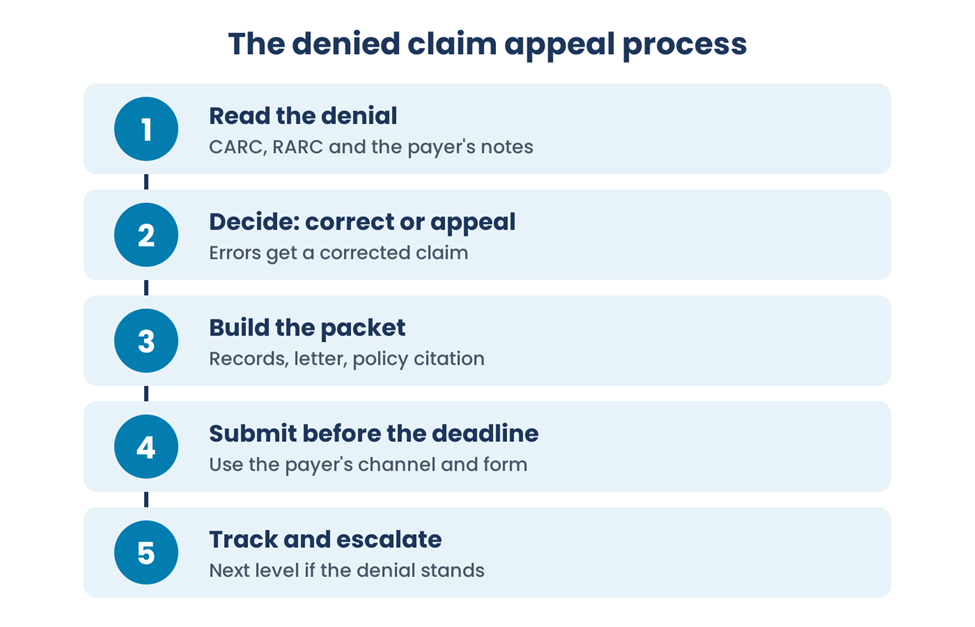
Step 1: Read the Denial Closely
Start with the remittance or EOB (explanation of benefits), not the phone. The CARC, or claim adjustment reason code, says why the line was cut; the RARC, or remittance advice remark code, adds detail. Our guide to claim denial codes explains the common ones.
Then pull the original claim and compare it line by line. A bundling denial, for example, is usually an NCCI (National Correct Coding Initiative) edit: check whether a modifier was missing or whether the services really are separate before you appeal. Our guide to bundling and unbundling CPT codes walks through that check.
Step 2: Check the Deadline
Appeal deadlines are strict, and a late appeal is dismissed no matter how strong it is. Log the deadline the day the denial posts.
| Payer type | First-level deadline | Where the rule comes from |
| Original Medicare | 120 days from receipt of the initial determination | Federal regulation; receipt is presumed 5 days after the notice date |
| Medicare Advantage | Set by the plan for contracted providers | Plan contract and provider manual |
| Commercial plans | Set by your contract | Contract and provider manual |
| Medicaid | Set by the state program or managed care plan | State Medicaid manual |
For Original Medicare, the CMS redetermination page confirms the 120-day window and the 60-day decision timeframe. Appeal deadlines are separate from claim filing limits, which our Medicare timely filing guide covers.
Step 3: Build the Appeal Packet
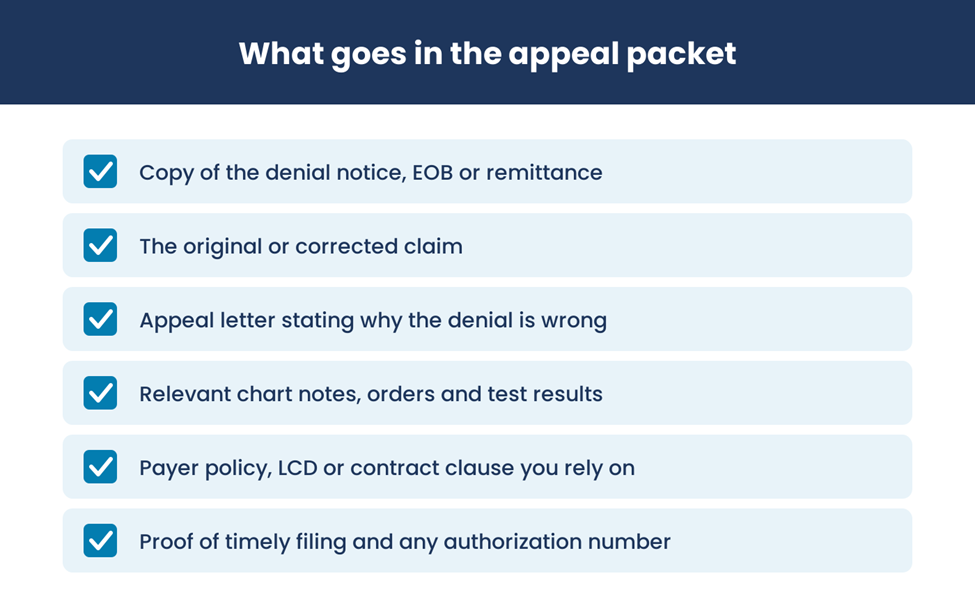
The checklist above covers six items, from the denial notice to proof of timely filing. Send only records that answer the denial reason. A medical necessity denial needs the visit note, orders and results that show why the service was needed; a 300-page chart dump makes the reviewer’s job harder.
Step 4: Write the Appeal Letter
Keep the letter to one page. Name the claim, quote the denial reason, state in one sentence why it’s wrong, and point to the evidence and the policy that support you. Here’s a complete example you can adapt.
Sample (fictional data).
Re: Request for redetermination. Patient: Jordan Avery. Member ID: SAMPLE-4471. Claim number: 7700-2291-18. Date of service: August 12, 2026. CPT 20610, left knee.
We are appealing the denial of this claim, which was reported with CARC 50, service not deemed medically necessary.
The patient has documented primary osteoarthritis of the left knee with pain limiting walking, and six weeks of physical therapy and oral anti-inflammatory medication did not relieve symptoms, as the enclosed notes from June 3 and July 15, 2026 show. These facts meet the indications in the payer’s injection policy, section 2, which is enclosed.
We ask that the claim be reprocess and pay. Enclosed: denial notice, claim copy, office notes, therapy summary and policy excerpt. Please contact our billing office with any questions.
Replace the patient, claim, dates, codes and clinical facts with your own, and cite the policy section that actually applies to your denial.
Step 5: Submit, Track and Escalate
Submit through the payer’s portal or the address on the denial, keep the confirmation and set a follow-up date. If the payer upholds the denial, the decision letter tells you the next level and its deadline.
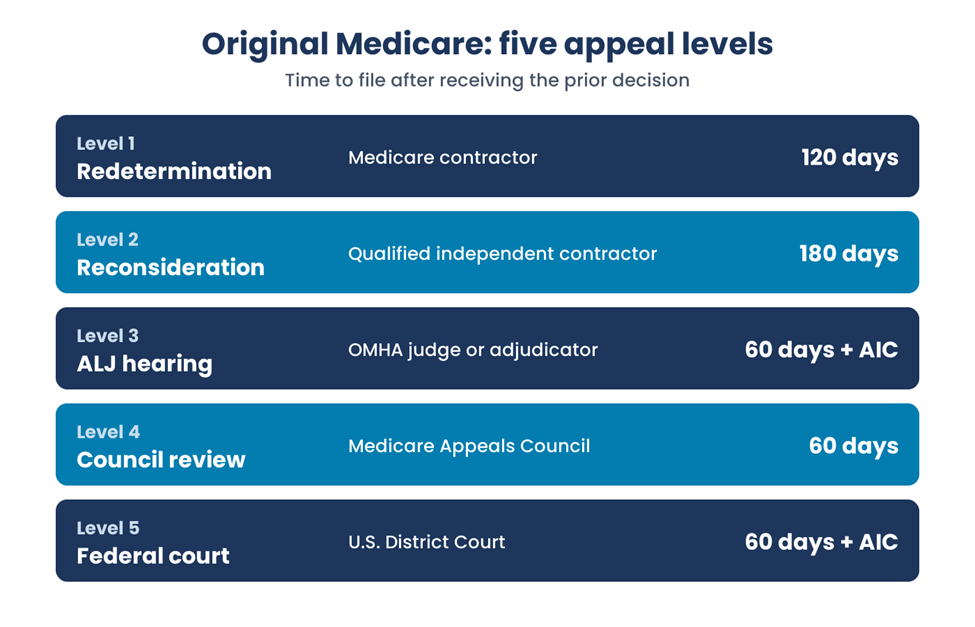
Original Medicare runs from redetermination by the contractor, to reconsideration by a qualified independent contractor (180 days), to an administrative law judge (60 days), the Medicare Appeals Council (60 days) and federal court (60 days). Levels 3 and 5 require a minimum amount in controversy: $200 and $1,960 for requests filed in 2026. The CMS amount in controversy notice for 2027 keeps the hearing threshold at $200 and raises the court threshold to $2,000 from January 1, 2027.
Commercial plans usually offer one or two internal appeal levels, then external review by an independent reviewer. Member appeal rights on most plans are summarized on the HealthCare.gov internal appeals page, including the 180-day window for members. Denials that arrive months after payment follow a different path, covered in our guide to retroactive claim denials.
Mistakes That Sink Appeals
| Mistake | Better approach |
| Appealing a billing error | Send a corrected claim or request a reopening. |
| Missing the deadline | Log the deadline the day the denial posts. |
| A letter that doesn’t address the denial reason | Answer the CARC directly in the first paragraph. |
| Sending the whole chart | Send only records that prove the point. |
| No follow-up | Diary a check-in date and escalate on time. |
Frequently Asked Questions
How long do I have to appeal a denied Medicare claim?
For Original Medicare, you have 120 days from receiving the initial determination to request a redetermination, and the notice is presumed receive 5 days after its date. The contractor generally decides within 60 days. Each later level has its own window, usually 180 or 60 days.
What is the first step when appealing a denied claim?
Review the remittance or EOB. The CARC and RARC tell you why the claim was denied, and that decides whether you need a corrected claim or a true appeal. Calling the payer or resubmitting before you understand the reason often wastes time and can trigger a duplicate denial.
Should I resubmit or appeal a denied claim?
Resubmit a corrected claim when the denial came from your own error, such as a wrong code or missing modifier. Appeal when the claim was correct and you disagree with the payer’s decision, such as a medical necessity or bundling determination that the record contradicts.
Can a provider appeal on the patient’s behalf?
Providers can appeal in their own right for most denied claims they billed. For member-level appeals or external review on commercial plans, the provider often needs the patient’s written authorization to act as their representative. Check the payer’s form and rules before filing.
Turning Denials Into Payments
Knowing how to appeal a denied medical claim comes down to discipline: read the reason, fix what’s yours to fix, appeal what isn’t, and never miss a deadline. If appeals are piling up faster than your team can work them, talk to the EzMedPro team about medical billing and denial support.
Sources: CMS First Level of Appeal: Redetermination page, CMS MLN booklet Medicare Parts A and B Appeals Process, the CY 2027 amount in controversy notice (CMS-4213-N) in the Federal Register, and HealthCare.gov internal appeals guidance. CPT is a registered trademark of the American Medical Association. This article explains billing practice only and is not legal advice.

