
Medical Billing Audit Cost: What a Practice Should Expect to Pay, and Why Quotes Differ?
Medical billing audit cost is the total price of reviewing coded claims against documentation, and it depends on sample size, audit depth and who performs the work. One published price list shows about $75 to $100 per reviewed encounter, while another vendor describes whole engagements from a few thousand to tens of thousands of dollars.
Most audit pricing sits behind a request-a-quote form, so practice owners often budget without a single reference number. This guide collects the figures that are actually published, explains why quotes differ and shows how to compare them fairly. It includes four worked examples with real arithmetic and a self-assessment checklist near the end.
It is written for practice owners, office managers and billing decision-makers at small and mid-size US practices. Figures reflect information available in October 2026, and each carries a source label. No audit price is a standard, so treat every dollar figure as a reference point to test against your own quotes.
Medical billing audit cost at a glance
Ten numbers frame most audit budgets: three price references, three sampling and review figures and four exposure and timing limits. Use the table to check a quote against published information. Only the repayment deadline, lookback period and penalty range are rules; the prices and timelines are references that vary by vendor and scope.
Audit Cost
| Metric | Practical target or range | Review frequency | Source type |
| Basic chart audit, one vendor’s list price | $1,495 per 20 encounters, about $75 per encounter | Each time you request quotes | V |
| Comprehensive chart audit, same vendor | $1,995 per 20 encounters, about $100 per encounter | Each time you request quotes | V |
| Total external audit engagement | A few thousand to tens of thousands of dollars | Annual budget | C |
| Baseline sample size | 5–10 records per physician, or 5+ per federal payer, or 5+ per service type | Annually and after coding changes | G |
| Medicare TPE review round | 20–40 claims per round, up to 3 rounds, at least 45 days between | When contacted by your MAC | G |
| External audit turnaround | About 4–6 weeks | Per audit | C |
| Overpayment report-and-return deadline | 60 days after identification; paused up to 180 days for a timely good-faith investigation | Per finding | S |
| Overpayment lookback | 6 years | Per finding | S |
| False Claims Act penalty per claim | $14,308 to $28,619, plus damages (assessed after July 3, 2025) | Annual adjustment | S, L |
| Medicare fee-for-service improper payment rate | 6.55% (about $28.83 billion), fiscal year 2025 | Annual CMS report | S |
Source types: S = published rule or published government figure. G = published guidance from a named government body, not a mandate. V = one named vendor’s published list price, not a market average. C = commonly reported across industry sources, mostly vendor guides without underlying data. L = law-firm summary of a government adjustment. The penalty range is adjusted annually; confirm the current amount.
A price reference is a prompt to ask questions, not a verdict on any quote. The improper payment rate is a national Medicare figure, not a prediction for your practice. Your own documentation, specialty and payer mix decide how much review you need, so start with the question the audit must answer.
Four ways auditors charge, and what each really buys
Auditors usually charge per encounter, a flat project fee, an hourly rate or a retainer. Each model shifts risk differently, and none is cheaper by default. Per-encounter pricing links cost to the number of charts reviewed, while flat and hourly pricing hide that number unless the quote states it.
| Model | How it works | Best when | Watch for |
| Per encounter or chart | A fee for each reviewed encounter, or a fixed fee per block such as 20 encounters | You want a predictable price tied to sample size | Minimum blocks and what each encounter includes |
| Flat project fee | One price for a defined scope, such as a practice-wide baseline | Scope and deliverables are written down | Unstated sample size and provider count |
| Hourly | Billed by reviewer time, often with travel and materials separate | Scope is unclear or exploratory | Open-ended hours; ask for a cap |
| Retainer | Ongoing monthly review and education | You need continuous monitoring across providers | Overlap with billing staff duties |
Illustrative summary of patterns in vendor guides and an AAPC forum thread (2019); actual terms vary by vendor, and a pricing model alone does not predict total cost.
Do not compare a coding per-chart rate with an audit rate. MedCodex Health (2026) reports coding outsourcing at roughly $1.50 to $8.00 per encounter, but that prices coding production, not an independent review of someone else’s coding. An audit reviews documentation, codes and billing, which takes more reviewer time per encounter.
What moves the price up or down?
Sample size, audit depth and specialty complexity move the price most. Turnaround, deliverables and expenses add the rest. A practice that fixes these inputs before asking for quotes gets comparable numbers, while a practice that leaves them open gets quotes that cannot be compared.
Sample size and number of providers
Price scales with the number of encounters reviewed. A four-physician practice using the CMS guideline of five to ten records per physician needs about 20 to 40 charts. Add charts when a provider bills high-level visits often, and use a CPT utilization report to focus on the services you bill most.
Audit depth and deliverables
A basic audit compares billed services with the record. A comprehensive audit adds documentation, coding and billing findings plus the financial impact. Practice Performance Partners lists its forensic tier at custom pricing. Ask whether the price includes encounter-level findings, provider education and a written report.
Specialty, turnaround and expenses
- Complexity: surgical and inpatient charts take longer than routine office visits, so expect a higher rate per encounter when the sample is surgical.
- Turnaround: one vendor guide cites about 4–6 weeks; ask for a rush surcharge in writing when you need results before a payer deadline.
- Expenses: an AAPC forum discussion notes that travel, printing and research materials are often billed separately.
- Data handling: the auditor will see protected health information, so confirm a business associate agreement before records move.
How to compare quotes on equal terms
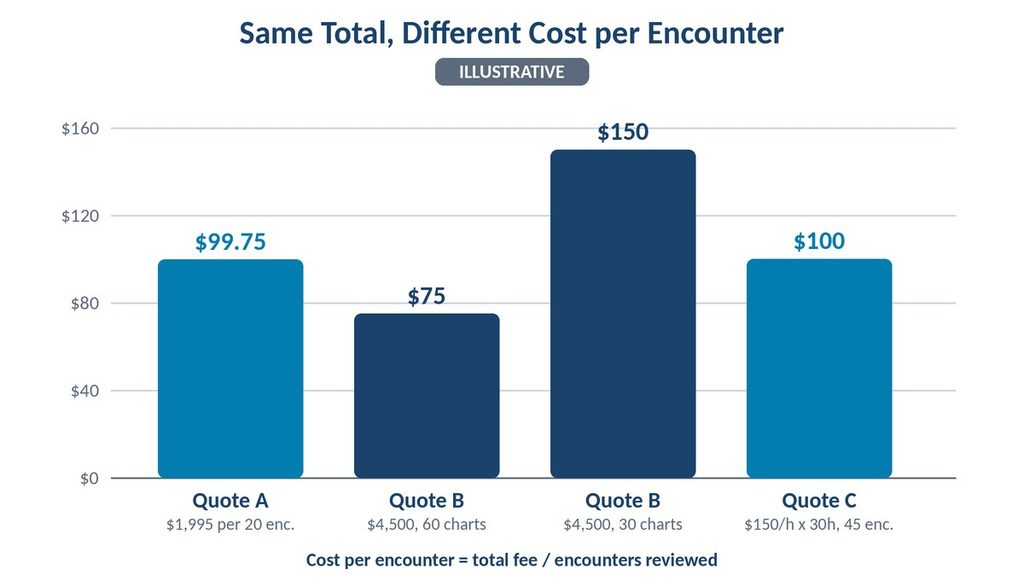
Convert every quote into cost per reviewed encounter before comparing. The formula is total fee ÷ encounters reviewed. A quote that does not state the encounter count cannot be compared, so ask for it. Include audit rights and reporting terms from your billing agreement, covered in the contract review checklist.
Illustrative scenario (not an actual client record): Quote A is a comprehensive audit at $1,995 per 20 encounters, or $99.75 each. Quote B is a $4,500 flat fee with no stated sample. At 60 charts it costs $75 each; at 30 charts it costs $150. Quote C is $150 per hour for 30 hours ($4,500); at an assumed 1.5 encounters per hour, that is 45 encounters, or $100 each.
In vendor quote comparisons, a common pattern is that two quotes with the same total differ by a factor of two in the charts actually reviewed. Ask each vendor to confirm the sample size, who selects it, the report format and the number of provider feedback sessions in writing.
How many charts do you actually need to pay for?
Most small practices need 20 to 40 reviewed encounters for a baseline, not a full-chart sweep. The CMS fact sheet on self-audits suggests five to ten records per physician, at least five per federal payer or at least five claims per service type, with larger samples for higher-risk areas. Random selection by someone outside billing is the key control.
Illustrative scenario (not an actual client record): a four-physician practice reviews 10 charts per physician, or 40 encounters. At the published $1,495 and $1,995 per 20 encounters, that is two blocks: $2,990 for a basic audit or $3,990 for a comprehensive one. Other vendors and scopes will price differently, so use the figures as a reference only.
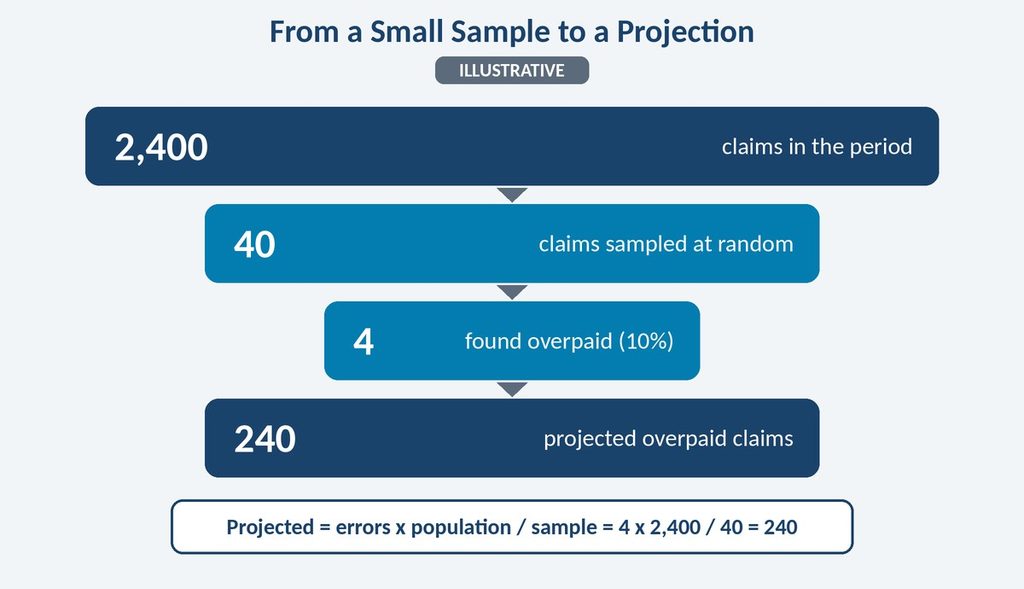
How does a small sample project to the whole practice?
CMS gives the formula: (items in error × items in population) ÷ items sampled. Illustrative scenario (not an actual client record): a 40-claim sample from 2,400 claims finds 4 overpaid claims. Projected overpaid claims = 4 × 2,400 ÷ 40 = 240. At an average overpayment of $42, the estimate is $10,080. A sample this small gives a rough indicator, not a precise figure.
Whether and how to extrapolate a repayment is a decision for counsel, not for the formula alone. Treat the projection as a reason to widen the review. When errors cluster, the documentation guide for higher-level office visits and the CPT bundling and unbundling guide show where findings usually start.
Internal audit or outside auditor: what does each cost?
An internal audit costs reviewer hours; an outside audit costs a fee and some internal time. Internal review is cheaper on paper but gives less independence, and CMS advises that staff who bill the sampled services should not select the sample. Choose by who is available, who is independent and what the findings will be used for.
| Approach | Main cost | Independence | Best when |
| Internal reviewer outside the billing team | Staff hours at a loaded hourly rate | Moderate | You want a baseline or a routine check |
| Outside auditor, basic scope | Vendor fee plus internal chart-pull time | High | You need an unbiased error rate |
| Outside auditor, comprehensive scope | Higher vendor fee, includes financial impact | High | Findings may affect repayment or payer disputes |
Illustrative scenario (not an actual client record): an internal reviewer checks 40 charts at 40 minutes each, or 26.7 hours, plus 8 hours to select the sample and write the report, for 34.7 hours. At an assumed loaded cost of $50 per hour, that is about $1,733. The BLS median pay for medical records specialists was $24.59 per hour in May 2025, a floor for the role rather than an auditor’s rate.
In practice reviews, a common pattern is that the largest hidden cost is provider time in chart pulls and feedback sessions, not the auditor’s fee. Budget for it. For the staffing side of this choice, see the outsource vs in-house comparison, and use the coding audit preparation checklist to cut prep time.
What does skipping the audit cost?
Skipping an audit does not remove the risk; it moves the cost to a later, less controlled moment. Overpayments must be reported and returned within 60 days of identification under 42 CFR 401.305, and the lookback is six years. The audit is how a practice finds problems on its own schedule.
Exposure differs by payer, so check each contract and program rule. Medicare reviews can follow a Targeted Probe and Educate pattern, described by CMS on TPE, of 20 to 40 claims per round. Problems that do not improve after three rounds are referred to CMS for next steps such as extrapolation or prepayment review.
| Payer type | Audit exposure | What to check |
| Medicare | MAC reviews, TPE, national error-rate testing, 60-day overpayment rule | Documentation support for billed levels and services |
| Medicare Advantage | Plan audits and recoupments under the provider contract | Contract audit and appeal windows |
| Medicaid | State program integrity reviews; federal law requires returning identified overpayments | Your state’s rules and fee schedule |
| Commercial | Contract-based payer audits and recoupment | Audit clauses and look-back limits in each contract |
Illustrative summary; specific rules and time limits vary by program, state and contract.
Illustrative scenario (not an actual client record): the False Claims Act penalty range of $14,308 to $28,619 per claim, assessed after July 3, 2025, applies to each false claim, plus damages. For 10 claims the penalty range alone is $143,080 to $286,190. That is a statutory range, not a prediction. Compare it with a $3,990 comprehensive audit to see why the audit is a control, not a cost center.
Retroactive recoupments can arrive long after payment, as described in the guide to retroactive claim denials. A documented audit program also supports the compliance structure described in the compliance program setup guide and the wider HIPAA and OIG compliance overview.
How to budget for a first audit in six steps
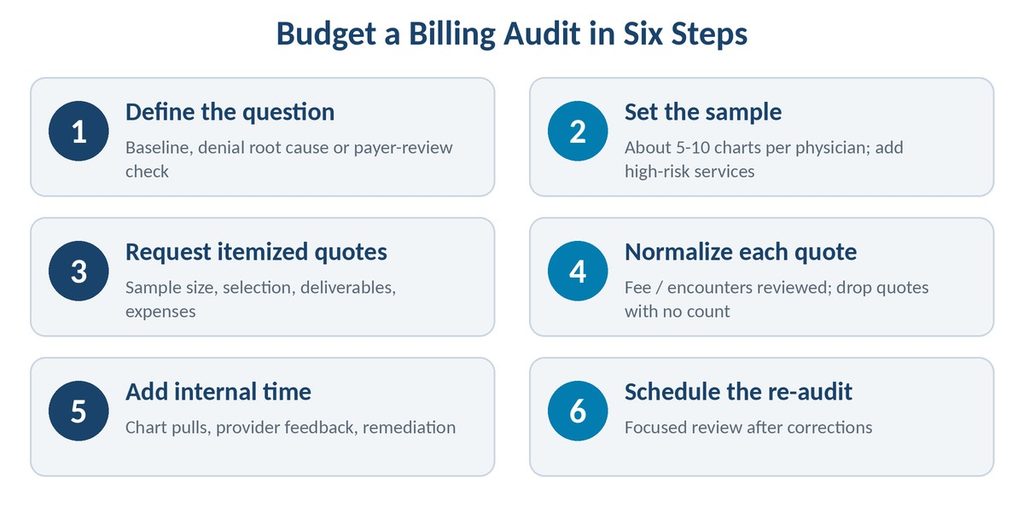
A first audit budget has six steps: define the question, set the sample, collect itemized quotes, normalize them, add internal time and remediation, and schedule the re-audit. Do each step in order, and stop when a quote cannot be normalized. The steps below use the numbers from this guide.
- Define the question: a compliance baseline, a denial root cause or a pre-payer-review check.
- Set the sample: about 5–10 charts per physician, adding charts for high-risk services.
- Request itemized quotes that state the sample size, who selects it, the deliverables and the expenses.
- Normalize each quote to cost per reviewed encounter and discard those that omit the encounter count.
- Add internal time for chart pulls and provider feedback, and a remediation allowance for education and template fixes.
- Schedule a focused re-audit after corrections, with timing based on your risk assessment.
How should you read the audit result?
Compare like for like: the same providers, code families and period, using the auditor’s written definition of an error. One audit is a snapshot, not a verdict. Judge the error rate by provider and by code family, because a blended figure can hide one provider or one E/M level that carries most of the problem.
- Ask how the auditor counts an error and whether undercoding is counted separately from overcoding.
- Request encounter-level findings so your team can verify a sample of them.
- Separate documentation fixes from coding fixes and billing fixes, because each has a different owner.
- When errors cluster in one area, re-audit that area first. See how accurate coding reduces denials and denial management best practices for follow-through.
In billing audits, a common pattern is that errors cluster in a few code families, such as E/M level selection and modifier use. A focused re-audit of those areas is usually cheaper than repeating a practice-wide review, and it tests the fixes where they matter most. Ask your auditor to rank findings by frequency and dollar impact so the re-audit targets the right areas.
How long does an audit take, and when do results show?
One vendor guide cites about 4 to 6 weeks for an external audit. A general planning range is 1 to 2 weeks for chart pulls, 2 to 4 weeks for review and 1 to 2 weeks for the report and education session. These are ranges, not guarantees, and they shift with sample size and how quickly records arrive.
- Partial results, weeks 1 to 6: the findings report and provider education session identify the top error patterns.
- Further progress, about 3 to 6 months: corrected templates and coding habits show up in new claims.
- Fuller confirmation, about 6 to 12 months: a focused re-audit tests whether the fixes held.
Which mistakes make an audit cost more than it should?
Most audit overspend comes from unclear scope, not from high fees. The mistakes below inflate cost or reduce the value of the findings, and each has a direct fix you can apply before you sign. Check this list against every quote you receive, and again when you read the final scope of work.
- Accepting a quote with no encounter count. Ask for the sample size and divide the fee by it.
- Letting billing staff choose the sample. Have someone outside the billing team select it randomly.
- Comparing coding rates with audit rates. Compare audit quotes only with audit quotes of similar scope.
- Buying a comprehensive audit when a focused one fits. Use a focused review when you know the problem area.
- Ignoring internal time. Budget provider and staff hours for chart pulls and feedback.
- Auditing without a repayment process. Write down who decides on repayment within the 60-day deadline before the audit starts.
- Never re-auditing. A single audit shows a snapshot; a re-audit shows whether fixes worked.
Quick summary
- Published audit prices are scarce; one vendor lists about $75 to $100 per reviewed encounter.
- Normalize every quote to cost per reviewed encounter before comparing.
- A baseline sample is commonly 5–10 records per physician, with random selection by someone outside billing.
- Projections from small samples are rough indicators; counsel decides repayment method.
- Overpayments must be reported and returned within 60 days of identification.
- Internal audits cost hours; outside audits add independence at a higher fee.
- Schedule a focused re-audit after corrections.
Self-assessment: is your audit budget ready?
Answer yes or no using documents rather than assumptions. Questions 1, 3, 5 and 8 carry the most weight, because a no on any of them is the most common source of avoidable cost or risk in a first audit.
- Do you know how many encounters your last audit actually reviewed?
- Do your quotes state the sample size and how it is selected?
- Have you converted each quote to cost per reviewed encounter?
- Does the sample cover at least 5–10 records per physician, or at least 5 per federal payer?
- Will someone outside the billing team select the sample at random?
- Do the quotes list deliverables, such as encounter-level findings and provider education?
- Is a business associate agreement in place before records are shared?
- Do you have a written process for the 60-day overpayment deadline?
- Have you budgeted internal time for chart pulls and provider feedback?
- Is a focused re-audit scheduled after corrections?
| Yes answers | Readiness | What to do |
| 9–10 | Budget-ready | Request quotes and proceed with the six-step process. |
| 6–8 | Partly ready | Fix questions 1, 3, 5 and 8 first, then request quotes. |
| 0–5 | Not ready | Do not sign a quote yet. Define the audit question, sample and repayment process first. |
When should you bring in an outside auditor?
Outside help makes sense when the audit outgrows your team’s time, independence or expertise. Five signals suggest the in-house approach has reached its limit. When two or more apply at the same time, an external review is usually the safer choice, because the findings may carry legal or payer consequences:
- Findings may require a repayment decision, and you need an independent error rate.
- A Medicare, Medicaid or commercial payer has asked for records or opened a review.
- No one outside billing can select the sample and review it objectively.
- Errors cluster in specialty-specific coding that your team does not audit regularly.
- Prior audits found problems but no one has verified that fixes held.
When evaluating an auditor, look for a written scope with the sample size, certified reviewers and encounter-level findings. Look also for a signed business associate agreement, a stated turnaround and a clear list of expenses. Ask how findings are handed to billing and providers for correction.
EZMedPro is one example. It delivers medical billing, coding, credentialing, denial management and compliance support through a US-based team, with an emphasis on transparent reporting and no hidden fees. Results vary by practice, so request a written scope and sample report from any vendor, including through EZMedPro’s revenue cycle management service, and see its wider billing and coding services.
Expert Insights
Medical billing audit cost is easiest to manage when you convert each quote into cost per reviewed encounter and tie the sample to the question you need answered. Published prices are rare, so use them as reference points and test them against your own quotes.
Only a few figures here are firm rules: the 60-day repayment deadline, the 180-day investigation pause, the 6-year lookback and the False Claims Act penalty range. The vendor prices, the 5–10 chart sampling guideline, the turnaround ranges and every worked example are practical or illustrative references.
The natural next question is what your own audit should review first. Start with the highest-risk provider or code family. Then ask vendors for itemized quotes that state the sample size and deliverables, beginning with a conversation with EZMedPro’s revenue cycle management team.
Frequently asked questions
How much does a medical billing audit cost?
No universal price exists. One published list prices a basic chart audit at $1,495 per 20 encounters and a comprehensive audit at $1,995 per 20, while another vendor says total engagements run from a few thousand to tens of thousands of dollars. Scope and sample size drive the difference.
What is a good price per chart for a billing audit?
One published vendor list works out to roughly $75 to $100 per reviewed encounter, which is a single data point rather than a market average. A good price is one that matches the scope in writing. Divide every quote by the number of encounters actually reviewed.
What is a good sample size for a billing audit?
A CMS Medicaid integrity fact sheet suggests a basic guideline of five to ten records per physician, at least five records per federal payer, or at least five claims per service type. Higher-risk areas may warrant more. Random selection by someone outside billing matters more than a larger number.
What is a good error rate in a coding audit?
No published standard sets a universal target. Auditors define errors differently, so ask how each is counted. Compare your rate with your own prior audit, by provider and code family, and treat a high rate in one area as a reason to re-audit that area.
How often should a practice audit its billing?
OIG’s 2023 general compliance guidance describes a schedule of audits based on risks found in an annual risk assessment. Many practices run a baseline audit each year and add focused reviews after coding changes, new providers or payer scrutiny. Frequency should follow risk, not the calendar alone.
Can my own billing staff run the audit?
Yes, with limits. CMS advises that staff who deliver or bill the sampled services should not select the sample. An internal reviewer outside the billing workflow can run a baseline audit, while an external reviewer adds independence when findings may affect repayment decisions or payer disputes.
Sources and methodology
(a) Published standards, rules and definitions from named bodies
- 42 CFR 401.305, requirements for reporting and returning overpayments (law.cornell.edu/cfr/text/42/401.305).
- CMS, Targeted Probe and Educate (TPE) program page (cms.gov/data-research/monitoring-programs/medicare-fee-service-compliance-programs/medical-review-and-education/targeted-probe-and-educate-tpe).
- CMS, Fiscal Year 2025 Improper Payments Fact Sheet, January 15, 2026 (cms.gov/newsroom/fact-sheets/fiscal-year-2025-improper-payments-fact-sheet).
- CMS Medicaid Integrity Program, Self-Audit fact sheet, February 2016 (cms.gov/files/document/selfauditfactfactsheet020116pdf), on sampling guidelines and the projection formula.
- US Bureau of Labor Statistics, Occupational Outlook Handbook, Medical Records Specialists, May 2025 data: median pay $24.59 per hour.
- HHS Office of Inspector General, General Compliance Program Guidance (November 2023), as summarized in a December 2023 law-firm review (cmhealthlaw.com).
(b) Named benchmarking data providers
No proprietary benchmarking dataset was used. MGMA, HFMA and AAPC publish compensation and revenue cycle data, but the prices and thresholds in this article are not drawn from those sources and are not attributed to them. Practices needing specialty-specific audit rates should request them from a named provider.

