
Urgent Care Billing in Florida: PIP, Workers’ Comp, Deadlines
Urgent care billing in Florida differs from most states because car-accident patients are covered by no-fault personal injury protection (PIP), on top of workers’ compensation, state prompt-pay rules and Medicaid managed care plans. Each has its own clock, and PIP has the strictest: initial care within 14 days of the accident and statements within 35 days of service. This guide explains what each rule means at registration and in the billing queue, and how to fix the denials they cause. For coding basics, see our guide to specialized billing for urgent care centers.
| Key takeaways Florida PIP reimburses 80% of reasonable medical expenses, up to $10,000, when initial care happens within 14 days of the accident.PIP statements generally cover services from the last 35 days, or 75 days after a timely notice of initiation of treatment.Insured major medical plans must pay or contest electronic claims within 20 days and paper claims within 40.Ask every patient whether the visit followed a car accident or a work injury. |
Urgent care billing in Florida at a glance
The reason for the visit decides the payer. This table shows where each claim goes and which clock is running.
| Payer type | Where the claim goes | Florida rule to track |
| Auto insurance (PIP) | The patient’s auto insurer | Up to $10,000 at 80% of reasonable expenses; initial care within 14 days of the accident; benefits overdue 30 days after written notice of the loss |
| Workers’ compensation | The employer’s carrier | No fixed provider billing deadline, so bill promptly; the carrier has 45 days to pay or deny |
| Insured major medical plans | The insurer | Electronic claims paid or contested in 20 days, paper claims in 40 |
| Medicaid managed care | The member’s health plan | The plan’s provider manual sets filing and appeal limits |
| Medicare | The Medicare contractor | Federal rules apply, not Florida deadlines |
Commercial payers set their own limits in the contract and provider manual, so check yours. Medicare follows federal rules, covered in our Medicare timely filing rules guide.
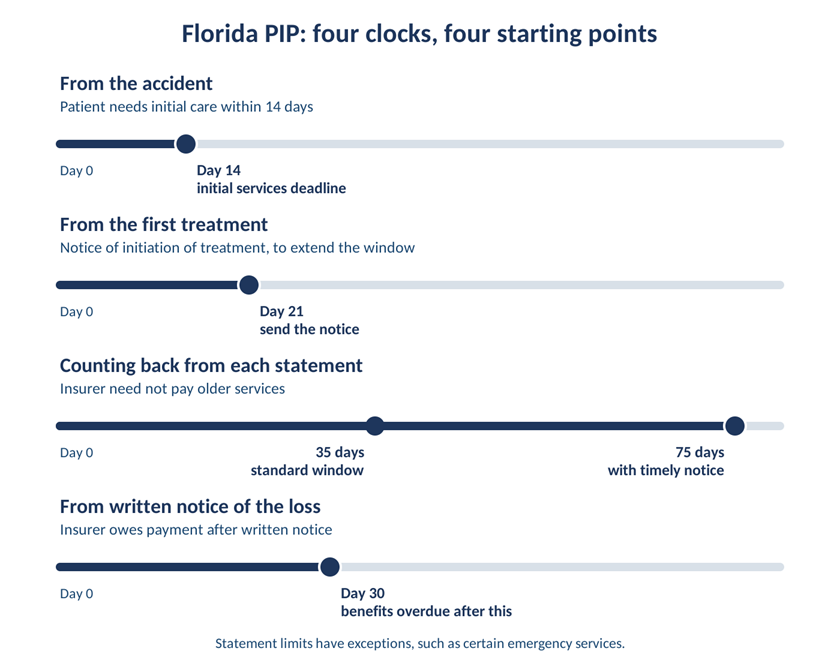
In short: the 14-day clock starts at the accident, the notice clock at first treatment, the 35 or 75 days count back from each statement, and payment is due 30 days after written notice.
PIP: how auto-accident visits are billed
Florida’s no-fault statute, section 627.736, gives injured drivers and passengers up to $10,000 in medical and disability benefits, with medical expenses reimbursed at 80% of reasonable charges. That 80% benefit applies when the patient receives initial services within 14 days of the accident.
A qualifying clinician, such as a physician, physician assistant or advanced practice registered nurse (APRN), decides whether an emergency medical condition existed. If so, reimbursement can reach $10,000. If not, it is limited to $2,500, so document that determination clearly in the chart.
Bill on a CMS-1500, and non-hospital providers must place their professional license number in the signature line. A disclosure and acknowledgment form is completed at first treatment: the treating professional signs it by hand, and the original goes to the insurer, not as an electronic copy. When another driver’s insurer is also involved, see our guide to third-party liability claims.
Each statement has a 35-day look-back. The insurer need not pay for services rendered more than 35 days before the statement’s postmark or electronic transmission date. A notice of initiation of treatment sent within 21 days of the first treatment extends that to 75 days. Charges unpaid because these limits were missed generally cannot be billed to the patient.
Workers’ compensation visits
The Florida CFO’s medical services FAQ says no statute sets a provider billing deadline, but bills should go out as soon as possible after the service. Under section 440.20 of the Florida Statutes, the carrier then has 45 calendar days to pay, disallow or deny the bill.
A carrier may deny a bill that lacks required documents, such as the DWC-25 form. Record the employer, carrier and claim number at check-in, and see our guide to workers’ compensation billing delays for follow-up steps.
Commercial plans and Florida prompt-pay rules
For major medical policies from licensed insurers, including PPO and exclusive provider organization (EPO) policies, section 627.6131 requires payment or notice of denial or contest within 20 days for electronic claims and 40 days for paper claims. Overdue payments accrue simple interest at 12% a year.
If the insurer contests a claim, it must list the information it needs, and the provider has 35 days to send it. Self-funded employer plans follow their own terms. Run an A/R aging report weekly and flag any electronic claim with no response after 20 days.
Front-desk checklist before the patient leaves
Most Florida denials can be prevented at registration. Start with a same-day check, as described in our guide to streamlining patient eligibility verification.
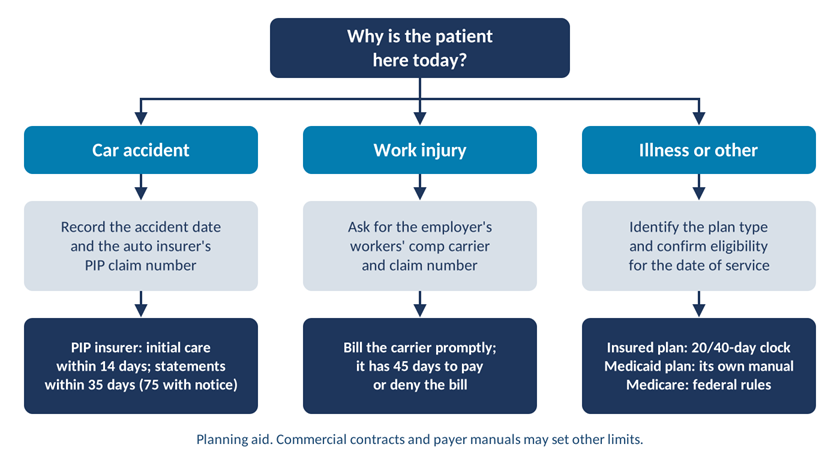
- Ask why the patient is here: car accident, work injury or illness.
- For an accident, record the accident date and the auto insurer’s PIP claim number.
- For a work injury, record the employer, carrier and claim number.
- For everything else, confirm eligibility and plan type for the date of service.
- Get the PIP disclosure form signed by hand and mail the original.
- Send the claim the same or next business day and log the 35-day PIP limit.
Common Florida urgent care denials and fixes
Sample (fictional data): a patient visits on day 16 after a car accident and the clinic bills the patient’s health plan.
The plan redirects the claim to PIP, but the provider never records the accident date. Now the clinic must prove timing and get statements out within the 35-day limit.
| Problem | Likely cause | Fix and prevention |
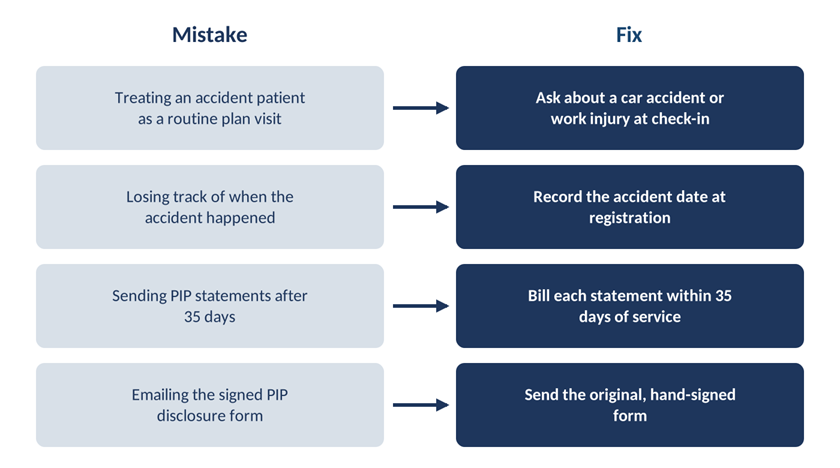
| Initial care outside 14 days | Accident date not recorded at registration | Record the date at check-in and route the claim before billing. |
| Wrong payer billed | Accident or work injury billed to a health plan | Rebill the right payer with proof of the first denial. |
| Statement too old | Services billed more than 35 days before the statement date | Bill each statement within 35 days of service. |
| Missing form or license number | Disclosure form not on file, or license number left off | Make both required fields at registration. |
| Missing claim number | Workers’ comp number not captured | Hold the claim until it is on file. |
For claims already denied, follow our step-by-step guide to appealing a denied medical claim.
Frequently asked questions
How much does Florida PIP pay for urgent care visits?
Florida PIP covers up to $10,000 in medical and disability benefits and reimburses 80% of reasonable medical charges.The 80% benefit applies when initial care happens within 14 days of the accident.
If the patient has no emergency medical condition, the insurer limits reimbursement to $2,500.
How long do Florida insurers have to pay a claim?
For major medical policies covered by section 627.6131, insurers must pay or notify the provider of a denial or contest within 20 days for electronic claims and 40 days for paper claims. Overdue amounts accrue 12% simple interest. Self-funded plans follow their own terms.
Is there a deadline to bill Florida workers’ comp?
The CFO’s guidance says no statute sets a provider billing deadline, but providers should bill as soon as possible after the service.
Once the provider submits the bill correctly, the carrier has 45 calendar days to pay, disallow, or deny it. Missing documents such as the DWC-25 can lead to denial.
What form does Florida PIP require?
Providers must submit PIP statements on a properly completed CMS-1500, UB-92, or another approved standard form. Non-hospital providers must include their professional license number in the signature line. The hand-signed disclosure and acknowledgment form must go to the insurer in original, not electronically.
Getting urgent care billing in Florida under control
Urgent care billing in Florida rewards clinics that ask why the patient is here and watch the clock after the visit. EZMedPro is a US-based medical billing, coding, credentialing and revenue cycle management company with transparent reporting and no hidden fees. Results vary by practice.
You can review our billing, coding, credentialing and revenue cycle management services or talk with the team about your clinic.
Sources: Florida Statutes sections 627.736 and 627.6131 (Florida Senate), the Florida CFO workers’ compensation medical services FAQ, and Florida Statutes section 440.20. General information, not legal advice.

