
AHCCCS Billing for Arizona Practices: A Step-by-Step Guide
AHCCCS billing works when four things line up before a claim leaves your office: every provider on the claim is registered with AHCCCS, the member is eligible on the date of service, the claim goes to the right payer, and it arrives inside the filing window. Miss one and the claim denies, sometimes past the point of recovery. This guide covers registration, eligibility, routing, deadlines, corrections, disputes and the most common denials.
| Key takeaways AHCCCS is Arizona’s Medicaid program. Most members belong to a contracted health plan, and those claims go to the plan, not to AHCCCS.Initial claims must be received within 6 months of the date of service and reach clean claim status within 12 months.Every billing, servicing, ordering and referring provider must be registered with AHCCCS and revalidate every four years.Corrections use frequency code 7 (replacement) or 8 (void) with the original claim reference number. |
How AHCCCS billing is organized
AHCCCS (the Arizona Health Care Cost Containment System) is the state’s Medicaid agency. Most members receive care through managed care health plans, which AHCCCS pays a monthly amount per member. The plan then pays your claims under its own contract and provider manual.
A smaller group stays fee-for-service (FFS), and AHCCCS pays those claims directly through its Division of Fee-for-Service Management (DFSM). This group includes the American Indian Health Program, tribal programs, the Federal Emergency Services Program and members not yet enrolled with a plan.
Medicaid is one payer stream inside your wider revenue cycle management process, so these steps fit the front-end and follow-up work you already run.
Step 1: Register every provider with AHCCCS
AHCCCS denies claims from any provider who is not registered and active on the date of service. The rule covers billing, servicing, attending, ordering and referring providers, including out-of-state providers. It traces back to the federal Medicaid screening rules in 42 CFR Part 455, Subpart E, which require states to enroll ordering and referring professionals as participating providers.
Registration happens in the AHCCCS Provider Enrollment Portal (APEP), with revalidation every four years. Ignoring a revalidation notice risks termination and loss of billing privileges. Health plans add their own credentialing and contracting, so a new clinician needs AHCCCS registration plus a contract with each plan you accept. Provider credentialing and contracting support keeps both tracks moving.
Step 2: Check eligibility and plan enrollment for each date
Check the member on the AHCCCS Online provider portal before the visit and again before you submit the claim. Eligibility is date-specific and plan assignment can change, so a member who was fee-for-service last month may belong to a health plan today. A repeatable patient eligibility verification routine prevents most misrouted claims.
Capture other coverage too. AHCCCS is the payer of last resort, so Medicare, commercial or liability coverage is billed first, and the primary payer’s EOB (explanation of benefits) supports the AHCCCS claim. Injury cases follow the rules for third-party liability claims.
Step 3: Send the claim to the right payer
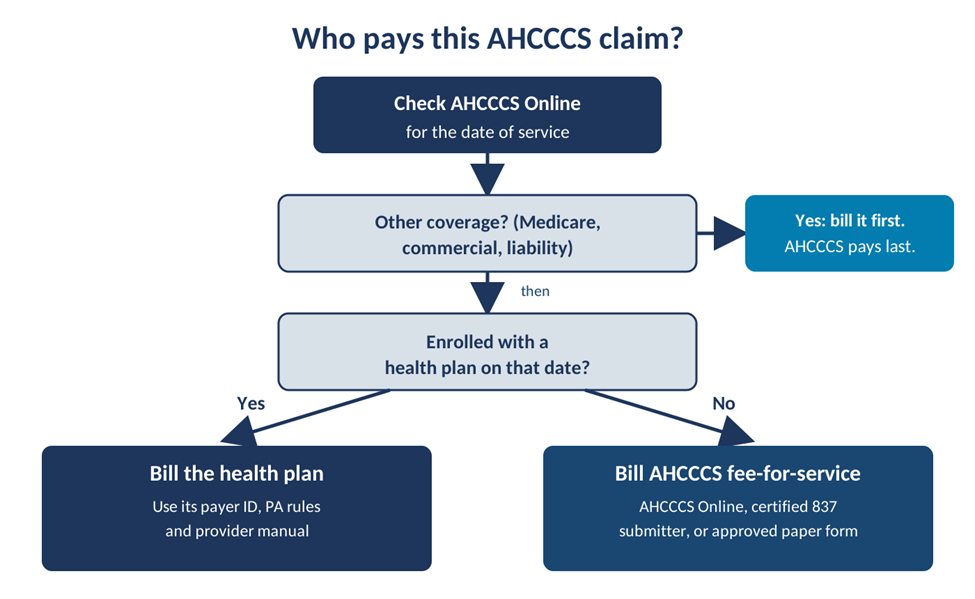
In short: bill other coverage first. If the member is enrolled with a health plan on the date of service, bill the plan under its provider manual. If the member is fee-for-service, bill AHCCCS through the AHCCCS Online portal, a certified 837 electronic submitter, or original paper forms (printed or downloaded copies are not accepted).
Prior authorization
For FFS members, DFSM reviews prior authorization (PA) requests, preferably through AHCCCS Online. Health plan members follow the plan’s PA process. Approval does not guarantee payment: the claim must match the authorized service, dates and provider. Good prior authorization tracking catches mismatches early.
AHCCCS billing deadlines you cannot miss
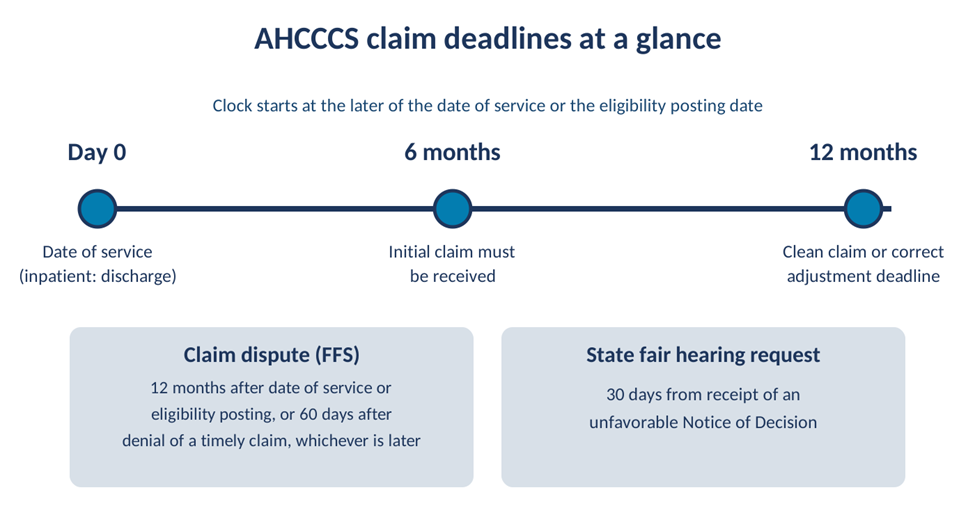
| Event | Deadline | Clock starts |
| Initial claim received | 6 months | Date of service (inpatient: discharge date), or eligibility posting date if later |
| Clean claim or correct adjustment | 12 months | Same start date as the initial claim |
| Claim dispute (fee-for-service) | Latest of 12 months after date of service, 12 months after eligibility posting, or 60 days after denial of a timely claim | Whichever date is later |
| State fair hearing request | 30 days | Receipt of an unfavorable Notice of Decision |
These limits come from Arizona statute and appear in the AHCCCS Fee-for-Service Provider Billing Manual, Chapter 4. Health plans apply the same statutory limits, while each plan’s manual sets details such as dispute addresses. Medicare runs on a separate one-year rule, covered in our Medicare timely filing guide.
Correcting a claim: replacement or void
When a submitted claim has an error, do not send a brand-new claim. AHCCCS treats a correction without the original claim reference number (CRN) as a new claim, and a new claim filed after six months denies for timely filing.
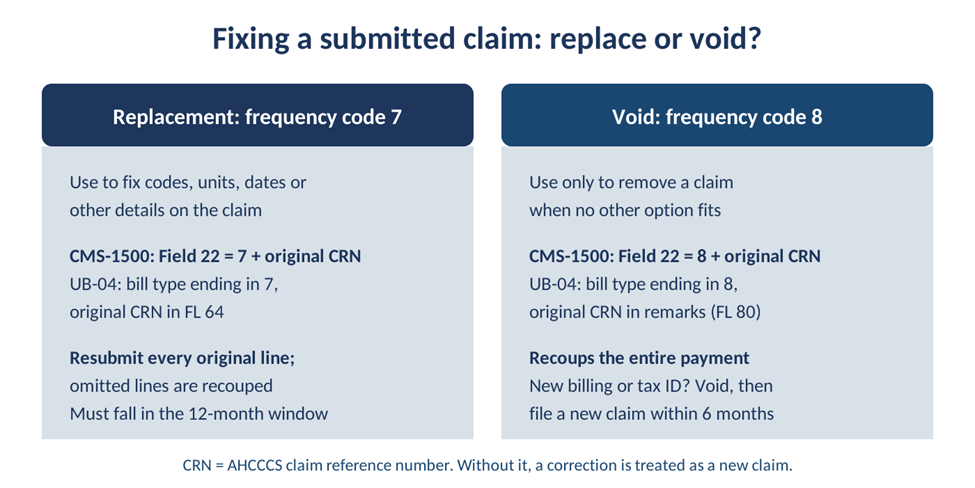
| Item | Replacement (frequency code 7) | Void (frequency code 8) |
| Use it to | Fix codes, units, dates or other claim details | Remove a claim when no other option fits |
| CMS-1500 | Field 22: code 7 plus the original CRN | Field 22: code 8 plus the original CRN |
| UB-04 | Bill type ending in 7; CRN in field 64 | Bill type ending in 8; CRN in remarks (field 80) |
| Key rule | Resubmit every original line; omitted lines are recouped | Recoups the entire payment |
Changing the billing provider, servicing provider or tax ID requires a void and a new claim, which must still land inside the six-month window.
Common AHCCCS denials and how to prevent them
| Denial | Fix | Prevention |
| Provider not registered or not active on the date of service | Register or reactivate in APEP, then send a replacement claim with the CRN | Track revalidation dates and check status before a new provider sees patients |
| Member not eligible, or enrolled with a health plan | Bill only eligible dates, or send the claim to the correct plan | Check AHCCCS Online at scheduling and again on the date of service |
| Timely filing | Rarely recoverable once the window closes | Submit within days of the visit and work rejections daily |
| Prior authorization missing or mismatched | Align the PA and claim codes, dates and provider, then resubmit | Confirm the PA on file before the service |
Sample (fictional data): a misrouted claim
A Tucson family practice sees an AHCCCS member on March 3. Eligibility was checked at scheduling in February, when the member was fee-for-service, so the claim goes to AHCCCS. It denies: the member joined a health plan on March 1. The biller re-checks AHCCCS Online and bills the plan, still well inside six months. Swap in your own dates and plan; the lesson is to check eligibility on the date of service.
Disputing an AHCCCS claim decision
If a timely claim is denied or underpaid and a correction will not fix it, file a written claim dispute. For FFS members, disputes go to the AHCCCS Office of the General Counsel; the AHCCCS provider claim disputes page lists the address and rules.
State the facts and the relief you want, with the claim, remittance and records attached. Health plan members’ disputes go to the plan. After an unfavorable Notice of Decision, you have 30 days to request a state fair hearing. The habits you use to appeal a denied medical claim apply: one clear argument, the right documents, a tracked deadline.
Frequently asked questions
What is the timely filing limit for AHCCCS?
AHCCCS must receive the initial claim within 6 months of the date of service, or of the eligibility posting date if that is later. For inpatient stays, the date of service is the discharge date. The claim then has 12 months from the same start date to reach clean status or be correctly adjusted. Health plans apply the same statutory limits.
Do I bill AHCCCS or the member’s health plan?
It depends on enrollment on the date of service. If AHCCCS Online shows the member enrolled with a health plan, bill the plan and follow its provider manual. If the member is fee-for-service, such as an American Indian Health Program member, bill AHCCCS directly. Always bill other coverage, including Medicare, first.
Does AHCCCS prior authorization guarantee payment?
No. AHCCCS states that an approved prior authorization does not guarantee payment. The claim must match the authorized service, dates and provider, the medical records must support the service, and the claim must meet billing rules such as timely filing. Treat the approval as one requirement, not the whole claim.
How often do providers revalidate with AHCCCS?
AHCCCS requires providers to revalidate their enrollment every four years in the AHCCCS Provider Enrollment Portal, and it can ask for off-cycle revalidation. Providers who do not respond to a notice risk termination, loss of billing privileges and loss of access to the AHCCCS Online portal, which stops claim payment.
Getting AHCCCS billing right
Strong AHCCCS billing is mostly front-end discipline: registered providers, date-specific eligibility checks, correct routing and claims filed well before the six-month mark.
EZMedPro’s US-based team provides billing, coding, credentialing and revenue cycle management with transparent reporting and no hidden fees. If AHCCCS denials or plan enrollment are slowing your cash flow, talk with our team about your Medicaid claims. Results vary by practice.
Sources: AHCCCS Fee-for-Service Provider Billing Manual (Chapters 1 and 4), AHCCCS Provider Claim Disputes, AHCCCS Prior Authorization and Provider Revalidation pages, AHCCCS Contractor Operations Manual Policy 203, and 42 CFR Part 455, Subpart E. This article is general billing information, not legal advice.

