
Orthopedic Medical Billing: A Practical Guide for Practices
Orthopedic claims carry more money and more rules per claim than almost any other specialty. A single joint procedure can involve a global surgery period, several modifiers, a prior authorization, and a separate facility claim, all at once. This guide walks through where orthopedic billing goes wrong, what Medicare’s global surgery and bundling rules actually require, and when it makes sense for a practice to bring in outside billing support.
Key Takeaways
- Orthopedic claims combine high dollar values, global surgery periods, and frequent prior authorization, so one missed step can delay an entire payment.
- Most orthopedic denials trace back to a handful of causes: modifier errors, bundling edits, authorization gaps, and documentation that doesn’t match medical necessity.
- Place of service — office, ambulatory surgery center, or hospital outpatient — changes how a procedure is coded and claimed.
- CMS’s CY2027 Medicare Physician Fee Schedule, finalized in November 2026, keeps adjusting same-day billing and procedure payment, so practices should expect continued change rather than a one-time update.
Why Orthopedic Billing Carries More Risk Than General Billing
General primary care billing deals mostly with evaluation and management (E/M) visits. Orthopedic billing adds surgical procedures, implants, imaging, and physical medicine codes on top of that, often for the same patient in the same month. That combination raises the dollar value of each claim and the number of rules that apply to it.
- Procedure-heavy coding: joint injections, fracture care, arthroscopy, and joint replacement each carry their own global period and documentation standard.
- Prior authorization load: imaging, injections, and most elective surgeries typically need authorization before the date of service, and Medicare Advantage plans often apply stricter review than original Medicare.
- Implant and hardware tracking: cases involving hardware need the device and lot information documented and billed correctly, separate from the surgeon’s professional fee.
- Site-of-service variation: the same procedure can be billed from an office, an ambulatory surgery center (ASC), or a hospital outpatient department (HOPD), each with different coding and facility-claim rules.
Prior Authorization: Where Orthopedic Claims Stall
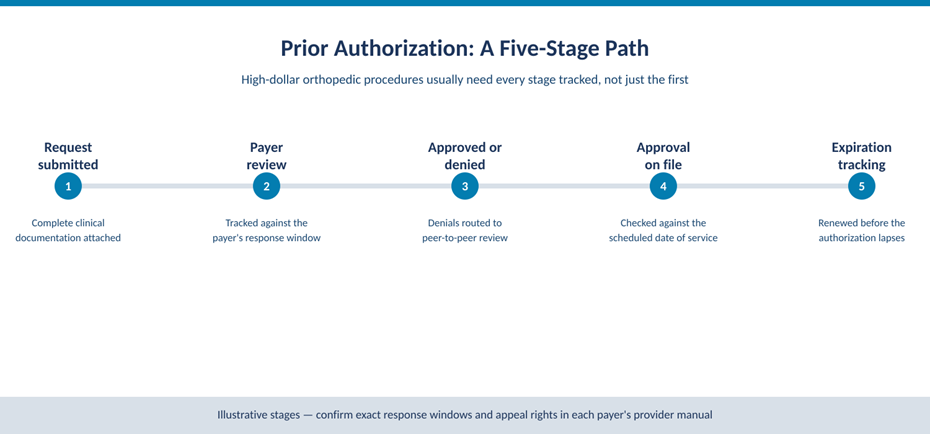
Prior authorization is a payer’s approval, obtained before a service is performed, confirming it will cover that service. For orthopedics, it usually applies to advanced imaging (MRI, CT), injections, durable medical equipment, and most scheduled surgeries. Because approvals expire and apply to a specific site of service, tracking the full path matters more than getting the first submission right.
- Submit the request with complete clinical documentation attached, rather than relying on a follow-up to fill gaps.
- Track the payer’s review against its stated response window instead of waiting for a denial notice to follow up.
- Route a denial to peer-to-peer review when the denial is clinical rather than administrative.
- Confirm the approval is still on file, and still matches the scheduled site of service, before the date of service.
- Renew or re-submit before the authorization expires, since an expired authorization is treated the same as no authorization.
Modifiers and the Global Surgery Period
A global surgery period is the window around a procedure during which routine follow-up care is already paid for as part of the procedure’s fee. Under Medicare’s global surgery rules, major procedures carry a 90-day global period, other minor procedures carry a 10-day period, and some minor procedures and endoscopies carry a 0-day period.
The CMS Global Surgery Booklet sets out these periods and the modifiers tied to them in detail. Billing a routine post-operative visit separately during that window, without the correct modifier, is one of the more common orthopedic denial reasons.
The modifiers that most often apply during an orthopedic global period:
- Modifier 24 — an unrelated evaluation and management (E/M) visit by the same provider during another procedure’s post-operative period.
- Modifier 25 — a significant, separately identifiable E/M service on the same day as a minor procedure.
- Modifier 57 — the E/M visit that leads to the decision for major surgery, billed the day of or day before that surgery.
- Modifier 58 — a staged or related procedure performed during the post-operative period, planned at the time of the original procedure.
- Modifier 78 — an unplanned return to the operating room for a related complication during the post-operative period.
- Modifier 79 — an unrelated procedure by the same provider during the post-operative period, which starts a new global period.
Laterality modifiers (LT, RT) and bundling-override modifiers also come up constantly in orthopedics, since so many diagnoses and procedures are side-specific or billed in pairs. For the full modifier list and how each one changes payment, see our CPT modifiers guide, and for the coding specifics behind fracture care, joint injections, and the 2025 split-care modifier change, see our orthopedic CPT codes and modifiers guide.
Common Orthopedic Denials and How to Prevent Them
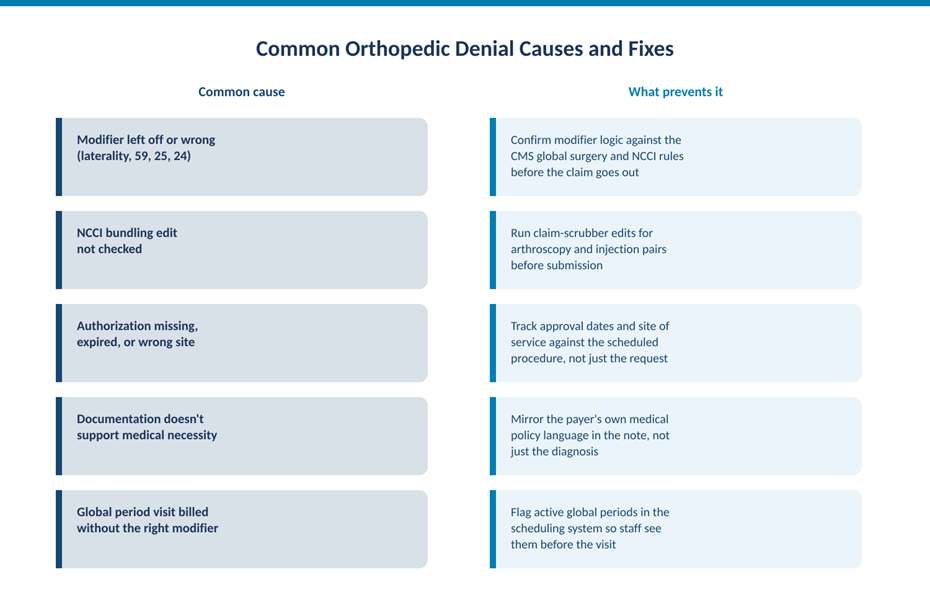
National Correct Coding Initiative (NCCI) edits are CMS’s rules on which code pairs cannot be billed together for the same patient on the same day, unless a modifier documents that they represent genuinely separate work. Orthopedic claims hit these edits often, because arthroscopy, injections, and E/M visits are frequently billed alongside a procedure.
| Common cause | What prevents it |
| Modifier missing or incorrect (laterality, 24, 25, 59) | Check modifier logic against CMS global surgery and NCCI rules before the claim goes out. |
| NCCI bundling edit triggered | Run claim-scrubber edits for arthroscopy and injection code pairs before submission, not after a denial. |
| Authorization missing, expired, or for the wrong site of service | Track approval dates and the approved site of service against the scheduled procedure. |
| Documentation doesn’t support medical necessity | Match the note to the payer’s own medical policy language for that procedure, not just the diagnosis code. |
| Routine post-op visit billed during the global period without a modifier | Flag active global periods in the scheduling system so front-desk and billing staff see them before the visit. |
For the broader set of denial and adjustment reason codes orthopedic claims share with every other specialty, see our claim denial codes guide, and for how to unbundle or correctly bundle CPT codes on a mixed-procedure claim, see our CPT bundling guide.
Site of Service and Payer Variation
The same orthopedic procedure is billed differently depending on where it happens. An office visit (place of service 11) usually bills the professional service alone. An ambulatory surgery center, or ASC, (place of service 24) adds a separate facility fee claim. A hospital outpatient department (place of service 22) usually produces the most complex claim, with separate facility and professional components.
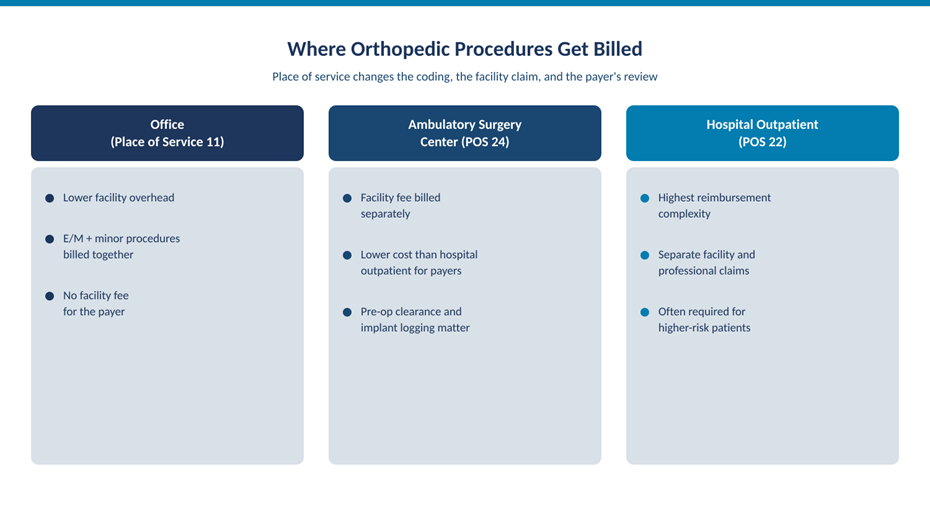
Payer rules vary on top of that. Original Medicare follows the global surgery and NCCI rules described above fairly consistently. Medicare Advantage plans and commercial payers can apply their own prior authorization lists, bundling logic, and appeal timelines, which may be stricter than Medicare’s.
CMS’s CY2027 Medicare Physician Fee Schedule final rule, finalized in November 2026 and effective January 1, 2027, continues to adjust payment for same-day office visits billed with minor procedures and introduces a new Ambulatory Specialty Model that holds specialists accountable for cost and quality in certain conditions, including low back pain — a detail worth watching for spine and orthopedic practices. Practices should confirm current-year rules with each payer’s own provider manual rather than assuming Medicare’s rule applies everywhere.
Orthopedic Billing Workflow From Visit to Payment
A reliable orthopedic billing workflow moves through the same six stages for nearly every claim, even though the details change by procedure and payer.
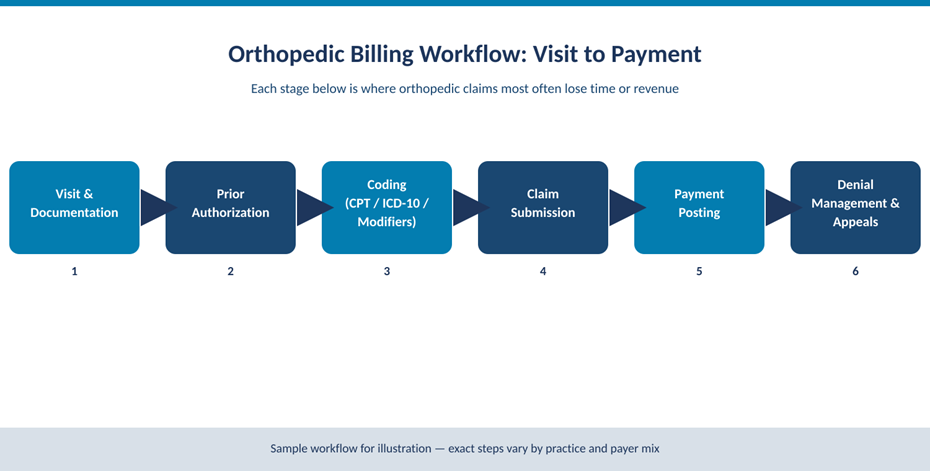
- Visit and documentation — the clinical note captures diagnosis, laterality, and the medical necessity the payer will look for.
- Prior authorization — confirmed and tracked before the scheduled date of service, not assumed from the initial request.
- Coding — CPT, ICD-10-CM, and modifiers are assigned together, since modifiers often depend on what else is billed that day.
- Claim submission — edits and scrubbers catch bundling conflicts and missing modifiers before the claim reaches the payer.
- Payment posting — payments and adjustment codes are reconciled against the expected allowed amount for that payer.
- Denial management and appeals — denials are worked promptly, since a global period or authorization dispute can take weeks to resolve.
When an Orthopedic Practice Should Consider Outsourcing Billing
Orthopedic practices often reach a point where the coding and prior-authorization workload outgrows what an in-house team can track reliably, especially once the practice adds a second surgeon, a new ASC relationship, or a growing Medicare Advantage patient base. The signals are usually practical rather than financial: authorizations missed because no one owns the follow-up, denials that pile up faster than staff can appeal them, or coding staff who are stretched across specialties they weren’t trained in.
If that sounds familiar, our in-house coder vs. outsourced coding guide walks through the trade-offs in more detail. EZMedPro works with a US-based team on billing, coding, credentialing, and revenue cycle management, and reports on claims with full transparency and no hidden fees — results still vary by practice, payer mix, and case volume.
Credentialing is part of the same picture: a surgeon who isn’t enrolled or re-credentialed with a payer in time can’t bill that payer at all, regardless of how clean the claim is. Our medical credentialing process guide covers that process step by step.
Specialty and State Resources
Orthopedic billing rules and payer mixes also shift from state to state. These guides look at orthopedic billing in specific markets:
Orthopedics medical billing services in Texas covers the payer landscape and common challenges for Texas orthopedic practices.
Orthopedics medical billing services in Florida looks at the same questions for Florida practices, including Florida-specific payer patterns.
Frequently Asked Questions
What’s the difference between modifier 24 and modifier 25 in orthopedic billing?
Modifier 24 covers an unrelated E/M visit during another procedure’s post-operative period. Modifier 25 covers a significant, separately identifiable E/M service billed on the same day as a minor procedure. They answer different questions: 24 is about timing relative to a prior procedure, 25 is about same-day billing.
How long is the global period for a total joint replacement?
Major orthopedic procedures, including most joint replacements, carry a 90-day global period under Medicare’s global surgery rules, plus one day of pre-operative care included in that period. Minor procedures carry a 10-day or 0-day period instead. Confirm the indicator for a specific code before billing follow-up visits.
Why do orthopedic claims get denied more often than general medical claims?
Orthopedic claims combine more rules per claim: global surgery periods, NCCI bundling edits, prior authorization, and implant documentation all apply at once. Missing any one of them — not just a coding error — can trigger a denial that a simpler E/M claim would not.
Does an orthopedic practice need separate billing for an ambulatory surgery center?
Yes. An ASC generates its own facility claim in addition to the surgeon’s professional claim, and the two are billed and reconciled separately. A practice that also owns or partners with an ASC needs a workflow that tracks both claims for the same case.
When does it make sense for an orthopedic practice to outsource billing?
Common signals include authorizations that fall through without a clear owner, a denial backlog that grows faster than staff can appeal it, or billing staff covering specialties beyond their training. These usually show up before revenue problems become visible, so it’s worth reviewing the workflow, not just the numbers.
Getting Orthopedic Billing Right, Claim by Claim
Orthopedic billing rewards practices that treat prior authorization, modifiers, and site-of-service rules as a single connected workflow rather than separate tasks. Most of the denials covered here come from one stage missing a handoff to the next, not from a single hard-to-find coding rule.
If your practice wants a second look at how its orthopedic claims move through that workflow, EZMedPro’s billing, coding, and RCM services cover orthopedics alongside other specialties, or you can reach our team directly to talk through a specific claim pattern.
Sources: Centers for Medicare & Medicaid Services (CMS) Global Surgery Booklet (MLN907166); CMS National Correct Coding Initiative (NCCI) edits; U.S. Department of Health and Human Services, CMS CY2027 Medicare Physician Fee Schedule final rule announcement. Results vary by practice, payer mix, and case volume.

