
In House Coder vs Outsourced Coding: How to Choose the Right Setup in 2026
In house coder vs outsourced coding is a staffing decision that compares a salaried coder on the practice payroll with an outside team of certified coders paid per chart, per hour or by percentage. Volume, specialty complexity, audit results and oversight capacity decide which model fits a given practice.
Short answer: neither model wins on its own. One in-house coder is usually cheaper when encounter volume is high and steady, an outside team is usually cheaper when volume is low or uneven, and a hybrid coding model often suits groups in between. This guide shows where the crossover sits with worked arithmetic, how to compare accuracy fairly, and what the OIG expects of practices that outsource. A self-assessment checklist near the end scores your own setup.
The question tends to surface when a coder resigns, the October 1 ICD-10-CM update arrives, or a new service line brings unfamiliar procedure codes. Medical coding converts clinical documentation into ICD-10-CM, CPT and HCPCS codes that drive what a payer pays, so it is the step where small errors become expensive. Accurate coding also shapes denials, as the guide to the role of accurate coding in the revenue cycle explains.
Which Numbers Should You Compare First?
Six numbers anchor the comparison: coding accuracy rate, fully loaded cost of a coder, outsourced pricing, turnaround time, continuing education units (CEUs) and the size of the annual code-set changes both models must absorb. The table gives practical ranges and names where each comes from.
| Metric | Practical target/range | Review frequency | Source type |
| Coding accuracy rate | About 95% or higher on audited charts; no single federal mandate | Quarterly audit | C |
| Fully loaded coder cost | Wage ÷ 0.70; BLS median of $51,140 (May 2025) for medical records specialists gives about $73,057 | Annually | A |
| Outsourced pricing | Per chart, hourly, percentage of collections or dedicated FTE; one vendor guide cites 4%–8% of collections | At signing and renewal | C |
| Turnaround time | Commonly 24–48 hours for routine charts | Weekly | C |
| Continuing education | 36 CEUs every two years for one AAPC CPC credential | Annually | A |
| Code-set volume | ICD-10-CM FY 2027: 190 new billable codes; CPT 2026: 288 new, 46 revised, 84 deleted | Each October 1 and January 1 | A, B |
Source labels: A = definition or data from a named standards body or agency (BLS, AAPC, CMS). B = named industry summary (Wolters Kluwer for CPT 2026; KZA and AGS Health for ICD-10-CM FY 2027). C = commonly reported across industry sources, a practical target and not a mandate. Summaries of the FY 2027 ICD-10-CM update differ on the number of deleted codes (21 to 30); CMS posts the official files.
In House Coder vs Outsourced Coding: Which Setup Fits Which Practice?
In-house coding generally fits stable, single-specialty practices with steady volume, while outsourced coding generally fits low or uneven volume, hard-to-hire specialties and short-term gaps. Published expert advice in Physicians Practice (2017) says a single-specialty fee-for-service practice may manage with periodic training and random chart audits. The same article says practices relying on Medicare Advantage, HMOs or ACO programs benefit from experienced coders on staff.
Those views predate today’s code-set pace, so test them against your own numbers. Treat the table below as a starting point, not a ruling. Specialty rules also change the answer, which is why the specialty billing guide is worth reading before you choose.
| Practice situation | Usually leans toward | Why |
| Single specialty, steady volume, one stable coder | In-house | Direct physician contact; fixed cost spreads across volume |
| Low or seasonal volume | Outsourced | Pay per chart instead of carrying an idle salary |
| Procedure-heavy or modifier-heavy specialty | Outsourced or hybrid | Specialty coders, if audit results confirm accuracy |
| Medicare Advantage or ACO risk contracts | In-house or hybrid | Experienced coders who know your documentation |
| Resignation, leave or backlog | Outsourced, short term | Coverage without a rushed hire |
| Growing multi-location group | Hybrid | Routine charts in-house, overflow outside |
Illustrative guidance based on published expert advice (Physicians Practice, 2017; Helpware, 2026) and our judgment; actual fit varies by practice.
Which Model Codes More Accurately, and How Would You Know?
Neither model is inherently more accurate; accuracy depends on coder credentials, specialty experience, documentation quality and how often charts are audited. The formula is simple: coding accuracy rate = charts coded correctly ÷ charts audited × 100. A 95% goal is a common convention rather than a federal rule, and experts quoted in For The Record magazine (2012) noted there is no universal standard.
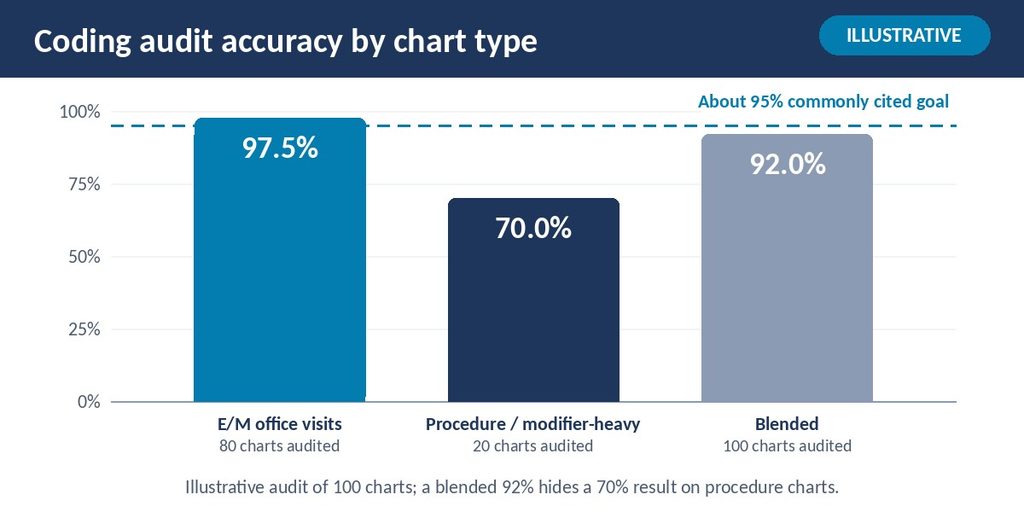
Illustrative scenario (not an actual client record): a coding audit of 100 charts finds 92 correct. That looks close to 95%, but the blended number hides a split. In coding audits, a common pattern is accuracy falling on procedure and modifier-heavy charts while routine E/M visits look clean.
| Chart type (Illustrative) | Charts audited | Coded correctly | Accuracy |
| E/M office visits | 80 | 78 | 97.5% |
| Procedure and modifier-heavy | 20 | 14 | 70.0% |
| Blended | 100 | 92 | 92.0% |
The blended 92% would prompt a general retraining session, yet the 70% in one group is the real problem. Audit by chart type, and sample in-house and outsourced coders the same way. Review CPT modifier rules when procedure charts miss, and use a coding audit checklist to standardize the sample.
The OIG’s 1998 guidance for third-party billing companies calls for a statistically valid sample reviewed annually by a qualified coding expert. That guidance addresses billing companies, but the practice works as a standard for any model. Read the full OIG compliance guidance before you sign a contract.
What Does Each Model Cost Per Encounter, and Where Does the Crossover Sit?
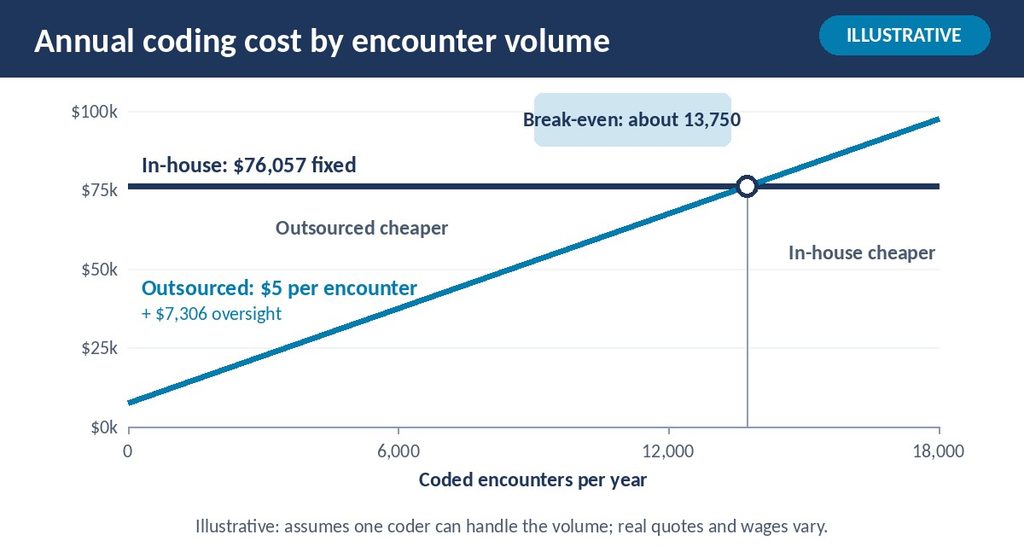
In-house coding is mostly a fixed cost and outsourced coding is mostly a variable cost, so the cheaper model flips as encounter volume changes. Start with the fully loaded figure. The Bureau of Labor Statistics reported private-industry compensation of $46.89 per hour in June 2026, with benefits at 30.0% of the total, so dividing a wage by 0.70 gives a practical loaded estimate. BLS lists a median of $51,140 for medical records specialists in May 2025; treat it as a proxy for coders.
Illustrative scenario (not an actual client record): one coder at that wage costs $51,140 ÷ 0.70 = $73,057 loaded. Adding $3,000 for an encoder license, AAPC membership and CEU costs, an assumption for illustration, brings in-house cost to $76,057. For the outsourced side, assume $5 per encounter plus 0.1 of a staff member for oversight at $7,306. Pricing models vary, so ask vendors for itemized quotes.
Break-even volume = (In-house annual cost − Outsourced oversight cost) ÷ Outsourced price per encounter
With these inputs, break-even is ($76,057 − $7,306) ÷ $5 = 13,750 encounters per year. Below that volume, the outsourced option is cheaper on cost alone; above it, the salary spreads thinner per encounter and in-house wins, provided one coder can handle the load.
| Annual encounters (Illustrative) | In-house cost | Outsourced cost | Cheaper option |
| 6,000 | $76,057 | $37,306 | Outsourced by $38,751 |
| 10,000 | $76,057 | $57,306 | Outsourced by $18,751 |
| 13,750 | $76,057 | $76,056 | About equal |
| 18,000 | $76,057 | $97,306 | In-house by $21,249 |
Illustrative arithmetic; assumes one coder can keep up with the volume and a $5 price per encounter. Real quotes, specialty complexity and productivity vary.
Compare total cost, not the sticker price. Helpware’s 2026 guide lists per-chart, hourly, percentage-of-collections and dedicated-FTE models, and advises comparing proposals on total cost including denial rework and audit corrections. Offshore teams deserve the same scrutiny: a two-year KIWI-TEK study of six hospitals found offshore coding at an effective $52.85 per hour after rework and auditing, against $60 for domestic outsourced coding. That study is vendor-affiliated and hospital-focused, so treat it as a caution, not a rule.
Who Keeps Up With Code Changes More Reliably?
Either model can keep current, but each needs a named owner for code-set updates and continuing education. A single AAPC-credentialed coder must earn 36 CEUs every two years to maintain a CPC. That requirement protects knowledge, though it also takes paid time away from daily work.
The FY 2027 ICD-10-CM files took effect for encounters on or after October 1, 2026, and the CMS ICD-10 page hosts the official addendum. Several summaries report 190 new billable codes, while deleted-code counts differ from 21 to 30. Physicians Practice reported in September 2026 that outpatient claims follow the date of service, with no grace period. The 2026 CPT set, effective January 1, added 288 codes, revised 46 and deleted 84, per a Wolters Kluwer summary.
In practice reviews, a common pattern is that the coder learns the October 1 changes but the EHR code pick-lists and encounter forms are not updated, so retired codes keep flowing. Do assign one person to update those tools whenever a code-set change lands, whether coding is in-house or outsourced. Ask any vendor how it applies updates before the effective date and who pays for rework when a code is rejected.
How Do Turnaround, Coverage and Physician Queries Compare?
In-house coders resolve questions faster face to face, while outsourced teams cover vacations and peaks more reliably. Published expert advice from 2017 notes that in-house coders can talk with physicians directly and may see activity that documentation misses, whereas outside firms can supply after-hours service and part-time help. Wing Assistant’s 2026 guide lists 24–48 hours as a vendor selection criterion for turnaround time.
A physician query is a written request asking a provider to clarify documentation before a code is assigned. The OIG’s guidance says coders should not assign a diagnosis or procedure without supporting documentation and should seek clarification when records are unclear. Outsourced coders often cannot walk down the hall, so agree on a written response window for queries. Strong notes reduce queries, and the guide to audit-proof documentation for office visits shows what coders need to see.
Slow or inaccurate coding shows up downstream as denials. When claim rejections cluster around a code family, check coder performance first, then review how accurate coding reduces claim denials. Track coding-related denials separately from payer-driven denials so the data points at the right fix.
What Risks Come With Each Model?
Each model carries distinct risks, and the safeguards differ. In-house risks center on coverage gaps and hiring; outsourced risks center on oversight, data handling and contract terms. Use the table to decide which risks you can absorb and which need a contract term or an internal control.
| Risk | In-house | Outsourced | Safeguard |
| Coverage gaps | One resignation or leave stalls charts | Vendor staff absorb absences | Cross-train, or name a backup |
| Hiring difficulty | AMA’s 2023 Spotlight cited a 30% national coder shortage | Vendor carries recruiting | Verify credentials either way |
| Compliance | Practice owns coding directly | Practice remains responsible for documenting its services | Written contract listing shared duties |
| Patient data | Controlled on site | Vendor handles PHI | Signed business associate agreement |
| Quality drift | Visible day to day | Less visible | Audit rights and a named account lead |
| Incentives | Salary has little upcoding pull | Volume or percentage pay can reward higher codes | Review pay terms with counsel |
Illustrative comparison compiled from the OIG guidance, HHS guidance and the sources listed below; the AMA figure comes from an unnamed set of studies.
On compliance, the OIG’s 1998 guidance says the practice and the billing company should list in a written contract which duties are shared. It also warns that an ineffective vendor compliance program can expose provider clients to liability, and that coder pay should not create incentives for improper upcoding. Percentage-based coding pay deserves legal review for that reason.
On patient data, HHS explains that a written business associate agreement (BAA) must limit uses of protected health information and require safeguards and breach reporting. A coding vendor with chart access generally fits that definition. Review the vendor’s data security practices, and ask where coders sit, since payer contracts and state Medicaid programs may restrict where patient data is handled.
When hiring in-house, the guide on hiring a certified medical coder covers credentials and interview questions. Verify certification status either way, because a vendor’s credential claims need the same check as a candidate’s, and ask which named coders will handle your charts.
Is a Hybrid Coding Model the Better Answer?
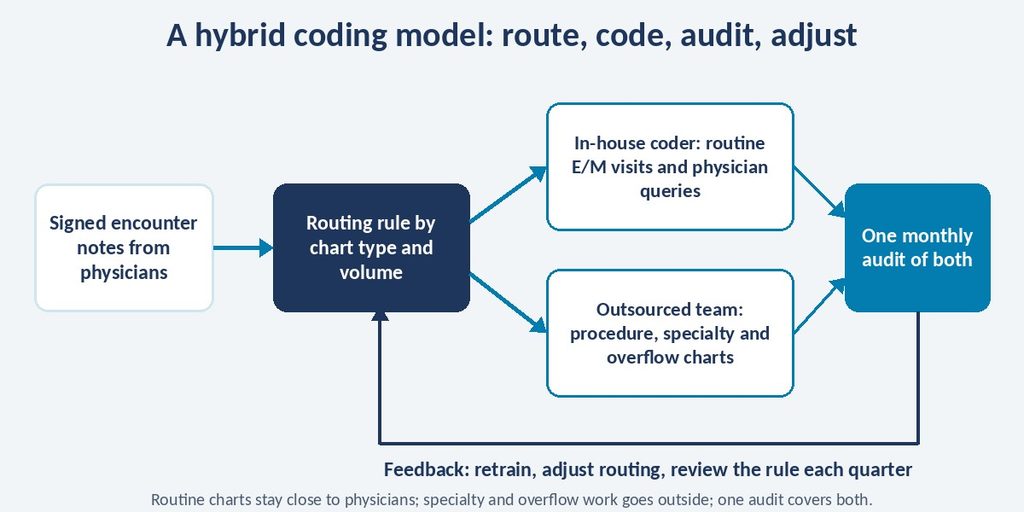
A hybrid coding model keeps routine encounters with an in-house coder and routes overflow, specialty charts, backlog or audits to an outside team. RapidClaims describes overflow and specialty models in its 2026 guide, and Helpware often suggests starting with an overflow engagement and expanding based on measured denial results. Both are vendor sources, so verify with your own audit data.
Routing rules make a hybrid work. For example, E/M visits stay in-house, procedure and modifier-heavy charts go to the outside team, and both sets feed one monthly audit. Do choose hybrid when volume swings seasonally or one specialty falls below your accuracy target. Skip it when overhead of managing two groups exceeds the savings. A practice at that point may want a partner to run the split; EZMedPro’s coding and revenue cycle services are one example.
How Do You Run a Fair Comparison Before Committing?
A fair comparison means testing both options on the same charts with the same audit method. Keep the pilot narrow enough to audit fully but broad enough to include your hardest chart types. Follow six steps, and keep every assumption visible so a partner or board member can challenge it.
- Pull 12 months of encounters by chart type and specialty.
- Calculate fully loaded in-house cost per encounter, including tools and CEUs.
- Request itemized outsourced pricing, with rework policy, audit rights and turnaround terms.
- Run a 30–60 day pilot on a defined encounter subset, a practical range from vendor guidance rather than a rule.
- Audit a blind sample from each coder with an independent certified auditor, such as an AAPC CPMA.
- Compare accuracy by chart type, turnaround, query rate and cost per encounter, then set a review date.
Use the numbers correctly. Compare like for like: the same chart mix, the same time window and the same accuracy definition. One missed benchmark is a signal to investigate by chart type and cause, not a verdict on the model.
How Long Until Results Show Up?
Plan on one to two months to onboard an outside team and run a pilot, partial gains in turnaround and accuracy within two to four months, and a fuller comparison after two quarters of audits. A new in-house coder also needs a ramp-up period on your payer mix and EHR templates. These are practical planning ranges, not guarantees.
Handoffs go better with a written plan. The guide on transitioning to a new billing system outlines how to avoid dropped claims during a change. Run old and new coding in parallel when open charts are numerous, and document who owns each chart type during the changeover.
Which Mistakes Undermine Both Models?
Several avoidable errors undermine either model. Most trace back to measuring the wrong thing or leaving an owner unnamed, so each fix below pairs with a measurement or an accountability step you can apply before choosing. Use the list as a pre-decision review.
- Judging by sticker price. Compare total cost per encounter, including rework and oversight.
- Trusting a blended accuracy rate. Audit by chart type and compare coders on the same sample.
- Assuming outsourcing transfers liability. Keep a named owner, a written contract and annual audits.
- Skipping the BAA. Sign it before any chart access, and confirm where data is handled.
- Leaving code-set updates unowned. Assign one person to update EHR pick-lists each October 1 and January 1.
- Ignoring physician query workflow. Set a written response window and track the query rate.
- Deciding once and never reviewing. Re-run the comparison when volume, specialty mix or payer mix changes.
Recap in Seven Lines
- In-house coding is mostly fixed cost; outsourced coding is mostly variable cost.
- Fully loaded coder cost is a practical estimate of wage ÷ 0.70, using BLS June 2026 benefit data.
- In the illustrative example, the crossover sat near 13,750 encounters per year.
- Accuracy of about 95% is a common goal, not a mandate; audit by chart type.
- Keep a named owner for code-set updates and CEUs in either model.
- Sign a BAA, list shared compliance duties in writing and audit annually.
- Consider a hybrid model when volume swings or one specialty misses its target.
Score Your Own Coding Setup
Answer yes or no using your last twelve months of data. Each question ties to a number in this guide, so every “no” points to a section worth revisiting. Pull figures from audit reports and billing system data rather than estimates.
- Have you calculated fully loaded cost per coded encounter?
- Do you know your annual encounter volume by chart type?
- Is your audited coding accuracy rate at or above about 95%?
- Do you audit accuracy separately for procedure and E/M charts?
- Is routine turnaround within about 24–48 hours?
- Do physicians answer coding queries within a set window?
- Does a named person update EHR pick-lists each October 1 and January 1?
- Could charts keep moving if your coder left tomorrow?
- Is a signed BAA in place with any outside coding vendor?
- Do you audit a statistically sound sample at least annually?
Scoring guide: 8–10 yes answers mean your current model is working, so change it only if an itemized quote beats your cost per encounter. 5–7 means mixed results; fix the weak areas or test a hybrid model. 0–4 means a strong case to run the six-step comparison with a pilot.
Warning Signs That Call for Outside Coding Help
Outside help makes sense when your current model has reached a limit that more effort from the same staff cannot fix. One persistent signal, confirmed across two quarters of audits, is enough to request quotes, so do not wait for all five of these to appear:
- Audited accuracy stays under about 95% on procedure or specialty charts.
- Charts wait beyond 48 hours because one coder carries the whole queue.
- A resignation or leave stops claims from going out.
- Coding-related denials cluster around one code family after retraining.
- Encounter volume swings enough that salary sits idle or overtime piles up.
When you evaluate a partner, look for a signed BAA, itemized pricing, audit rights, named coders with credentials, a written query process and a clear plan for annual code changes. Ask for references from practices with a similar specialty and payer mix.
EZMedPro is one example. The team delivers end-to-end billing, coding, credentialing, denial management and compliance support through a US-based team, with transparent reporting and an emphasis on no hidden fees. Results vary by practice, so any proposal should start from your own audit data. You can review the approach on EZMedPro’s revenue cycle management services page. Related decisions are covered in the comparison of outsourced versus in-house billing.
Expert Insights
The in house coder vs outsourced coding choice comes down to three tests you can run this month: cost per encounter at your real volume, accuracy by chart type from a blind audit, and whether you can oversee a vendor. In the illustrative example, outsourcing won below roughly 13,750 encounters and in-house won above it.
Firm published standards in this guide are limited to AAPC’s CEU policy, BLS compensation data, the CMS ICD-10 files, HHS’s business associate contract requirements and the OIG’s 1998 billing-company guidance. The 95% accuracy goal, turnaround ranges, vendor pricing, pilot length and every dollar figure in the example are practical or illustrative.
Your next step: pull 12 months of encounters by chart type, then ask what your own break-even volume is. EZMedPro can walk through that comparison with you through its revenue cycle management service team.
Common Questions About In-House and Outsourced Coding
Is outsourced coding cheaper than hiring an in-house coder?
Outsourced coding is usually cheaper at low or uneven volume, and in-house coding is usually cheaper at high, steady volume. In the illustrative example, the crossover was about 13,750 encounters per year. Your crossover depends on your wage, vendor pricing, oversight time and specialty complexity.
What is a good coding accuracy rate?
About 95% or higher on audited charts is a commonly cited goal, though no single federal mandate sets it. Experts in a 2012 For The Record article noted no universal standard. Measure accuracy by chart type, because a blended rate can hide weak procedure or specialty charts.
What is a good turnaround time for outsourced coding?
Vendor guides commonly cite 24–48 hours for routine charts, which is a practical expectation rather than a regulation. Complex procedure charts and unanswered physician queries can run longer. Put the turnaround standard, query handling and service credits in the written contract.
What is a good per-chart price for outsourced coding?
No published benchmark exists, and vendor pricing varies by specialty, volume and complexity. One 2026 vendor guide cites 4%–8% of collections for outsourced coding. Use the break-even formula with itemized quotes, and include rework, audit corrections and oversight time in the comparison.
Do I need a BAA if I outsource coding?
A coding vendor that accesses patient records for a covered entity generally qualifies as a business associate, which calls for a written contract. HHS describes required terms, including safeguards and breach reporting. Consult counsel for your situation, and confirm state or payer rules on where patient data may be handled.
Is a hybrid coding model worth considering?
A hybrid model can fit when volume swings or one specialty misses its accuracy target. Routine charts stay in-house while overflow or specialty work goes outside under one shared audit. It adds coordination work, so choose it only when savings or accuracy gains outweigh the management time.
Where These Numbers Come From
(a) Published standards and definitions from named bodies
- HHS Office of Inspector General, Compliance Program Guidance for Third-Party Medical Billing Companies, Federal Register Vol. 63, No. 243 (December 18, 1998).
- U.S. Department of Health and Human Services, Office for Civil Rights, Business Associate Contracts guidance.
- U.S. Bureau of Labor Statistics, The Economics Daily, private-industry compensation costs, June 2026 (released September 17, 2026).
- U.S. Bureau of Labor Statistics, Occupational Outlook Handbook, medical records specialists, median pay May 2025 ($51,140).
- AAPC, Medical Coding Continuing Education Unit Policy (36 CEUs every two years for one credential).
- CMS, ICD-10 codes page, FY 2027 files (page modified September 8, 2026).
(b) Named benchmarking data providers
- None used. No proprietary benchmark data, such as MGMA DataDive, was available for this article.
(c) Practical or illustrative targets from general industry sources
- Wing Assistant, outsourcing medical coding guide (modified September 2026): turnaround of 24–48 hours and 4%–8% of collections.
- Helpware, medical coding outsourcing guide (modified September 2026): pricing models and hybrid starting approach.
- RapidClaims, outsourcing medical coding guide (August 2026): overflow and specialty models.
- Physicians Practice, Building a Medical Coding Team: In-House vs. Outsourced (K. Appold, 2017), quoting R. Lucibella and B. Hays, CPC.
(d) Survey or study data with named source
- For The Record magazine, M. Bassett, October 8, 2012: expert statements on a 95% accuracy goal.
- KIWI-TEK, W. Wagner and S. Humbert, offshore versus domestic coding study (2018, updated 2025).
- AMA Health System Spotlight, J. Lubell, April 19, 2023: 30% coder shortage, underlying studies not named.
- Wolters Kluwer, CPT code updates 2026 (February 9, 2026).
- KZA (Karen Zupko & Associates), AGS Health and Physicians Practice (K. Reynolds, September 9, 2026): FY 2027 ICD-10-CM summaries.
Methodology. Competing guides were reviewed in October 2026 to find gaps in coverage. All dollar figures in the scenario are illustrative arithmetic, not client records or outcomes. Results vary by practice, and figures reflect information available at the time of research in October 2026. Code sets, fee schedules and payer policies change annually, so recheck them before acting.

