
How Arizona Emergency Department Medical Billing Works
Arizona emergency department medical billing means sending two separate claims for most visits, one from the hospital and one from the ED physician group, under rules set by Medicare, AHCCCS (Arizona Medicaid) and state-regulated insurers. Getting paid depends on correct ED coding, payer-specific filing limits and surprise billing protections. This guide explains how the two claims work, the Arizona payer rules that matter, how ED visits and critical care are coded, the denials that cost the most, and a pre-submission checklist your team can use today.
| Key takeaways Most ED visits create a hospital facility claim and a separate professional claim from the ED group.AHCCCS expects the initial claim within 6 months of service and a clean claim within 12 months, with the emergency clearly marked.State-regulated insurers in Arizona have 30 days to adjudicate a clean claim and 30 more days to pay it.ED visit levels 99281 to 99285 are chosen by medical decision making, not time; critical care is time-based.Federal and Arizona surprise billing rules limit what you can bill patients for out-of-network emergency care. |
What makes ED billing in Arizona different
Emergency billing differs from office billing because you treat first and confirm coverage later, every visit carries two claims, and payers review emergencies under special federal rules. In Arizona, you also juggle Medicare through Noridian, AHCCCS health plans with their own filing clocks, and a state prompt-pay law for commercial insurers.
That mix is why ED revenue leaks quietly. A single missed emergency flag or late resubmission can turn a payable claim into a write-off. A structured revenue cycle management process that tracks each claim from registration to payment is the base everything else in this guide builds on.
It also helps to separate ED work from urgent care. Urgent care centers bill office-type visits with scheduled-care rules, while EDs operate under federal emergency law. If you run both, the differences in specialized billing for urgent care centers are worth reviewing alongside this guide, and Arizona operators can compare notes with our page on urgent care billing support in Phoenix.
One ED visit creates two claims
When a patient is seen in a hospital ED, the hospital bills for the space, nursing, supplies and equipment, and the emergency physicians bill for their own medical work. The two claims go out on different forms, follow different coding rules and are often handled by different billing teams.
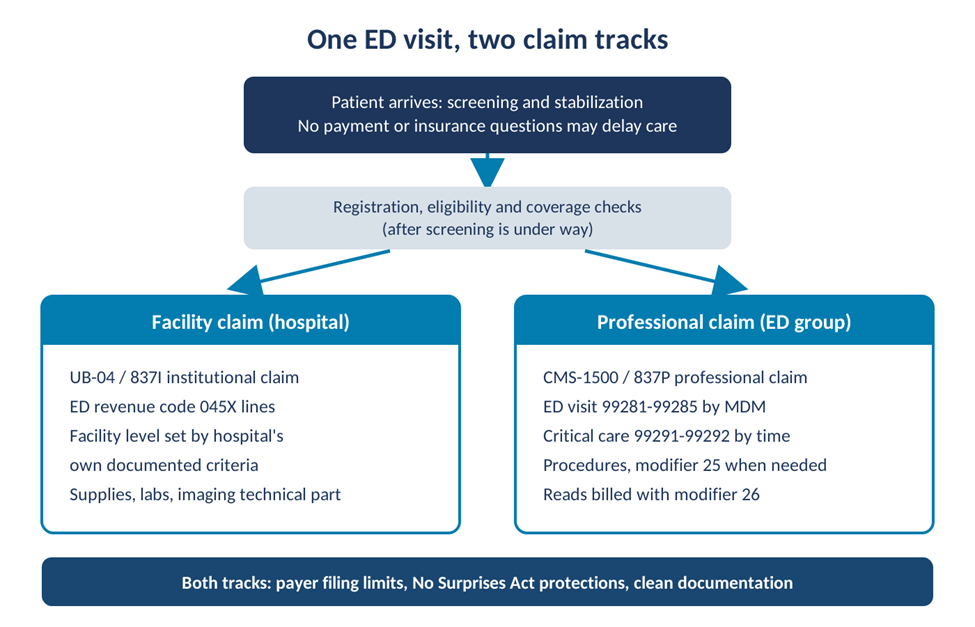
In short: screening and stabilization come first, registration follows, and the visit then splits into a facility track and a professional track.
The facility claim
The hospital submits an institutional claim (the UB-04 paper form or the 837I electronic file) with ED revenue code lines and a facility visit level. Medicare lets each hospital set its own documented criteria for facility ED levels, so the facility level and the physician level for the same visit often differ. That is normal and not, by itself, an error.
The professional claim
The ED group submits a professional claim (the CMS-1500 or 837P) with the physician or advanced practice provider as rendering provider. This claim carries the ED visit code, any critical care time, procedures such as laceration repair, and interpretations of ECGs or imaging. When the hospital owns the imaging equipment, the physician’s read is billed with modifier 26 for the professional component only.
Arizona payer rules that shape ED claims
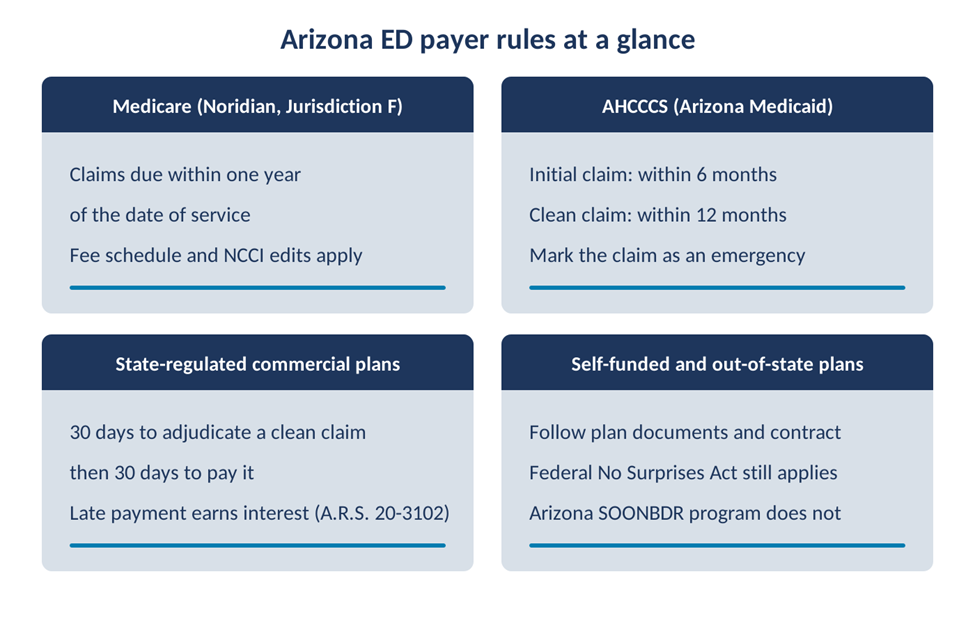
Filing limits and payment rules depend on who the payer is. The table below sums up the main Arizona payer groups for emergency claims; commercial payers also set their own limits in the contract and provider manual, so check each payer’s manual for your exact terms.
| Payer type | Filing limit | Emergency-specific rule | Where the rule lives |
| Medicare (Noridian, Jurisdiction F) | One year from the date of service | Emergency care needs no prior authorization; standard fee schedule and edits apply | Noridian and CMS manuals |
| AHCCCS fee-for-service | Initial claim within 6 months; clean claim within 12 months | Claims are treated as non-emergent unless the emergency is clearly marked | AHCCCS Fee-for-Service Provider Billing Manual |
| AHCCCS health plans | Same 6-month and 12-month limits under state law | Plan-specific emergency and claims policies | Each plan’s provider manual |
| State-regulated commercial insurers | Set by contract | 30 days to adjudicate a clean claim, then 30 days to pay | A.R.S. 20-3102 and your contract |
| Self-funded employer plans | Set by plan documents | Federal No Surprises Act protections apply | Plan documents and federal rules |
Medicare in Arizona
Noridian Healthcare Solutions administers Medicare in Jurisdiction F, which includes Arizona. As the Noridian timely filing page for Jurisdiction F explains, providers have one year from the date of service to submit a claim. Our guide to Medicare timely filing rules covers exceptions and how to prove timely submission.
AHCCCS emergency claims
The AHCCCS Fee-for-Service Provider Billing Manual, Chapter 4 treats every claim as non-emergent unless the provider clearly identifies the emergency. On the professional claim, that means marking the emergency indicator (field 24C on the CMS-1500). Leave it blank and the claim can run into prior authorization edits that never applied to emergency care.
The same chapter sets the clocks: AHCCCS must receive the initial claim within 6 months of the date of service, and the claim must reach clean status within 12 months. AHCCCS health plans follow the same state-law limits, but each plan publishes its own claims process.
Commercial prompt-pay rules
Under A.R.S. 20-3102, state-regulated health insurers have 30 days from receipt of a clean claim to adjudicate it and then 30 days to pay the approved amount. The Arizona Department of Insurance and Financial Institutions explains this two-step timeline in its 2025 timely pay and grievance bulletin, which also states that late payments earn interest at the legal rate unless the contract sets another reasonable rate.
Surprise billing, EMTALA and patient balances
Federal law protects ED patients in two ways that directly affect billing: when you can ask about payment, and what you can bill out-of-network patients.
EMTALA and registration timing
The Emergency Medical Treatment and Labor Act (EMTALA) requires hospitals to screen and stabilize anyone who comes to the ED, regardless of ability to pay. CMS states that screening and stabilizing care may not be delayed to ask about payment or insurance. Build registration so eligibility checks happen after screening is under way, never as a gate.
The No Surprises Act
Since January 1, 2022, out-of-network providers and facilities may not balance bill most privately insured patients for emergency services. Patients pay only in-network cost sharing. CMS summarizes these duties in its No Surprises Act provider requirements overview, including the narrow notice-and-consent route that applies only to certain post-stabilization care.
Plans must also cover emergency services without prior authorization and may not deny them based on the final diagnosis code alone. Coverage turns on the presenting symptoms, which is why your documentation of the chief complaint matters as much as the final diagnosis.
Arizona’s SOONBDR program
Arizona runs its own surprise out-of-network billing dispute resolution program for enrollees of state-regulated plans. According to the Arizona SOONBDR program page, bills must be at least $1,000 and the date of service within one year. Self-insured employer plans, government employee plans and out-of-state policies are not eligible.
Coding ED visits: MDM levels and critical care
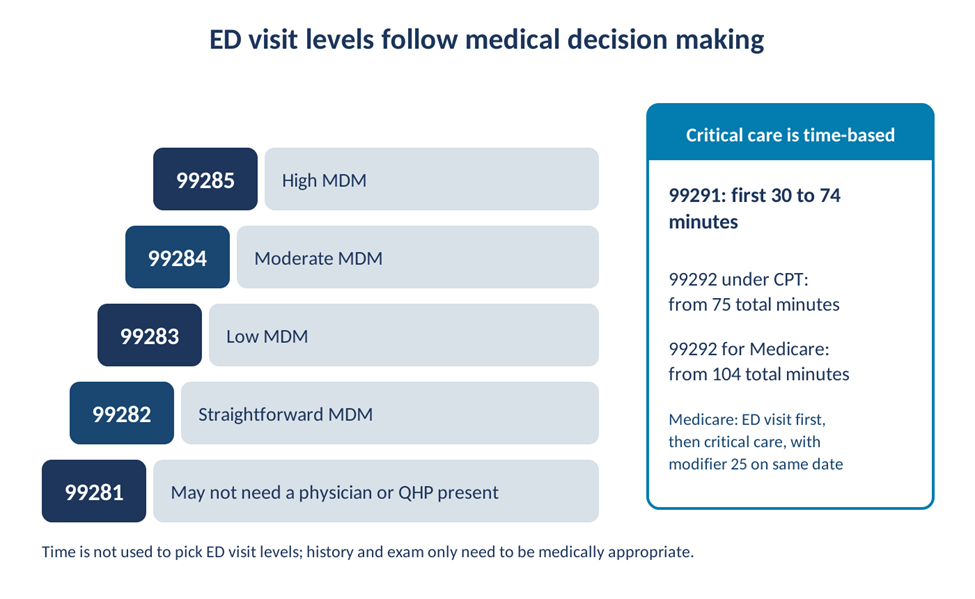
Since 2023, ED visit codes 99281 to 99285 are selected on medical decision making (MDM) alone. Time does not count toward the level, and history and exam only need to be medically appropriate. MDM weighs the problems addressed, the data reviewed and the risk of management.
| Code | Level basis | Documentation focus |
| 99281 | May not require a physician or other qualified health care professional to be present | Brief problem; triage alone is not an E/M service |
| 99282 | Straightforward MDM | One minor or self-limited problem |
| 99283 | Low MDM | Limited data and low-risk management |
| 99284 | Moderate MDM | Workup, independent interpretation or prescription drug management |
| 99285 | High MDM | Threat to life or bodily function, or decisions about hospitalization |
Critical care is different because it is billed by time. Code 99291 covers the first 30 to 74 minutes. Under CPT, 99292 can be added from 75 total minutes, but Medicare requires a full additional 30 minutes, so 99292 applies from 104 total minutes for Medicare claims.
When an ED visit is followed later the same day by critical care, Medicare allows both when billed in that order, with modifier 25 on the ED visit. The reverse sequence is not payable. Our explainer on when and how to use CPT modifiers covers modifier 25 in more depth.
Common Arizona ED denials and how to fix them
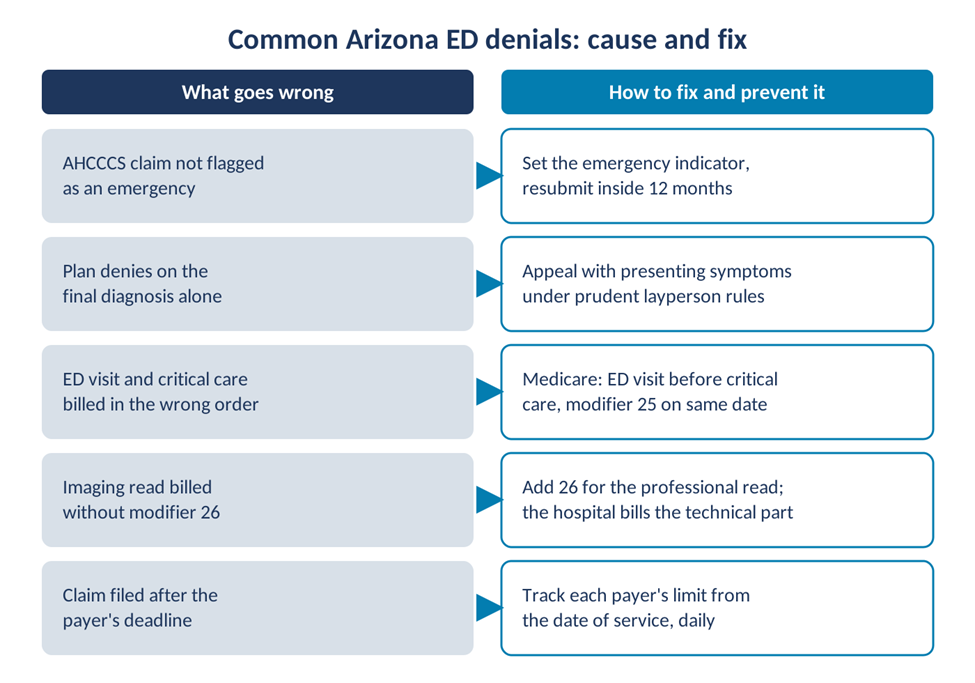
Most emergency denials come from a small set of repeat causes. A CARC (claim adjustment reason code) on the remittance tells you the category, and a RARC (remittance advice remark code) adds detail. Read both before choosing a fix.
| Denial cause | Fix | Prevention |
| Emergency not marked on an AHCCCS claim | Correct the indicator and resubmit inside the 12-month clean claim window | Make the emergency flag a required field in your ED charge template |
| Plan downgrades or denies based on final diagnosis | Appeal with the chief complaint and presenting symptoms | Document the presenting complaint in the patient’s own words |
| ED visit and critical care conflict | Rebill in the correct sequence with modifier 25 where required | Capture start and stop times for critical care |
| Imaging or ECG read denied as duplicate | Add modifier 26 or use the interpretation-only code | Map reads to professional-component codes in the charge master |
| Motor vehicle or injury claim pended | Identify the liable carrier and bill in the correct order | Ask about accident details during registration |
| Timely filing denial | Appeal only with proof of timely submission | Run a daily aging report by payer deadline |
ED visits after car crashes and workplace injuries often involve other payers. Our guide on third-party liability claims explains coordination order, and when a denial is wrong, follow this step-by-step guide to appealing denied claims.
Sample scenario: an AHCCCS chest pain visit
Sample (fictional data)
A 58-year-old patient arrives at a Maricopa County hospital ED with chest pain and shortness of breath. The ED physician orders labs and an ECG, interprets the ECG, reviews a chest X-ray, and admits the patient for observation of possible acute coronary syndrome.
- The professional coder assigns 99285 because the problem posed a threat to bodily function and the decision to hospitalize was made.
- The ECG interpretation goes on the claim as 93010, the interpretation-and-report-only code, and the X-ray read carries modifier 26.
- The claim goes to the patient’s AHCCCS health plan without the emergency indicator and denies for missing prior authorization.
- The biller marks the emergency indicator, attaches no extra records unless the plan requests them, and resubmits in week three, well inside the 12-month clean claim window.
- The corrected claim adjudicates. To stop a repeat, the team makes the indicator mandatory for every ED encounter in the billing system.
Change the payer, codes and timeline to match your own case; the sequence of checks stays the same.
Pre-submission checklist for Arizona ED claims
| Check | Why it matters |
| Payer and plan type confirmed (Medicare, AHCCCS plan, state-regulated, self-funded) | Sets the filing clock and which surprise billing rules apply |
| Emergency indicator set on AHCCCS claims | Prevents non-emergent processing and authorization denials |
| ED level supported by MDM in the note | Protects 99284 and 99285 in audits |
| Critical care start and stop times documented | Supports 99291 and 99292 thresholds |
| Modifier 25 and 26 used where required | Avoids bundling and duplicate denials |
| Chief complaint and presenting symptoms recorded | Supports prudent layperson appeals |
| Accident or injury details captured | Routes claims to the liable payer first |
| Rendering provider enrolled with the payer | Prevents provider-not-eligible denials for new or locum clinicians |
In-house team or billing partner?
ED billing is high volume and low margin per claim, so staffing gaps show up quickly in aging reports. Groups that bring on new or locum clinicians often find that payer enrollment, not coding, is the hidden bottleneck; credentialing and payer contracting support keeps new providers billable from their first shift.
Whether you keep billing in-house or outsource it, judge the arrangement by clean claim rate, denial trends and days in accounts receivable. Results vary by practice, payer mix and documentation quality.
Frequently asked questions
Why do ED patients get two bills?
Most hospital ED visits produce two claims: the hospital bills for the facility, staff and supplies on an institutional claim, and the emergency physician group bills for the doctor’s medical work on a professional claim. Patients may see two statements, and the plan applies its emergency cost sharing to each claim separately.
Can an ED ask for insurance before treating a patient?
No. Under EMTALA, a hospital may not delay the medical screening examination or stabilizing treatment to ask about payment or insurance status. Registration can collect insurance details, but only in a way that never holds up care. Billing teams should check eligibility after screening has started, then correct coverage details before the claim goes out.
What is the AHCCCS timely filing limit for emergency claims?
For AHCCCS fee-for-service, the initial claim must be received within 6 months of the date of service, and the claim must reach clean claim status within 12 months. For inpatient hospital claims, the date of service is the discharge date. AHCCCS health plans follow the same state-law limits, so track both clocks for every ED encounter.
Can I balance bill an out-of-network ED patient in Arizona?
Usually not. The federal No Surprises Act bars balance billing for emergency services for most privately insured patients, who owe only in-network cost sharing. Arizona’s SOONBDR program adds a state dispute process for qualifying state-regulated plans. Payment disputes with the plan go through the federal or state dispute process, not to the patient.
Does time count toward ED visit levels?
No. Since 2023, ED visit codes 99281 through 99285 are chosen only on medical decision making. Time is not a factor for these codes, though it still matters for critical care codes 99291 and 99292. Document the problems addressed, data reviewed and risk of management clearly so the selected level holds up in audits.
Getting Arizona emergency department medical billing right
Arizona emergency department medical billing rewards teams that set the right payer clock on day one, code from MDM, and flag emergencies clearly for AHCCCS. Start with the checklist above and your current denial report, and fix the top two causes first.
If you would like support, EZ Med Professionals offers billing, coding, credentialing and revenue cycle management with a US-based team, transparent reporting and no hidden fees. You can review our full list of services or contact our team for a no-pressure conversation about your ED claims. Results vary by practice.
Sources: AHCCCS Fee-for-Service Provider Billing Manual (Chapter 4); Arizona DIFI Regulatory Bulletin 2025-01 and SOONBDR program page; CMS No Surprises Act provider requirements overview; CMS EMTALA patient notice; Noridian Jurisdiction F timely filing guidance; AMA CPT ED E/M and critical care guidelines as summarized by ACEP. This article is general billing information, not legal advice.

