
How to Choose a Medical Billing Company: A 7-Step Vetting Guide for Practice Owners
Choosing a medical billing company means verifying five things before signing. They are HIPAA and exclusion-screening compliance, specialty and payer experience, payer-level reporting, total cost rather than the headline percentage, and contract terms that protect data access and exit rights. A reference call and a written pilot scope confirm what the sales pitch claims.
A billing company controls your cash flow, your payer relationships and your patients’ financial experience, yet many practices pick one from a price quote and a demo. This guide shows how to choose a medical billing company using seven checks, a cost comparison with real numbers, and the compliance questions most competing guides skip. A self-assessment checklist near the end scores your shortlist, so the decision rests on evidence rather than sales polish.
It is written for practice owners, office managers and billing decision-makers at small and mid-size US practices. Figures reflect information available in October 2026, every number is labeled by source type, and every recommendation states the condition that triggers it, so readers can skip steps that do not apply.
Which benchmarks matter most when you compare billing companies?
Nine numbers cover most vendor comparisons: six performance metrics, one fee range and two rules or screening practices with legal weight. Use the table as a reference sheet during demos, and ask each vendor which of these figures it reports today, by payer, and how each one is calculated.
| Metric | Practical target/range | Review frequency | Source type |
| First-pass clean claim rate | About 95% or higher (some guides cite 90% as a floor) | Monthly, by payer | C |
| Initial denial rate | Roughly 5%–10% or lower; lower is better | Monthly, by payer and reason | C |
| Days in A/R | About 30–45 days; varies by specialty | Monthly, with aging buckets | C |
| Share of A/R older than 90 days | Roughly 10%–20% or less | Monthly | P |
| Net collection rate | About 95% or higher | Monthly | C |
| Claim submission lag | Within about 24–48 hours of visit close | Weekly | P |
| Billing fee (percentage model) | Roughly 4%–9% of collections; varies by scope and specialty | At quote and annually | C |
| Exclusion-list screening | Monthly | Monthly | G |
| Medicare Part B timely filing | 12 months from date of service | Per claim | S |
Source types: S = published rule or standard from a named government body. G = published guidance from a named body that is not a mandate. C = commonly reported across industry sources; an industry convention, not a mandated target, and published figures conflict by a few points. P = practical planning target used in this guide. Illustrative figures elsewhere in this article are labeled as such.
Treat these as practical targets, not pass-or-fail scores. Only the filing limit comes from a published rule; the others are industry conventions, and the right target shifts with specialty and payer mix. A vendor that cannot state how it calculates each figure, or refuses to report by payer, has already given you useful information.
What does a medical billing company actually handle?
A medical billing company is a third-party firm that manages a practice’s claim lifecycle: eligibility checks, charge and code review, claim submission, payment posting, denial follow-up and patient statements. Scope varies widely, so the first task is listing which of these functions a quote covers. Our overview of what medical billing services include breaks down each function.
Revenue cycle management (RCM) is the broader label. RCM adds front-end work such as scheduling and registration, plus credentialing, analytics and compliance support. In billing audits, a common pattern is a practice that buys “billing” but assumes coding review, appeals and credentialing follow-up are included, then finds them priced as add-ons.
Is a billing company the right choice, or should billing stay in-house?
A billing company fits when claim volume, payer mix or staff turnover outpaces the in-house team. In-house billing fits when stable, trained staff and direct control matter more than scale. Outsourcing usually makes sense when billing staff turn over repeatedly, when denials tied to payer rules keep rising, or when the practice is adding providers, specialties or locations.
Staying in-house works when a long-tenured, certified biller already produces payer-level reports. Even then, a quarterly outside audit can catch drift before it becomes write-offs. The trade-offs are compared in detail in our guide to outsourcing versus in-house medical billing.
How do you choose a medical billing company? Seven steps in order
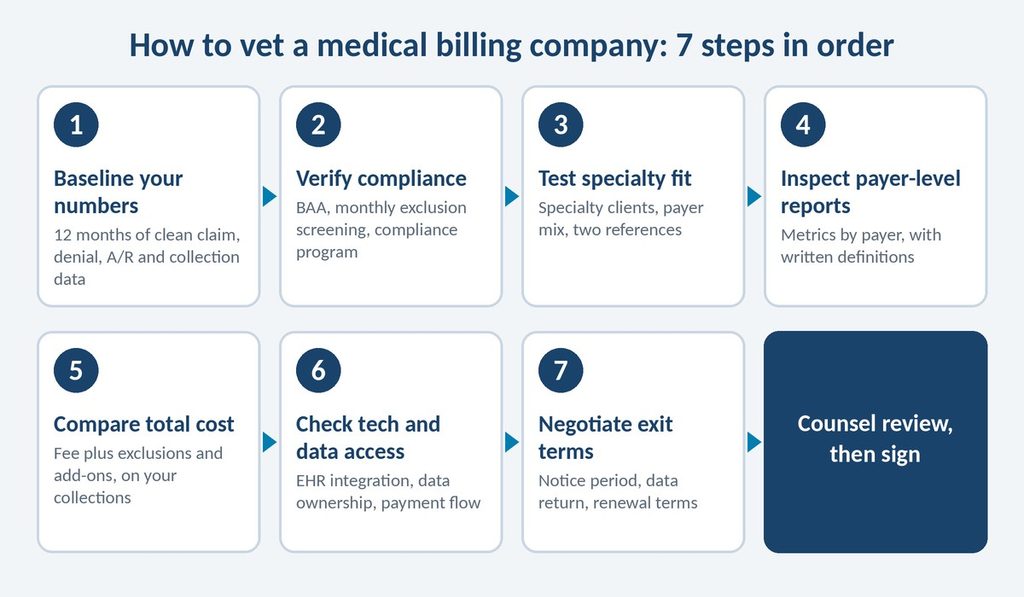
Choose a medical billing company by working through seven steps in order. Baseline your own numbers, verify compliance, test specialty fit, inspect payer-level reports, compare total cost, check technology and data access, then negotiate exit terms. Each step below states the action and the condition that triggers it.
Step 1: Baseline your own numbers first
Pull twelve months of your own data on clean claim rate, denial rate by payer, days in A/R and net collection rate. A vendor can only prove improvement against a starting point you can measure. When your practice management system lacks these reports, ask each finalist to rebuild them from your remittances during the evaluation. The medical billing KPIs every practice should track give you the metric list to request.
Step 2: Verify compliance before comparing features
Confirm the company will sign a HIPAA business associate agreement, screens staff against the federal exclusion list and runs a documented compliance program. Do this before pricing, because a compliance gap can erase any savings. The compliance section below lists the four checks that must clear first.
Step 3: Test specialty and payer experience
Ask how many clients the company serves in your specialty, which payers they bill most, and request two references from practices of your size. Modifier use, global periods and prior authorization patterns differ between orthopedics and behavioral health, for example. Also confirm whether provider credentialing is included or priced separately, since it decides how quickly a new clinician can bill.
Step 4: Inspect payer-level reports, not summaries
Request a sample monthly report and check whether it shows clean claim rate, denial rate and days in A/R by payer rather than one blended figure. Ask who owns denial management and appeals. A practice-management consultant writing in Medical Economics (2026) notes that percentage-based pay can steer attention toward easy collections, so ask how claims older than 90 days are worked.
Step 5: Compare total cost, not the headline rate
Convert every quote into annual cost on your own collections, then add what each quote excludes. A lower percentage that omits appeals, credentialing or reporting can cost more than a higher all-inclusive rate. The worked example in the cost section shows the arithmetic with real numbers.
Step 6: Check technology and data access
Confirm whether the company works inside your EHR or practice management system, who owns the billing data, and how patient payments and remittances flow. When you plan to keep your current software, ask for a written description of the integration. When you plan to replace it, require a data-migration plan before the contract is signed.
Step 7: Negotiate exit terms before signing
Read the term length, auto-renewal, termination notice and data-return obligations. A July 2025 Day Pitney law-firm newsletter advises requiring electronic transfer of all billing data at exit and clarifying whether fees apply to gross or net collections. Use our contract review checklist for practices as a working list, and have counsel review the final draft.
What compliance and security checks must come before any contract?
Four checks must clear before any contract: a signed business associate agreement, monthly exclusion-list screening, a documented compliance program, and a clear rule for where Medicare payments are deposited. A vendor that hesitates on any of the four is unlikely to improve with a larger contract.
Business associate agreement and data security
A billing company handles protected health information, so HIPAA requires a written business associate agreement (BAA) with the practice. The HHS Office for Civil Rights publishes sample business associate agreement provisions (2013) covering permitted uses, safeguards, breach reporting, subcontractor obligations and, where feasible, return or destruction of data at termination. Check each item against the vendor’s template.
Ask whether subcontractors or offshore staff touch your data and whether they sign the same terms. Also ask which clearinghouse the vendor uses and what happens when it goes offline. An AMA informal survey released in April 2024 (more than 1,400 respondents) found 80% reported lost revenue after the Change Healthcare cyberattack. Our guide to data security and privacy in medical billing covers what to request.
One recent change to watch: the HIPAA Security Rule update proposed in January 2025 had not been finalized as of May 2026, according to industry coverage. If it is finalized as proposed, practices would need written annual verification of business associates’ safeguards, so ask vendors whether their security program could already support that.
Exclusion-list screening
Contracting with someone excluded from federal health care programs creates liability for the practice. The OIG’s 2013 Special Advisory Bulletin states that screening employees and contractors each month best minimizes exposure, and that no statute sets a required frequency. The bulletin describes civil monetary penalties of up to $10,000 per item or service, plus up to three times the amount claimed. Penalty amounts are adjusted for inflation, so check current OIG figures.
A documented compliance program
The OIG’s compliance guidance for third-party billing companies (63 Fed. Reg. 70138, 1998) is voluntary and dated, but its elements remain a practical checklist: written standards, a designated compliance officer, training, audits, reporting channels and exclusion screening. The guidance also flags that percentage-based compensation can create incentives to upcode. When pay is percentage-based, require periodic coding audits. See also HIPAA and OIG compliance in medical billing.
Where Medicare payments land
Medicare may pay a billing agent only when the conditions in 42 CFR 424.73(b)(3) are met. These include agent pay that is not related to dollars billed or collected, and payment issued in the provider’s name. When a vendor charges a percentage fee, confirm that Medicare remittances deposit into an account the practice owns and controls, and ask counsel how the fee arrangement fits.
How much does a medical billing company cost, and what is the real price?
Most billing companies charge a percentage of collections, commonly reported at roughly 4% to 9% in vendor pricing guides such as OmniMD’s 2026 guide. The real price depends on scope, exclusions and the claims the vendor fails to collect. A 2005 Physicians Practice article attributing figures to the billing trade association listed 10% to 15% for primary care. Scope, era and specialty explain the gap, so rely on quotes from your own market.
| Pricing model | Typical structure | Best fit | Main trade-off |
| Percentage of collections | Roughly 4%–9% of collections | Practices wanting vendor pay tied to collections | Confirm gross vs. net basis; may favor easy claims |
| Per-claim fee | Roughly $3–$12 per claim | High-volume, predictable claim flow | Rewards submission, not dollars collected |
| Flat monthly fee | Roughly $500–$2,500 per month | Stable volume and simple payer mix | Fee is unrelated to results; watch scope creep |
| Hybrid | Base fee plus lower percentage | Multi-specialty or complex groups | More fee lines to audit |
Illustrative: ranges are those commonly reported in vendor pricing guides (for example OmniMD, 2026), not from a single standards body. Actual quotes vary by specialty, volume, scope and region.
Worked example: total annual cost of two quotes
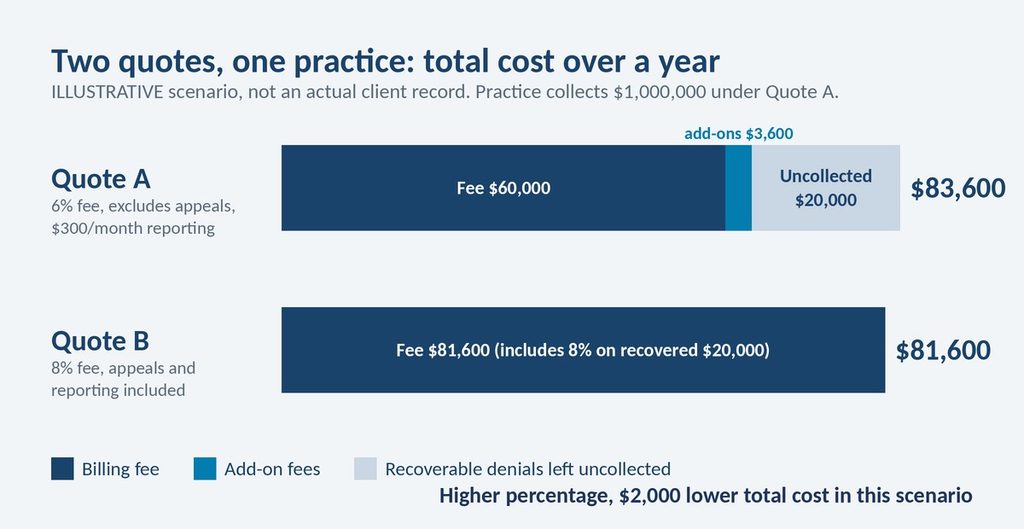
Net revenue after billing costs = collections − (fee % × collections) − add-on fees. Illustrative scenario (not an actual client record): a practice collects $1,000,000 a year under Quote A, which charges 6%, excludes appeals and bills $300 a month for reporting. Quote B charges 8% with appeals and reporting included.
Under Quote A the fee is $60,000 and add-ons are $3,600, so the practice nets $936,400. Assume $20,000 of recoverable denials goes unworked. Under Quote B, appeals recover that $20,000, collections reach $1,020,000, the 8% fee is $81,600, and the practice nets $938,400. The cheaper-looking quote leaves the practice about $2,000 worse off, and the gap grows if more denials are recoverable. Test the recovery assumption against your own denial data.
A practice without time to compare scope line by line can ask any vendor, including EZMedPro, for a written scope and fee breakdown. EZMedPro’s service page states that fees are typically a small percentage of monthly collections, so confirm exactly which services that percentage includes before signing.
How do Medicare, Medicare Advantage, Medicaid and commercial payers change what you ask?
Each payer type changes a billing company’s risk profile, so ask for performance by payer type and confirm who tracks each payer’s filing deadlines and rules. A vendor strong on Medicare may be weaker on a state Medicaid program or a regional commercial plan.
| Payer type | What differs | What to ask the vendor |
| Medicare (Part B) | 12-month timely filing limit from date of service; rejected claims do not count as filed; no appeal rights on timely-filing denials | How are filing deadlines and rejected claims tracked? |
| Medicare Advantage | Plan contracts set deadlines, prior authorization and appeal rules; they differ by plan | Do you maintain plan-by-plan rules and authorization workflows? |
| Medicaid | State fee schedules, filing limits and managed care plans differ; check your state Medicaid fee schedule before billing | Which states do you bill, and how do you separate managed care from fee-for-service? |
| Commercial | Each contract sets allowed amounts, filing limits and appeal windows | Do you load contracted rates and flag underpayments? |
Medicare filing rule: 42 CFR 424.44, as described on Noridian’s Part B timely filing page and CMS Claims Processing Manual, Chapter 1, Section 70. Other payer rows: no single source; terms vary by contract and state.
For Medicare, our guide to Medicare timely filing rules explains how the 12-month window is counted and when extensions apply. For Medicaid and commercial plans, the contract or state manual is the authority, and the vendor should be able to show where each deadline is documented.
How do the key formulas work with real numbers?
Three formulas let any practice test a vendor’s claims: clean claim rate, days in A/R and net collection rate. Each walkthrough below uses an illustrative scenario, and each shows how a blended average can hide a problem in one sub-group.
First-pass clean claim rate
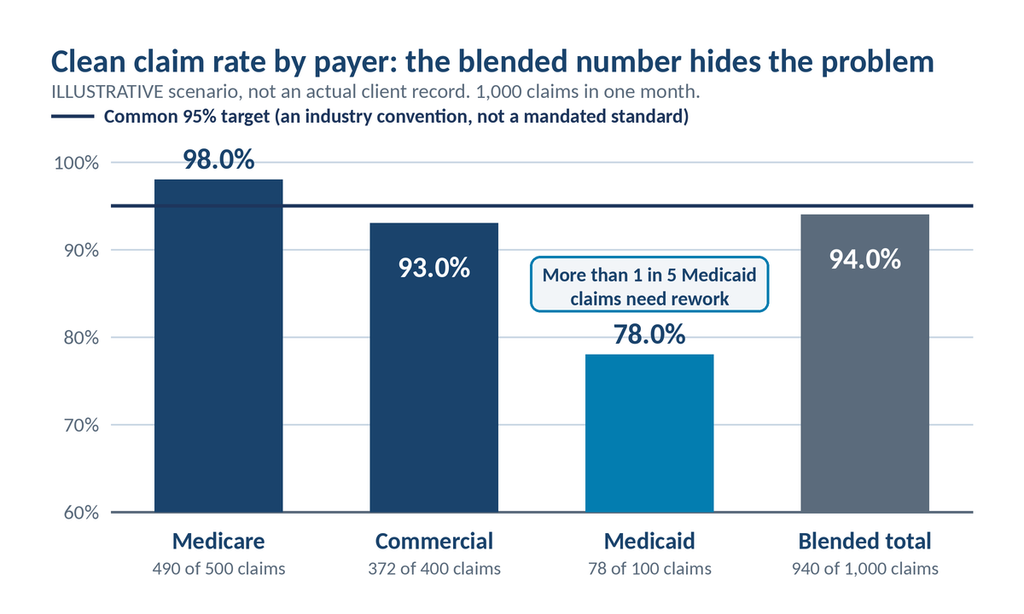
Clean claim rate = claims accepted and paid without rework on first submission ÷ total claims submitted × 100. Illustrative scenario (not an actual client record): a practice submits 1,000 claims in a month and 940 pass first time, a 94.0% blended rate. By payer, Medicare passes 490 of 500 (98.0%), commercial 372 of 400 (93.0%) and Medicaid 78 of 100 (78.0%). The blend sits near a common 95% target, yet more than one in five Medicaid claims needs rework.
Definitions of “clean” differ: some vendors count claims accepted by the clearinghouse, others count claims paid without rework. Put the definition in the contract. Our explainer on clean claim rate and how to improve it covers the common causes of rework.
Days in A/R and aged balances
Days in A/R = total accounts receivable ÷ average daily charges, where average daily charges = charges in the period ÷ days in the period. Illustrative scenario (not an actual client record): A/R of $270,000 and $540,000 of charges over 90 days gives $6,000 a day, or 45 days. If $54,000 of the balance is older than 90 days, 20% is aged, at the upper end of the practical range.
An average can hold steady while old balances sit, because new claims pay quickly and mask the stuck ones. Ask for aging buckets and confirm whether the vendor uses gross charges or net revenue in the denominator. For tactics, see our guide to reducing A/R days.
Net collection rate
Net collection rate = payments collected ÷ (charges − contractual adjustments) × 100. Illustrative scenario (not an actual client record): charges of $100,000 and contractual adjustments of $35,000 leave $65,000 allowed; payments of $61,750 give 95.0%. The same data gives only 61.75% if payments are divided by gross charges, which is why vendors must state which version they report.
A low net collection rate can also reflect underpayments the vendor never disputed. Ask whether the company loads your contracted rates and flags payments below them. The total-cost example earlier completes the fourth calculation that matters: net revenue after billing costs.
How should you read a billing company’s performance numbers?
Compare like for like: the same payer mix, specialty, time period and written definitions. One missed benchmark is a signal to investigate, not a verdict, because a single month can reflect a payer policy change or a one-time batch of old claims. In reporting reviews, a common pattern is a report showing one blended denial rate while a single payer drives most of the denials.
- Compare each metric to your own twelve-month baseline first, then to specialty peers, when peer data is available.
- Judge trends over at least three months before concluding that performance has changed.
- Break every metric out by payer; when a vendor reports only blended figures, request the split before relying on them.
- Investigate any metric that misses its range by asking for the top three drivers, such as denial reasons or aging buckets.
How long does it take to see results after switching billing companies?
Plan on roughly 30 to 60 days for onboarding and 60 to 90 days for stable reporting. Denial and A/R trends usually need about three to six months to show a clear direction. Full results can take longer when payer enrollment is involved. These are general planning ranges, not guarantees, and results vary by practice.
In onboarding reviews, a common pattern is that early months look worse than expected, because old claims, enrollment fixes and remittance setup are all in the mix. When switching from another vendor, expect overlap on legacy claims. When adding providers, build in payer enrollment time. Our checklist for moving to a new billing system helps sequence the handoff.
Which mistakes cost practices the most when hiring a billing company?
The costliest mistakes are choosing on percentage alone, accepting blended reports, skipping specialty references and signing without exit terms. Most come from time pressure during evaluation, so each fix below is a single action a practice can complete before the contract reaches the signature stage.
- Choosing the lowest percentage. Compare total annual cost; when a quote excludes appeals, credentialing or reporting, price those separately.
- Accepting blended reports. Require payer-level clean claim, denial and A/R figures, and written definitions for each.
- Skipping specialty references. Call two references in your specialty and size, and ask what went wrong during onboarding.
- Ignoring data ownership and exit. Require electronic data return and a reasonable termination notice; a commonly cited range is 30 to 90 days.
- Assuming the vendor owns compliance. The OIG guidance notes that proper documentation remains the provider’s responsibility, so keep documentation standards and review audit results quarterly.
- Letting credentialing lag. When a new provider is joining, get the enrollment timeline in writing, because unenrolled providers cannot bill the payer.
Quick summary
- Verify the business associate agreement, monthly exclusion screening and a documented compliance program before comparing prices.
- Ask for clean claim rate (about 95% or higher), denial rate (roughly 5%–10% or lower) and days in A/R (about 30–45) by payer, with written definitions.
- Convert each quote to total annual cost; a lower percentage that excludes appeals can cost more.
- Confirm where Medicare payments deposit; with a percentage fee, keep deposits in a practice-owned account.
- Require data return and reasonable termination notice before signing.
- Plan for roughly three to six months before trends are clear; treat one missed month as a signal, not a verdict.
Self-assessment: is your shortlisted billing company ready for a contract?
Answer yes or no for your top candidate, using written evidence rather than verbal assurances from a sales call. Each question ties to a number or check covered above, and the scoring guide after the list shows what your total means for the next step.
- Has the vendor agreed to sign a BAA that covers subcontractors?
- Does the vendor screen staff against the OIG exclusion list monthly and show a written policy?
- Does the vendor report clean claim rate by payer, with a written definition of “clean”?
- Is the reported clean claim rate near or above about 95% on a payer mix similar to yours?
- Is the initial denial rate reported by payer and reason, near or below roughly 5%–10%?
- Are days in A/R in the roughly 30–45 range, with aging buckets provided?
- Does the quote list every included service, including appeals, credentialing and reporting?
- Have you calculated total annual cost on your own collections?
- Is it confirmed, with counsel, that Medicare payments deposit into a practice-owned account?
- Does the contract allow termination on reasonable notice with electronic data return?
| Yes answers | Tier | What to do |
| 9–10 | Ready to negotiate | Move to counsel review and a defined pilot scope. |
| 6–8 | Promising, with gaps | Close each gap in writing before signing. |
| 0–5 | Not ready | Request more evidence or keep looking. |
When should a practice look outside for billing support?
Outside support makes sense when in-house effort has stopped moving the numbers, even after training, process changes or an extra hire. Five signals suggest the in-house approach has reached its limit, and any one of them justifies at least a comparison quote:
- Days in A/R stay above roughly 45 despite internal follow-up.
- Denial rates sit above about 10% and the root causes are unclear.
- One biller’s absence stalls claim submission.
- New providers wait on payer enrollment while visits go unbilled.
- The practice is expanding into a new specialty, location or state Medicaid program.
When evaluating outside support, look for a signed BAA, monthly exclusion screening, payer-level reporting, a written scope, no multi-year lock-in and electronic data return. Those requirements apply to any vendor, whatever its size, and they are easier to negotiate before the first claim is transferred than after it.
EZMedPro is one example. It delivers medical billing, coding, credentialing, denial management and compliance support through a US-based team, with an emphasis on transparent reporting and no hidden fees. Its RCM service page describes monthly reports covering performance, payer trends and denial reasons. Results vary by practice, so request a sample report and written scope, as you would from any vendor, through its revenue cycle management service.
Expert Insights
How to choose a medical billing company comes down to evidence over presentation: compliance gates first, payer-level numbers second, total cost third and exit rights last. Each step in this guide turns a sales claim into something a practice can verify before signing.
Only a few figures here are firm published standards or guidance: the 12-month Medicare Part B filing limit, the HIPAA business associate agreement requirement and the OIG exclusion-screening bulletin. The clean claim, denial, A/R, net collection and fee ranges are industry conventions or practical targets, and every example is illustrative. Adjust them for your specialty and payer mix.
The natural next question is what a fair baseline looks like for your own practice. Start by pulling twelve months of payer-level data, then ask EZMedPro or any shortlisted vendor to walk through it. To discuss a shortlist or your current numbers, begin with EZMedPro’s revenue cycle management team.
Frequently asked questions
What is a good clean claim rate for a medical billing company?
A clean claim rate of about 95% or higher is the figure commonly reported across industry sources; some vendor guides cite 90% as a floor. It is not a mandated standard. Ask how the vendor defines “clean” and request the rate by payer, because a strong blended number can hide a weak segment.
What is a good denial rate for a billing company?
Initial denial rates of roughly 5% to 10% are commonly cited in industry guides, and lower is better. The right target shifts with specialty and payer mix, so compare against your own twelve-month baseline and track denial reasons, not only the percentage.
What is a good days in A/R number?
About 30 to 45 days is the range commonly reported across vendor guides, and many cite under 40. Specialty and payer mix move the target. Also review the share of balances older than 90 days, since an average can look healthy while aged claims accumulate.
How much does a medical billing company charge?
Vendor pricing guides commonly report about 4% to 9% of collections for percentage models, plus per-claim and flat monthly alternatives. A 2005 article attributing figures to the billing trade association listed higher primary care rates. Compare total annual cost, including exclusions and add-ons, not the headline percentage.
What questions should I ask before hiring a billing company?
Ask about the business associate agreement, exclusion-list screening, payer-level reports, data ownership, what the fee includes, how claims older than 90 days are worked, where Medicare payments deposit, termination notice, and two references from practices of your specialty and size.
Can a billing company receive Medicare payments into its own bank account?
Medicare pays a billing agent only when 42 CFR 424.73(b)(3) conditions are met. They include payment issued in the provider’s name and agent pay unrelated to dollars billed or collected. Practices should confirm with counsel where Medicare deposits go under their fee arrangement.
Sources and methodology
(a) Published standards, rules and definitions from named bodies
- HHS Office for Civil Rights, Sample Business Associate Agreement Provisions (January 25, 2013).
- HHS Office of Inspector General, Special Advisory Bulletin: The Effect of Exclusion From Participation in Federal Health Care Programs (May 8, 2013).
- HHS Office of Inspector General, Compliance Program Guidance for Third-Party Medical Billing Companies, 63 Fed. Reg. 70138 (December 18, 1998); voluntary guidance.
- 42 CFR 424.73 (payment to agents) and 42 CFR 424.44 (timely filing), as described by Noridian JE Part B, Claim Submission Timeliness (med.noridianmedicare.com/web/jeb/topics/claim-submission/timely-filing), and CMS Claims Processing Manual, Chapter 1, Section 70.
(b) Named benchmarking data providers
No proprietary benchmarking dataset was used. MGMA and HFMA publish revenue cycle benchmarks and metric definitions; the ranges in this article are not drawn from those datasets and are not attributed to them. Readers who need peer data for their specialty should obtain it from a named benchmarking provider.
(c) Practical or illustrative targets from general industry sources
- OmniMD, How To Choose The Right Medical Billing Company (2026): clean claim rate 90% or higher, denial rate under 8%, days in A/R under 40–45, claim submission within 24–48 hours; pricing ranges of 4%–9% of collections, $3–$12 per claim and $500–$2,500 per month. Vendor publication; figures unsourced.
- Medwave Billing & Credentialing (2026): clean claim rate 95% or higher, denial rate under 5%, days in A/R under 35, net collection rate 95%–98%. Vendor publication; figures unsourced.
- ADSC (2026): clean claim rate 95% or higher, A/R over 90 days under 10%, net collection rate 96%; attributes some figures to MGMA and HFMA without linking the underlying data, so they are treated here as commonly reported figures only.
- Medical Economics, What independent practices get wrong when they hire a billing company (2026), on percentage-based pay and aged claims.
- Physicians Practice, Billing company charges (2005), attributing percentage ranges by specialty to the billing trade association; dated and shown only for contrast.
(d) Survey and study data
- American Medical Association, informal survey on the Change Healthcare cyberattack (April 10, 2024): more than 1,400 respondents, a convenience sample; 80% reported lost revenue from unpaid claims.
- Day Pitney LLP, Where There’s a Bill, There’s a Way: Understanding Key Nuances of Medical Billing Contracts Before You Sign (July 21, 2025).
- Paubox, What’s changing with HIPAA in 2026 (May 13, 2026), on the status of the proposed HIPAA Security Rule update.
Methodology: the SERP and AI-source review was a research-based approximation of live US results, not rank-tracking data from a paid tool. Results vary by practice, and figures reflect information available at the time of research (October 2026). This article is general information, not legal or financial advice; confirm contract and payment questions with qualified counsel.

