
How to Catch and Recover Underpaid Insurance Claims
An underpaid insurance claim is one the payer paid, but for less than your contract, the fee schedule or the patient’s benefits allow. Because the account shows a payment, nobody works it, and the shortfall quietly becomes a write-off. This guide shows how to compare payments with expected amounts, separate real underpayments from normal adjustments, build a dispute packet and spot payer patterns.
| Key takeaways Underpayments hide in paid claims, so they need their own review.Compare the allowed amount on each remittance with a contract or fee schedule amount.Read the adjustment group codes first: patient responsibility is not a payer shortfall.Dispute in batches, with proof, and watch the deadline. |
Why Underpaid Insurance Claims Slip Through
A denial triggers a worklist. An underpayment does not. The claim posts as paid, the balance goes to zero, and the account closes with money still owed.
Payment posting is where shortfalls should surface. Our guide to the role of payment posting in RCM accuracy explains why, and our overview of the EOB and ERA shows how to read the remittance behind each payment.
Underpayment or Normal Adjustment?
Read the remittance before you flag anything. Adjustment group codes tell you who owes what: PR is patient responsibility, CO is a contractual obligation and OA covers other adjustments, as the CMS Claims Processing Manual, Chapter 22 defines them.
| What you see | What it usually means | Next action |
| PR amounts: deductible, coinsurance, copay | Patient owes the balance | Check against benefits, then bill the patient |
| CO adjustment equals the gap to your contract | Expected write-off | Match the allowed amount to the contract and close |
| CO adjustment larger than the contract explains | Possible underpayment | Compare allowed amounts and dispute |
| Paid at a lower code than you billed | Possible downcoding | Send documentation that supports the billed code |
| Modifier ignored, line paid at a reduced rate | Possible edit error | Review modifier use against our CPT modifiers guide and the payer policy |
Build an Expected-Payment Check
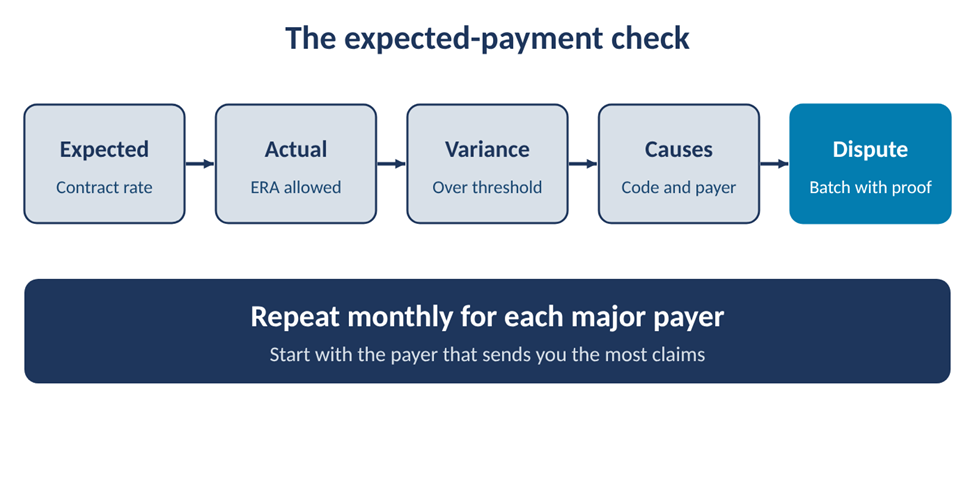
You cannot spot a shortfall without knowing what the right payment looks like. Build that reference once, then compare against it every month.
- List your top codes per payer. Record the contracted allowed amount for your highest-volume CPT codes. For Medicare, the CMS Physician Fee Schedule Look-Up Tool shows payment amounts adjusted by locality.
- Sample paid claims. Each month, pull a set of paid claims per payer and compare the ERA allowed amount with your reference.
- Flag variances. Agree on a variance threshold, then log the payer, code, date and amount for anything above it.
- Group by cause. The same code, modifier or payer showing up repeatedly signals a systematic error worth a batch dispute.
Our guide to fee schedule analysis for private practices helps you build and maintain that reference.
Common Causes of Underpayments
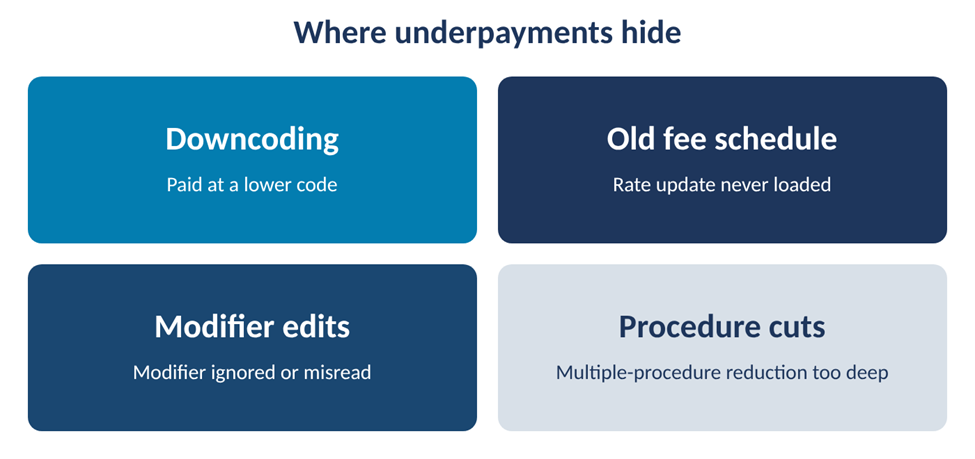
| Cause | What it looks like | Fix |
| Outdated fee schedule at the payer | Same code paid at an old rate across many claims | Send the contract amendment and dispute the batch |
| Downcoding | Paid at a lower code than billed | Send notes that support the billed level |
| Modifier or bundling edit | A line reduced or denied despite a valid modifier | Appeal with the modifier rationale and payer policy |
| Multiple-procedure reduction | Second procedure paid below contract terms | Compare the reduction with the contract language |
Build a Dispute Packet That Gets Read
A dispute wins when the reviewer can confirm the shortfall in one pass. Include these items:
- Claim number, date of service, billed code, paid amount and expected amount.
- The remittance or EOB showing the allowed amount.
- The contract page or fee schedule line that sets the rate.
- Clinical documentation, only when the code or modifier is in question.
- One clear request, such as reprocessing at the contracted rate.
Sample (fictional data). The claim review below shows how the variance and likely cause point to the proof you send. Change the amounts and codes to match your own payer.
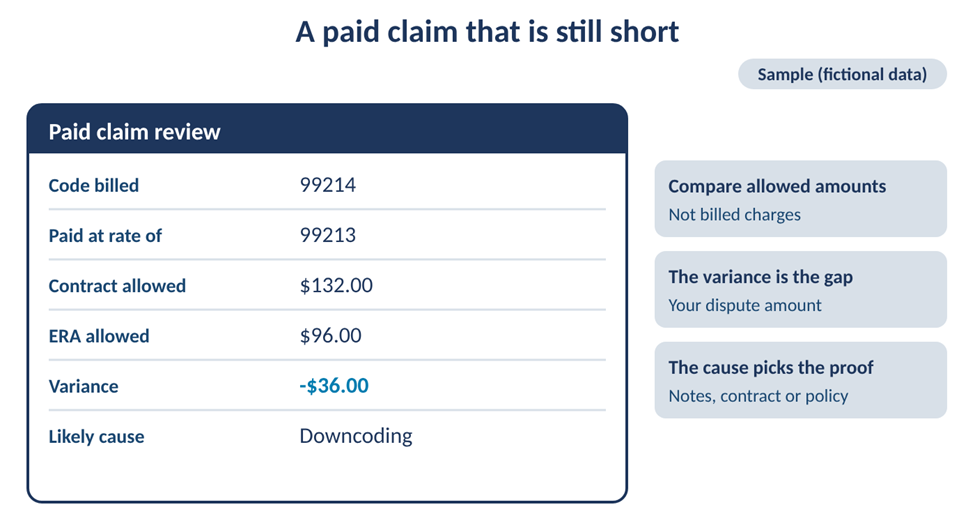
Sample dispute request (fictional data) Please reprocess claim SAMPLE-5520. Code 99214 was billed and supported by the attached visit note, but the remittance shows payment at the 99213 rate. The contract allows $132.00 for 99214, and the remittance allowed $96.00. We request reprocessing and payment of the $36.00 difference.
Deadlines and Escalation
Dispute windows differ by payer, so check your contract first and calendar the deadline the day you flag a claim. For group health plans covered by ERISA, the federal claims procedure rule requires at least 180 days to appeal an adverse benefit determination, and it counts payment in part as one. Whether a provider can use that route depends on assignment or authorization, so confirm in the plan documents.
If the first dispute fails, escalate to your payer representative with the claim list. Our appeal process guide walks through letters and follow-up.
Track Payer Patterns
Individual recoveries help, but patterns change contracts. Track the underpayment rate, the amount recovered and the days to resolve for each payer. Our examples of a medical billing metrics dashboard show how to display them, and medical billing audits help you find leaks you have not measured. Bring that data to contract renewals.
Common mistakes
- Treating a zero balance as proof the claim was paid correctly.
- Writing off CO adjustments without matching them to the contract.
- Disputing one claim at a time instead of batching by cause.
Results vary by practice.
Frequently Asked Questions
What is an underpaid insurance claim?
An underpaid claim is one the payer processed and paid, but for less than your contract, the Medicare fee schedule or the patient’s benefits allow. Because it posts as paid, it does not show up on a denial worklist. You find it only by comparing the allowed amount on the remittance with what you expected.
How do I know if an insurance company underpaid me?
Compare the allowed amount on each remittance with your contract rate or, for Medicare, the fee schedule amount for your locality. Then read the adjustment codes. If the contractual write-off is larger than the contract explains, or the paid code is lower than the billed code, you likely have an underpayment.
Is a contractual adjustment an underpayment?
Not by itself. A contractual adjustment (group code CO) is the expected difference between your charge and the contracted amount. It becomes an underpayment only when the allowed amount is lower than your contract says it should be. Always match the allowed amount to the contract before you write anything off.
How long do I have to dispute an underpayment?
It depends on the payer and the plan. Your contract often sets its own dispute window, so check it first. For group health plans covered by ERISA, claimants must get at least 180 days to appeal an adverse benefit determination, and partial payment counts. Calendar every deadline when you flag a claim.
Should I dispute small underpayments?
Yes, but do it in batches. One short payment may not justify staff time, yet the same error often repeats across many claims. Group flagged claims by payer, code and cause, then send one dispute with a claim list and proof. The combined amount is what makes the effort worthwhile.
Get Help Recovering Underpaid Claims
Catching underpaid insurance claims takes steady comparison work that busy front offices rarely have time for. EZMedPro is a US-based medical billing, coding, credentialing and revenue cycle management company with transparent reporting and no hidden fees. If paid claims may be falling short, explore our revenue cycle management services or contact the team to talk through your payment review.
Sources: CMS Medicare Claims Processing Manual, Chapter 22; CMS Physician Fee Schedule Look-Up Tool; 29 CFR 2560.503-1 (eCFR). This article is general education, not legal advice, and payer rules vary, so check your contract and your payer’s provider manual.

