
Urgent Care Billing in Texas: Rules, Deadlines and Fixes
Urgent care billing in Texas follows national coding rules, but four Texas-specific rules decide whether many claims get paid: Texas Medicaid’s 95-day filing limit, state prompt-pay timelines for insured plans, a workers’ compensation system that employers can opt out of, and Medicaid managed care plans with their own manuals. This guide shows what each rule means at the front desk and in the billing queue, and how to fix the denials they cause. For coding and documentation basics, see our guide to specialized billing for urgent care centers.
| Key takeaways Texas Medicaid fee-for-service claims generally must be filed within 95 days of the date of service.Texas Department of Insurance (TDI) rules call for action on clean claims within 30 days (electronic) or 45 days (paper) for regulated plans.Texas employers may opt out of workers’ compensation, so ask at check-in whether the employer has a carrier.Most avoidable denials start at registration. |
Urgent care billing in Texas at a glance
The payer decides the rules. This table shows where each claim goes and which clock is running.
| Payer type | Where the claim goes | Texas rule to track |
| Texas Medicaid (fee-for-service) | TMHP, the Texas Medicaid and Healthcare Partnership | File within 95 days of the date of service; appeals and adjustments within 120 days of the last denial |
| Medicaid or CHIP managed care | The member’s health plan | The plan’s provider manual sets filing and appeal limits |
| Insured HMO, PPO or EPO plans | The insurer | Electronic clean claims decided in 30 days, paper in 45 (TDI) |
| Workers’ compensation | The employer’s carrier | Bill no later than the 95th day after the date of service |
| Medicare | The Medicare contractor | Federal rules apply, not Texas deadlines |
Commercial payers set their own limits in the contract and provider manual, so check yours. Medicare follows federal rules, covered in our Medicare timely filing rules guide.
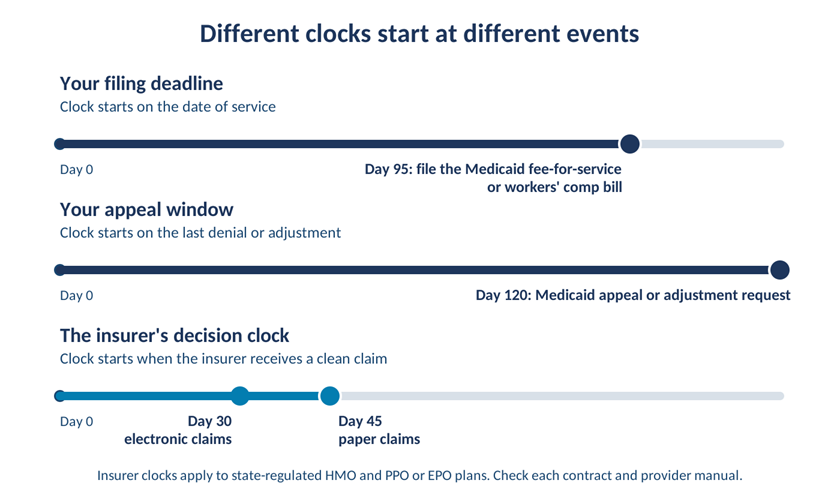
In short: filing limits run from the date of service, appeals from the last denial, and insurer decisions from receipt of a clean claim.
Texas Medicaid and CHIP: know which plan you are billing
Under the Texas Administrative Code (Title 1, Section 354.1003), Medicaid claims generally must be filed within 95 days of the date of service, and claims older than 24 months are not paid unless an exception applies. If another insurer was billed first, the 95 days run from that insurer’s decision. If eligibility was added after the visit, they run from the add date, within 365 days of service. Keep the other insurer’s electronic remittance advice (ERA) in the file.
Many Texas Medicaid and CHIP members are enrolled in a managed care plan. Bill the plan, whose provider manual sets its own filing and appeal rules. Providers also enroll with Texas Medicaid before contracting with a plan, so an enrollment gap can surface as a denial.
Commercial plans and Texas prompt-pay rules
For insurers regulated by the Texas Department of Insurance, a TDI bulletin on prompt payment says carriers must decide whether a claim is clean (free of errors that stop payment) or deficient within 30 days for electronic claims and 45 days for paper claims. They generally must also pay, deny with written notice, or pay the undisputed part in that window. An insurer may make only one written request for more information, so answer it quickly instead of resubmitting.
These rules cover state-regulated HMO and PPO or exclusive provider organization (EPO) plans. Self-funded employer plans follow their own terms. Run an A/R aging report weekly and flag any electronic claim with no response after 30 days.
Workers’ compensation and employer-paid visits
Texas lets private employers choose not to carry workers’ compensation. These nonsubscribers have notice and reporting duties, described on the state’s nonsubscriber employer page. An injured worker’s visit may therefore have a carrier, an employer who pays directly, or no coverage. Ask “Did this happen at work?” at check-in and record the employer, carrier and claim number.
When a carrier is involved, Title 28, Section 133.20 of the Administrative Code says a provider must not submit a bill later than the 95th day after the date of service, with limited exceptions. Billing the patient’s group health plan by mistake is a common reason these claims stall, and our guide to workers’ compensation billing delays explains the fix.
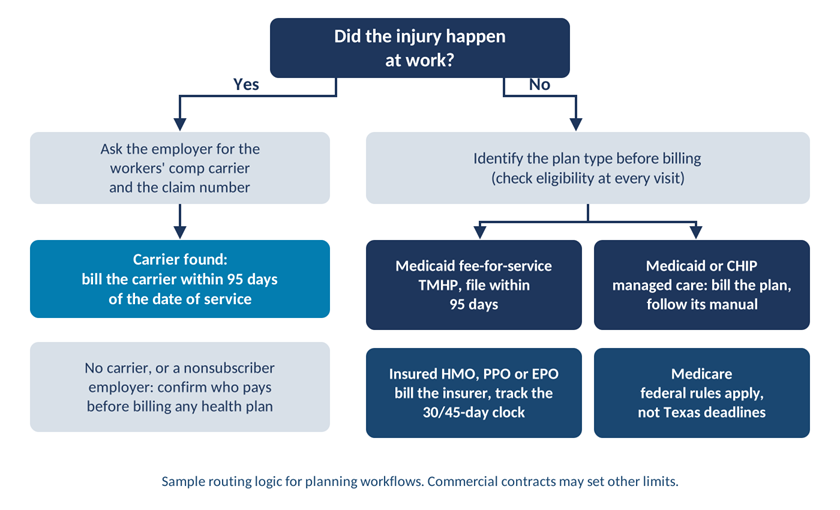
In short: work injuries go to the carrier within 95 days, and other visits route by plan type.
Place of service: match your contract
The Centers for Medicare & Medicaid Services (CMS) defines place of service (POS) 20 as an urgent care facility, a walk-in site separate from an emergency room, office or clinic, in its Place of Service Code Set. POS 11 is the office code. Which one a payer expects depends on your contract, and a mismatch can cause a denial or underpayment, so confirm it during contracting.
Front-desk checklist before the patient leaves
Most Texas denials can be prevented at registration. Start with a same-day check, as described in our guide to streamlining patient eligibility verification.
- Scan the ID and insurance card and confirm eligibility for the date of service.
- Identify the plan type: Medicaid fee-for-service, managed care, insured commercial, self-funded or Medicare.
- Ask whether the visit is work related and record the employer, carrier and claim number.
- Confirm the place of service matches the payer contract.
- Collect the copay and send the claim electronically the same or next business day.
- Add the date of service to a deadline queue for the 95-day clocks.
Common Texas urgent care denials and fixes
Sample (fictional data): a Friday-evening patient with a hand laceration shows a group health card, and the clinic bills that plan. Three weeks later it denies the claim because the injury happened at work. The clinic must now find the employer’s carrier, get a claim number and bill inside the 95-day window.
| Problem | Likely cause | Fix and prevention |
| Past filing limit | Medicaid or workers’ comp claim sent after 95 days | Check for an exception. Prevent it with a deadline queue. |
| Wrong payer billed | Managed care member sent to TMHP, or work injury sent to group health | Rebill the right payer with proof of the first denial. Check plan type each visit. |
| Eligibility not active | Coverage ended or went unchecked | Confirm eligibility before the patient leaves. |
| Place of service mismatch | POS 20 or 11 conflicts with the contract | Correct the code and resubmit. Add a clearinghouse edit. |
| Missing claim number | Workers’ comp number not captured | Hold the claim until it is on file. |
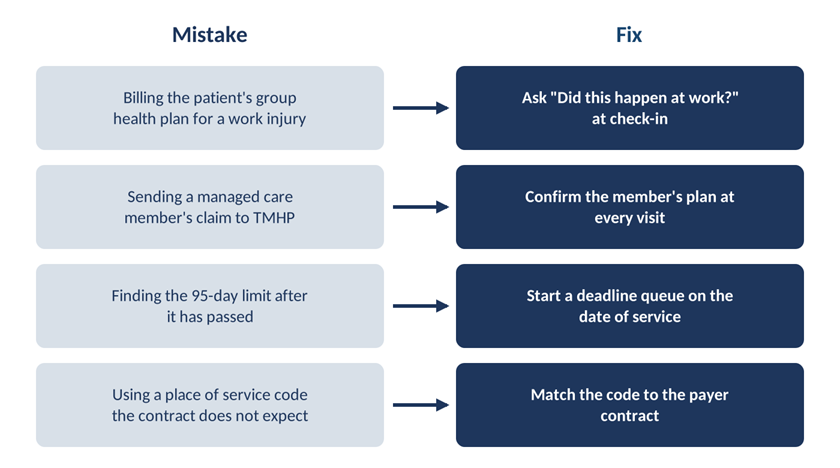
For claims already denied, follow our step-by-step guide to appealing a denied medical claim.
Frequently asked questions
What is the timely filing limit for Texas Medicaid urgent care claims?
Texas Medicaid fee-for-service claims generally must be filed within 95 days of the date of service. Exceptions exist, such as retroactive eligibility or a slow primary insurer. Managed care plans set their own limits, so check the plan’s provider manual before relying on 95 days.
How long does a Texas insurer have to pay a clean urgent care claim?
For HMO and PPO or EPO plans regulated by the Texas Department of Insurance, carriers generally must pay, deny or pay the undisputed part of a clean claim within 30 days for electronic claims and 45 days for paper claims. Self-funded plans follow their own terms.
Do all Texas employers carry workers’ compensation?
No. Texas private employers may choose not to carry workers’ compensation and become nonsubscribers. When an injured worker visits, ask for the employer’s carrier and claim number. If there is no coverage, confirm who is responsible for payment before billing any health plan.
Does a Medicaid managed care member’s claim go to TMHP?
No, not for managed care members. Members enrolled in a Medicaid or CHIP managed care plan are billed through that plan, and the plan’s manual sets billing rules. Providers also need to be enrolled with Texas Medicaid before contracting with a plan. Check the member’s plan at every visit.
Getting urgent care billing in Texas under control
Urgent care billing in Texas rewards clinics that identify the payer at check-in and watch the clock after the visit. EZMedPro is a US-based medical billing, coding, credentialing and revenue cycle management company with transparent reporting and no hidden fees. Results vary by practice.
You can review our billing, coding, credentialing and revenue cycle management services or talk with the team about your clinic.
Groups that run urgent care alongside other lines can also read about our multi-specialty billing in Texas.
Sources: Texas Department of Insurance bulletin B-0034-20 and nonsubscriber employer page; CMS Place of Service Code Set; Texas Administrative Code, Title 1 Section 354.1003 and Title 28 Section 133.20. General information, not legal advice.

