
Multi-Specialty Medical Billing Services in Texas 2026
Multi-specialty medical billing services in Texas manage coding, credentialing, claims, and collections for groups that combine several specialties under one organization. They coordinate specialty-specific coding rules, group-level Medicare rules, Texas Medicaid requirements, and Texas prompt pay deadlines. A commonly cited practical target is a clean claim rate of 95% or higher for every specialty, not just the group average.
Running several specialties under one roof multiplies billing risk in ways single-specialty clinics rarely face. A cardiologist, a pediatrician, and an orthopedic surgeon share a tax ID but follow very different coding rules. In Texas, those rules also meet Medicare group policies, TMHP managed care plans, and state prompt pay deadlines. This guide explains how multi-specialty medical billing services in Texas work and where group revenue usually leaks. You will get a benchmark scorecard, worked examples, and realistic timelines. Near the end, a ten-question self-assessment checklist helps you grade your current process.
Texas Multi-Specialty Billing Scorecard: Key Figures
Use this table during monthly reviews, and apply it to each specialty separately. Every figure is labeled by where it comes from.
| Metric | Practical Target / Range | Review Frequency | Primary Source |
| Clean claim rate (per specialty) | 95% or higher | Weekly | Commonly reported industry target |
| Denial rate (per specialty) | Under 5–8% | Weekly | Commonly reported range |
| Days in A/R | Under 35–40 days | Monthly | Commonly reported range |
| A/R older than 90 days | Under 15% of total A/R | Monthly | Commonly reported range |
| Net collection rate | 95% or higher | Monthly | Industry-defined metric + common benchmark |
| New vs. established patient window | 3 years, same specialty and group | Per visit | Published standard (CPT and CMS) |
| Clean claim payment (regulated commercial plans) | 30 days electronic / 45 days paper | Per claim | Published standard (Texas Insurance Code, TDI) |
| Claim filing deadline (contracted commercial plans) | 95 days from date of service | Per claim | Published standard (TDI prompt pay rules; fully insured plans only, not self-funded ERISA plans) |
Source labels: “Published standard” means a figure set in CPT guidelines, CMS manuals, or Texas rules. “Commonly reported range” means a target repeated across industry sources that no body mandates. Groups such as MGMA define collection metrics, but the 95% figure reflects common industry benchmarking, not a body-mandated number.
Why Texas Multi-Specialty Groups Face Extra Billing Pressure?
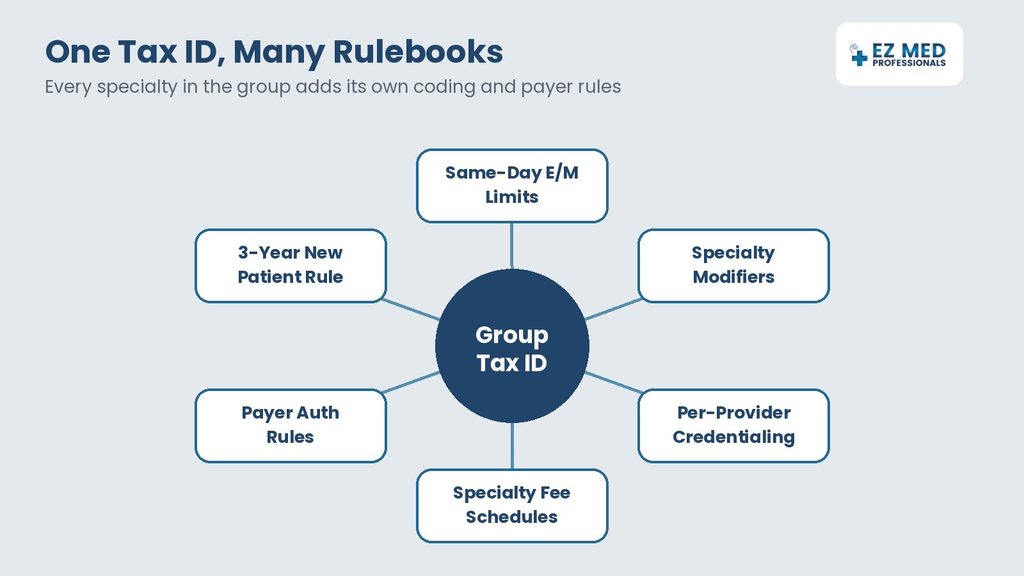
One Tax ID, Many Specialty Rulebooks
Medicare and CPT treat group practices by specialty, which changes several everyday coding decisions. A patient counts as new only if no physician of the same specialty in your group saw them within three years. So a longtime primary care patient can still be new to your dermatologist. Medicare also limits same-day E/M visits billed by physicians of the same specialty in one group. Physicians in different specialties, however, can bill separately without regard to group membership. The Texas Medical Association’s summary of the three-year rule explains these distinctions clearly. Accurate provider specialty records in your billing system make these rules work automatically.
The Texas Payer Landscape
Texas groups typically bill Medicare through Novitas Solutions, the regional contractor, alongside Texas Medicaid and commercial carriers. Most Medicaid patients belong to STAR managed care plans, each with its own authorization rules and portals. Every specialty in your group may face different authorization lists from the same plan. For fully insured commercial plans, the Texas Prompt Pay Act requires payment of clean electronic claims within 30 days and paper claims within 45. The TDI Prompt Pay FAQ explains how audits and information requests affect those clocks. Self-funded employer plans may follow federal ERISA rules instead.
Coding and Credentialing Friction Points Across Specialties
Modifiers and Cross-Specialty Referrals
Multi-specialty groups generate more modifier-heavy claims than most single-specialty practices. Modifier 25 separates a significant E/M visit from a same-day procedure, which is common in dermatology and orthopedics. Modifier 59, or its more specific X modifiers, supports distinct procedures that would otherwise trigger NCCI edits. Cardiology and radiology often split services with modifiers 26 and TC. Internal referrals add another layer, because referring and rendering provider fields must match each payer’s expectations. Overusing any modifier invites audits, so audit samples should cover every specialty. Our guide to CPT modifiers explained walks through correct usage.
Credentialing Every Provider With Every Payer
Multi-specialty credentialing is often the largest hidden source of lost revenue in growing groups. Each provider needs an individual NPI linked to the group’s organizational NPI and correct specialty taxonomy codes. Every provider must also be enrolled with Medicare, TMHP, each STAR plan, and each commercial panel you bill. A single missing enrollment can deny months of visits for one specialist. CAQH profiles need regular attestation, and revalidation dates differ by payer. A shared credentialing calendar prevents most of these gaps. Our step-by-step credentialing guide covers the full enrollment process.
Specialty-Specific Fee Schedules
Commercial contracts often pay specialties very differently for similar codes. A group that negotiates one contract for all specialties may accept rates that undervalue procedure-heavy service lines. Reviewing allowed amounts by specialty shows which contracts deserve renegotiation. Posting teams should also flag underpayments against contracted rates, not just billed charges. That review is easier when each specialty’s top twenty codes are tracked separately. Our fee schedule analysis guide outlines a practical review method. Group leaders should revisit these numbers at least once a year, ideally before contract renewals.
Services to Expect From a Multi-Specialty Billing Partner
Capable multi-specialty billing support covers the full revenue cycle management process for every service line. The strongest multi-specialty medical billing services in Texas also report results by specialty, provider, and location. The table below links each service to the problem it prevents. Use it to evaluate an outside vendor or your internal team. Any row you cannot confidently check off probably shows up in one specialty’s denial numbers already.
| Service | What It Prevents | Multi-Specialty Detail |
| Eligibility & benefits verification | Denials for inactive coverage or specialist copay errors | Specialist benefits often differ from primary care |
| Prior authorization tracking | Unpaid imaging, procedures, and injections | Authorization lists vary by specialty and plan |
| Credentialing & enrollment | Unenrolled-provider denials | Every provider, every payer, correct taxonomy |
| Specialty coding review | Undercoding, modifier misuse, NCCI conflicts | Coders assigned by specialty expertise |
| Claim scrubbing & submission | Rejections and missed filing windows | 95-day window for contracted Texas plans |
| Payment posting & underpayment review | Silent losses on short payments | Compare allowed amounts by specialty contract |
| Reporting | Hidden weak service lines | KPIs split by specialty, provider, and location |
Worked Examples for Group Billing Metrics
Each example uses simple monthly numbers, so you can repeat the math with your own reports.
Clean Claim Rate
Formula: claims accepted on first submission ÷ total claims submitted × 100. Example: a group submits 1,600 claims, and 1,504 pass without rejection or rework. The clean claim rate is 94.0%, just below the common 95% target.
Days in A/R
Formula: total A/R ÷ average daily charges. Example: A/R totals $396,000, and 90-day charges reach $1,080,000. Average daily charges are $12,000, so days in A/R equal 33, inside the common range.
Net Collection Rate
Formula: payments ÷ (charges − contractual adjustments) × 100. Example: charges are $1,300,000, adjustments are $520,000, and payments are $748,800. The net collection rate is $748,800 ÷ $780,000 = 96.0%, above the common target.
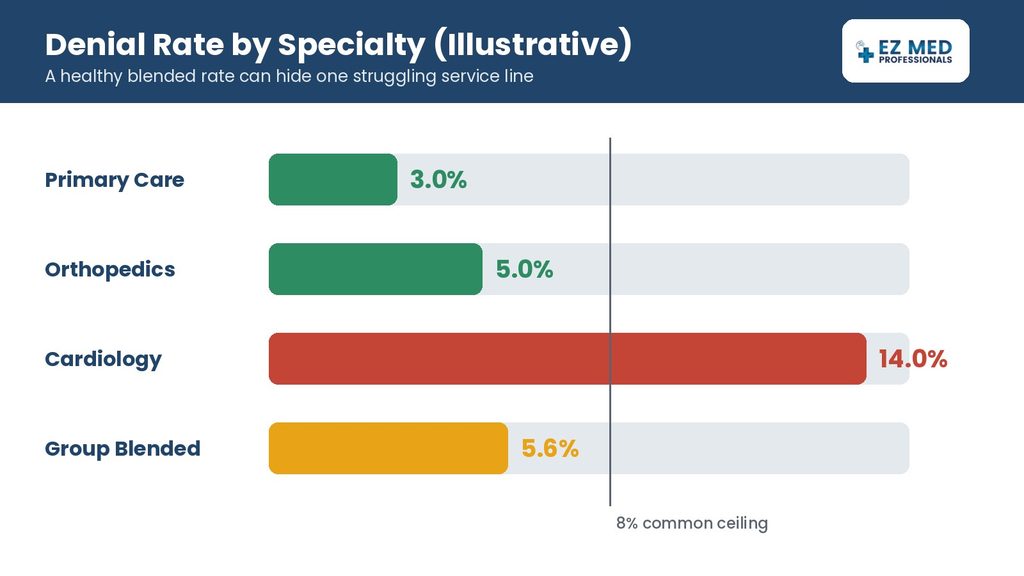
When a Blended Average Hides a Weak Specialty
Group averages can hide a specialty that is quietly failing. Illustrative scenario (not an actual client record): a group submits 900 primary care, 400 orthopedic, and 300 cardiology claims monthly. Primary care has 27 denials, a 3% rate, and orthopedics has 20, a 5% rate. Cardiology has 42 denials, a troubling 14% rate. Combined, the group sees 89 denials across 1,600 claims, or about 5.6%. That blended denial rate looks healthy against the common 5–8% range. Yet cardiology is clearly struggling, likely from authorization or modifier problems. If your reports look similar, targeted denial management support can isolate the cause quickly.
Putting Group Benchmarks in Context
A benchmark is only useful when the comparison is like-for-like. A procedure-heavy surgical specialty and a primary care service line naturally show different A/R patterns. Compare each specialty against similar specialties, not against the group average. Use the same reporting period and the same formulas every month. January dips often reflect deductible resets rather than billing mistakes. Treat any single missed benchmark as a signal to investigate, never as a verdict. Trends across three to six months say far more than one bad week. Our guide on managing multi-specialty billing covers practical reporting structures.
Realistic Timelines for Group-Wide Fixes
These are general planning ranges, not guarantees for any specific group. Timing depends on backlog size, specialty mix, and staffing.
| Fix Area | Early Signs of Progress | Fuller Results |
| Eligibility & authorization workflows | 30–60 days | About 90 days |
| Specialty coding & modifier accuracy | 30–60 days | 90–120 days |
| Denial backlog & appeals | 60–90 days | 4–6 months |
| Aged A/R (90+ days) cleanup | 60–90 days | About 6 months |
| Credentialing gaps for new providers | Approvals often 60–120 days | Varies by payer |
Illustrative planning ranges compiled from commonly reported industry experience. Actual results vary; verify against your own data.
At-a-Glance Recap
- The three-year new patient rule and same-day E/M limits apply by specialty within a group, per CPT and CMS.
- Texas prompt pay rules require regulated plans to pay clean claims within 30 days electronically or 45 on paper. Self-funded ERISA plans usually fall outside these state deadlines.
- A clean claim rate of 95% or higher and denials under 5–8% are commonly reported targets for each specialty.
- Days in A/R under 35–40 and net collections of 95% or higher are industry-common targets, not mandates.
- Credentialing every provider with every payer prevents large, hidden revenue gaps.
- Always split metrics by specialty, because group averages can hide one failing service line.
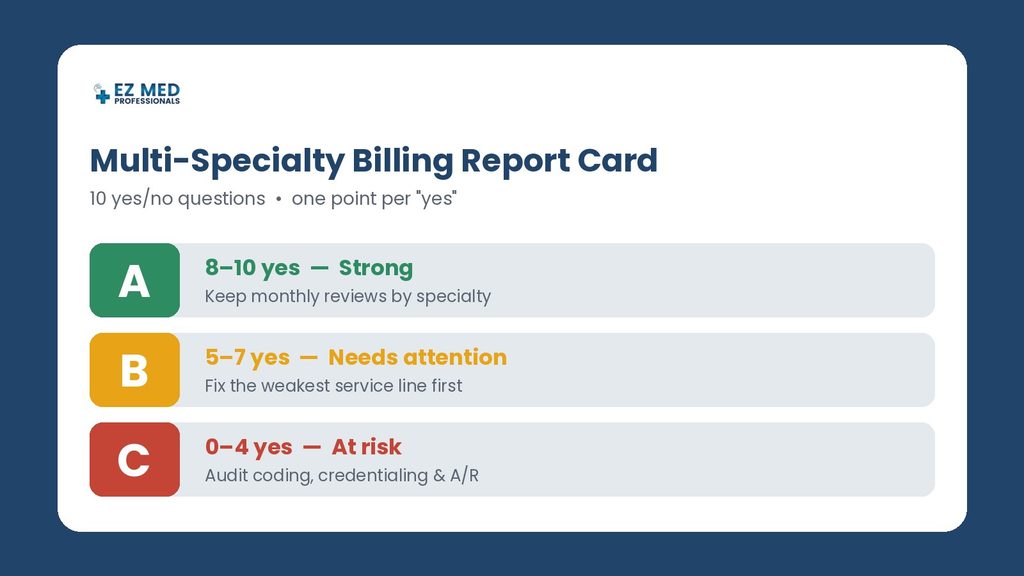
Self-Check: Is Your Multi-Specialty Billing Working?
Answer each question yes or no, then count your yes answers.
- Is each specialty’s clean claim rate at or above 95%?
- Is each specialty’s denial rate below 8%?
- Are your group’s days in A/R under 40?
- Is less than 15% of your A/R older than 90 days?
- Is your net collection rate 95% or higher?
- Does your system apply the three-year new patient rule by specialty?
- Is every provider enrolled with every payer your group bills?
- Are coders assigned based on specialty expertise?
- Do you compare allowed amounts against contracted rates by specialty?
- Do you review KPIs monthly by specialty, provider, and location?
Scoring: 8–10 yes answers means your billing is strong, so keep reviewing monthly. 5–7 yes answers means it needs attention, so fix your weakest specialty first. 0–4 yes answers means revenue is at risk, and a full coding, credentialing, and A/R review is worth scheduling soon.
Knowing When to Bring in a Billing Partner
Internal teams can handle a lot, but some patterns suggest your current setup has reached its limits.
- One specialty’s denials keep climbing despite repeated internal fixes.
- New providers wait months to see insured patients because enrollment stalls.
- Your billers handle every specialty without dedicated coding expertise.
- Aged A/R over 90 days grows month after month.
- Nobody can report collections by specialty and payer within a day.
When evaluating outside support, focus on structure before promises. You want coders with proven experience in each of your major specialties. Ask how the vendor tracks credentialing, authorizations, and prompt pay deadlines across providers. Reporting should split results by specialty, provider, and location every month. A named point of contact matters more than a large team you cannot reach. Confirm HIPAA safeguards, clear pricing, and reasonable contract terms before signing. Be cautious with any vendor promising guaranteed percentages before reviewing your data.
EZMed Professionals is one example of this structure. The team provides end-to-end revenue cycle management covering billing, ICD-10 and CPT coding, credentialing, eligibility verification, prior authorization, and denial management. Each practice works with a dedicated agent, and reporting is built to stay transparent, with no hidden fees. The US-based team supports urgent care, family practice, and multi-specialty groups using HIPAA-compliant processes throughout. Results vary by group, payer mix, and starting point, so any engagement should begin with a baseline review. To talk through your numbers, you can contact the EZMed Professionals team directly.
Expert Insight
Multi-specialty billing in Texas rewards groups that manage each specialty as its own revenue stream. Shared tax IDs bring shared rules, but coding, credentialing, and contracts still differ by service line. Groups that stay healthy report results by specialty, catch weak lines early, and keep enrollment current. Whether you bill in-house or use multi-specialty medical billing services in Texas, those habits matter most. Start with the self-check, pick your weakest specialty, and fix that first.
Keep the source of every number clear in your own reporting. The three-year new patient window, same-day E/M limits, 30- and 45-day prompt pay deadlines, and 95-day filing window are published standards. The 95% clean claim target, the 5–8% denial ceiling, the 35–40 day A/R range, and the 95% collection target are commonly reported industry figures. The timeline ranges and specialty scenario are illustrative only. Confirm current rules with CMS, TMHP, TDI, and your payer contracts, since policies change often.
Frequently Asked Questions
What do multi-specialty medical billing services in Texas include?
They usually cover eligibility, authorization, specialty coding, claim submission, posting, denial management, and credentialing. Strong services also report results by specialty and provider.
What is a good clean claim rate for a multi-specialty group?
A commonly reported practical target is 95% or higher. Track it for each specialty, since a group average can hide a weak service line.
What is a good denial rate for multi-specialty billing?
Many industry sources cite 5–8% as a reasonable ceiling. Procedure-heavy specialties may run higher, so compare each against similar specialties.
What is a good days in A/R number for a multi-specialty practice?
Under 35–40 days is a commonly reported range. Surgical and procedure-heavy lines may run longer than primary care.
Can two doctors in the same group bill new patient visits?
Yes, if they are different specialties. A patient is established only if a same-specialty provider in the group saw them within three years.
Can two physicians in one group bill E/M visits on the same day?
Physicians of different specialties can bill separately. Same-specialty physicians usually bill one combined visit unless the problems are unrelated.
How fast must Texas insurers pay clean claims?
Regulated HMO and PPO plans must pay clean electronic claims within 30 days and paper claims within 45 days. Self-funded ERISA plans may not follow these deadlines.
Why is credentialing harder for multi-specialty groups?
Every provider must be enrolled with every payer under the correct specialty taxonomy. More providers and specialties mean more enrollments, renewals, and chances for gaps.
What is a good net collection rate for multi-specialty groups?
A commonly cited target is 95% or higher of collectible revenue. The metric excludes contractual adjustments, so it reflects what payers actually owe.
Sources, Standards, and Methodology
(a) Published standards and definitions: the three-year new patient rule and same-day E/M limits come from CPT guidelines and the Medicare Claims Processing Manual, summarized in a CMS transmittal and TMA guidance. Texas prompt pay deadlines and the 95-day filing window come from Texas Insurance Code provisions and TDI rules. CPT code definitions are maintained by the AMA.
(b) Named benchmarking providers: MGMA and similar bodies define collection metrics, but no proprietary benchmark figures are reproduced here. (c) Practical and illustrative targets: the clean claim, denial, A/R, and collection targets and all timeline ranges come from commonly reported industry sources. The specialty scenario is hypothetical. (d) Survey data: none used. Actual results vary by practice and situation, and figures reflect information available at the time of research in September 2026.

