
Speech Pathology Medical Billing Services in California
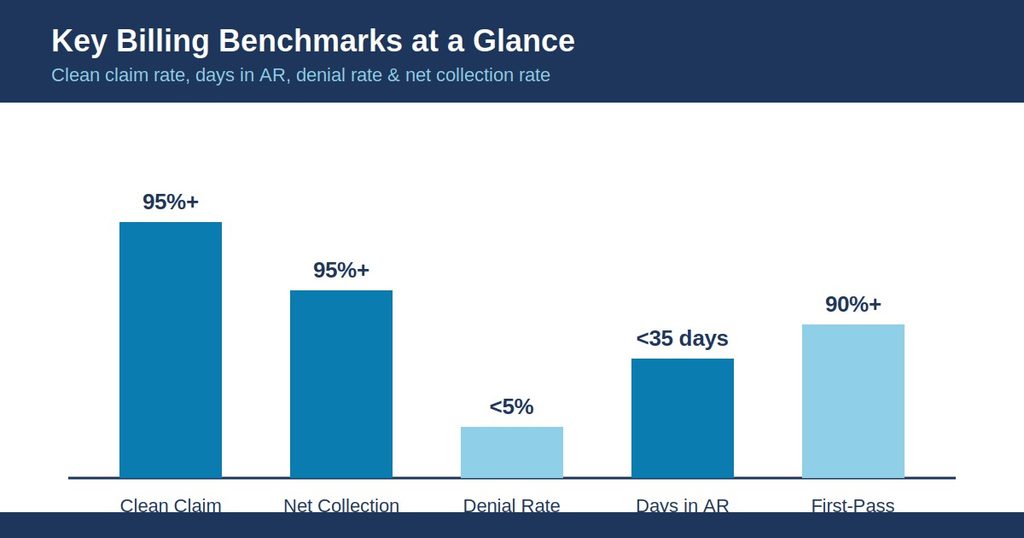
Speech pathology medical billing services in California cover CPT coding for codes like 92507 and 92523, Medi-Cal managed care and commercial payer rules, and denial follow-up built around each SLP’s plan of care. A well-run program commonly targets a clean claim rate around 95% or higher and days in accounts receivable under 35, though the right target for any single practice depends on payer mix and caseload.
Running speech pathology medical billing services in California means treating patients while also chasing down denied claims, tracking Medi-Cal managed care rules, and hoping a missing modifier doesn’t cost a week of revenue. This guide walks through the CPT codes, documentation habits, and benchmark numbers that determine whether an SLP practice’s billing is actually working, plus a state-by-state look at what makes California billing different from the rest of the country.
Below you’ll find a quick-reference table of the key numbers worth tracking, worked examples showing exactly how to calculate them, and a short self-assessment checklist near the end so you can score your own practice’s billing health in a few minutes.
speech pathology medical billing services in California-Key Numbers Cheat Sheet
Speech therapy billing touches more than five trackable metrics, so here is a consolidated quick-reference table before diving into the details. Review frequency and source are noted for each line.
| Metric | Practical Target/Range | Review Frequency | Primary Source |
| Clean claim rate | 95% or higher | Monthly | Commonly reported industry range |
| Days in accounts receivable (AR) | Under 35 days | Weekly / monthly | MGMA- and HFMA-aligned benchmarking |
| Denial rate | Under 5–8% | Monthly | Commonly reported industry range |
| Net collection rate | 95% or higher | Monthly | Commonly reported industry range |
| First-pass resolution rate | 90% or higher | Monthly | Commonly reported industry range |
| AR over 90 days | Under 15–20% of total AR | Monthly | Commonly reported industry range |
| GN modifier on Medicare SLP claims | Present on 100% of qualifying claims | Per claim / monthly audit | CMS coding requirement; compliance target is illustrative |
Source labels: “CMS coding requirement” means a federal agency defines the rule itself; “MGMA- and HFMA-aligned benchmarking” means the figure reflects ranges commonly cited by these associations’ published benchmarking work, not a number either body mandates; “commonly reported industry range” means the figure appears consistently across multiple billing-industry sources without one single named originator.
What Speech Pathology Medical Billing Actually Involves?
Speech pathology medical billing (often shortened to SLP billing) is the process of coding, submitting, and following up on insurance claims for speech, language, voice, swallowing, and cognitive-communication services. It overlaps with revenue cycle management broadly, but it has its own rulebook: most treatment codes are untimed rather than billed in 15-minute increments, evaluation and treatment usually can’t be billed the same day, and documentation has to tie each session back to measurable, functional goals rather than just a diagnosis.
Because so many SLP codes are untimed and session-based, a biller who is used to physical or occupational therapy’s 15-minute unit rules can easily misapply that logic here — and that mismatch is one of the more common, avoidable sources of denials for speech therapy claims. Getting coding right the first time matters more in this specialty than in most others precisely because there is less room for time-based flexibility.
Why California Adds Extra Complexity?
California billing carries more moving parts than a single-state, single-payer practice. Beyond standard commercial payers, practices juggle Medi-Cal fee-for-service, dozens of Medi-Cal managed care plans, independent practice associations (IPAs), regional HMOs, and, in some cases, school-district contracts for pediatric caseloads. Each of these can carry its own prior authorization rules, visit caps, and documentation preferences, which means a billing process built around a single set of rules rarely holds up statewide.
Verifying eligibility and prior authorization before every visit is especially important with Medi-Cal managed care, since coverage can shift between plans and eligibility can lapse without an obvious notice to the practice. Practices that serve both pediatric school-referred clients and adult outpatient clients often need two parallel billing workflows just to keep up with the different payer rules attached to each population.
Common SLP CPT codes
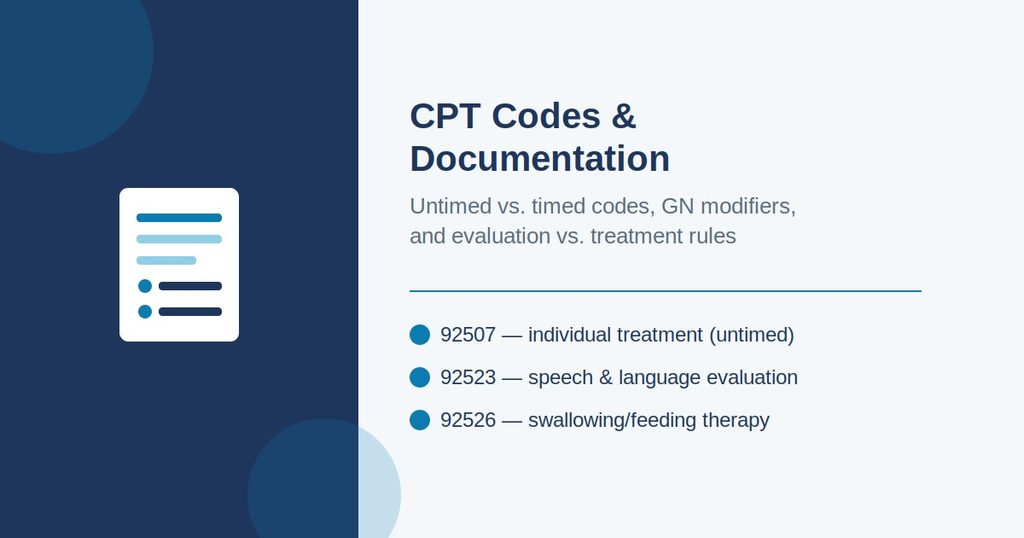
Most speech therapy CPT codes are untimed — billed once per session regardless of how long the session ran. That is a meaningful distinction from PT and OT billing, where the 8-minute rule governs how many timed units can be billed. Applying an 8-minute-rule mindset to SLP claims is a commonly reported source of coding errors in industry billing guides, since it can lead to billing multiple units on a code that only accepts one.
| CPT Code | Description | Timed / Untimed |
| 92507 | Individual treatment: speech, language, voice, communication, or auditory processing disorder | Untimed — 1 unit per session |
| 92508 | Group treatment, two or more patients | Untimed — 1 unit per session |
| 92521 | Evaluation of speech fluency (e.g., stuttering) | Untimed — 1 unit per eval |
| 92522 | Evaluation of speech sound production | Untimed — 1 unit per eval |
| 92523 | Speech sound production plus language comprehension/expression evaluation | Untimed — 1 unit per eval |
| 92526 | Treatment of swallowing dysfunction and/or oral function for feeding | Untimed — 1 unit per session |
Two rules trip
Two rules trip up otherwise careful billers most often. First, Medicare generally will not pay for a full evaluation (92523) and a treatment code (92507) billed for the same patient on the same date by the same clinician. The logic being that if a full evaluation happened, that is the service for the day. Second, every Medicare SLP claim needs the GN therapy modifier attached to signal that the service falls under a speech-language pathology plan of care. A missing GN modifier is one of the more frequent, preventable denial reasons billing teams report.
Looking ahead, CPT 92507 is schedule for deletion effective January 1, 2027. To be replace with a set of new time codes. A change practices and their billing partners will need to prepare documentation workflows. For well before it takes effect. For the most current code set and payment rules. The American Speech-Language-Hearing Association’s reimbursement resources are the named source practices should check directly.
How to Measure Whether Your Billing Is Working?
Speech pathology medical billing services in California, tracking the right numbers is what separates a billing process you can trust from one you’re only hoping is working. The four metrics below are the ones worth calculating by hand at least once, so you understand exactly what’s driving them before relying on a dashboard.
Clean Claim Rate
Formula: (Clean claims submitted ÷ Total claims submitted) × 100.
Worked example: an SLP practice submits 400 claims in a month, and 372 go out the door without a payer edit, rejection, or return for correction. 372 ÷ 400 = 93%. That sits just below the commonly cited 95% range, which is usually a signal to review front-end intake data — eligibility checks, authorization numbers, and coding accuracy — rather than a reason to panic. Our clean claim rate guide walks through common upstream fixes in more detail.
Days in Accounts Receivable (AR)
Formula: Total AR balance ÷ (Total charges for the last 12 months ÷ 365).
Worked example: a practice carries an $85,000 AR balance against $900,000 in annual charges. Daily charges equal $900,000 ÷ 365 = $2,465.75. Days in AR = $85,000 ÷ $2,465.75 ≈ 34.5 days — inside the commonly cited under-35-day range, meaning cash is moving through the system at a healthy pace for this practice’s charge volume. See our guide to reducing AR days if this number is trending the wrong way.
Denial Rate
Formula: (Denied claims ÷ Total claims submitted) × 100.
Worked example: out of the same 400 claims, 26 come back denied. 26 ÷ 400 = 6.5%. That falls at the upper edge of the commonly reported 5–8% range, which is worth a closer look at denial reason codes by payer before it drifts higher.
Net Collection Rate
Formula: Payments received ÷ (Charges − contractual adjustments) × 100.
Worked example: charges total $150,000, contractual adjustments bring the allowed amount down to $95,000, and the practice actually collects $82,650. $82,650 ÷ $95,000 ≈ 87% — meaningfully below the commonly cited 95% benchmark. A gap that size usually isn’t one small leak; it points to something more systemic, like unwork patient balances, secondary payer claims that never got file, or write-offs that were never actually earn adjustments in the first place.
Tracking all four of these numbers by hand every month is realistic for a small practice, but it gets harder fast as claim volume grows. This is the kind of recurring, unglamorous tracking that a specialize billing partner’s monthly reporting is built to handle — worth keeping in mind as you read through the rest of this guide. More on EZMedPro’s approach to transparent billing reporting further down.
Where a Blended Average Can Hide a Problem?
This is arguably the single most useful habit in this guide: checking performance by payer instead of trusting one company-wide number. A blended average that looks acceptable can still be masking a real problem in one segment of a practice’s payer mix.
Illustrative scenario (not an actual client record): a practice’s blended clean claim rate looks fine at 94% overall. Broken out by payer, though, commercial claims run 97% clean and Medicare claims run 95% clean — while Medi-Cal managed care claims sit at just 84%. The strong commercial and Medicare numbers pull the blended average up enough to mask a real problem in the Medi-Cal segment, which is exactly the kind of gap that only shows up once denial rate is track by payer instead of as one company-wide figure.
Illustrative Benchmark Breakdown by Caseload Type
The table below illustrates how targets can shift by caseload mix. It is not pulled from one single named source — actual figures vary by practice, and readers should verify against their own billing data where precision matters.
| Caseload Type | Illustrative Clean Claim Target | Illustrative Denial Rate Target |
| Commercial-payer-heavy | 96–98% | 3–5% |
| Medi-Cal-managed-care-heavy | 88–93% | 6–10% |
| Mixed pediatric/adult, multiple payers | 92–95% | 5–8% |
Common Speech Therapy Billing Challenges
Beyond the GN modifier and evaluation/treatment bundling issues already covered, a handful of other patterns account for most preventable SLP denials in California. Missing or expired prior authorizations top the list for Medi-Cal managed care plans, followed by documentation that describes a session generically instead of tying it to a measurable, functional goal from the plan of care. Frequency and visit-cap limits — which some commercial and Medi-Cal plans track separately from PT/OT caps — are also easy to miss without a dedicated tracking process.
Teletherapy billing adds one more layer. Payers increasingly accept telehealth-delivered SLP sessions, but documentation still needs to note the delivery modality and, for many plans, an appropriate place-of-service or telehealth modifier. Practices moving between in-person and virtual sessions benefit from a written checklist so nothing gets missed — a workflow question worth exploring further in our guide to telehealth versus in-person billing, which walks through the same modality-tracking principles for another therapy-adjacent specialty.
How to Use These Numbers Correctly?
A benchmark is only useful when compared like-for-like: similar payer mix, comparable caseload size, and the same reporting period. Comparing a small, Medi-Cal-heavy pediatric practice’s denial rate against a large, commercial-heavy multi-specialty group’s denial rate will produce a misleading conclusion in either direction. One missed benchmark in a single month is a signal to investigate — a coding pattern, an eligibility gap, a new payer policy — not a verdict on the practice or the billing team. Consistent underperformance across several months, on the other hand, is worth a deeper root-cause review.
Timeframe to Improvement
Once a benchmark or a payer-specific gap flags where to look, the next practical question is how long a fix actually takes to show up in the numbers. These are general planning ranges, not a guarantee for any specific practice — actual timelines depend on how significant the underlying issues are and how quickly documentation and intake workflows can change.
| Fix Applied | Partial Results Typically Visible | Full Results Typically Visible |
| Claim scrubbing / coding corrections | 2–4 weeks | 60–90 days |
| Eligibility & prior-authorization workflow fixes | 30 days | 90 days |
| Denial root-cause resolution by payer | 30–60 days | 90–180 days |
| Full AR cleanup / aging normalization | 60 days | 120–180 days |
In-House vs. Outsourced Speech Therapy Billing
Many practice owners weigh keeping billing in-house against outsourcing to a specialized partner. In-house billing offers direct control and familiarity with the practice’s own workflow. But it also means absorbing the cost of ongoing coding-rule updates, staff turnover, and payer-policy monitoring internally. Outsourcing to a partner that specializes in denial management and specialty-specific coding can reduce that burden. Though it requires trusting an outside team with sensitive revenue data. Which is why transparent, itemized reporting matters so much when evaluating a partner.
Quick Summary
- Most SLP CPT codes (92507, 92508, 92521–92526) are untimed — billed once per session, not in time increments.
- A practical clean claim rate target is 95% or higher; a practical days-in-AR target is under 35 days.
- California billing means tracking Medi-Cal managed care, IPAs, HMOs, and sometimes school-district contracts separately.
- Check performance by payer, not just as one blended number — that’s where problems usually hide.
- One missed benchmark is a signal to investigate, not a verdict — compare like-for-like caseloads and time periods.
- Outsourcing can lighten the tracking burden, but only pays off with transparent, itemized reporting from the partner.
Self-Assessment Checklist
Speech pathology medical billing services in California-Score your practice’s billing health with these 10 yes-or-no questions, then check the scoring guide below.
1. Is your clean claim rate at or above 95%?
2. Is your days in AR under 35 days?
3. Is your denial rate under 5–8%?
4. Is your net collection rate 95% or higher?
5. Do you track denials by payer rather than only as one blended number?
6. Is the GN modifier appended to every Medicare SLP claim?
7. Do you verify Medi-Cal managed care eligibility and authorization before every visit?
8. Are evaluation and treatment codes kept on separate dates of service when required?
9. Do you have a documented process for teletherapy/telehealth claims and modifiers?
10. Do you receive a monthly, itemized billing report with no hidden fees?
Scoring guide — 8–10 “yes” answers: billing fundamentals are strong; focus on fine-tuning. 5–7 “yes” answers: several gaps need attention before they compound into AR problems. 0–4 “yes” answers: it’s worth a full billing-process review soon, since multiple risk points are stacking up at once.
Expert Insights
Speech pathology medical billing services in California
Speech pathology billing in California rewards precision over volume. Getting the untimed-code rules right, attaching the GN modifier consistently, and separating evaluation from treatment dates prevents a large share of denials before they happen — and none of that requires guesswork, since CMS and ASHA publish the underlying coding rules directly.
The benchmark figures cited throughout this guide are practical, commonly reported industry targets — useful starting points, not numbers any single body mandates for every practice. The caseload-based breakdown table and the blended-average scenario are explicitly illustrative, meant to show how the same underlying data can look different depending on how it’s sliced, not to represent verified results from any real practice.
Whether a practice keeps billing in-house or brings in outside help, the numbers in this guide give a concrete starting point for judging whether the current process is actually working — and the self-assessment checklist above offers a fast way to find out where to look first.
When to Consider Professional Support?
A few signals tend to show up before an in-house billing process quietly falls behind: denial rate has crept above 8% for more than a couple of months, the practice can’t say what its Medi-Cal-specific clean claim rate is (only the blended number), staff turnover keeps resetting institutional knowledge of payer rules, AR over 90 days keeps growing instead of shrinking, or nobody on staff has time to keep up with coding changes like the upcoming 92507 replacement codes.
When those signals show up, it’s worth looking for a billing partner that specializes in the specialty in question, provides claim-level visibility rather than a black-box summary, and lays out its fee structure clearly upfront. Ask prospective partners how they handle denial root-cause tracking by payer, how quickly they turn around appeals, and whether their reporting shows the same clean claim rate, AR, and denial figures covered in this guide.
EZ MED Professionals (EZMedPro) is one example of that kind of structure: a US-based billing team built around transparent, itemized reporting and a no-hidden-fees pricing approach, working across specialties that include urgent care, family practice, and multi-specialty groups. Results vary by practice and payer mix, so any partner worth evaluating should be willing to walk through its process — not just its promises — before signing on. Learn more at ezmedpro.com.
Related Reading from EZMedPro-Speech pathology medical billing services in California
- Specialty Medical Billing Guide: How to Bill for Every Practice Type
- What Is Clean Claim Rate? How to Improve It
- How to Reduce A/R Days in Medical Billing
- The Complete Guide to the Medical Credentialing Process
Sources & Methodology
- Published standards/definitions: CPT code descriptions and the GN modifier requirement follow CMS and AMA CPT coding rules; the scheduled 2027 deletion of CPT 92507 reflects published CPT code-set changes.
- Named benchmarking data providers: Days-in-AR and clean claim rate ranges reflect figures commonly attributed to MGMA (Medical Group Management Association) and HFMA (Healthcare Financial Management Association) benchmarking publications.
- Practical/illustrative targets: The caseload-breakdown table and the blended-average scenario are illustrative compilations based on general industry patterns, not a single named data set, and are labeled accordingly throughout.
- Coding reference: CPT code details were cross-checked against ASHA’s published reimbursement guidance for speech-language pathology billing.
Actual results vary by practice, payer mix, and reporting period. Figures in this article reflect information available at the time of research and should be verified against current payer policy and CMS/CPT updates before relying on them for billing decisions.
Frequently Asked Questions
Speech pathology medical billing services in California
What is speech pathology medical billing?
It’s the process of coding, submitting, and following up on insurance claims for speech-language pathology services — treatment, evaluations, and swallowing therapy — using CPT codes like 92507 and 92523 along with payer-specific documentation and modifier rules.
What is a good clean claim rate for a speech therapy practice?
A commonly cited practical target is 95% or higher. Practices with a heavier Medi-Cal managed care caseload may see a somewhat lower blended figure even when performance is otherwise solid, so it helps to review the rate by payer.
What is a good days-in-AR number for an SLP practice?
Under 35 days is a commonly reported practical target, with MGMA- and HFMA-aligned benchmarking generally citing under 40 days as acceptable and anything above 50 days signaling a real problem worth investigating.
Is CPT code 92507 timed or untimed?
It’s untimed. 92507 is billed once per session regardless of how long the session ran, unlike PT/OT codes that follow the 8-minute rule for timed units.
What is the GN modifier and when is it required?
GN is the therapy modifier signaling that a service falls under a speech-language pathology plan of care. CMS requires it on Medicare SLP claims, and its absence is a frequent, preventable cause of denials.
How does Medi-Cal affect speech therapy billing in California?
Medi-Cal fee-for-service and its many managed care plans each carry their own prior authorization rules, eligibility quirks, and documentation preferences, which is why California practices often need payer-specific workflows rather than one universal process.
What is a good denial rate for speech therapy claims?
A commonly reported practical range is under 5–8%. Rates above that typically point to a specific, fixable pattern — a missing modifier, an expired authorization, or a documentation gap — rather than a systemic failure.
Can 92507 and 92523 be billed on the same day?
Generally no, for Medicare and most payers that follow similar logic — if a full evaluation (92523) took place, that’s considered the service for that date, and treatment isn’t billed separately.
How is speech therapy billed differently for telehealth?
Documentation needs to note the delivery modality, and many payers require a specific place-of-service code or telehealth modifier alongside the usual CPT and ICD-10 codes for the session.
How much does outsourcing speech pathology billing typically cost?
Percentage-of-collections pricing commonly falls in the 4–9% range, while flat per-claim models often run roughly $3–8 per claim; the right fit depends on claim volume and average reimbursement per visit. Always ask for a transparent, itemized quote rather than accepting one blended, unexplained rate.

