
Radiology Medical Billing Services in New York
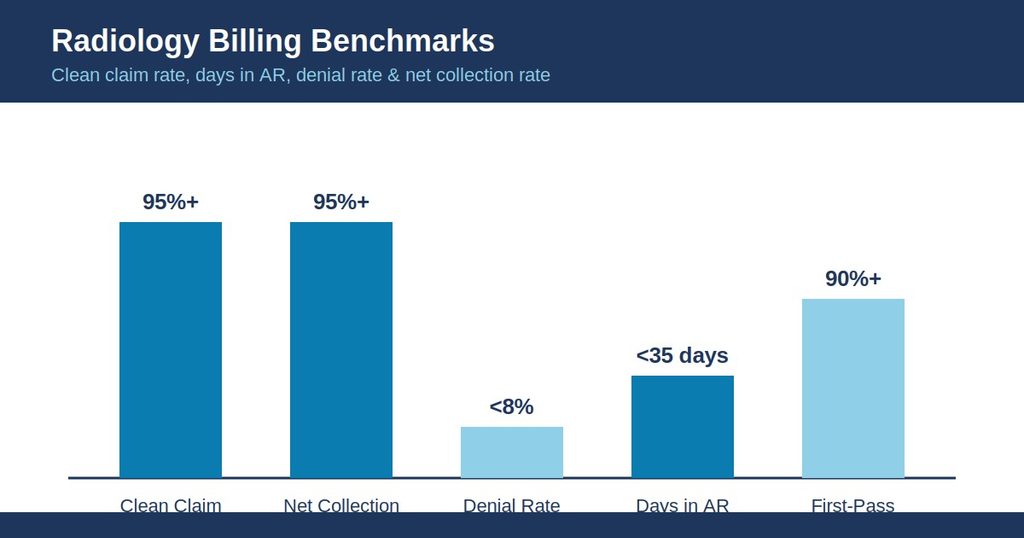
Radiology medical billing services in New York cover professional/technical (PC/TC) component splitting, prior authorization for advanced imaging, and the state’s uniquely strict No-Fault auto insurance billing deadlines alongside NY Medicaid’s APG payment rules. A well-run radiology billing program commonly targets a clean claim rate around 95% or higher and days in accounts receivable under roughly 35, though the right target for any single practice depends on modality mix and how much of its caseload runs through No-Fault or Medicaid claims.
Radiology medical billing services in new yorkbill differently than almost any other specialty — every study can split into a professional and technical component, most advanced imaging needs prior authorization, and a meaningful share of claims come from patients injured in car accidents, which pulls the state’s unusual No-Fault insurance system into the mix.
This guide covers the CPT codes and modifiers that matter most, the benchmark numbers worth tracking, and the New York-specific rules — No-Fault filing deadlines, Medicaid APG payment groups, SPARCS reporting — that a generic billing process tends to miss. A short self-assessment checklist near the end lets you score your own practice’s billing health in a few minutes.
Key Numbers Cheat Sheet
Radiology billing touches more than five trackable metrics, so here’s a consolidated reference before the details below.
| Metric | Practical Target/Range | Review Frequency | Primary Source |
| Clean claim rate | 95% or higher | Monthly | Commonly reported industry range |
| Days in accounts receivable (AR) | Under 35 days | Weekly / monthly | MGMA- and HFMA-aligned benchmarking |
| Denial rate | Under 8% | Monthly | Commonly reported industry range |
| Net collection rate | 95% or higher | Monthly | Commonly reported industry range |
| First-pass resolution rate | 90% or higher | Monthly | Commonly reported industry range |
| No-Fault claim submission | Within 45 days of date of service | Per claim | NY Insurance Law / DFS Regulation 68 requirement |
| PC/TC modifier accuracy (26/TC) | Reviewed on 100% of split-billed claims | Per claim / monthly audit | CMS PC/TC indicator rules; compliance target is illustrative |
Source labels: “NY Insurance Law / DFS Regulation 68 requirement” and “CMS PC/TC indicator rules” mean a state or federal authority defines the underlying rule itself; “MGMA- and HFMA-aligned benchmarking” means the figure reflects ranges commonly cited by these associations’ published work, not a body-mandated number; “commonly reported industry range” means the figure appears consistently across billing-industry sources without one single named originator.
One note on the table above: first-pass resolution rate measures the share of claims paid after their first submission with no resubmission or appeal needed — a stricter cousin of clean claim rate, since a claim can leave the office clean but still get kicked back on the payer’s end.
What Radiology Medical Billing Actually Involves?
Radiology billing is revenue cycle management built around a structural quirk most other specialties don’t have: most diagnostic imaging CPT codes carry both a professional component (PC) — the radiologist’s interpretation and written report — and a technical component (TC) — the equipment, staff, and facility costs of actually performing the scan. When the same entity provides both, the code is billed globally with no modifier. When a radiologist interprets images for a facility that owns the equipment, the radiologist bills modifier 26 and the facility bills modifier TC separately.
Getting that split wrong — billing the global code when only the professional component was actually performed, for instance — is one of the most common, avoidable sources of radiology denials. Prior authorization adds another layer, and in practice it’s often the more painful one: most commercial payers route advanced imaging (MRI, CT, PET) through a radiology benefit manager (RBM) like eviCore or HealthHelp, each with its own portal, its own medical necessity criteria, and its own turnaround time. An authorization that’s valid for the order date can expire before the actual scan happens if scheduling runs long, and a peer-to-peer review requested by the RBM can add days to that window — which is exactly why practices with high MRI/CT volume often dedicate staff specifically to prior auth rather than folding it into general front-desk work.
Why New York Adds Extra Complexity?
New York requires every auto insurance policy to carry Personal Injury Protection, known statewide as No-Fault insurance. A meaningful share of MRI and CT volume at many New York imaging centers comes from patients injured in car accidents, and No-Fault billing runs on its own strict clock: medical bills generally must be submitted to the No-Fault carrier within 45 days of the date of service, and missing that window can let the carrier deny the claim outright regardless of medical necessity. New York regulation does allow an exception when there’s clear and reasonable justification for the delay, but carriers set a high bar for what qualifies, so treating the 45-day window as a hard deadline rather than a fallback is the safer operating assumption.
No-Fault carriers also routinely deny MRI claims as “not medically necessary,” even when the imaging is later shown to be appropriate — a pattern common enough that specialized No-Fault collections attorneys build entire practices around appealing exactly these denials. Beyond No-Fault, New York Medicaid managed care pays many outpatient radiology claims through the state’s Ambulatory Patient Groups (APG) methodology rather than a straight fee-for-service rate, and hospital-based imaging volume feeds into SPARCS — New York’s Statewide Planning and Research Cooperative System, a hospital discharge and outpatient data-reporting requirement most other states don’t have an equivalent to.
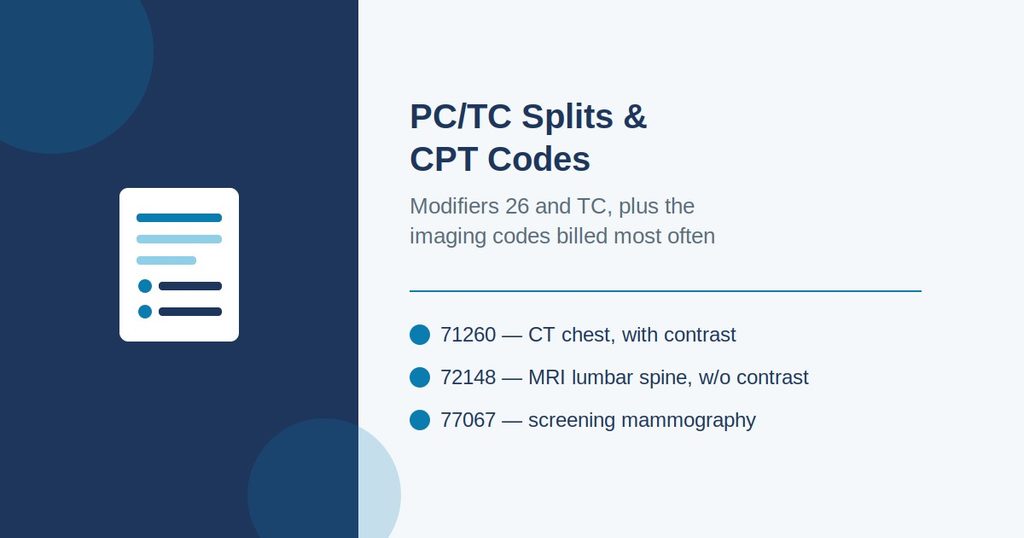
The table below covers the imaging codes that generate the most volume — and the most PC/TC confusion — for New York radiology practices.
| CPT Code | Description | Common Modifiers |
| 71045 | Chest X-ray, single view | 26 / TC |
| 71260 | CT chest, with contrast | 26 / TC |
| 72148 | MRI lumbar spine, without contrast | 26 / TC |
| 77067 | Screening mammography, bilateral | 26 / TC |
| 93306 | Echocardiography, complete | 26 / TC |
| 76700 | Abdominal ultrasound, complete | 26 / TC |
The table below covers the modifiers that matter most for split-billed radiology claims.
| Modifier | Meaning | When to Use |
| 26 | Professional component | Radiologist interprets and reports; does not own the equipment |
| TC | Technical component | Facility owns the equipment and staff; radiologist bills separately |
| No modifier | Global service | Same entity performs both the scan and the interpretation |
| 76 | Repeat procedure, same physician | Same imaging study repeated by the same provider same day |
| 77 | Repeat procedure, different physician | Same imaging study repeated by a different provider same day |
| 59 | Distinct procedural service | Two imaging services that would otherwise bundle are genuinely separate |
One rule trips up otherwise careful billers most often: if the interpreting radiologist is employed directly by the hospital, that interpretation is already folded into the hospital’s own claim, and the radiologist’s group does not bill modifier 26 separately for that study. Modifier 26 only applies when the interpreting physician is independent from — or contracted separately outside — the facility that owns the equipment.
How to Measure Whether Your Billing Is Working?
The four numbers below are worth calculating by hand at least once so you know exactly what’s driving them.
Clean Claim Rate
Formula: (Clean claims submitted ÷ Total claims submitted) × 100.
Worked example: a multi-site imaging center submits 640 claims in a month; 578 go out without a payer edit or rejection. 578 ÷ 640 ≈ 90%. That’s below the commonly cited 95% range — worth checking whether PC/TC modifier mismatches or missing prior authorization numbers are the recurring culprit. This guide to improving clean claim rate covers common upstream fixes.
Days in Accounts Receivable (AR)
Formula: Total AR balance ÷ (Total charges for the last 12 months ÷ 365).
Worked example: AR balance sits at $410,000 against $4.1 million in annual charges. Daily charges = $4,100,000 ÷ 365 ≈ $11,233. Days in AR = $410,000 ÷ $11,233 ≈ 36.5 days — just above the commonly cited under-35-day target, consistent with a caseload that includes some slower-paying No-Fault and Medicaid APG claims mixed in with faster commercial reimbursement. Our guide to reducing AR days breaks down where to start.
Denial Rate
Formula: (Denied claims ÷ Total claims submitted) × 100.
Worked example: out of the same 640 claims, 58 come back denied. 58 ÷ 640 ≈ 9.1% — just above the commonly reported 8% range. Splitting that number by claim type (commercial, No-Fault, Medicaid APG) usually shows the gap concentrated in one segment, most often No-Fault medical-necessity denials, rather than spread evenly across the board.
Net Collection Rate
Formula: Payments received ÷ (Charges − contractual adjustments) × 100.
Worked example: charges total $520,000, contractual and fee-schedule adjustments bring the allowed amount to $340,000, and the center collects $278,800. $278,800 ÷ $340,000 ≈ 82% — meaningfully below the commonly cited 95% benchmark. A gap that size in radiology often traces back to No-Fault claims stuck in appeal past the point of realistic recovery, not just routine write-offs.
Tracking these four numbers monthly, broken out by claim type, is realistic for a small practice but gets harder fast once No-Fault, Medicaid APG, and commercial claims are all mixed together. That’s the kind of ongoing, claim-type-segmented reporting a specialized billing partner is built to handle — more on EZMedPro’s approach to transparent billing further down.
Where a Blended Average Can Hide a Problem?
Checking performance by claim type, not just as one overall number, is arguably the single most useful habit for a New York radiology practice specifically — because commercial, No-Fault, and Medicaid APG claims can behave very differently.
Illustrative scenario (not an actual client record): an imaging center’s blended clean claim rate looks reasonable at 92% overall. Broken out by claim type, though, commercial claims run 97% clean and Medicaid APG claims run 93% clean — while No-Fault claims sit at just 76%, largely from “not medically necessary” denials and missed 45-day filing deadlines. The strong commercial and Medicaid numbers pull the blended average up enough to hide a real problem in the No-Fault segment, which only becomes visible once denial and clean claim rates are tracked by claim type instead of as one company-wide figure.
Illustrative Benchmark Breakdown by Caseload Type
This table is not pulled from one single named source — actual figures vary by practice, and readers should verify against their own billing data where precision matters. Practices where medical-necessity denials are running especially heavy on the No-Fault side can see clean claim rates well below the 82–89% range shown here; the range reflects a typical mix, not a floor.
| Caseload Type | Illustrative Clean Claim Target | Illustrative Denial Rate Target |
| Commercial-payer-heavy | 96–98% | 3–6% |
| No-Fault (auto injury)-heavy | 82–89% | 10–18% |
| Mixed imaging caseload, multiple payers | 91–95% | 6–10% |
Common Radiology Billing Challenges in New York
Beyond PC/TC modifier errors, a handful of other patterns drive most preventable radiology denials statewide. Expired or mismatched prior authorizations top the list for advanced imaging — an authorization tied to a specific CPT code or date range that doesn’t match what actually gets billed is an easy, automatic denial. No-Fault “not medically necessary” denials are close behind, especially for MRI ordered after a motor vehicle accident, and often require a formal appeal or arbitration to overturn rather than a simple resubmission.
Practices with a meaningful No-Fault caseload benefit from a workflow built specifically around its tight deadlines and appeal process — tracking the 45-day billing window per patient the way other practices track eligibility. A similar claim-type-specific tracking discipline applies to other complex payer categories, a topic covered in more depth in our guide to workers’ compensation billing delays, which walks through the same deadline-driven appeal principles for another non-standard payer category.
How to Use These Numbers Correctly?
A benchmark only means something compared like-for-like: similar claim-type mix, comparable imaging volume, and the same reporting period. A practice running a heavy No-Fault caseload will show a different denial rate than one that’s almost entirely commercial — comparing the two directly produces a misleading conclusion. One missed benchmark in a single month is a signal to investigate, not a verdict; a pattern that holds for several months in a row is worth a deeper root-cause review.
Timeframe to Improvement
Once a gap is identified, the next practical question is how long a fix takes to show up in the numbers. These are general planning ranges, not a guarantee for any specific practice.
| Fix Applied | Partial Results Typically Visible | Full Results Typically Visible |
| PC/TC modifier corrections | 2–4 weeks | 60–90 days |
| Prior authorization workflow fixes | 30 days | 60–90 days |
| No-Fault appeal/arbitration backlog resolution | 30–60 days | 90–180 days |
| Full AR cleanup across claim types | 60 days | 120–180 days |
In-House vs. Outsourced Radiology Billing
Many practice owners weigh keeping billing in-house against outsourcing to a specialized partner. In-house billing offers direct control and familiarity with the practice’s own referral base and payer relationships, but it also means absorbing the cost of tracking PC/TC indicator updates, No-Fault regulation changes, and Medicaid APG group revisions internally. Outsourcing to a partner with dedicated denial management and radiology-specific coding experience can reduce that burden, though it requires trusting an outside team with claim-type-sensitive data, which is exactly why transparent, itemized reporting matters so much when evaluating a partner.
For radiology billing specifically outside New York, see our Los Angeles radiology billing page, which covers the same PC/TC fundamentals applied to a different state’s payer mix.
Quick Summary
- Most diagnostic imaging CPT codes split into a professional (26) and technical (TC) component — billing the wrong one is a common, preventable denial reason.
- A practical clean claim rate target is 95% or higher; a practical days-in-AR target is under 35 days.
- New York’s No-Fault auto insurance claims must generally be billed within 45 days of the date of service.
- No-Fault MRI claims face frequent “not medically necessary” denials that often require formal appeal to overturn.
- Check performance by claim type (commercial, No-Fault, Medicaid APG) — blended averages hide segment-specific problems.
- One missed benchmark is a signal to investigate, not a verdict — compare like-for-like caseloads and time periods.
Radiology medical billing services in New York-Self-Assessment Checklist
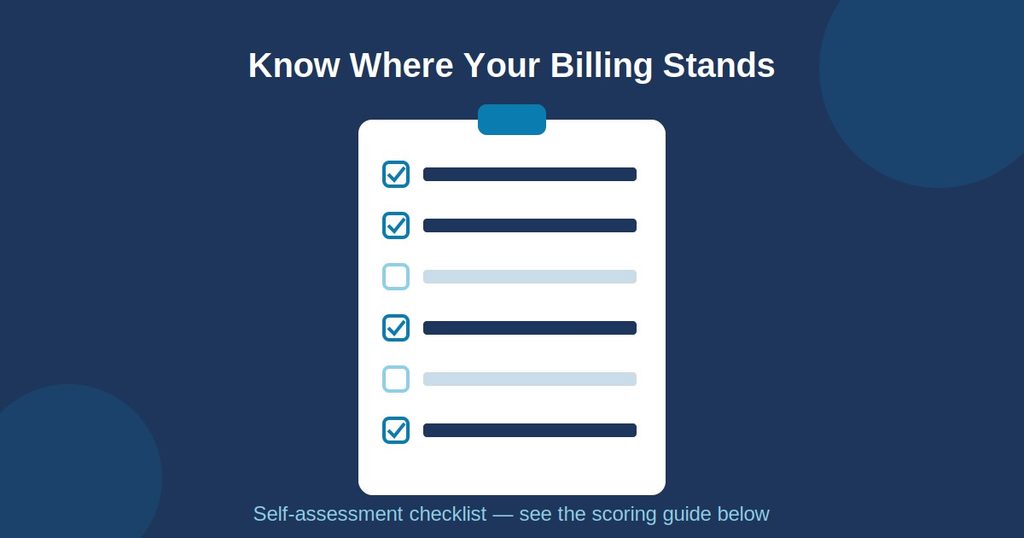
Score your practice’s billing health with these 10 yes-or-no questions, then check the scoring guide below.
- 1. Is your clean claim rate at or above 95%?
- 2. Is your days in AR under 35 days?
- 3. Is your denial rate under 8%?
- 4. Is your net collection rate 95% or higher?
- 5. Do you track clean claim and denial rates separately for commercial, No-Fault, and Medicaid APG claims?
- 6. Do you review PC/TC modifiers (26/TC) on every split-billed claim before submission?
- 7. Do you have a tracking system for the No-Fault 45-day billing deadline per patient?
- 8. Do you have a documented appeal process for No-Fault “not medically necessary” denials?
- 9. Are prior authorizations for advanced imaging confirmed valid through the actual scan date?
- 10. Do you receive a monthly, itemized billing report with no hidden fees?
Scoring guide — 8–10 “yes” answers: billing fundamentals are strong; focus on fine-tuning. 5–7 “yes” answers: several gaps need attention before they compound into AR problems. 0–4 “yes” answers: it’s worth a full billing-process review soon, since multiple risk points are stacking up at once.
Expert Insights
Radiology billing in New York rewards precision on two fronts at once: getting the PC/TC split right on every claim, and respecting the state’s unusually tight No-Fault deadlines. Neither requires guesswork — CMS publishes the PC/TC indicator rules directly, and New York’s Department of Financial Services publishes the No-Fault filing requirements under Regulation 68.
The benchmark figures cited throughout this guide are practical, commonly reported industry targets — useful starting points, not numbers any single body mandates for every practice. The caseload-based breakdown table and the blended-average scenario are explicitly illustrative, meant to show how the same underlying data can look different depending on how it’s sliced, not to represent verified results from any real practice.
Whether a practice keeps billing in-house or brings in outside help, the numbers in this guide give a concrete starting point for judging whether the current process is actually working — and the self-assessment checklist above offers a fast way to find out where to look first.
When to Consider Professional Support?
Most practices don’t decide to bring in outside billing help because of one bad month — it’s usually a slow accumulation of small warning signs. A denial rate that’s quietly sat above 10% for a while. Nobody on staff who can actually answer what the No-Fault-specific clean claim rate looks like versus the commercial rate, because no one’s ever pulled it apart that way. No-Fault claims missing the 45-day window often enough that it’s stopped feeling like an emergency and started feeling normal. AR over 90 days that keeps climbing instead of leveling off. Or simply that every time someone who understood the PC/TC rules or the RBM quirks leaves, the practice is starting over.
If a few of those sound familiar, it’s worth talking to a billing partner that actually specializes in radiology and diagnostic imaging — not a generalist that happens to also handle imaging claims. A good fit will show you claim-level detail broken out by claim type instead of a single blended summary, and will be upfront about what they charge before you ask twice. Worth asking directly: how do they track the No-Fault 45-day window per patient, who handles medical-necessity appeals when they come in, and will their monthly reporting actually show the same clean claim, AR, and denial numbers this guide walks through?
EZ MED Professionals (EZMedPro) is built around that kind of structure — a US-based team, itemized reporting instead of a black box, and a pricing approach with no hidden fees, working across radiology alongside urgent care, family practice, and multi-specialty groups. Results vary by practice and payer mix, so treat that as a starting point for a conversation rather than a promise. If it’s useful, take a look at how EZMedPro approaches billing and judge for yourself whether the fit makes sense.
Related Reading from EZMedPro
- Radiology Medical Billing Services in Los Angeles, CA
- What Is Clean Claim Rate? How to Improve It
- How to Reduce A/R Days in Medical Billing
- Dealing with Workers’ Compensation Billing Delays
Sources & Methodology
- Published standards/definitions: CPT code descriptions and PC/TC indicator rules (modifiers 26, TC, 76, 77, 59) follow CMS and AMA CPT coding rules. New York’s No-Fault billing deadline and medical-necessity dispute framework follow published New York Insurance Law and Department of Financial Services Regulation 68 requirements.
- Named benchmarking data providers: Days-in-AR and clean claim rate ranges reflect figures commonly attributed to MGMA (Medical Group Management Association) and HFMA (Healthcare Financial Management Association) benchmarking publications.
- Practical/illustrative targets: The caseload-breakdown table and the blended-average scenario are illustrative compilations based on general industry patterns, not a single named data set, and are labeled accordingly throughout.
- Regulatory reference: No-Fault filing deadlines and PC/TC modifier rules were cross-checked against publicly available New York Department of Financial Services and CMS guidance current as of the time of research.
Actual results vary by practice, payer mix, and reporting period. Figures in this article reflect information available at the time of research and should be verified against current payer policy, CMS/CPT updates, and New York No-Fault regulation changes before relying on them for billing decisions.
Frequently Asked Questions
What is radiology medical billing?
It’s the process of coding, submitting, and following up on insurance claims for diagnostic imaging — X-ray, CT, MRI, ultrasound, mammography — using CPT codes that typically split into a professional and technical component.
What is a good clean claim rate for a radiology practice?
A commonly cited practical target is 95% or higher. Practices with a heavier No-Fault or Medicaid APG caseload may see a somewhat lower blended figure even when performance is otherwise solid, so it helps to review the rate by claim type.
What is a good days-in-AR number for a radiology practice?
Under 35 days is a commonly reported practical target; MGMA- and HFMA-aligned benchmarking generally treats anything above 50 days as a real problem. Practices with significant No-Fault volume often run a few days higher given the appeal timelines involved.
What’s the difference between modifier 26 and modifier TC?
Modifier 26 bills the professional component — the radiologist’s interpretation and report. Modifier TC bills the technical component — the equipment, staff, and facility costs of performing the scan. The same entity performing both bills the code globally with neither modifier.
How does New York’s No-Fault insurance affect radiology billing?
No-Fault (auto insurance PIP) claims generally must be submitted within 45 days of the date of service, and MRI claims in particular face frequent “not medically necessary” denials that often require formal appeal or arbitration to overturn.
What is New York Medicaid’s APG payment method?
APG (Ambulatory Patient Groups) is the methodology New York Medicaid managed care uses to pay many outpatient claims, including radiology, grouping related services into a single payment rather than paying each CPT code separately at a flat fee-for-service rate.
What is a good denial rate for radiology claims?
A commonly reported practical range is under 8%. Rates above that in radiology often trace back to PC/TC modifier errors, expired prior authorizations, or — for practices with meaningful No-Fault volume — medical-necessity disputes specific to that claim type.
Does a hospital-employed radiologist bill modifier 26 separately?
Generally no — if the interpreting radiologist is directly employed by the hospital, that interpretation is already included in the hospital’s own claim, and a separate professional-component bill isn’t submitted for that study.
How long does a No-Fault medical-necessity appeal typically take?
It varies by carrier and by whether the dispute proceeds to arbitration — initial appeal windows are often quite short, while arbitration can extend the timeline well beyond that. This variability is part of why practices with heavy No-Fault caseloads tend to run higher days-in-AR than purely commercial practices, and why a dedicated appeal-tracking process matters more here than for standard denials.
How much does outsourcing radiology billing typically cost?
Percentage-of-collections pricing commonly falls in the 4–9% range, while flat per-claim models vary with study complexity and claim volume. No-Fault-heavy caseloads often push pricing toward the higher end. Largely because of the extra appeal and arbitration workload those claims carry. Always ask for a transparent, itemized quote — and whether No-Fault appeal handling. It is included or billed separately — rather than accepting one blended rate.

