
Orthopedics Medical Billing Services in Texas
Orthopedics medical billing services in Texas cover surgical CPT coding, 90-day global-period tracking, and the state’s unusual dual-track workers’ compensation system, where employers can legally opt out of coverage entirely. A well-run orthopedic billing program commonly targets a clean claim rate around 93% or higher and days in accounts receivable under roughly 38, though the right target for any single practice depends on payer mix and how much of its caseload runs through workers’ comp versus commercial insurance.
Orthopedic practices & orthopedics medical billing services in Texas bill some of the highest-dollar claims in medicine — joint replacements, spinal fixation, arthroscopic repairs — and every one of them carries a 90-day global period, implant costs, and modifier rules that are easy to get wrong. Add Texas’s unique workers’ compensation system, where an estimated one in four employers opts out of coverage entirely according to Texas Department of Insurance data, and billing gets more complicated than in almost any other state.
This guide covers the CPT codes and modifiers that matter most, the benchmark numbers worth tracking, and the Texas-specific rules — DWC fee guidelines, non-subscriber claims, Medicaid STAR/CHIP — that a generic billing process tends to miss. A short self-assessment checklist near the end lets you score your own practice’s billing health in a few minutes.
Key Numbers Cheat Sheet
Orthopedics medical billing services in Texas touches more than five trackable metrics, so here’s a consolidated reference before the details below.
| Metric | Practical Target/Range | Review Frequency | Primary Source |
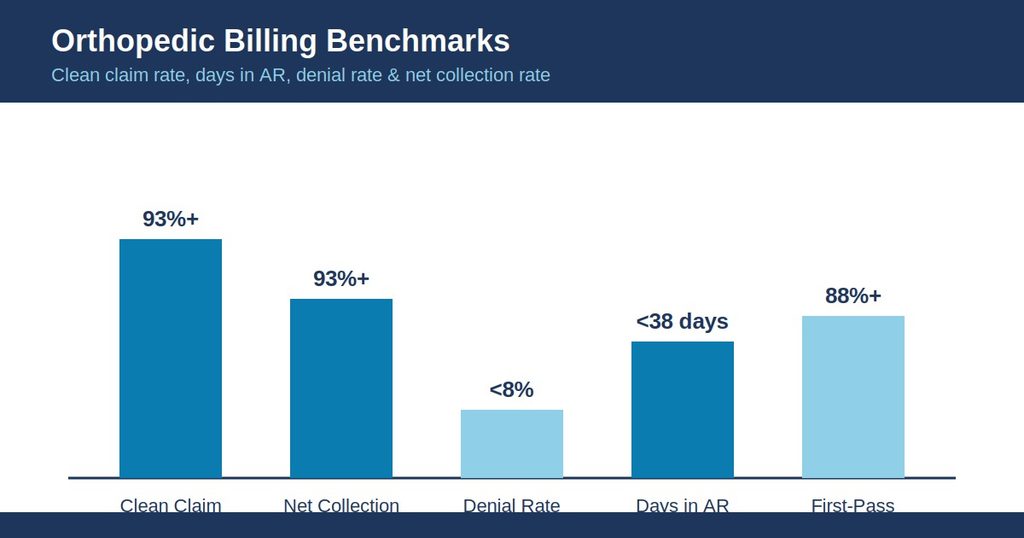
| Clean claim rate | 93% or higher | Monthly | Commonly reported industry range |
| Days in accounts receivable (AR) | Under 38 days | Weekly / monthly | MGMA- and HFMA-aligned benchmarking |
| Denial rate | Under 8% | Monthly | Commonly reported industry range |
| Net collection rate | 93% or higher | Monthly | Commonly reported industry range |
| First-pass resolution rate | 88% or higher | Monthly | Commonly reported industry range |
| Implant/DME invoice documentation rate | 100% of billed implant claims | Per claim | TDI-DWC and payer documentation requirement |
| Global-period postop modifier accuracy (24/58/78/79) | Reviewed on 100% of postop claims | Per claim / monthly audit | CMS global surgery rules; compliance target is illustrative |
Source labels: “CMS global surgery rules” and “TDI-DWC documentation requirement” mean a federal or Texas state agency defines the underlying rule itself; “MGMA- and HFMA-aligned benchmarking” means the figure reflects ranges commonly cited by these associations’ published work, not a body-mandated number; “commonly reported industry range” means the figure appears consistently across billing-industry sources without one single named originator.
Two quick notes on the table above. First-pass resolution rate measures the share of claims paid after their first submission, with no resubmission or appeal required — a stricter cousin of clean claim rate, since a claim can leave the office “clean” but still get kicked back on the payer’s end. Second, the clean claim rate and net collection rate targets here (93%) sit a few points below the 95% commonly cited for lower-complexity specialties. That gap isn’t a lower bar for orthopedic billing quality — it reflects that implant reimbursement, DWC fee-guideline reviews, and workers’ comp documentation requirements add friction that a routine office-visit claim doesn’t have, even when the underlying billing process is sound.
What Orthopedic Medical Billing Actually Involves?
Orthopedics medical billing services in texas is revenue cycle management built around surgical claims rather than routine office visits. Fracture care, joint replacement, arthroscopy, and hardware removal each carry their own CPT code, and most surgical codes come bundled with a 90-day global period that folds routine follow-up visits into the original procedure fee. Billing a separate visit inside that window without the right modifier is one of the most common — and most preventable — orthopedic denial reasons.
Implants add another layer most other specialties don’t deal with. Plates, screws, and joint components each need supporting medical necessity documentation and, for workers’ comp claims, an invoice attached before separate reimbursement is even considered. A billing process built for a general primary care practice usually isn’t built for this level of surgical and hardware-specific detail.
Why Texas Adds Extra Complexity?
Texas runs the only workers’ compensation system in the country where private employers can legally opt out of coverage altogether. Employers who carry coverage are “subscribers” and fall under the Texas Division of Workers’ Compensation (DWC) fee guideline; employers who opt out are “non-subscribers,” and injury claims against them typically route through private injury benefit plans or civil litigation instead of any state fee schedule at all. Identical orthopedic injuries — a fractured tibia from a workplace fall, say — can bill completely differently depending on a single employer’s coverage decision.
For subscriber claims, the DWC fee guideline replaces the standard Medicare conversion factor with its own Texas-specific conversion factor, recalculated annually. For a full breakdown of how that calculation works, the Texas Department of Insurance’s DWC fee guideline page is the named source to check directly. Beyond workers’ comp, Texas Medicaid managed care (STAR and CHIP) layers on its own prior authorization rules for orthopedic procedures and imaging, and outpatient facility reporting to THCIC adds one more state-specific compliance step most other states don’t require.
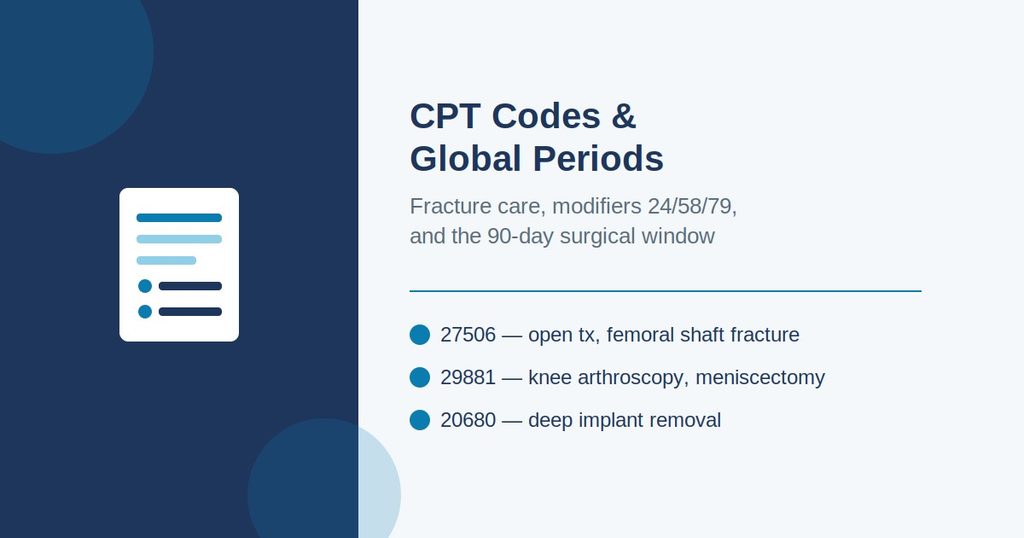
The table below covers the codes that generate the most revenue — and the most denials — for Texas orthopedic practices.
| CPT Code | Description | Global Period |
| 25565 | Closed treatment, both-bone forearm fracture, with manipulation | 90 days |
| 27506 | Open treatment of femoral shaft fracture | 90 days |
| 27758 | Open treatment of tibial shaft fracture, with plate | 90 days |
| 29827 | Shoulder arthroscopy with rotator cuff repair | 90 days |
| 29881 | Knee arthroscopy with meniscectomy | 90 days |
| 20680 | Removal of deep or buried orthopedic implant | 90 days |
| 29075 | Cast application, elbow to finger (short arm) | 0 days — minor procedure |
Modifiers are where most global-period claims go wrong. The table below covers the ones orthopedic billers use most. Note that 57 applies to the decision-for-surgery E/M visit itself, before the global period even starts — the cheat sheet’s postop modifier accuracy line above tracks 24, 58, 78, and 79 specifically, since those are the ones that govern claims filed during the 90-day window.
| Modifier | Meaning | When to Use |
| 24 | Unrelated E/M during the postoperative period | Visit addresses a condition unrelated to the original surgery |
| 25 | Significant, separately identifiable E/M same day as a procedure | A distinct E/M service is documented alongside a same-day procedure |
| 57 | Decision for surgery | The decision to operate is made the day of or day before the procedure |
| 58 | Staged or related procedure | A planned, later-stage procedure related to the original surgery |
| 78 | Return to the OR for a complication | An unplanned return to the operating room during the global period |
| 79 | Unrelated procedure during the postop period | A separate, unrelated procedure performed during the global window |
One nuance worth flagging:
federal oversight bodies have scrutinized global-period billing before, and industry orthopedic coding guidance commonly cites documentation gaps in postoperative visits as a recurring audit finding — not because the global fee assumes a fixed visit count (it doesn’t; it simply bundles whatever routine follow-up occurs), but because payers use visit documentation to confirm the bundled care actually happened as billed. Clean documentation of what took place inside the 90-day window, not just accurate CPT selection, is what protects these claims on audit.
How to Measure Whether Your Billing Is Working?
The four numbers below are worth calculating by hand at least once so you know exactly what’s driving them.
Clean Claim Rate
Formula: (Clean claims submitted ÷ Total claims submitted) × 100.
Worked example: a two-surgeon orthopedic practice submits 260 claims in a month; 231 go out without a payer edit or rejection. 231 ÷ 260 ≈ 89%. That’s below the commonly cited 93% range — worth checking whether global-period modifiers or implant documentation are the recurring culprit. This guide to improving clean claim rate covers common upstream fixes.
Days in Accounts Receivable (AR)
Formula: Total AR balance ÷ (Total charges for the last 12 months ÷ 365).
Worked example: AR balance sits at $310,000 against $2.6 million in annual charges. Daily charges = $2,600,000 ÷ 365 ≈ $7,123. Days in AR = $310,000 ÷ $7,123 ≈ 43.5 days — above the commonly cited under-38-day target, which tracks with how surgical, implant-heavy claims and workers’ comp fee disputes tend to run slower than routine office-visit billing. Our guide to reducing AR days breaks down where to start.
Denial Rate
Formula: (Denied claims ÷ Total claims submitted) × 100.
Worked example: out of the same 260 claims, 23 come back denied. 23 ÷ 260 ≈ 8.8% — just above the commonly reported 8% range. A closer look at denial reason codes, split between commercial, DWC, and Medicaid STAR claims, usually shows the gap concentrated in one segment rather than spread evenly.
Net Collection Rate
Formula: Payments received ÷ (Charges − contractual adjustments) × 100.
Worked example: charges total $410,000, contractual and fee-schedule adjustments bring the allowed amount to $265,000, and the practice collects $221,850. $221,850 ÷ $265,000 ≈ 84% — meaningfully below the commonly cited 93% benchmark. A gap that size in an orthopedic practice often traces back to unbilled or underpaid implant invoices and DWC fee-guideline disputes that were never appealed, not just routine write-offs.
Tracking these four numbers monthly, broken out by payer type, is realistic for a small group but gets harder fast once workers’ comp, Medicaid STAR, and commercial claims are all mixed together. That’s the kind of ongoing, payer-segmented reporting a specialized billing partner is built to handle — more on EZMedPro’s approach to transparent billing further down.
Where a Blended Average Can Hide a Problem?
Checking performance by payer type, not just as one overall number, is arguably the single most useful habit for a Texas orthopedic practice specifically — because commercial, DWC subscriber, non-subscriber, and Medicaid STAR claims can behave very differently.
Illustrative scenario (not an actual client record): a practice’s blended clean claim rate looks reasonable at 91% overall. Broken out by claim type, though, commercial claims run 96% clean and Medicaid STAR claims run 92% clean — while DWC workers’ comp claims sit at just 78%, largely from fee-guideline coding mismatches and missing implant invoices. The strong commercial and Medicaid numbers pull the blended average up enough to hide a real problem in the workers’ comp segment, which only becomes visible once denial and clean claim rates are tracked by payer type instead of as one company-wide figure.
Illustrative Benchmark Breakdown by Caseload Type
This table is not pulled from one single named source — actual figures vary by practice, and readers should verify against their own billing data where precision matters.
| Caseload Type | Illustrative Clean Claim Target | Illustrative Denial Rate Target |
| Commercial-payer-heavy | 95–97% | 4–7% |
| DWC workers’ comp (subscriber)-heavy | 85–91% | 8–13% |
| Mixed surgical caseload, multiple payers | 90–94% | 6–10% |
Common Orthopedic Billing Challenges in Texas
Beyond global-period modifier errors, a handful of other patterns drive most preventable orthopedic denials statewide. Missing implant invoices top the list for both DWC and commercial surgical claims — payers routinely deny separately billed hardware without supporting documentation attached. Prior authorization gaps for advanced imaging (MRI, CT) and Medicaid STAR procedures are close behind, especially when authorization expires between the imaging order and the actual surgery date.
Non-subscriber claims add a layer most billing teams aren’t set up for at all: since there’s no state fee schedule to fall back on, claims often route through a private injury benefit plan with its own rules, or end up pending a legal settlement. Practices that treat a meaningful non-subscriber caseload benefit from a workflow built specifically around that ambiguity — a topic covered in more depth in our guide to workers’ compensation billing delays.
How to Use These Numbers Correctly?
A benchmark only means something compared like-for-like: similar payer mix, comparable surgical volume, and the same reporting period. A practice running a heavy DWC subscriber caseload will show a different denial rate than one that’s almost entirely commercial — comparing the two directly produces a misleading conclusion. One missed benchmark in a single month is a signal to investigate, not a verdict; a pattern that holds for several months in a row is worth a deeper root-cause review.
Timeframe to Improvement
Once a gap is identified, the next practical question is how long a fix takes to show up in the numbers. These are general planning ranges, not a guarantee for any specific practice.
| Fix Applied | Partial Results Typically Visible | Full Results Typically Visible |
| Global-period modifier corrections | 2–4 weeks | 60–90 days |
| Implant invoice / documentation workflow fixes | 30 days | 60–90 days |
| DWC fee-guideline dispute resolution | 30–60 days | 90–180 days |
| Full AR cleanup across payer types | 60 days | 120–180 days |
In-House vs. Outsourced Orthopedic Billing
Many practice owners weigh keeping billing in-house against outsourcing to a specialized partner. In-house billing offers direct control and institutional knowledge of the practice’s own surgeons and payer relationships, but it also means absorbing the cost of tracking annual DWC conversion factor updates, CPT changes, and NCCI edits internally — on top of routine staff turnover. Outsourcing to a partner with dedicated denial management and orthopedic-specific coding experience can reduce that burden, though it requires trusting an outside team with sensitive, high-dollar claims data, which is exactly why transparent, itemized reporting matters so much when evaluating a partner.
For a broader look at coding conventions across the specialty, see our orthopedic CPT codes and modifiers guide.
Quick Summary
- Most surgical orthopedic CPT codes carry a 90-day global period that bundles routine follow-up care.
- A practical clean claim rate target is 93% or higher; a practical days-in-AR target is under 38 days.
- Texas is the only state where employers can legally opt out of workers’ comp — subscriber and non-subscriber claims bill very differently.
- Implant and hardware claims need supporting invoices and medical necessity documentation to get paid.
- Check performance by payer type (commercial, DWC, Medicaid STAR) — blended averages hide segment-specific problems.
- One missed benchmark is a signal to investigate, not a verdict — compare like-for-like caseloads and time periods.
Self-Assessment Checklist
Score your practice’s billing health with these 10 yes-or-no questions, then check the scoring guide below.
1. Is your clean claim rate at or above 93%?
2. Is your days in AR under 38 days?
3. Is your denial rate under 8%?
4. Is your net collection rate 93% or higher?
5. Do you track clean claim and denial rates separately for commercial, DWC, and Medicaid STAR claims?
6. Do you review global-period modifiers (24, 58, 78, 79) on every postoperative claim?
7. Is an implant invoice attached to every claim requesting separate hardware reimbursement?
8. Do you have a documented workflow for non-subscriber workers’ comp claims?
9. Are prior authorizations for advanced imaging confirmed valid through the actual surgery date?
10. Do you receive a monthly, itemized billing report with no hidden fees?
Scoring guide — 8–10 “yes” answers: billing fundamentals are strong; focus on fine-tuning. 5–7 “yes” answers: several gaps need attention before they compound into AR problems. 0–4 “yes” answers: it’s worth a full billing-process review soon, since multiple risk points are stacking up at once.
Expert Insights
Orthopedic billing in Texas rewards precision at every step of the global period, not just accurate CPT selection at the time of surgery. Tracking modifiers on postoperative claims, attaching implant invoices consistently, and knowing which fee schedule applies to a given claim — DWC, Medicaid STAR, or commercial — prevents a large share of denials before they happen.
The benchmark figures cited throughout this guide are practical, commonly reported industry targets — useful starting points, not numbers any single body mandates for every practice. The caseload-based breakdown table and the blended-average scenario are explicitly illustrative, meant to show how the same underlying data can look different depending on how it’s sliced, not to represent verified results from any real practice.
Whether a practice keeps billing in-house or brings in outside help, the numbers in this guide give a concrete starting point for judging whether the current process is actually working — and the self-assessment checklist above offers a fast way to find out where to look first.
When to Consider Professional Support?
A few signals tend to show up before an in-house orthopedic billing process quietly falls behind: denial rate has crept above 10% for more than a couple of months, nobody can say what the practice’s DWC-specific clean claim rate is versus its commercial rate, implant claims keep coming back denied for missing documentation, AR over 90 days keeps growing instead of shrinking, or staff turnover keeps resetting institutional knowledge of the DWC fee guideline’s annual updates.
When those signals show up, it’s worth looking for a billing partner that specializes in orthopedic and surgical coding, provides claim-level visibility by payer type rather than a black-box summary, and lays out its fee structure clearly upfront. Ask prospective partners how they handle DWC fee-guideline disputes, how they track implant documentation, and whether their reporting shows the same clean claim, AR, and denial figures covered in this guide.
EZ MED Professionals (EZMedPro) is one example of that kind of structure: a US-based billing team built around transparent, itemized reporting and a no-hidden-fees pricing approach, working across specialties that include orthopedics, urgent care, family practice, and multi-specialty groups. Results vary by practice and payer mix, so any partner worth evaluating should be willing to walk through its process — not just its promises — before signing on. Learn more at ezmedpro.com.
Related Reading from EZMedPro
- Orthopedic Billing Simplified: CPT Codes and Modifiers
- Dealing with Workers’ Compensation Billing Delays
- Medical Billing Fee Schedule Analysis for Private Practices
- Orthopedic Medical Billing Services in Los Angeles, CA
Sources & Methodology
- Published standards/definitions: CPT code descriptions, global period lengths, and modifier definitions (24, 25, 57, 58, 78, 79) follow CMS and AMA CPT coding rules. Texas DWC fee guideline structure and the subscriber/non-subscriber distinction follow published Texas Department of Insurance rules under 28 TAC Chapter 134.
- Named benchmarking data providers: Days-in-AR and clean claim rate ranges reflect figures commonly attributed to MGMA (Medical Group Management Association) and HFMA (Healthcare Financial Management Association) benchmarking publications.
- Practical/illustrative targets: The caseload-breakdown table and the blended-average scenario are illustrative compilations based on general industry patterns, not a single named data set, and are labeled accordingly throughout.
- Regulatory reference: DWC conversion factor and fee guideline details were cross-checked against the Texas Department of Insurance’s published DWC fee guideline pages.
Actual results vary by practice, payer mix, and reporting period. Figures in this article reflect information available at the time of research and should be verified against current payer policy, CMS/CPT updates, and DWC conversion factor changes before relying on them for billing decisions.
Frequently Asked Questions
What is orthopedic medical billing?
It’s the process of coding, submitting, and following up on insurance claims for orthopedic surgical and non-surgical care — fracture treatment, joint procedures, and implants — using CPT codes tied to 90-day global periods and specialty-specific modifiers.
What is a good clean claim rate for an orthopedic practice?
A commonly cited practical target is 93% or higher. Practices with a heavier workers’ comp or Medicaid STAR caseload may see a somewhat lower blended figure even when performance is otherwise solid, so it helps to review the rate by payer type.
What is a good days-in-AR number for an orthopedic practice?
Under 38 days is a commonly reported practical target for orthopedics specifically, slightly higher than many other specialties because of implant reimbursement timelines and workers’ comp fee disputes; MGMA- and HFMA-aligned benchmarking generally treats anything above 50 days as a real problem.
What is the 90-day global period, and why does it matter?
It’s the window after most surgical procedures during which routine follow-up visits are bundled into the original procedure fee. Billing a separate office visit inside that window without an appropriate modifier (24, 58, 78, or 79) typically triggers a denial.
Is Texas really the only state where employers can opt out of workers’ comp?
Yes — Texas is the only state where private employers can legally choose not to carry workers’ compensation insurance. An estimated one in four Texas employers are “non-subscribers” per Texas Department of Insurance data, and injury claims against them typically route through private injury benefit plans or civil litigation rather than the DWC fee schedule.
How does the Texas DWC fee guideline differ from Medicare?
It uses the same RVU-based structure as Medicare but swaps in a Texas-specific conversion factor, recalculated annually, instead of the national Medicare conversion factor — so the dollar reimbursement for the same CPT code differs between the two systems.
What is a good denial rate for orthopedic claims?
A commonly reported practical range is under 8%. Rates above that in orthopedics often trace back to missing implant invoices, global-period modifier errors, or expired prior authorizations rather than a systemic billing failure.
Do implants need separate documentation to get reimbursed?
Generally yes — most payers, and Texas DWC specifically, require an invoice for implanted items before considering separate reimbursement, along with documentation supporting medical necessity for the hardware used.
How is a non-subscriber workers’ comp claim billed differently?
Since there’s no state fee schedule to fall back on, non-subscriber claims are typically billed against a private injury benefit plan’s own rules, or held pending a legal settlement — a workflow that looks nothing like standard DWC subscriber billing.
How much does outsourcing orthopedic billing typically cost?
Percentage-of-collections pricing commonly falls in the 4–9% range for surgical specialties, while flat per-claim models often run higher than primary care given claim complexity. Surgical volume, implant documentation burden, and how much of the caseload runs through workers’ comp are the main things that move a quote up or down. Always ask for a transparent, itemized quote rather than accepting one blended rate.

