
Speech Pathology Medical Billing Services in Texas (2026)
Speech pathology medical billing services in Texas manage coding, claims, and payment follow-up for SLP practices. They work across Texas Medicaid, Medicare, and commercial payers every day. A good partner also tracks rules like the 95-day Texas Medicaid filing window.
Many Texas SLP owners lose money long before a payer says no. Missed filing windows, mismatched codes, and unsigned authorizations quietly drain revenue. This guide explains speech pathology medical billing services in Texas. It covers the rules that matter most in 2026 and what to check before hiring help. You will find a key numbers table, worked examples, and a short self-assessment checklist near the end. Every figure is labeled as a published standard, a commonly reported range, or a practical target.
Key Numbers for Texas SLP Billing
| Metric | Practical Target/Range | Review | Primary Source |
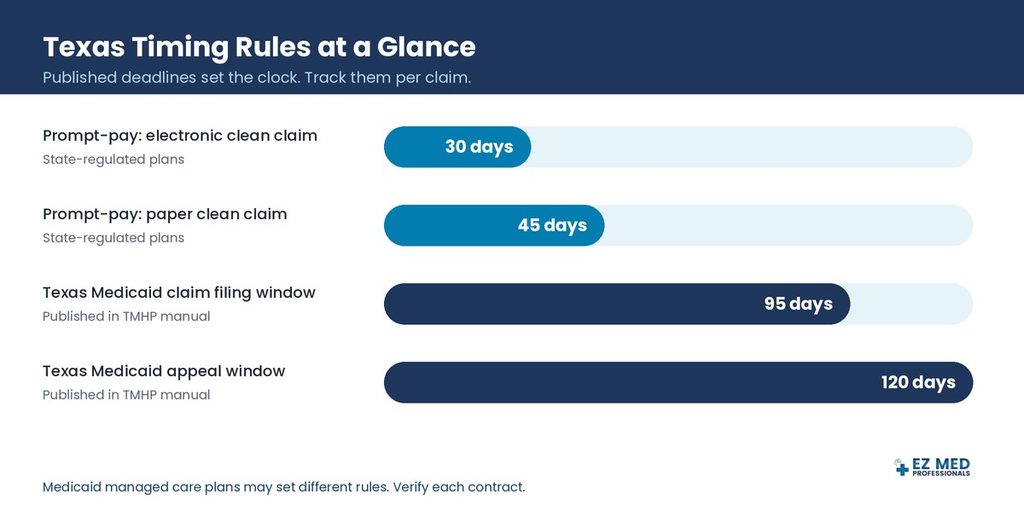
| Texas Medicaid filing and appeals | 95 days from service to file; 120 days from disposition to appeal | Weekly | Published: TMHP manual; 1 Tex. Admin. Code §354.1003 |
| Prompt-pay deadline | 30 days electronic, 45 paper (state-regulated plans) | Monthly | Published: Texas Insurance Code §1301.103 (PPO) and §843.338 (HMO) |
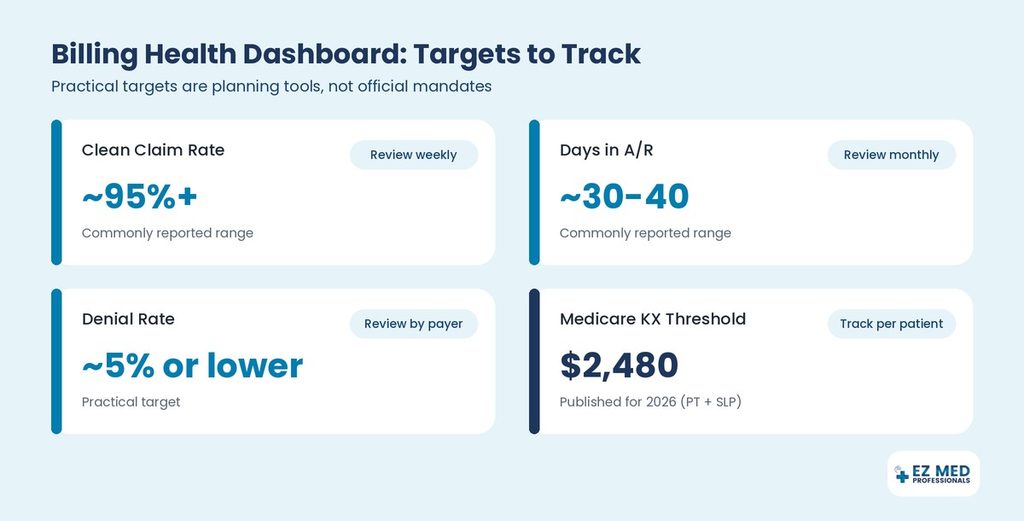
| Medicare KX threshold, 2026 | $2,480, PT and SLP combined | Per patient | Published: CMS Transmittal R13437CP |
| Clean claim rate | About 95% or higher | Weekly | Commonly reported |
| Days in A/R | About 30 to 40 days | Monthly | Commonly reported |
| Denial rate | About 5% or lower | Monthly | Practical target |
Published: stated in a named manual or statute. Commonly reported: seen across industry sources, not mandated. Practical target: a planning goal.
What Speech Therapy Billing Services Actually Handle?
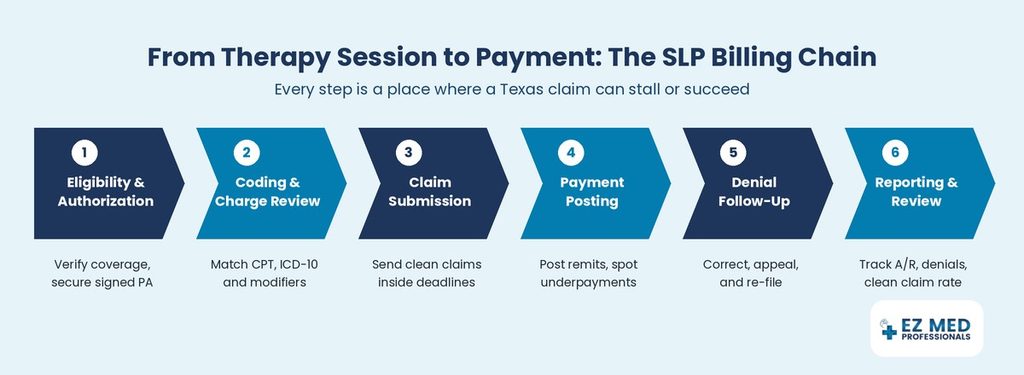
Full-service speech therapy billing does far more than simple claim entry. It starts with eligibility verification and prior authorization, then moves through coding, charge review, and submission. After payment, the team posts remittances, works denial management, and chases aging balances. In Texas, the chain also includes credentialing and payer enrollment. SLPs must be enrolled with TMHP before they can bill Texas Medicaid. Payer credentialing also checks the SLP license issued by the Texas Department of Licensing and Regulation. When any single link fails, the claim stalls, denies, or simply never gets paid.
Texas Payer Rules That Shape Billing
The 95-day Texas Medicaid window deserves more attention than any other number here. TMHP’s manual states that claims received after the deadline are not payable. Prior authorization brings its own set of traps for therapy practices. The therapy handbook requires a request form signed by both therapist and prescriber. It also asks for proof of a current Texas Health Steps checkup or a recent developmental screening. Managed care plans may set different steps and deadlines, so verify each contract. A weekly aging report and a structured prior authorization tracking process help catch problems early.
The 2027 Coding Change Ahead
ASHA reports that CPT 92507 remains valid through December 31, 2026. On January 1, 2027, ten new individual treatment codes will replace it. They use a time-based structure with base and add-on codes across five clinical categories. CMS proposed Medicare payment values for the new codes in July 2026, but ASHA cautions that state Medicaid programs and commercial plans set their own adoption timelines. Clinicians will need to record treatment minutes carefully, since time now shapes code choice. Review how each payer counts time, using the 8-minute rule as a starting point.
Four Calculations to Run Monthly
| Metric | Formula | Worked Example | Result |
| Timely filing date | Date of service + 95 days | Service on March 3, plus 95 days | June 6 |
| Clean claim rate | Clean claims ÷ claims submitted × 100 | 412 ÷ 440 × 100 | 93.6% |
| Days in A/R | Total A/R ÷ (charges in period ÷ days in period) | $86,400 ÷ ($216,000 ÷ 90 days) | 36 days |
| Denial rate | Denied claims ÷ claims submitted × 100 | 31 ÷ 620 × 100 | 5.0% |
Illustrative scenario (not an actual client record): 600 claims in one month, split by payer.
| Payer | Claims | Denied | Denial Rate |
| Commercial | 400 | 12 | 3.0% |
| Medicare | 150 | 6 | 4.0% |
| Texas Medicaid | 50 | 10 | 20.0% |
| Blended total | 600 | 28 | 4.7% |
Illustrative only. Actual figures vary, so verify against your own payer reports.
A 93.6% clean claim rate sits just under the commonly cited 95% goal. Thirty-six days in A/R falls inside the commonly reported range. In the scenario, the blended 4.7% denial rate looks healthy at first glance. Yet one in five Texas Medicaid claims was actually denied within that mix. A blended average hides that problem, so always split denial rate by payer. Industry sources commonly link denials to missing GN modifiers and mismatched CPT and ICD-10 codes. Improving your clean claim rate helps prevent many of those errors. Any denial that still arrives should be appealed inside TMHP’s 120-day window.
Using Benchmarks Without Misreading Them
A benchmark only helps when you compare like with like. Pediatric clinics, adult neurogenic caseloads, and skilled-nursing contractors face different payer mixes and denial patterns. Compare the same segment, similar size, comparable payer mix, and the same reporting period. One missed benchmark is a signal to investigate, not a verdict on your team. Start by asking which payer, which code, and which clinician drive the gap. Then fix the root cause instead of chasing the average. Re-run the comparison each quarter, because payer rules and caseloads shift.
How Long Fixes Take to Show Results?
| Improvement | Early Signs | Fuller Results |
| Eligibility and authorization fixes | 30 to 60 days | 3 to 6 months |
| Claim edits and coding fixes | 1 to 2 billing cycles | 3 to 4 months |
| Denial backlog and appeals | 60 to 90 days | 4 to 6 months |
| Days in A/R reduction | 60 to 90 days | 4 to 6 months |
Illustrative planning ranges, not guarantees. Payer speed, staffing, and starting point all matter.
Quick Recap for SLP Owners
- Speech pathology medical billing services in Texas must respect a 95-day Texas Medicaid filing window and 120-day appeals (published, TMHP).
- Medicare’s 2026 KX threshold is $2,480 for PT and SLP combined (published).
- CPT 92507 is replaced on January 1, 2027, though payer start dates may vary (published, ASHA).
- Clean claim, A/R, and denial targets are practical, not mandated. Split each by payer.
Self-Check: Is Your Billing on Track?
Answer yes or no, then count your yeses.
- Do you file Texas Medicaid claims well inside the 95-day window?
- Does one named person track authorizations and prescriber signatures?
- Is your clean claim rate near 95% or higher?
- Are your days in A/R about 40 or fewer?
- Is your denial rate near or below 5%?
- Do you review denial rate by payer, not only overall?
- Do you track Medicare patients against the $2,480 KX threshold?
- Do you have a written plan for the 2027 coding change?
- Is every clinician credentialed with each payer before treating its patients?
| Yes Answers | What It Suggests |
| 8 to 9 | On track. Keep monitoring monthly. |
| 5 to 7 | Gaps to investigate. Start with payer-level reports. |
| 0 to 4 | High risk. Consider an audit or outside support. |
Expert Insight
Speech pathology medical billing services in Texas work best when rules, codes, and deadlines stay connected. The firm numbers here are published: the Texas Medicaid filing and appeal windows, the prompt-pay periods, the Medicare KX threshold, and ASHA’s January 1, 2027 coding date. Payer adoption of the new codes may still vary, so confirm each start date. Prompt-pay rules generally reach state-regulated plans, not every employer plan. The key numbers table near the top lists the source for each figure.
Everything else is a practical or illustrative target. That covers the roughly 95% clean claim rate, the 30-to-40-day A/R range, the 5% denial goal, the payer example, and the fix timelines. No standards body or association mandates any of them. Treat them as prompts for better questions about your own data, and compare like with like before drawing conclusions. A blended average can look healthy while Texas Medicaid claims struggle, so split every metric before you act. Small, steady corrections, tracked monthly, usually beat dramatic overhauls.
Frequently Asked Questions
What do speech therapy billing services include?
They cover eligibility checks, authorizations, coding review, claim submission, payment posting, and denial follow-up. Many also handle credentialing, so ask for a written scope of work.
How much do speech pathology medical billing services in Texas cost?
Pricing varies by vendor, practice size, and model, such as percentage of collections or flat fees. Ask for a written fee schedule confirming no hidden fees.
What is a good clean claim rate for a speech therapy practice?
Many practices aim for about 95% or higher, a commonly reported range, not a mandate. Track it weekly and by payer, since low rates usually signal front-end errors.
What is a good days in A/R for an SLP practice?
A commonly reported range is about 30 to 40 days, though payer mix matters. Rising A/R often signals slow follow-up, repeat denials, or authorization delays.
What is a good denial rate for speech therapy claims?
Many practices aim to stay near or below 5%, though 5% to 10% is often reported. These are practical targets, not standards, so review denials by payer.
How long do I have to file Texas Medicaid claims?
TMHP must generally receive fee-for-service claims within 95 days of the date of service. Appeals are due within 120 days of the disposition date, and managed care plans may differ.
What is the 2026 Medicare KX threshold for speech therapy?
For 2026, the threshold is $2,480 for physical therapy and speech-language pathology combined. Above it, claims need the KX modifier and documentation supporting medical necessity.
Is CPT 92507 going away?
ASHA reports that 92507 stays valid through December 31, 2026. Ten time-based codes replace it on January 1, 2027, and payer start dates may vary.
When Outside Billing Support Makes Sense?
Outside speech pathology medical billing services in Texas make sense when several of these signals appear together:
- Texas Medicaid claims sit near, or past, the 95-day window.
- The same denial reasons repeat every month.
- No one owns authorization or KX threshold tracking.
- New clinicians wait months for payer enrollment.
- There is no plan for the 2027 code change.
When comparing partners, look for clear structure rather than catchy slogans. Ask which US-based team members will own your account and how often reports arrive. Request a written fee schedule that confirms there are no hidden fees. Check for hands-on experience with TMHP, Texas Medicaid managed care, Medicare, and commercial payers. Be cautious of guaranteed collection percentages that lack a stated measurement method. Weigh the trade-offs using an in-house versus outsourced billing comparison before deciding. Sample reports and a short pilot can help you verify each answer.
EZMed Professionals (EZMedPro) is one example of a partner built around this structure. Its US-based team delivers medical billing, coding, credentialing, and revenue cycle management. The company describes its reporting as transparent and states that it charges no hidden fees. The company serves urgent care, family practice, and multi-specialty groups. Its approach links billing, coding, denial management, and compliance support from end to end. Whichever firm you consider, EZMedPro included, compare its written scope and a sample payer-level report against your own Texas Medicaid, Medicare, and commercial mix. Results vary by practice, payer mix, and situation.
Sources and Methodology
- (a) Published standards: TMHP Texas Medicaid Provider Procedures Manual; 1 Tex. Admin. Code §354.1003; Texas Insurance Code §§1301.103 and 843.338 and Texas Department of Insurance guidance; CMS Transmittal R13437CP on the CY 2026 KX threshold (a national figure; Texas Medicare Part B claims are processed by Novitas Solutions, Jurisdiction H); ASHA’s CPT 92507 notice and its July 2026 summary of CMS’s proposed payment for the new codes; Texas Department of Licensing and Regulation SLP pages.
- (b) Named benchmarking data providers: none used.
- (c) Practical or illustrative targets: clean claim rate, A/R range, denial goal, payer example, and timelines reflect commonly reported industry ranges and planning assumptions.
- (d) Survey data: none used.
Results vary by practice and situation. Figures reflect information available in September 2026; verify current rules with each payer.

