
Occupational Therapy Medical Billing Services in Texas
Occupational therapy medical billing services in Texas manage coding, authorizations, claims, and collections for OT clinics under Texas and federal payer rules. That covers Medicare timed-code and KX modifier rules, Texas Medicaid prior authorization through TMHP and managed care plans, and Texas prompt pay deadlines. A commonly cited practical target is a clean claim rate of 95% or higher.
Occupational therapy claims often fail on minutes, modifiers, and missing authorizations rather than clinical care. In Texas, clinics juggle Medicare therapy thresholds, Medicaid authorization periods, and commercial plans with their own visit limits. This guide explains how occupational therapy medical billing services in Texas work and where revenue commonly leaks. You will find a benchmark cheat sheet, worked calculations, and realistic timelines for improvement. It is written for clinic owners, office managers, and billing leads at small and mid-size therapy practices. Near the end, a ten-question self-assessment checklist helps you score your current billing process.
Texas OT Billing Benchmarks at a Glance
Keep this table close during monthly reviews. Each figure is labeled by where it actually comes from.
| Metric | Practical Target / Range | Review Frequency | Primary Source |
| Clean claim rate | 95% or higher | Weekly | Commonly reported industry target |
| Denial rate | Under 5–8% | Weekly | Commonly reported range |
| Days in A/R | Under 35–40 days | Monthly | Commonly reported range |
| A/R older than 90 days | Under 15% of total A/R | Monthly | Commonly reported range |
| Net collection rate | 95% or higher | Monthly | Industry-defined metric + common benchmark |
| Medicare KX modifier threshold (OT) | $2,480 per beneficiary, CY 2026 | Per patient, yearly | Published standard (CMS) |
| Medicare targeted medical review threshold (OT) | $3,000 | Per patient, yearly | Published standard (CMS) |
| Texas Medicaid acute therapy authorization | Up to 60 days per request | Per authorization | Published standard (TMHP handbook) |
| Texas Medicaid chronic therapy authorization | Up to 180 days | Per authorization | Published standard (TMHP handbook) |
| Clean claim payment (regulated commercial plans) | 30 days electronic / 45 days paper | Per claim | Published standard (Texas Insurance Code, TDI) |
Source labels: “Published standard” means a figure set by federal or Texas rules or an official program manual. “Commonly reported range” means a target repeated across industry sources that no body mandates. Groups such as MGMA define collection metrics, but the 95% figure reflects common industry benchmarking, not a body-mandated number.
Three Payer Rulebooks Texas OT Clinics Must Follow
Medicare: Timed Codes, GO, and the KX Threshold
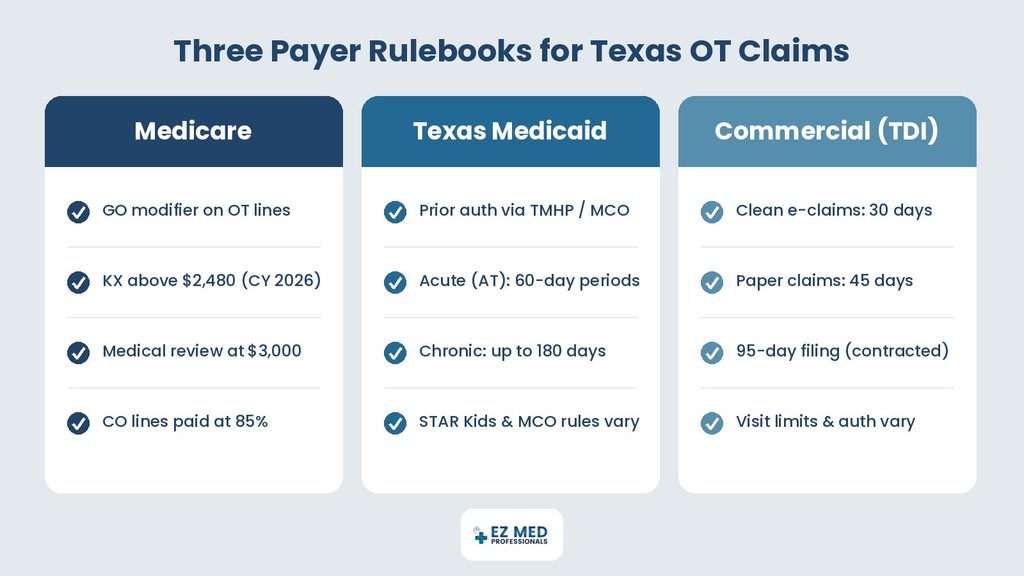
Medicare outpatient OT claims carry the GO modifier, which ties each line to an occupational therapy plan of care. Most OT treatment codes are timed, so the 8-minute rule decides how many units you can bill. Once a patient’s yearly OT charges pass the KX modifier threshold, claims need the KX modifier to show continued medical necessity. According to the CMS therapy services page, that threshold is $2,480 for OT in 2026. Claims above it without KX are denied. Services furnished partly by an occupational therapy assistant also carry the CO modifier and pay at a reduced rate. Our 8-minute rule guide explains unit counting in detail.
Texas Medicaid: TMHP and Managed Care Authorizations
Texas Medicaid therapy billing depends almost entirely on getting authorizations right. The February 2026 TMHP Physical, Occupational, and Speech Therapy Services Handbook sets the framework. Acute therapy, billed with the AT modifier, is authorized in periods of up to 60 days per request. After two acute periods, continued care moves under chronic rules, where authorizations can run up to 180 days. A diagnosis alone does not establish medical necessity, so documentation must show functional need and progress. Most Medicaid children receive OT through managed care plans such as STAR Kids, and each plan runs its own authorization portal.
Commercial Plans and the Texas Prompt Pay Act
For fully insured HMO and PPO plans, the Texas Prompt Pay Act sets firm payment clocks. Under Texas Department of Insurance rules, carriers must pay clean electronic claims within 30 days and clean paper claims within 45 days. Contracted providers generally have 95 days from the date of service to file. The TDI Prompt Pay FAQ explains how audits and information requests pause those clocks. Commercial plans often add annual visit limits and their own authorization rules for therapy. Self-funded employer plans may follow federal ERISA rules instead of Texas deadlines. Tracking each patient’s plan type from intake prevents costly surprises later.
OT Coding Details That Decide Reimbursement
Evaluation and Re-Evaluation Codes
OT evaluation codes are sorted by complexity: 97165 for low, 97166 for moderate, and 97167 for high complexity. Re-evaluations use 97168 and require a documented change in the patient’s condition or plan. Complexity must match the occupational profile, assessed performance deficits, and clinical decision-making in the note. Choosing a higher level without that support invites downcoding and audit exposure. Texas Medicaid adds its own limits, historically paying evaluations only once every three years to the same rendering provider. Build a simple checklist that links each complexity level to its required documentation elements.
Timed Treatment Codes and Unit Counting
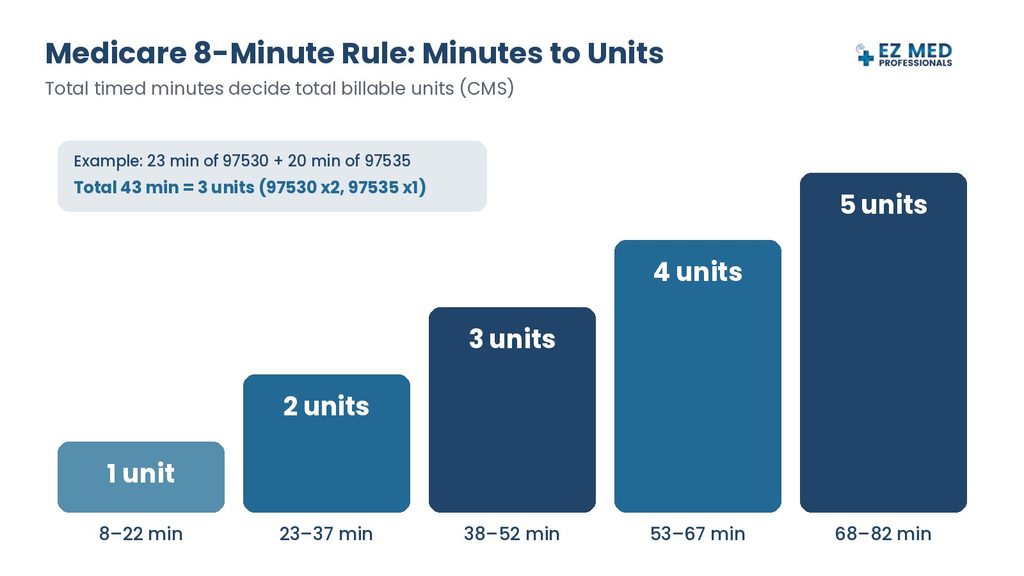
Most OT treatment revenue comes from timed codes such as 97530 for therapeutic activities and 97535 for self-care training. Other common codes include 97110 for therapeutic exercise and 97112 for neuromuscular re-education. CPT timed codes are billed in 15-minute units, but payers count those minutes differently. Medicare adds total timed minutes first, then assigns units using the 8-minute rule. Some commercial plans instead apply a per-code rounding method, which can change unit totals. Your billing system should know which method each payer uses. Our 97530 therapeutic activity billing guide covers documentation for the most-billed OT code.
Group Therapy, Modalities, and Same-Day Limits
Group therapy uses 97150, billed once per patient in the group rather than by time. Supervised modalities are untimed and often restricted, especially under Texas Medicaid, where they must accompany timed treatment codes. Medicare applies a multiple procedure payment reduction to the second and later therapy services on the same day. That reduction lowers payment, not units, so posting teams should expect it rather than appeal it. National Correct Coding Initiative edits can also block certain code pairs without a proper modifier. Regular claim scrubbing catches most of these conflicts before submission.
What a Texas OT Billing Partner Should Handle?
Capable therapy billing services cover the full revenue cycle management process, not just claim submission. The best occupational therapy medical billing services in Texas also manage authorization calendars and payer-specific unit rules. Therapist credentialing matters too, since Medicare, TMHP, each managed care plan, and commercial panels enroll separately. The table below links each service to the problem it prevents. Use it to evaluate an outside vendor or your internal team. Any row you cannot confidently check off is probably visible in your denial reports already.
| Service | What It Prevents | Texas-Specific Detail |
| Eligibility & benefits verification | Denials for exhausted visit limits or inactive coverage | Commercial visit caps; managed care plan changes |
| Prior authorization tracking | Unpaid visits outside authorized dates | TMHP acute 60-day and chronic 180-day periods |
| Credentialing & enrollment | Denials for unenrolled OTs or OTAs | Medicare, TMHP, STAR Kids, commercial panels |
| Coding & unit review | Unit errors, missing GO/KX/CO modifiers | Medicare 8-minute rule vs. commercial methods |
| Claim scrubbing & submission | NCCI edits and missed filing windows | 95-day filing for contracted commercial plans |
| Payment posting & underpayment review | Silent losses on short payments | MPPR and CO reductions reconciled correctly |
| Denial management & appeals | Write-offs of recoverable claims | Plan-specific appeal deadlines |
Worked Examples for OT Revenue Metrics
Each example uses simple numbers, so you can repeat the math with your own reports.
Units Under the 8-Minute Rule
Method: add all timed minutes, convert the total to units, then assign units by minutes per code. Example: a visit includes 23 minutes of 97530 and 20 minutes of 97535, totaling 43 minutes. That equals 3 units. Each code earns one full unit, and the third goes to 97530, which has more remaining minutes.
KX Threshold Tracking
Method: year-to-date allowed OT charges + today’s allowed charges, compared with $2,480. Example: a patient’s allowed OT charges total $2,310 so far this year. Today’s visit adds $210, bringing the total to $2,520. That visit’s lines need the KX modifier, supported by documented medical necessity.
Clean Claim Rate
Formula: claims accepted on first submission ÷ total claims submitted × 100. Example: a clinic submits 1,450 claims, and 1,363 pass without rejection or rework. That gives a clean claim rate of 94.0%, just below the common 95% target.
Days in A/R
Formula: total A/R ÷ average daily charges. Example: A/R totals $126,000, and 90-day charges reach $324,000. Average daily charges are $3,600, so days in A/R equal 35, inside the common range. Our article on reducing A/R days covers next steps.
When a Blended Average Hides a Problem
Blended averages can hide a payer group that is quietly failing. Illustrative scenario (not an actual client record): an OT clinic submits 700 commercial, 450 Medicare, and 300 Medicaid managed care claims monthly. Commercial denials total 21, a 3% rate, and Medicare denials total 18, a 4% rate. Medicaid managed care denials total 39, a worrying 13% rate. Overall, the clinic sees 78 denials across 1,450 claims, or about 5.4%. That blended denial rate looks acceptable against the common 5–8% range. Yet Medicaid claims are clearly struggling, likely from expired or mismatched authorizations. If this pattern looks familiar, focused denial management support can pinpoint the cause.
Comparing OT Numbers Fairly
A benchmark only helps when you compare like with like. A pediatric OT clinic with heavy Medicaid volume differs sharply from an outpatient hand therapy practice. Compare your results against clinics with similar size, patient mix, and payer blend. Use the same reporting period and the same formulas every month. January collections often dip because deductibles reset and new authorizations start. Treat any single missed benchmark as a signal to investigate, never as a verdict on your team. Trends across three to six months say far more than one slow week. Split results by payer and therapist before acting.
How Long OT Billing Improvements Take?
These are general planning ranges, not guarantees for any specific clinic. Timing depends on backlog size, payer mix, and staffing.
| Fix Area | Early Signs of Progress | Fuller Results |
| Authorization tracking & eligibility | 30–60 days | About 90 days |
| Unit counting & modifier accuracy | 30 days | 60–90 days |
| Denial backlog & appeals | 60–90 days | 4–6 months |
| Aged A/R (90+ days) cleanup | 60–90 days | About 6 months |
| New payer enrollment (credentialing) | Approvals often 60–120 days | Varies by payer |
Illustrative planning ranges compiled from commonly reported industry experience. Actual results vary; verify against your own data.
Key Points to Remember
- Medicare’s 2026 KX threshold for OT is a published standard: $2,480, with targeted review at $3,000.
- Texas Medicaid authorizes acute therapy in periods up to 60 days and chronic therapy up to 180 days.
- Texas prompt pay rules require regulated plans to pay clean claims in 30 days electronically or 45 on paper.
- A 95%+ clean claim rate and denials under 5–8% are commonly reported practical targets.
- Days in A/R under 35–40 and net collections of 95%+ are industry-common targets, not mandates.
- Split every metric by payer, since blended averages can hide an authorization problem.
OT Billing Self-Assessment: 10 Quick Questions
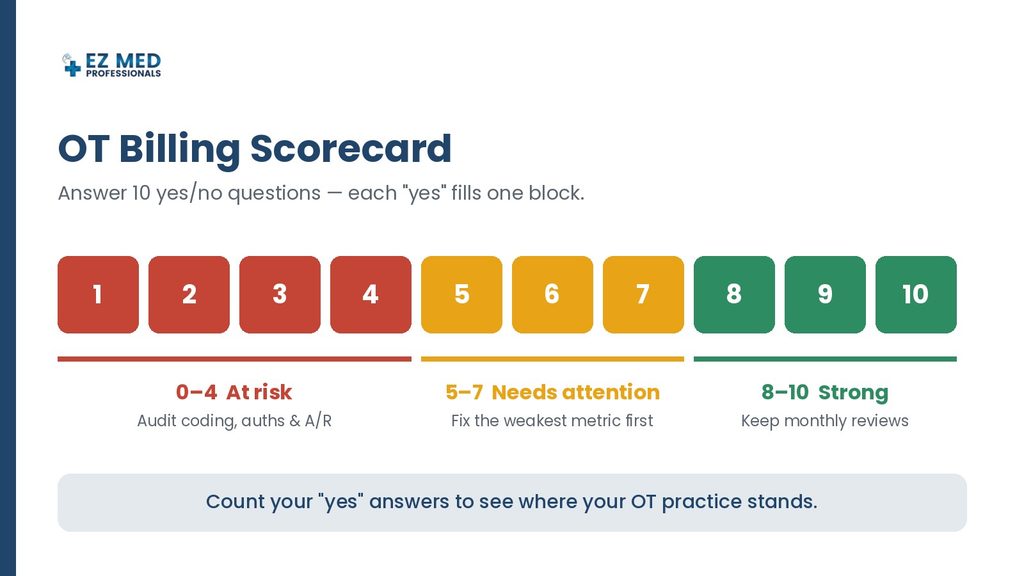
Answer each question yes or no, then count your yes answers.
- Is your clean claim rate at or above 95%?
- Is your denial rate below 8% for every payer group?
- Are your days in A/R under 40?
- Is less than 15% of your A/R older than 90 days?
- Is your net collection rate 95% or higher?
- Do you track each Medicare patient’s year-to-date OT charges against the KX threshold?
- Are Medicaid and managed care authorizations checked before every treatment visit?
- Does your system apply the correct unit-counting method for each payer?
- Is every OT and OTA enrolled with Medicare, TMHP, and each plan you bill?
- Do you review KPIs monthly by payer, therapist, and location?
Scoring: 8–10 yes answers means your billing is strong, so keep reviewing monthly. 5–7 yes answers means it needs attention, so fix your weakest metric first. 0–4 yes answers means revenue is at risk, and a full coding, authorization, and A/R review is worth scheduling soon.
When Outside OT Billing Support Makes Sense?
Internal teams can go a long way, but certain patterns suggest your process has hit its limits.
- Authorization-related denials keep appearing despite repeated staff reminders.
- Aged A/R over 90 days grows month after month.
- New therapists wait weeks to treat insured patients because enrollment stalls.
- One person handles authorizations, posting, and appeals with no backup.
- Nobody can explain last month’s collections by payer and therapist.
When evaluating outside support, look at structure before promises. You want coders who understand OT evaluation codes, timed units, and payer-specific modifiers. Ask how the vendor tracks KX thresholds, TMHP authorization periods, and credentialing renewals. Payer-level reporting should arrive monthly without constant follow-up. A named point of contact usually matters more than a large, distant team. Confirm HIPAA safeguards, clear pricing, and reasonable contract terms before signing. Be cautious with any vendor promising guaranteed percentages before reviewing your data. Honest partners begin with a baseline review of your numbers.
EZMed Professionals is one example of this structure. The team provides end-to-end revenue cycle management covering billing, ICD-10 and CPT coding, credentialing, eligibility verification, prior authorization, and denial management. Each practice works with a dedicated agent, and reporting is built to stay transparent, with no hidden fees. The US-based team supports therapy, specialty, and multi-specialty groups using HIPAA-compliant processes throughout. Results vary by practice, payer mix, and starting point, so any engagement should begin with a baseline review. To talk through your numbers, you can contact the EZMed Professionals team directly.
Expert Insight
OT billing in Texas rewards clinics that treat minutes, modifiers, and authorizations as revenue controls. Medicare, Texas Medicaid, and commercial plans each apply separate rules to the same session. Clinics that stay healthy track thresholds, authorization dates, and unit methods before claims go out. They also review results monthly and split them by payer and therapist. Whether you bill in-house or use occupational therapy medical billing services in Texas, those habits matter most. Start with the self-assessment, choose your weakest metric, and fix that one first.
Keep the source of every number clear in your own reporting. The $2,480 KX threshold, the $3,000 review threshold, the 60- and 180-day TMHP authorization periods, and the 30- and 45-day prompt pay deadlines are published standards. The 95% clean claim target, the 5–8% denial ceiling, the 35–40 day A/R range, and the 95% collection target are commonly reported industry figures. The timeline ranges and the payer-split scenario are illustrative only. Confirm current rules with CMS, TMHP, TDI, and your payer contracts, since policies change often.
Frequently Asked Questions
What do occupational therapy medical billing services in Texas include?
They usually cover eligibility checks, prior authorization, coding, claim submission, payment posting, denial management, and credentialing. Texas-focused services also track TMHP authorization periods and prompt pay deadlines.
What is a good clean claim rate for an OT clinic?
A commonly reported practical target is 95% or higher. Rates below 90% usually point to authorization, eligibility, or unit-counting problems.
What is a good denial rate for occupational therapy billing?
Many industry sources cite 5–8% as a reasonable ceiling. Always check the rate by payer, since blended figures can hide one failing plan.
What is a good days in A/R number for OT practices?
Under 35–40 days is a commonly reported range. Clinics with heavy Medicaid volume may run slightly longer, so compare against similar payer mixes.
What is the KX modifier threshold for OT in 2026?
CMS set the 2026 threshold at $2,480 for occupational therapy services. Claims above it need the KX modifier and documentation supporting medical necessity.
How does the 8-minute rule work for OT?
Medicare adds all timed treatment minutes, then converts the total into 15-minute units. For example, 8–22 minutes equals one unit, and 23–37 minutes equals two.
Does Texas Medicaid require prior authorization for OT?
Yes, most OT treatment requires prior authorization through TMHP or the patient’s managed care plan. Acute authorizations run up to 60 days per request, and chronic ones up to 180 days.
Which CPT codes do OT clinics bill most often?
Common codes include 97165–97168 for evaluations and 97530, 97535, 97110, and 97112 for treatment. Group therapy uses 97150.
What is a good net collection rate for OT clinics?
A commonly cited target is 95% or higher of collectible revenue. The metric excludes contractual adjustments, so it shows what payers actually owe.
Sources, Standards, and Methodology
(a) Published standards and definitions: KX and medical review thresholds, the 8-minute rule, and therapy modifiers come from the CMS therapy services page and CMS Transmittal R13437CP (CY 2026 threshold update). Authorization periods come from the February 2026 TMHP therapy handbook. Texas prompt pay deadlines come from Texas Insurance Code provisions and TDI rules. CPT code definitions are maintained by the AMA.
(b) Named benchmarking providers: MGMA and similar bodies define collection metrics, but no proprietary benchmark figures are reproduced here. (c) Practical and illustrative targets: the clean claim, denial, A/R, and collection targets and all timeline ranges come from commonly reported industry sources. The payer-split scenario is hypothetical. (d) Survey data: none used. Actual results vary by practice and situation, and figures reflect information available at the time of research in September 2026.

