
Affordable Chiropractic Medical Billing Services in Los Angeles, CA
Affordable chiropractic medical billing services in Los Angeles, CA help chiropractic practices submit clean claims, reduce denials, and get paid faster without overpaying for billing support. These services combine specialty-specific coding, claim scrubbing, and transparent flat-fee pricing so practices always know what they’re paying for. EZMedPro delivers this model to LA-based chiropractors through a US-based billing team and no-hidden-fee reporting.
Running a chiropractic practice-affordable Chiropractic Medical Billing Services in Los Angeles CA in Los Angeles means fighting two battles at once: caring for patients and chasing reimbursement. Many clinic owners quietly overpay for medical billing services that still produce denied claims, slow payment posting, and confusing invoices. Others try to manage billing in-house, only to lose hours each week to modifier errors and visit-limit denials. Either way, revenue leaks out of the practice long before anyone notices.
This guide breaks down what affordable chiropractic medical billing services in Los Angeles, CA should actually include, why local practices need specialty-trained billers, and how to compare in-house costs against outsourced pricing. You’ll also find a practical checklist for vetting a billing partner and a closer look at how EZMedPro keeps chiropractic billing transparent, compliant, and priced fairly for practices across LA.
What Are Chiropractic Medical Billing Services?
Chiropractic medical billing services manage the entire administrative side of getting a chiropractic provider paid correctly and on time. This work covers charge entry, claim scrubbing, electronic claims submission, payment posting, and denial follow-up on every visit a practice bills. Because chiropractic care relies heavily on manual therapy and spinal manipulation codes, billing looks different from general primary care work. A specialized biller understands how to pair CPT codes 98940 through 98943 with the correct modifiers so claims aren’t flagged for manual review. Without that expertise, even a well-run clinic can watch reimbursement slow to a crawl.
Core Components of Chiropractic Billing
A complete chiropractic billing service typically covers four connected functions, and each one affects how quickly a practice gets paid. Skipping or rushing any single step usually surfaces later as a denied claim or a smaller-than-expected payment. Most Los Angeles chiropractic offices lose revenue not from one big mistake, but from small gaps repeated across hundreds of claims each month. Understanding these components helps practice owners evaluate whether their current billing setup, in-house or outsourced, is actually built to catch errors before they cost money.
Coding and Charge Entry
Accurate coding starts with correctly documenting spinal regions treated and matching them to CPT codes 98940–98943. Modifier usage, particularly Modifier 25 and AT, determines whether Medicare and commercial payers recognize a visit as medically necessary. Charge entry teams must also capture manual therapy, therapeutic exercise, and X-ray charges without duplicating services already bundled into a chiropractic manipulation code. A single missed modifier can trigger an automatic denial, which is why specialty-trained coders matter more here than in general medical billing.
Claims Submission and Scrubbing
Claim scrubbing checks every claim against payer-specific rules before it’s ever submitted, catching mismatched diagnosis codes or missing modifiers early. This step is what separates a high clean claim rate from a practice constantly resubmitting rejected claims. Electronic claims submission through a clearinghouse speeds up processing compared to paper claims, which some payers still require extra documentation for. Chiropractic claims are especially prone to scrutiny because insurers often cap covered visits, so scrubbing software flags claims likely to exceed a patient’s remaining allowance.
Payment Posting and Denial Management
Once a payer responds, accurate payment posting matches each remittance (ERA or EOB) to the original claim so the practice’s books reflect real revenue. Denial management picks up where posting leaves off, identifying why a claim was rejected and building an appeal before the timely-filing window closes. For chiropractic practices, common denial reasons include exceeded visit limits, missing medical necessity documentation, and modifier mismatches. A billing partner that tracks denial patterns can often prevent the same error from repeating across future claims.
Why Los Angeles Chiropractic Practices Need Specialized Billing Support?
Affordable Chiropractic Medical Billing Services in Los Angeles CA-Los Angeles is one of the most competitive healthcare markets in the country, and chiropractic care is no exception. Practices here deal with a dense mix of commercial insurers, Medicare Advantage plans, and workers’ compensation claims tied to auto accidents and workplace injuries. Each payer type applies different visit limits, documentation rules, and prior authorization requirements. A biller unfamiliar with California workers’ comp billing, for example, may misapply fee schedules that don’t match the state’s official guidelines. That single error can delay payment by months or trigger a full claim denial requiring a lengthy appeal process.
Local Market Pressures That Affect Billing
Beyond payer complexity, LA chiropractic practices often see higher patient volume and tighter margins due to local competition and real estate costs. That makes every denied or delayed claim more costly relative to overhead. Practices also frequently treat personal injury and lien-based cases, which involve entirely different billing timelines than standard insurance claims. Generic, one-size-fits-all billing services rarely account for these local nuances, leading to avoidable claim denials and slower revenue cycle management. Chiropractors need a billing partner who understands both the clinical codes and the regional payer landscape specific to Southern California.

Common Chiropractic Billing Challenges in Los Angeles
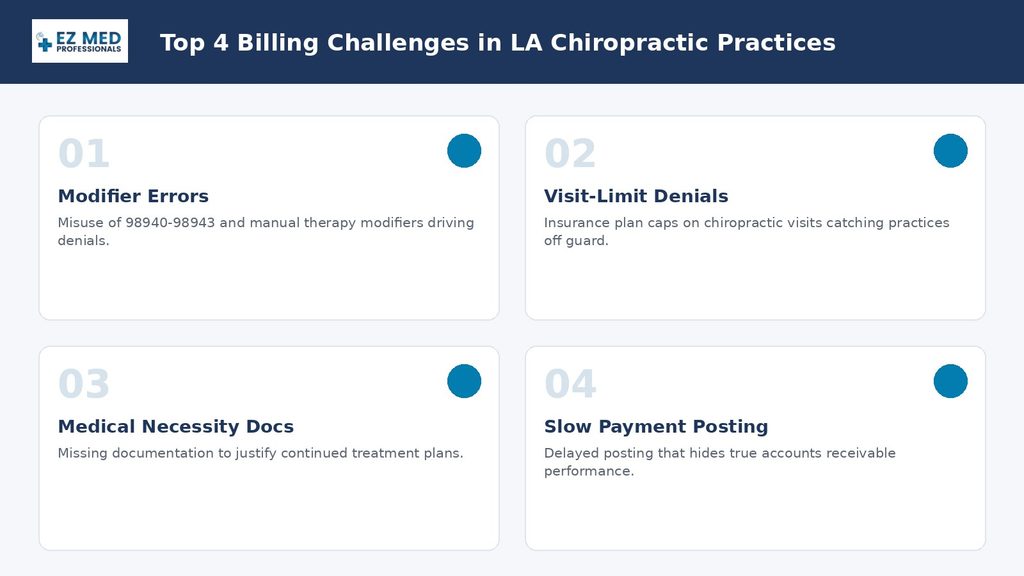
Even well-managed chiropractic practices run into recurring billing obstacles. Recognizing these patterns is the first step toward fixing them, whether billing is handled in-house or outsourced. The four challenges below account for the majority of denied or delayed chiropractic claims seen across Los Angeles practices. Addressing them usually requires a mix of better documentation habits, updated coding knowledge, and consistent claims tracking. A billing partner familiar with chiropractic-specific patterns can catch most of these issues before a claim ever reaches the payer.
Modifier and Coding Errors
Modifier errors remain the single biggest cause of chiropractic claim denials. Missing or incorrect use of Modifier AT (active treatment) can cause Medicare to deny a claim outright, assuming the visit was maintenance care instead. Overlapping charges for manual therapy and manipulation on the same visit, without proper modifiers, also trigger automatic rejections. Consistent, specialty-trained coding review catches these errors before submission rather than after a denial arrives.
Visit-Limit and Medical Necessity Denials
Many commercial and Medicare Advantage plans cap the number of chiropractic visits covered per year. Practices that don’t track remaining visits in real time risk billing for sessions the payer won’t reimburse. Similarly, claims lacking clear medical necessity documentation, like updated treatment plans and progress notes, are easy targets for denial. In fact, CMS review data has found documentation errors in roughly a third of chiropractic claims nationally, which underscores how much this single issue costs practices in denied revenue.
Slow Payment Posting and A/R Buildup
When payment posting lags behind incoming remittances, practices lose visibility into their true accounts receivable position. This delay makes it harder to catch underpayments or spot denial trends early. Over time, unposted payments can quietly inflate days in A/R, masking real revenue cycle problems. Timely, accurate posting is one of the simplest ways to keep a practice’s financial picture honest and actionable.
In-House vs. Outsourced Chiropractic Billing: Cost & Performance Comparison
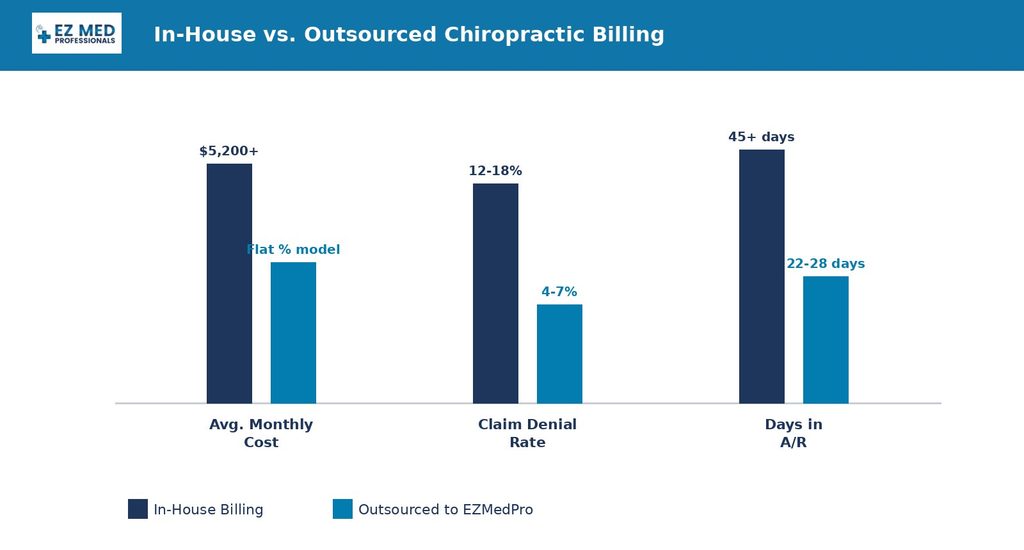
Deciding between an in-house biller and an outsourced billing partner comes down to cost, consistency, and expertise. In-house billing offers direct oversight but often costs more once salary, benefits, software, and training are factored in. Outsourced billing typically runs on a flat percentage of collections, which scales with practice revenue instead of fixed overhead. The table below compares typical performance benchmarks for Los Angeles chiropractic practices using each model, based on industry averages and EZMedPro client experience.
| Metric | Typical In-House Billing | Outsourced (EZMedPro Model) |
| Average Monthly Cost | $4,500–$6,500+ (salary, benefits, software) | Flat percentage of collections, no hidden add-ons |
| Claim Denial Rate | 12–18% industry average for specialty practices | 4–7% with specialty-trained coders |
| Days in A/R | 45+ days common without dedicated follow-up | 22–28 days with active denial management |
| Coding Expertise | Varies by staff training and turnover | Chiropractic-specific coding experience |
| Reporting Access | Manual or limited dashboards | Real-time, transparent reporting |
These numbers illustrate why cost alone shouldn’t drive the in-house-versus-outsourced decision. A lower monthly bill from an in-house biller can still result in higher claim denial rates and slower reimbursement, which costs more in lost revenue than it saves in salary. Practices comparing options should ask any prospective billing partner for their average clean claim rate and days in A/R, not just their fee structure. Transparent pricing only matters when it’s paired with measurable performance.
What Makes EZMedPro’s Chiropractic Billing Affordable and Transparent?
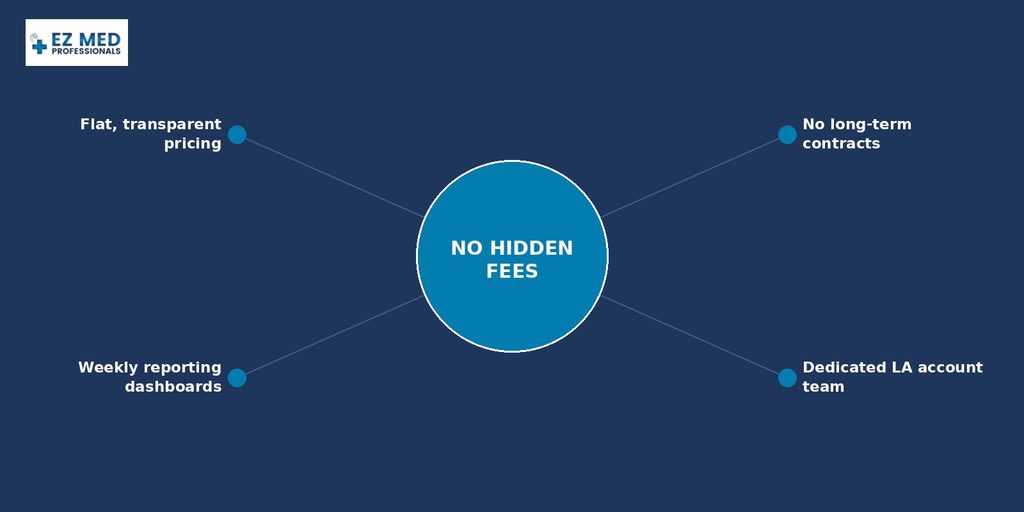
EZMedPro built its chiropractic billing model around one core idea: practices should never have to guess what they’re paying for. Every client receives a flat, transparent pricing structure with no setup fees, no long-term contract lock-in, and no surprise charges buried in monthly invoices. This approach appeals to Los Angeles chiropractors who’ve been burned by billing vendors that quote a low rate upfront, then add fees for reporting, phone support, or claim corrections. With EZMedPro, the quoted rate is the rate — full stop.
Real-Time Reporting and Dedicated Support
Beyond pricing, EZMedPro gives practices direct visibility into their own revenue cycle through real-time reporting dashboards that track clean claim rate, days in A/R, and denial trends. Instead of waiting for a monthly summary, practice owners can check performance whenever they want. Each Los Angeles chiropractic client also works with a dedicated, US-based account manager who understands both chiropractic coding and the regional payer landscape. That combination of transparent pricing and hands-on support is designed to make outsourced billing feel less like a black box and more like an extension of the practice itself.
How to Choose an Affordable Chiropractic Billing Partner in Los Angeles?
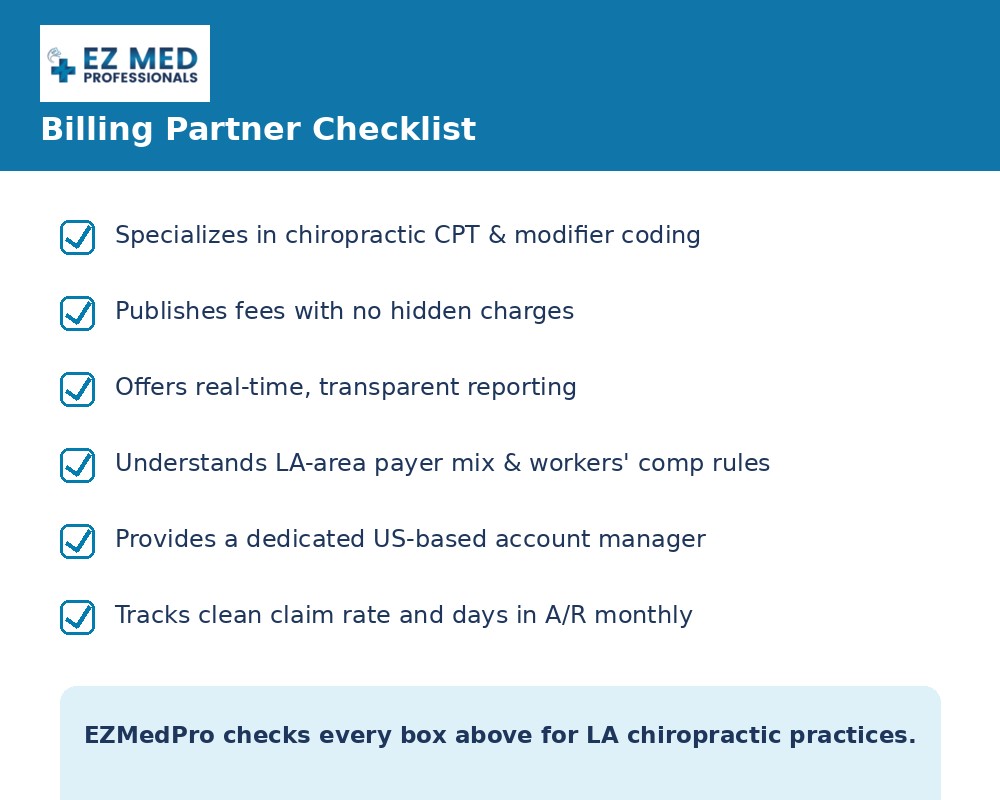
Not every billing company that claims to be “affordable” actually delivers value for a chiropractic practice. The cheapest quote isn’t helpful if it comes with high denial rates or opaque reporting. Practice owners should evaluate potential partners against a consistent set of criteria rather than price alone. The checklist below covers the factors that matter most for chiropractic practices operating in the Los Angeles market, where payer complexity and competition make billing performance especially important to get right.
What to Look For?
- Specializes in chiropractic CPT and modifier coding
- Publishes fees with no hidden charges
- Offers real-time, transparent reporting
- Understands LA-area payer mix and workers’ comp rules
- Provides a dedicated US-based account manager
- Tracks clean claim rate and days in A/R monthly
Ask any prospective billing partner to walk through their onboarding process, reporting cadence, and denial appeal workflow before signing an agreement. A partner confident in their performance will share real metrics, not just marketing claims. This due diligence upfront saves far more time and revenue than switching billing vendors after a bad experience. Take a closer look at our chiropractic billing process to see exactly what’s included.
Quick Summary
- Chiropractic billing requires specialty coding for CPT 98940–98943 and correct modifier use
- Los Angeles practices face a complex payer mix, including workers’ comp and Medicare Advantage
- Common challenges include modifier errors, visit-limit denials, and slow payment posting
- Outsourced billing typically lowers denial rates and shortens days in A/R versus in-house billing
- EZMedPro offers flat, transparent pricing with no hidden fees and real-time reporting
- Choosing a partner should be based on measurable performance, not price alone
Expert Insight
Affordable chiropractic medical billing services in Los Angeles, CA aren’t about finding the lowest monthly rate. They’re about finding a billing partner whose coding accuracy, denial management, and reporting transparency actually protect the revenue a practice has already earned. The cheapest option often costs more once denied claims and slow payment posting are factored in.
Los Angeles chiropractors operate in a market where payer complexity and competition leave little room for billing mistakes. Specialty-trained coders, real-time reporting, and clear pricing aren’t luxuries in this environment — they’re what keeps a practice financially healthy month over month.
EZMedPro was built around that standard: transparent, flat-fee pricing with no hidden charges, backed by a US-based team that understands chiropractic coding and the Southern California payer landscape. Practices considering a switch can request a free billing analysis to see how their current performance compares.
Frequently Asked Questions
What does affordable chiropractic medical billing actually include?
Affordable chiropractic billing should include coding, claim scrubbing, submission, payment posting, and denial management, all under a transparent flat-fee structure. The word “affordable” should reflect measurable value, like a lower denial rate, not just a low sticker price.
How much do chiropractic medical billing services cost in Los Angeles?
Outsourced chiropractic billing typically costs a flat percentage of monthly collections rather than a fixed salary, which usually totals less than an in-house biller once benefits and software are included. Exact pricing depends on claim volume and services included, so it’s worth requesting a direct quote.
What CPT codes are most common in chiropractic billing?
CPT codes 98940 through 98943 cover chiropractic manipulative treatment based on the number of spinal regions involved. Practices often also bill for manual therapy, therapeutic exercise, and X-rays, each requiring correct modifier pairing to avoid denial.
Why do chiropractic claims get denied so often?
Chiropractic claims are frequently denied due to modifier errors, exceeded visit limits, or missing medical necessity documentation. See our denial management guide for a full breakdown of common denial codes and how to appeal them.
Does EZMedPro charge hidden fees for chiropractic billing?
No. EZMedPro uses transparent, flat-fee pricing with no setup costs, no long-term contract requirements, and no surprise charges added to monthly invoices.
How long does it take to switch chiropractic billing providers?
Most practices can transition to a new billing partner within a few weeks, depending on data migration and payer credentialing needs. EZMedPro manages onboarding directly so the practice avoids gaps in claims submission during the switch.
Trusted Industry Leader
Stop guessing what your chiropractic billing actually costs. EZMedPro offers affordable, transparent billing services for Los Angeles chiropractic practices, with no hidden fees and real-time reporting built in. Visit ezmedpro.com to request a free billing analysis and see exactly where your practice stands.

