
Neurology Medical Billing Services in Florida
Neurology medical billing services in Florida handle coding, claims, credentialing, and collections for neurology practices under Florida payer rules. That includes Florida prompt pay deadlines, Statewide Medicaid Managed Care plans, and detailed coding for EEG, EMG, and nerve conduction studies. A commonly cited practical target is a clean claim rate of 95% or higher.
Neurology claims rarely fail on the office visit. They fail on the diagnostics, the drug units, and the payer rules around them. In Florida, practices also juggle Medicare, managed Medicaid plans, and commercial insurers with strict statutory deadlines. This guide explains how neurology medical billing services in Florida work and where revenue typically slips away. You will find a benchmark cheat sheet, four worked calculations, and realistic improvement timelines. It is written for practice owners, office managers, and billing leads at small and mid-size groups. Near the end, a ten-question self-assessment checklist helps you score your current billing process honestly.
Florida Neurology Billing Benchmarks: Quick Reference
Use this table as a monthly reference point. Every figure is labeled by where it actually comes from.
| Metric | Practical Target / Range | Review Frequency | Primary Source |
| Clean claim rate | 95% or higher | Weekly | Commonly reported industry target |
| Denial rate | Under 5–8% | Weekly | Commonly reported range |
| Days in A/R | Under 35–40 days | Monthly | Commonly reported range |
| A/R older than 90 days | Under 15% of total A/R | Monthly | Commonly reported range |
| Net collection rate | 95% or higher | Monthly | Industry-defined metric + common benchmark |
| Insurer action on clean e-claims (pay, deny, or contest) | 20 days electronic / 40 days paper | Per claim | Published standard (s. 627.6131, F.S.) |
| Final pay-or-deny deadline | 90 days; 120 days makes payment uncontestable | Per claim | Published standard (s. 627.6131, F.S.) |
| Filing deadline to primary insurer | 6 months from outpatient date of service | Per claim | Published standard (s. 627.6131, F.S.) |
| Interest on overdue claim payments | 12% simple annual interest | Per claim | Published standard (s. 627.6131, F.S.) |
Source labels: “Published standard” means a figure written into Florida statute. “Commonly reported range” means a target repeated across industry sources that no body mandates. Groups such as MGMA define collection metrics, but the 95% figure reflects common industry benchmarking, not a body-mandated number. Statutory figures apply to regulated health insurers; self-funded ERISA plans may follow different rules.
Florida Rules Every Neurology Biller Must Know
The Florida Prompt Pay Statute
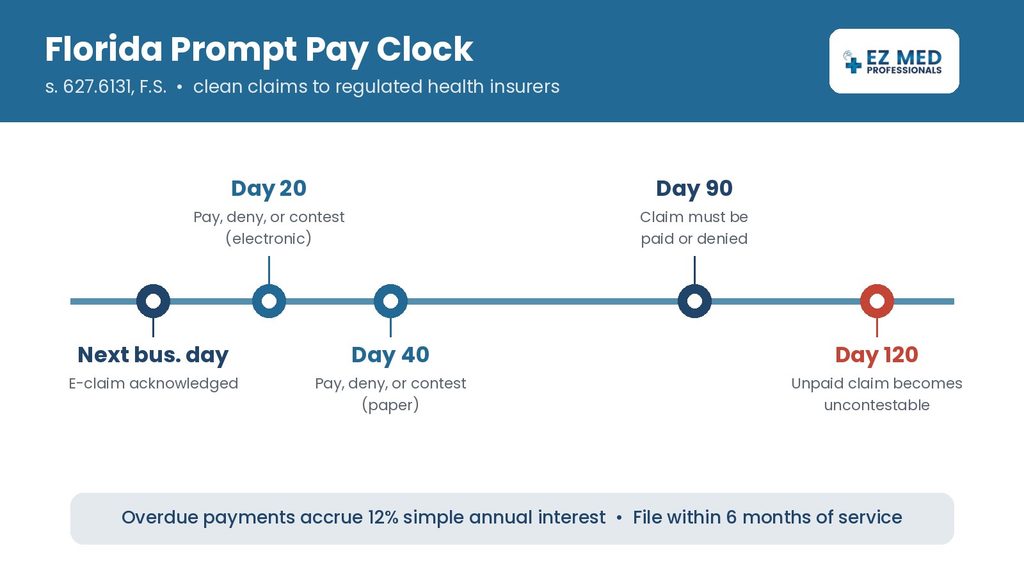
The Florida prompt pay statute, section 627.6131, sets firm clocks for regulated health insurers. For electronic claims, insurers must pay, deny, or contest within 20 days of receipt. Paper claims get 40 days for the same decision. Every claim must be paid or denied within 90 days, and silence past 120 days creates an uncontestable obligation to pay. Overdue payments carry 12% simple annual interest. Providers carry obligations too. Claims must reach the primary insurer within six months of an outpatient service, once the provider has the insurer’s correct name and address. Secondary claims are due within 90 days of the primary insurer’s final decision. You can read the full text in the official Florida Statutes. HMOs follow parallel rules in a separate section of state law.
Medicaid Managed Care and Medicare in Florida
Most Florida Medicaid patients now receive care through Statewide Medicaid Managed Care, which AHCA administers. The program’s third generation, SMMC 3.0, launched on February 1, 2025, with new plan contracts. Each managed medical assistance plan sets its own authorization steps, portals, and filing windows. The AHCA SMMC program page lists current plans by region, which helps when verifying enrollment. On the Medicare side, First Coast Service Options is the contractor for Jurisdiction N, covering Florida. Its local coverage determinations shape documentation expectations for electrodiagnostic testing and other neurology services. Check those policies before scheduling high-volume diagnostic work.
Neurology Coding Areas Where Revenue Slips?
Electrodiagnostic Testing
Nerve Conduction Studies and Needle EMG
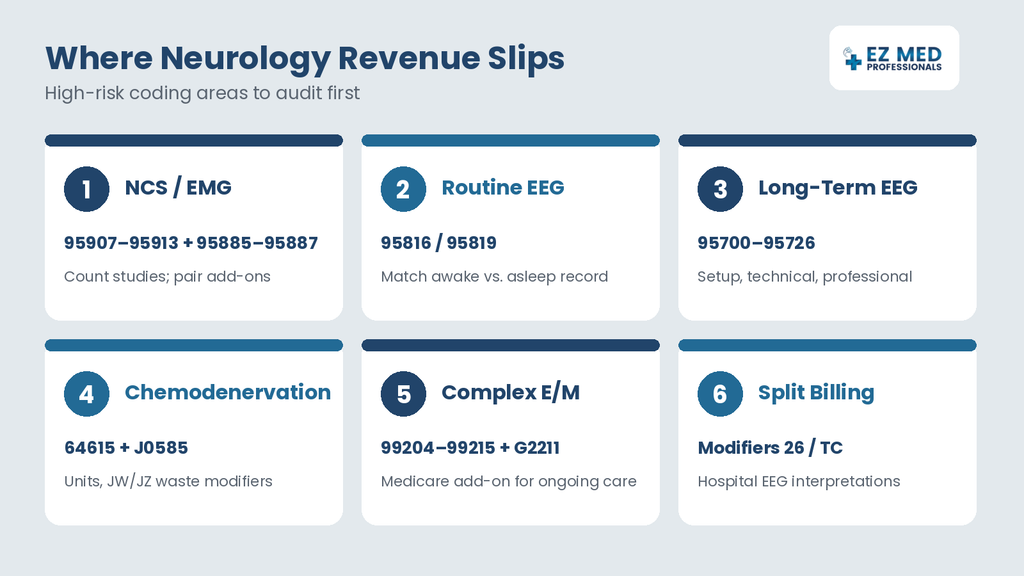
Nerve conduction study billing depends on counting studies correctly, not simply counting nerves. Codes 95907 through 95913 scale with the number of studies performed during the session. When needle EMG accompanies those studies, add-on codes 95885, 95886, or 95887 usually apply. Coders must match the add-on to extremity versus non-extremity testing and full versus limited exams. Medicare contractors have also long treated hand-held screening devices without real-time waveform display as part of the E/M service. Documentation should name each nerve tested, the findings, and the clinical reason for testing. Weak indications invite medical necessity denials during post-payment review.
Routine and Long-Term EEG
EEG coding splits into routine and long-term families. Routine studies use codes such as 95816 for awake and drowsy recordings, or 95819 when sleep is captured. Long-term monitoring, including video EEG, uses the 95700 to 95726 series. That series separates setup, technical recording time, and professional interpretation. Hospital-based neurologists often bill only the interpretation with modifier 26, while the facility bills the technical portion. Mixing these components up leads to duplicate-billing denials or lost professional fees. Our guide to CPT modifiers explained covers modifier 26, TC, and 59 logic in more detail.
Chemodenervation and Drug Units
Botulinum toxin injections combine a procedure code with a separately billed drug. Chronic migraine injections, for example, typically use CPT 64615 alongside HCPCS J0585 for onabotulinumtoxinA units. Units billed must match units administered, and Medicare expects the JW modifier for discarded drug. When nothing is discarded from a single-dose vial, the JZ modifier applies instead. Most commercial plans require prior authorization for these injections, often with documented headache-day history. Missing authorizations are among the costliest neurology denials, because drug costs are already sunk. Our prior authorization tracking guide outlines a workable tracking system.
Complex E/M Visits and G2211
Neurology relies heavily on longitudinal care for epilepsy, multiple sclerosis, Parkinson’s disease, and migraine. Medicare’s G2211 add-on code recognizes that ongoing relationship when a practitioner manages a serious or complex condition over time. It pairs with office E/M codes but has specific conditions, so blanket use invites audits. Level selection for E/M coding should follow medical decision-making or total time, documented clearly. Neurology visits often qualify for higher levels because of test review and medication management. Undercoding those visits quietly costs more than most practices realize. A periodic coding audit compares documentation against billed levels.
Core Services to Expect From a Neurology Billing Partner
Capable neurology billing services cover the full revenue cycle management process, from scheduling to final payment. The strongest neurology medical billing services in Florida also track state deadlines and managed care rules closely. Provider credentialing matters here, since Medicare, each SMMC plan, and commercial panels enroll on separate timelines. The table below links each service to the problem it prevents. Use it to evaluate an outside vendor or your own internal team. Any row you cannot confidently check off probably shows up in your denial reports already. That gap is usually the best place to start improving.
| Service | What It Prevents | Florida-Specific Detail |
| Eligibility & benefits verification | Denials for inactive or reassigned coverage | SMMC plan assignments change; verify every visit |
| Prior authorization tracking | Unpaid injections, imaging, and long-term EEG | Each managed care plan sets its own rules |
| Credentialing & enrollment | Out-of-network and unenrolled-provider denials | Medicare (First Coast), SMMC plans, commercial panels |
| Coding & charge review | Undercoding, add-on errors, unit mismatches | LCD documentation for electrodiagnostic tests |
| Claim scrubbing & submission | Rejections and missed filing windows | 6-month filing window for regulated insurers |
| Payment posting & underpayment review | Silent revenue loss on short payments | 12% statutory interest on overdue payments |
| Denial management & appeals | Write-offs of recoverable claims | Plan-specific appeal deadlines |
Running the Numbers: Four Worked Examples
Each example uses simple monthly figures, so you can repeat the math with your own reports.
Clean Claim Rate
Formula: claims accepted on first submission ÷ total claims submitted × 100. Example: a practice submits 860 claims, and 826 pass without rejection or rework. That gives 826 ÷ 860 = 96.0%, above the common 95% target. Our clean claim rate guide explains how to sustain it.
Days in A/R
Formula: total A/R ÷ average daily charges. Example: A/R totals $264,000, and charges over the last 90 days reach $540,000. Average daily charges are $6,000, so days in A/R equal 44, above the common range. Our article on reducing A/R days covers practical fixes.
Net Collection Rate
Formula: payments ÷ (charges − contractual adjustments) × 100. Example: charges are $610,000, adjustments are $250,000, and payments are $342,000. The net collection rate is $342,000 ÷ $360,000 = 95.0%, right at the common target.
Florida Prompt Pay Interest
Formula: unpaid amount × 12% × days overdue ÷ 365. Example: a $2,400 clean claim is paid 45 days after its statutory deadline. Interest owed is $2,400 × 0.12 × 45 ÷ 365 = $35.51. Small amounts add up across hundreds of late claims, so track them.
When a Blended Average Hides a Problem
Blended averages can make a struggling payer group look fine. Illustrative scenario (not an actual client record): a neurology group submits 400 Medicare, 300 commercial, and 160 SMMC plan claims monthly. Medicare denials total 12, a 3% rate, and commercial denials total 12, a 4% rate. SMMC denials total 22, a troubling 13.75% rate. Overall, the practice sees 46 denials across 860 claims, or about 5.3%. That blended denial rate sits comfortably inside the common 5–8% range. Yet managed Medicaid claims are clearly failing, likely from authorization or enrollment gaps. If your numbers look similar, targeted denial management support can help isolate the cause.
Comparing Your Results Fairly
A benchmark only means something when the comparison is like-for-like. A general neurology clinic differs sharply from an epilepsy center billing long-term video EEG. Compare your results against practices with similar size, service mix, and payer blend. Use the same reporting period and the same formulas every month. A January dip in collections may reflect deductible resets rather than billing errors. Treat any single missed benchmark as a signal to investigate, never as a final verdict. Trends across three to six months reveal far more than one difficult week. Always split results by payer and service line before acting.
How Quickly Billing Fixes Pay Off?
These are general planning ranges, not guarantees for any specific practice. Timing depends on backlog size, payer mix, and staffing.
| Fix Area | Early Signs of Progress | Fuller Results |
| Front-end eligibility & authorization | 30–60 days | About 90 days |
| Diagnostic coding & documentation | 30–60 days | 90–120 days |
| Denial backlog & appeals | 60–90 days | 4–6 months |
| Aged A/R (90+ days) cleanup | 60–90 days | About 6 months |
| New payer enrollment (credentialing) | Approvals often 60–120 days | Varies by payer |
Illustrative planning ranges compiled from commonly reported industry experience. Actual results vary; verify against your own data.
Quick Summary for Busy Practice Leaders
- Florida’s prompt pay statute is a published standard: 20 days to act on clean e-claims and 40 days for paper.
- Claims must be paid or denied within 90 days, and overdue payments earn 12% simple annual interest.
- A clean claim rate of 95% or higher and denials under 5–8% are commonly reported practical targets.
- Days in A/R under 35–40 and net collections of 95% or higher are industry-common targets, not mandates.
- NCS/EMG, EEG, and chemodenervation coding carry the highest neurology revenue risk.
- Split every metric by payer, because blended averages can hide a failing SMMC plan.
Neurology Billing Health Check: 10 Questions
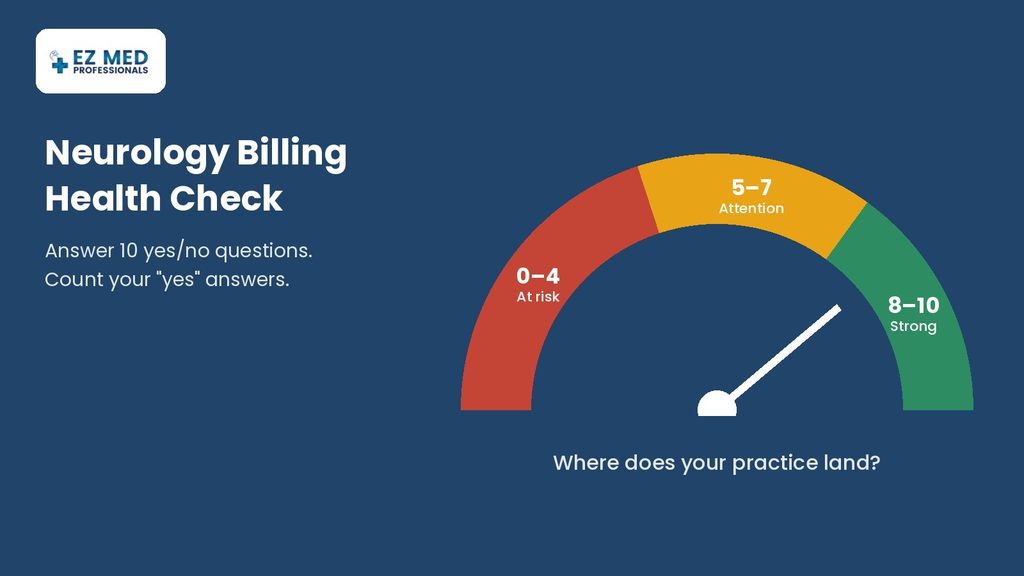
Answer each question yes or no, then total your yes answers.
- Is your clean claim rate at or above 95%?
- Is your denial rate below 8% for every payer group?
- Are your days in A/R under 40?
- Is less than 15% of your A/R older than 90 days?
- Is your net collection rate 95% or higher?
- Do you verify SMMC plan assignment and benefits before every visit?
- Are authorizations confirmed before every chemodenervation or long-term EEG service?
- Do NCS and EMG notes list each study and its clinical indication?
- Do you track Florida prompt pay deadlines and statutory interest on late claims?
- Do you review KPIs monthly by payer, provider, and service line?
Scoring: 8–10 yes answers means your billing is strong, so keep reviewing monthly. 5–7 yes answers means it needs attention, so fix your weakest metric first. 0–4 yes answers means revenue is at risk, and a full coding, A/R, and credentialing review is worth scheduling soon.
When Outside Billing Support Makes Sense?
Internal teams can handle a lot, but some patterns suggest your current approach has hit its limits.
- Denials for one payer group keep climbing despite repeated internal fixes.
- Aged A/R over 90 days grows month after month.
- New neurologists wait months to see insured patients because enrollment stalls.
- Drug units, authorizations, and appeals all depend on one overloaded person.
- Nobody can explain last month’s collections by payer and service line.
When evaluating outside support, look at structure before promises. You want certified coders who understand electrodiagnostic, EEG, and drug billing rules. Ask how the vendor tracks Florida prompt pay clocks, SMMC authorizations, and credentialing renewals. Transparent, payer-level reporting should arrive monthly without constant follow-up. A named point of contact often matters more than a large, faceless team. Confirm HIPAA safeguards, clear pricing, and reasonable contract terms before signing. Be cautious with any vendor promising guaranteed percentages before reviewing your actual data. Honest partners start with a baseline review of your numbers.
EZMed Professionals is one example of this structure. The team provides end-to-end revenue cycle management covering billing, ICD-10 and CPT coding, credentialing, eligibility verification, prior authorization, and denial management. Each practice works with a dedicated agent, and reporting is built to stay transparent, with no hidden fees. The US-based team supports specialty and multi-specialty groups using HIPAA-compliant processes throughout. Results vary by practice, payer mix, and starting point, so any engagement should begin with a baseline review. To discuss your numbers, you can contact the EZMed Professionals team directly.
Expert Insight
Neurology billing in Florida rewards practices that respect both coding detail and state rules. Diagnostic testing, drug units, and complex visits drive revenue, but they also drive denials. Florida’s prompt pay statute gives practices real leverage, if someone actually tracks the deadlines. Managed Medicaid plans and Medicare contractors each add their own requirements. Whether you bill in-house or use neurology medical billing services in Florida, consistent monthly review matters most. Start with the health check, choose your weakest metric, and fix that one first. Small, steady improvements compound faster than occasional large overhauls.
Keep the source of every number clear in your own reporting. The 20- and 40-day action deadlines, the 90- and 120-day limits, the six-month filing window, and 12% interest are published Florida standards. The 95% clean claim target, the 5–8% denial ceiling, the 35–40 day A/R range, and the 95% collection target are commonly reported industry figures. The timeline ranges and the payer-split scenario are illustrative only. Confirm current rules with the Florida Statutes, AHCA, First Coast, and your payer contracts, since policies change often.
Frequently Asked Questions
What do neurology medical billing services in Florida include?
They usually cover eligibility checks, prior authorization, coding, claim submission, payment posting, denial management, and credentialing. Florida-focused services also track prompt pay deadlines and SMMC plan requirements.
What is a good clean claim rate for a neurology practice?
A commonly reported practical target is 95% or higher. Rates below 90% usually point to eligibility, authorization, or diagnostic coding problems.
What is a good denial rate for neurology billing?
Many industry sources cite 5–8% as a reasonable ceiling. Always check the rate by payer, since blended figures can hide one failing plan.
What is a good days in A/R number for neurology?
Under 35–40 days is a commonly reported range. Practices with heavy drug or long-term EEG billing may run slightly longer, so compare like-for-like.
How fast must Florida insurers pay neurology claims?
Under section 627.6131, regulated insurers must pay, deny, or contest clean electronic claims within 20 days and paper claims within 40 days. Claims must be paid or denied within 90 days.
How are nerve conduction studies billed?
Codes 95907 through 95913 are selected by the number of studies performed. Needle EMG done alongside them usually uses add-on codes 95885, 95886, or 95887.
Who is the Medicare contractor for Florida neurologists?
First Coast Service Options administers Medicare Jurisdiction N, which includes Florida. Its local coverage determinations guide documentation for many neurology services.
Do Botox injections for migraine need prior authorization in Florida?
Most commercial and managed Medicaid plans require it, though rules vary by plan. Confirm authorization and unit limits before every injection visit.
What is a good net collection rate for neurology practices?
A commonly cited target is 95% or higher of collectible revenue. The metric excludes contractual adjustments, so it reflects what payers actually owe.
Sources, Standards, and Methodology
(a) Published standards and definitions: Florida prompt pay deadlines, the six-month filing window, and 12% interest come from section 627.6131 of the Florida Statutes. SMMC details come from AHCA program materials. CPT and HCPCS code definitions are maintained by the AMA and CMS, and Medicare jurisdiction details come from CMS contractor information.
(b) Named benchmarking providers: MGMA and similar bodies define collection metrics, but no proprietary benchmark figures are reproduced here. (c) Practical and illustrative targets: the clean claim, denial, A/R, and collection targets and all timeline ranges come from commonly reported industry sources. The payer-split scenario is hypothetical. (d) Survey data: none used. Actual results vary by practice and situation, and figures reflect information available at the time of research in September 2026.

