
Psychiatry Medical Billing Services in Texas: 2026 Guide
Psychiatry medical billing services in Texas manage coding, claims, credentialing, and collections for psychiatric practices under Texas-specific payer rules. That includes TMHP and STAR managed care requirements, Texas Prompt Pay deadlines, and add-on coding for psychotherapy with E/M visits. A commonly cited practical target is a clean claim rate of 95% or higher.
A single missing modifier can delay a psychiatric claim for weeks. In Texas, that risk grows because psychiatrists juggle TMHP rules, managed care plans, and commercial carriers with different deadlines. This guide explains how psychiatry medical billing services in Texas work, which numbers matter, and where revenue usually leaks. You will get a key numbers cheat sheet, worked calculations, and realistic timelines for improvement. It is written for practice owners, office managers, and billing leads who want clear answers without jargon. Near the end, a ten-question self-assessment checklist helps you score your current process. Use that score to decide whether to fix issues internally or bring in outside support.
Texas Psychiatric Billing Numbers at a Glance
Keep this quick-reference table handy during monthly reviews. Each figure is labeled by where it actually comes from.
| Metric | Practical Target / Range | Review Frequency | Primary Source |
| Clean claim rate | 95% or higher | Weekly | Commonly reported industry target |
| Denial rate | Under 5–8% | Weekly | Commonly reported range |
| Days in A/R | Under 35–40 days | Monthly | Commonly reported range |
| A/R older than 90 days | Under 15% of total A/R | Monthly | Commonly reported range |
| Net collection rate | 95% or higher | Monthly | Industry-defined metric + common benchmark |
| Clean claim payment deadline (regulated commercial plans) | 30 days electronic / 45 days paper | Per claim | Published standard (Texas Insurance Code, TDI) |
| Claim filing deadline (contracted commercial plans) | 95 days from date of service | Per claim | Published standard (TDI prompt pay rules) |
| Texas Medicaid rate for LCSW, LMFT, LPC | 70% of psychiatrist or psychologist rate (similar service) | Annual review | Published standard (1 TAC §355.8091 via TMHP) |
Source labels: “Published standard” means a figure written into Texas statute, agency rule, or an official program manual. “Commonly reported range” means a target repeated across industry sources that no body mandates. Industry groups such as MGMA define collection metrics, but the 95% figure reflects common industry benchmarking, not a body-mandated number.
What Makes Texas Psychiatry Claims Different?
Texas Medicaid, TMHP, and STAR Managed Care
Texas Medicaid fee-for-service claims run through TMHP, the state’s claims administrator. Most Medicaid patients, however, belong to STAR managed care plans such as STAR, STAR+PLUS, STAR Kids, and STAR Health. Each managed care organization sets its own prior authorization steps, portals, and filing windows. The April 2026 TMHP Behavioral Health and Case Management Services Handbook adds firm rules worth knowing. Outpatient mental health services delivered through synchronous audiovisual technology must carry modifier 95. The handbook also pays LCSW, LMFT, and LPC providers 70% of the rate paid to a psychiatrist or psychologist for similar services. That gap matters when your group blends psychiatrists with licensed therapists. Always confirm the current handbook edition, because TMHP updates it regularly.
Commercial Payers and the Texas Prompt Pay Act
For fully insured HMO and PPO plans, the Texas Prompt Pay Act sets firm payment clocks. Under Texas Department of Insurance rules, carriers must pay clean electronic claims within 30 days. Clean paper claims get 45 days, and late payments can trigger penalties owed to the provider. Contracted providers generally have 95 days from the date of service to file. The TDI Prompt Pay FAQ explains how clearinghouses, secondary claims, and audits affect those clocks. One important catch involves self-funded employer plans. Many fall under federal ERISA rules instead, so the Texas clock may not apply. A capable billing team tracks each patient’s plan type from the very first visit.
Coding Rules That Trip Up Psychiatric Practices
Evaluations and Add-On Psychotherapy
Psychiatric CPT codes carry more nuance than most specialties. Code 90791 covers a diagnostic evaluation without medical services, while 90792 includes them. Medication management visits use standard E/M codes, often 99213 or 99214. When psychotherapy happens during that same visit, add-on codes 90833, 90836, or 90838 apply. Psychotherapy time must be documented separately from the E/M work itself. Payers deny these claims quickly when time statements are missing or overlap. ICD-10-CM coding also needs specificity, since vague depression or anxiety codes invite medical necessity reviews. Our guide to mental health billing for psychiatrists and therapists walks through these code pairings in more depth.
Telepsychiatry, Place of Service, and Modifiers
Telepsychiatry billing is routine across Texas now, yet payer rules still differ widely. Commercial carriers may expect POS 02 or POS 10, depending on where the patient sits. Texas Medicaid, as noted above, requires modifier 95 for audiovisual outpatient mental health services. Medicare publishes its own requirements in the CMS Medicare & Mental Health Coverage booklet. The practical rule is simple: build a payer-by-payer matrix and update it every quarter. Staff should never have to guess which modifier a plan expects. For a side-by-side comparison of session types, see our breakdown of telehealth versus in-person mental health billing.
Services a Texas Psychiatry Billing Partner Should Handle
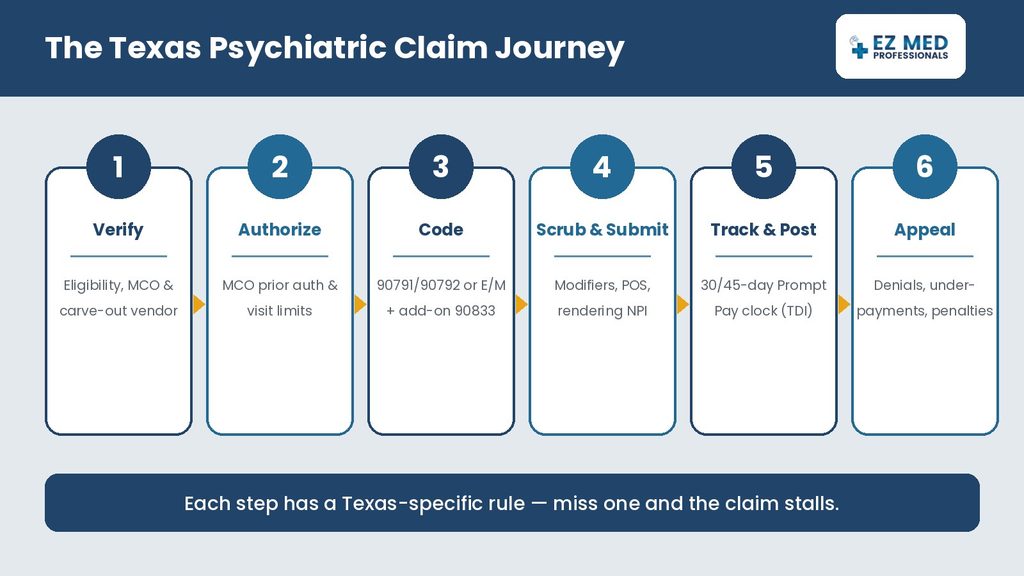
Strong psychiatric billing services cover the full revenue cycle management process, not just claim submission. The best psychiatry medical billing services in Texas close the gaps that usually appear at the edges. Eligibility gets checked too late, or credentialing lands on already busy front-desk staff. Behavioral health credentialing deserves special attention, since TMHP, each MCO, and commercial panels run on separate timelines. The table below maps each core service to the problem it prevents. Use it as a checklist when evaluating any vendor, including your current in-house team. If several rows feel uncovered today, that gap is probably visible in your denial numbers already.
| Service | What It Prevents | Texas-Specific Detail |
| Eligibility & benefits verification | Denials for inactive coverage or carve-outs | Some plans route behavioral health to a separate vendor |
| Prior authorization tracking | Unpaid visits beyond approved limits | Each STAR MCO sets its own authorization rules |
| Credentialing & payer enrollment | Denials for unenrolled rendering providers | TMHP enrollment plus separate MCO panels |
| Coding & charge review | Add-on denials, downcoding, audit exposure | Modifier 95 for Texas Medicaid telehealth |
| Claim scrubbing & submission | Rejections and missed filing windows | 95-day window for contracted commercial plans |
| Payment posting & underpayment review | Silent revenue loss on short payments | Prompt Pay penalties may apply to late clean claims |
| Denial management & appeals | Write-offs of recoverable claims | MCO-specific appeal deadlines |
Worked Examples: Calculating the Metrics That Matter
Each formula below uses simple monthly numbers, so you can repeat the math with your own reports.
Clean Claim Rate
Formula: claims accepted on first submission ÷ total claims submitted × 100. Example: a practice submits 1,200 claims, and 1,128 pass without rejection or rework. That gives 1,128 ÷ 1,200 = 94%, just under the common 95% target. Our clean claim rate guide covers the usual fixes.
Denial Rate
Formula: claims denied ÷ claims adjudicated × 100. Example: 84 denials out of 1,200 claims equals a denial rate of 7%. That sits inside the commonly reported 5–8% ceiling, but only barely.
Days in A/R
Formula: total A/R ÷ average daily charges. Example: A/R totals $180,000, and charges over the last 90 days reach $405,000. Average daily charges are $4,500, so days in A/R equal 40, the upper edge of the common range. Our article on reducing A/R days explains practical next steps.
Net Collection Rate
Formula: payments ÷ (charges − contractual adjustments) × 100. Example: charges are $520,000, adjustments are $190,000, and payments are $310,000. The net collection rate is $310,000 ÷ $330,000 = 93.9%, leaving roughly $20,000 of collectible revenue uncollected.
When a Blended Average Hides a Problem
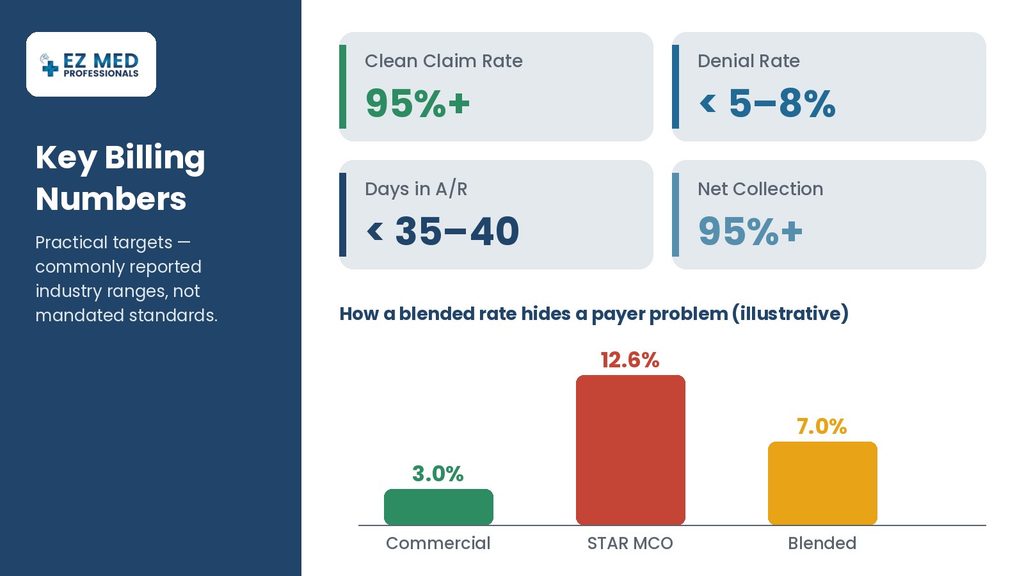
Averages can look healthy while one payer group quietly drains revenue. Illustrative scenario (not an actual client record): a psychiatric group submits 700 commercial claims and 500 STAR MCO claims in one month. Commercial denials total 21, which is a 3% rate. STAR MCO denials total 63, a troubling 12.6% rate. Combined, the practice sees 84 denials across 1,200 claims, or 7% overall. That blended figure looks acceptable against the common benchmark. Yet the Medicaid side is clearly failing, likely from authorization or enrollment gaps. If your MCO numbers resemble this example, focused denial management support can isolate root causes faster.
Reading Benchmarks the Right Way
A benchmark only helps when you compare like with like. A solo telepsychiatry practice and a hospital-affiliated group have very different payer mixes and costs. Compare your numbers against practices of similar size, specialty mix, and payer blend. Use the same reporting period, and apply the same formula every single month. A denial spike in January may reflect deductible resets and eligibility changes, not coding errors. Treat any single missed benchmark as a signal to investigate, never as a verdict on your team. Trends across three to six months will tell you far more than one difficult week. Split every number by payer before acting on it.
Realistic Timelines for Billing Improvements
These are general planning ranges, not guarantees for any specific practice. Actual timing depends on payer mix, backlog size, and staff capacity.
| Fix Area | Early Signs of Progress | Fuller Results |
| Front-end eligibility & authorization | 30–60 days | About 90 days |
| Coding & documentation for add-on codes | 30–60 days | 90–120 days |
| Denial backlog & appeals | 60–90 days | 4–6 months |
| Aged A/R (90+ days) cleanup | 60–90 days | About 6 months |
| New payer enrollment (credentialing) | Approvals often 60–120 days | Varies by payer |
Illustrative planning ranges compiled from commonly reported industry experience. Actual results vary; verify against your own data.
Key Takeaways at a Glance
- Texas psychiatric billing blends TMHP, STAR managed care, commercial, and Medicare rules, each with separate requirements.
- The Texas Prompt Pay Act is a published standard: 30 days for clean electronic claims and 45 days for paper.
- A clean claim rate of 95% or higher and denials under 5–8% are commonly reported practical targets.
- Days in A/R under 35–40 and net collections of 95% or higher are industry-common targets, not mandates.
- Split every metric by payer group, because blended averages can hide a failing segment.
- Expect early gains within 30–90 days and fuller results over several months.
Self-Assessment Checklist for Texas Psychiatric Practices
Answer each question with a simple yes or no, then count your yes answers.
- Is your clean claim rate at or above 95%?
- Is your denial rate below 8%, when split by payer group?
- Are your days in A/R under 40?
- Is less than 15% of your A/R older than 90 days?
- Is your net collection rate 95% or higher?
- Do you verify eligibility and behavioral health carve-outs before every visit?
- Is every rendering provider enrolled with TMHP and each STAR MCO you bill?
- Do you document psychotherapy time separately when billing add-on codes?
- Do you track Prompt Pay deadlines and request penalties on late clean claims?
- Do you review KPIs monthly by payer, provider, and location?
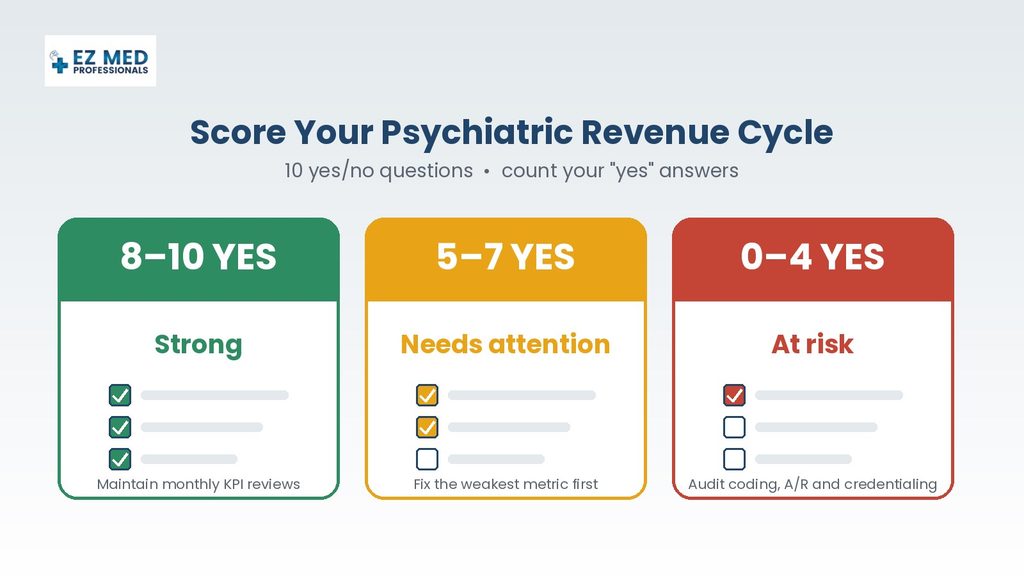
Scoring: 8–10 yes answers means your process is strong, so keep reviewing monthly. 5–7 yes answers means it needs attention, so fix your weakest metric first. 0–4 yes answers means revenue is at risk, and a full coding, A/R, and credentialing review is worth scheduling soon.
Signs It Is Time to Bring in Outside Help
Psychiatry medical billing services in Texas-Internal teams can go far, but certain patterns suggest your current approach has reached its limits.
- Denials keep rising for one payer group despite repeated internal fixes.
- Aged A/R over 90 days grows month after month.
- New psychiatrists wait months to see insured patients because enrollment stalls.
- One biller handles coding, posting, and appeals alone, with no backup.
- Nobody can explain last month’s collections by payer within a day.
When evaluating outside support, look for structure before promises. You want certified coders who understand psychiatric codes and Texas Medicaid rules. Ask how the vendor tracks Prompt Pay clocks, MCO authorizations, and credentialing renewals. Transparent, payer-level reporting should arrive monthly without you having to chase it. A named point of contact matters more than a large team you can never reach. Confirm HIPAA safeguards, a clear fee structure, and reasonable contract terms before signing anything. Any vendor quoting guaranteed percentages before reviewing your data deserves extra scrutiny, since honest partners start with your baseline numbers.
EZMed Professionals is one example of this structure. The team provides end-to-end revenue cycle management covering billing, ICD-10 and CPT coding, credentialing, eligibility verification, prior authorization, and denial management. Each practice works with a dedicated agent, and reporting is built to stay transparent, with no hidden fees. The US-based team supports psychiatric, family practice, and multi-specialty groups using HIPAA-compliant processes throughout. Results vary by practice, payer mix, and starting point, so any engagement should begin with a baseline review. If you want to talk through your numbers, you can contact the EZMed Professionals team directly.
Expert Insight
Psychiatric billing in Texas rewards practices that treat each payer as its own system. TMHP, STAR managed care plans, commercial carriers, and Medicare all apply different rules. Practices that stay financially healthy track their numbers monthly and split them by payer. They document psychotherapy time carefully and keep credentialing current for every provider. None of this demands perfection, only consistent attention and clear ownership of each step. Whether you keep billing in-house or choose psychiatry medical billing services in Texas, the same disciplines apply. Start with the self-assessment, choose your weakest metric, and fix that one first.
Keep the source of every number clear in your own reporting, too. The 30- and 45-day Prompt Pay deadlines, the 95-day filing window, the modifier 95 rule, and the 70% Medicaid rate ratio are published standards. The 95% clean claim target, the 5–8% denial ceiling, the 35–40 day A/R range, and the 95% collection target are commonly reported industry figures. The timeline ranges and the payer-split scenario are illustrative only. Confirm current rules with TMHP, TDI, and your payer contracts, since policies change often.
Frequently Asked Questions
What do psychiatry medical billing services in Texas include?
They typically cover eligibility checks, prior authorizations, coding, claim submission, payment posting, denial management, and credentialing. Texas-focused services also handle TMHP rules, STAR MCO requirements, and Prompt Pay tracking.
What is a good clean claim rate for a psychiatric practice?
A commonly reported practical target is 95% or higher. Rates below 90% usually point to eligibility, authorization, or coding problems worth investigating quickly.
What is a good denial rate for psychiatry billing?
Many industry sources cite 5–8% as a reasonable ceiling. Always check the rate by payer, because a blended figure can hide one failing plan.
What is a good days in A/R number for a mental health practice?
Under 35–40 days is a commonly reported range. Practices with heavy Medicaid or MCO volume may run slightly longer, so compare against similar payer mixes.
How fast must Texas insurers pay psychiatric claims?
Under the Texas Prompt Pay Act, regulated HMO and PPO plans must pay clean electronic claims within 30 days and paper claims within 45 days. Self-funded ERISA plans may fall outside these state deadlines.
Do I need modifier 95 for telepsychiatry in Texas?
Texas Medicaid requires modifier 95 for outpatient mental health services delivered through synchronous audiovisual technology. Commercial payers set their own rules, so confirm requirements plan by plan.
Which CPT codes do psychiatrists in Texas bill most often?
Common codes include 90791 and 90792 for evaluations and E/M codes such as 99214 for medication management. Add-on codes 90833, 90836, and 90838 cover psychotherapy performed alongside E/M visits.
How long does psychiatrist credentialing take in Texas?
Many practices report 60 to 120 days per payer, though timelines vary widely. Starting TMHP and MCO enrollment early prevents months of unbillable visits.
What is a good net collection rate for psychiatric practices?
A commonly cited target is 95% or higher. The metric excludes contractual adjustments, so it shows how well you collect what payers actually owe.
Should a small psychiatric practice outsource billing?
It depends on claim volume, payer mix, and staff capacity. Outsourcing often makes sense when denials, aged A/R, or credentialing delays keep growing despite internal fixes.
Sources and Methodology
(a) Published standards and definitions: Texas Prompt Pay deadlines and the 95-day filing window come from Texas Insurance Code provisions and TDI rules, summarized in the TDI Prompt Pay FAQ. The modifier 95 rule and 70% rate ratio come from the April 2026 TMHP Behavioral Health handbook, citing 1 TAC §355.8091. CPT codes are AMA-maintained and referenced in CMS booklet MLN1986542.
(b) Named benchmarking providers: MGMA and similar bodies define collection metrics, but no proprietary benchmark figures are reproduced here. (c) Practical and illustrative targets: the clean claim, denial, A/R, and collection targets and all timeline ranges are compiled from commonly reported industry sources. The payer-split scenario is hypothetical. (d) Survey data: none used. Actual results vary by practice and situation, and figures reflect information available at the time of research in September 2026.

