
Trusted mental health medical billing services in San Francisco, CA manage coding, claims submission, and payment follow-up for therapists, psychiatrists, and behavioral health groups. A qualified partner handles timed CPT codes, California telehealth parity rules, and payer-specific prior authorization requirements so practices see fewer denials and faster reimbursement.
Trusted Mental Health Medical Billing Services in San Francisco CA. It means balancing patient care with an increasingly complicated payer landscape. Many therapists and psychiatrists spend evenings correcting rejected claims instead of documenting sessions or resting after a full caseload. A single miscoded CPT time increment can delay payment by weeks, and California’s telehealth parity requirements add another layer most billing teams were never trained to handle. If claims keep bouncing back, cash flow tightens fast, especially in a market with San Francisco’s overhead costs.
This guide walks through what makes mental health billing different, the challenges local practices face most often, what to look for in a trusted billing partner, and how EZMedPro approaches behavioral health revenue cycle management with transparent reporting and no hidden fees.
What Makes Mental Health Billing Different From Other Specialties?
Behavioral health claims follow different rules than most other specialties. Medical billing services for therapists and psychiatrists must account for session length, provider credentials, and frequency limits that payers track closely. Unlike a single diagnostic visit, mental health treatment often involves recurring sessions over months, which means revenue cycle management has to track authorizations, session counts, and renewal dates simultaneously. Coding accuracy also carries more weight, since behavioral health claims are flagged for audit more frequently than general medical claims.
A billing partner unfamiliar with these nuances often causes underpayment or repeated denials, which directly affects a practice’s ability to serve patients consistently. The APA’s coding and reimbursement resources outline just how detailed CPT selection needs to be for psychiatric and therapy services, which is why specialty experience matters more than general billing familiarity.
Timed CPT Codes for Therapy Sessions
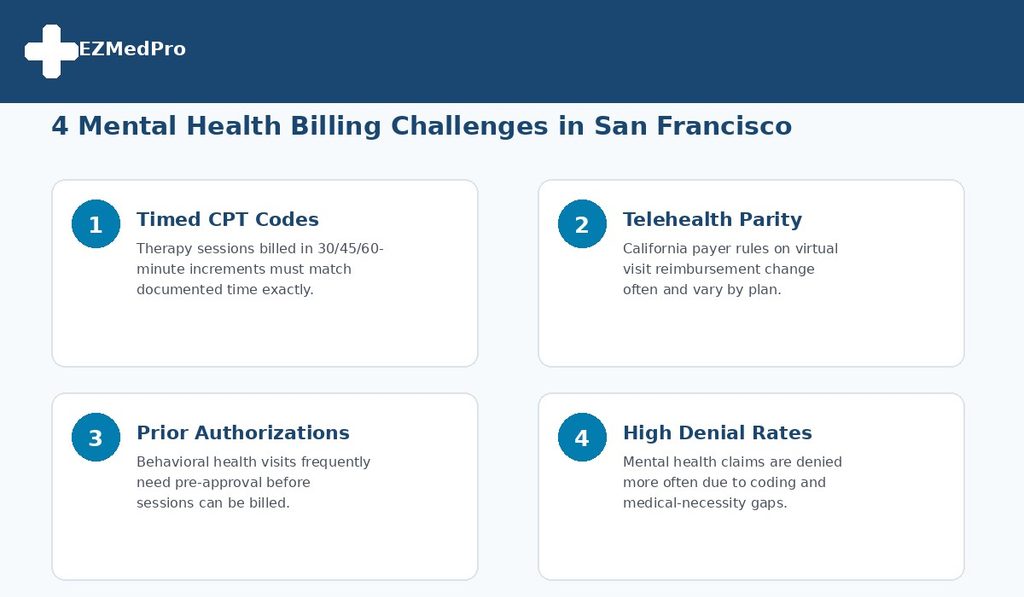
Therapy sessions are billed using CPT codes tied to specific time increments, typically 30, 45, or 60 minutes. If the documented session time does not match the billed code, payers deny the claim or request records for review. Add-on codes for extended sessions, family therapy, or crisis intervention introduce further complexity. Billing staff need to cross-check clinical notes against claims submission data before sending anything to a payer. Even small mismatches, like rounding session time incorrectly, can trigger a denial that delays payment for weeks and forces staff to spend hours on appeals instead of patient care.
California Telehealth Parity Rules
California requires many commercial payers to reimburse telehealth mental health visits at rates comparable to in-person sessions, but the specifics vary by plan and by whether the payer is regulated at the state or federal level. Telehealth billing also depends on correct place-of-service codes and modifiers, which differ between Medicare, Medicaid (Medi-Cal), and commercial insurers. CMS guidance on telehealth services confirms how frequently these federal rules are updated. A San Francisco practice offering both virtual and in-office therapy needs a billing team that tracks these distinctions closely — our telehealth vs. in-person mental health billing guide breaks down the modifier and place-of-service differences in more detail.
Common Mental Health Billing Challenges in San Francisco Practices
San Francisco therapists and psychiatric groups report similar billing obstacles regardless of practice size. High patient volume combined with strict payer documentation rules creates repeated friction between clinical staff and billing staff. Insurance verification often gets skipped during busy weeks, which leads to claims for patients whose coverage lapsed or changed. Behavioral health practices also deal with more prior authorization requirements than many other specialties, particularly for extended treatment plans. Addressing these issues requires dedicated billing staff who understand both the clinical side of mental health care and the administrative side of payer requirements.
Prior Authorization Delays
Many commercial and Medi-Cal managed care plans require prior authorization before a patient can continue therapy beyond an initial number of sessions. Missing a renewal deadline means sessions delivered afterward may not be reimbursed at all. Tracking authorization limits across dozens or hundreds of active patients is difficult without a dedicated system. A billing partner that proactively monitors session counts and renewal windows prevents care disruptions and protects revenue that would otherwise be written off. This is one of the highest-value areas where outsourced billing teams save practices both time and lost income.
High Claim Denial Rates for Behavioral Health
Behavioral health claims are denied more often than general medical claims, largely due to documentation mismatches and payer-specific coding rules. A denial isn’t the end of the process, but it does delay payment and requires staff time to research and resubmit. Denial management works best when a billing team reviews the reason code immediately, corrects the issue, and resubmits within the payer’s appeal window. Practices without a structured denial workflow often let claims sit unresolved for months, quietly losing revenue that a more attentive process would have recovered.
Trusted Mental Health Medical Billing Services in San Francisco CA-Common Denial Reasons Breakdown
- Session time doesn’t match the billed CPT code
- Missing or expired prior authorization
- Incorrect telehealth modifier or place-of-service code
- Eligibility mismatch at time of service
- Medical necessity documentation gaps
- Duplicate claim submission errors
What to Look for in a Trusted Mental Health Billing Partner?
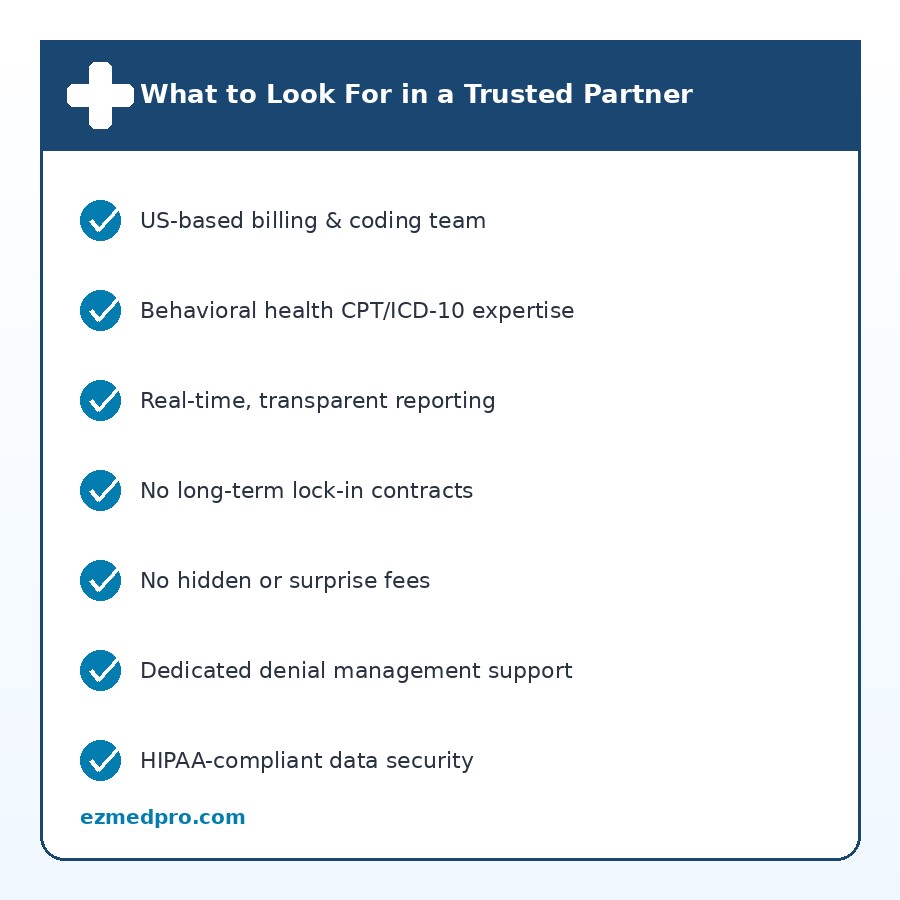
Choosing a billing partner is a bigger decision than it looks, since the wrong fit can cost a practice thousands in missed reimbursement. Look for a team with direct experience in behavioral health billing, not just general medical claims. Ask how they handle credentialing, since new therapists joining a group practice need to be enrolled with payers before they can bill under their own NPI. Transparent reporting matters just as much as technical skill; a practice should always be able to see claim status, denial reasons, and collection trends without requesting a special report.
Below is a quick comparison of handling billing in-house versus outsourcing to a specialized partner.
| Factor | In-House Billing | Outsourced with EZMedPro |
| Staffing cost | Salary, benefits, and training for billing staff | Included in service fee, no extra hires needed |
| Behavioral health coding expertise | Varies by individual staff experience | Dedicated behavioral health coding knowledge |
| Reporting | Manual reports, often delayed | Real-time, transparent reporting |
| Denial follow-up | Depends on staff bandwidth | Dedicated denial management workflow |
| Scalability | Requires hiring as the practice grows | Scales automatically with patient volume |
| Contract terms | N/A | No hidden fees, no long-term lock-in |
Questions to Ask Before Signing
Before committing to any billing partner, practices should ask a short list of direct questions. The answers reveal whether a company actually understands behavioral health billing or is applying a generic medical billing process to a specialty that doesn’t fit it well.
- How do you verify session time against billed CPT codes?
- What’s your average turnaround time for denied claims?
- Do you track prior authorization expiration dates automatically?
- Is reporting available in real time, or only on request?
- Are there setup fees, cancellation fees, or long-term contracts?
How EZMedPro Supports Mental Health Practices in San Francisco?
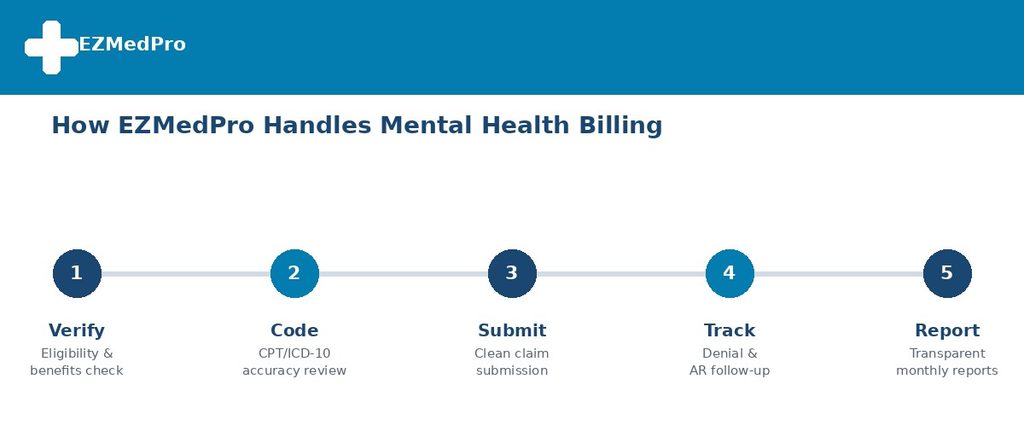
EZMedPro works with therapists, psychiatrists, and multi-provider behavioral health groups across the country, including practices based in San Francisco. The team handles insurance verification, coding, claims submission, payment posting, and denial management as one connected process rather than separate handoffs. Because EZMedPro is a US-based team, practices get direct communication instead of routing questions through offshore call centers.
Every client receives transparent reporting on claim status and revenue trends, with no hidden fees added after the engagement starts. Our mental health billing guide for psychiatrists and therapists provides a deeper look at how session-based coding works and how EZMedPro applies it day to day.
Specialties EZMedPro Also Supports
While this guide focuses on mental health billing, EZMedPro supports a broader range of specialties using the same transparent approach. Urgent care centers, family practice groups, and multi-specialty clinics all benefit from the same coding accuracy and reporting standards. EZMedPro’s full range of billing services outlines the specialties supported beyond behavioral health, which is useful for multi-provider groups that combine mental health and primary care under one roof.
Mental Health Billing KPIs and Benchmarks to Track
Tracking the right numbers helps a practice see whether its billing process is actually working, not just assume it is. Clean claim rate shows the percentage of claims accepted the first time, without needing correction. Days in AR measures how long it takes to collect payment after a session is billed. A high denial rate or long AR cycle usually points to a coding or documentation issue upstream.
Practices should review these benchmarks monthly and compare them against industry standards published by organizations like MGMA to see where their billing performance stands relative to similar-sized practices.
| KPI | Healthy Benchmark |
| Clean Claim Rate | 95% or higher |
| Days in AR | Under 30 days |
| Denial Rate | Below 5–10% |
| Net Collection Rate | 95% or higher |
| First-Pass Resolution Rate | 90% or higher |
Quick Summary
- Mental health billing involves timed CPT codes, frequent prior authorizations, and California telehealth parity rules
- Common denial causes include time mismatches, expired authorizations, and modifier errors
- A trusted billing partner offers behavioral health coding expertise and transparent reporting
- In-house billing costs more in staffing and often lacks scalability
- Tracking KPIs like clean claim rate and days in AR shows real billing performance
- EZMedPro provides US-based, no-hidden-fee billing support for San Francisco mental health practices
Expert Insight
Mental health billing carries more moving parts than many practices realize until claims start piling up. Between timed CPT codes, prior authorization tracking, and California’s telehealth parity requirements, even a well-run practice can lose revenue to preventable denials. The difference between a practice that struggles with cash flow and one that runs smoothly often comes down to who is managing the billing process behind the scenes.
Choosing a billing partner with direct behavioral health experience, transparent reporting, and no hidden fees gives San Francisco therapists and psychiatric groups room to focus on patient care instead of paperwork. Reviewing KPIs regularly, understanding common denial triggers, and asking the right questions before signing with a billing partner all reduce the risk of ongoing revenue loss.
Whether a practice is just starting to outsource billing or looking to switch from an underperforming vendor, the right partner should feel like an extension of the practice, not a black box. EZMedPro’s approach is built around that principle for behavioral health providers throughout San Francisco and beyond.
Frequently Asked Questions
Trusted Mental Health Medical Billing Services in San Francisco CA
What makes mental health billing more complex than general medical billing?
Mental health billing relies on timed CPT codes, frequent prior authorizations, and session-count tracking that most general medical claims don’t require. Payers also flag behavioral health claims for audit more often, so documentation accuracy matters more than it does for many other specialties.
Does EZMedPro handle telehealth billing for therapists in California?
Yes, EZMedPro manages telehealth claims including the correct place-of-service codes and modifiers required under California’s payer rules. This covers practices offering a mix of virtual and in-person therapy sessions.
How long does it typically take to see improved reimbursement after switching billing partners?
Many practices notice fewer denials and steadier cash flow within the first one to two billing cycles, though the full benefit depends on how many legacy claims and authorizations need to be cleaned up first.
Are there hidden fees with EZMedPro’s mental health billing services?
No. EZMedPro operates on transparent reporting with no hidden fees added after the engagement begins, so practices know exactly what they’re paying for each month.
Can EZMedPro handle credentialing for new therapists joining a practice?
Yes, credentialing new providers with payers is part of EZMedPro’s revenue cycle management services, which helps avoid delays in billing for a therapist’s first sessions.
What insurance payers does EZMedPro work with in San Francisco?
EZMedPro works across commercial payers, Medi-Cal managed care plans, and Medicare, adjusting billing workflows to each payer’s specific behavioral health requirements.
Trusted Industry Leader
Mental health billing shouldn’t be the reason a San Francisco practice loses revenue or burns out its staff. EZMedPro brings US-based behavioral health billing expertise, transparent reporting, and a no-hidden-fees approach to therapists, psychiatrists, and multi-provider groups across the city. Visit ezmedpro.com to learn more, or contact the EZMedPro team to talk through your practice’s billing needs.

