
Radiology Medical Billing Services in Pennsylvania (2026)
Radiology medical billing services in Pennsylvania handle coding, claims, and follow-up for imaging practices. They manage professional and technical splits, prior authorization, and payers from Medicare to workers’ compensation. A strong partner also tracks Pennsylvania rules, such as the 45-day prompt-pay standard for clean claims.
Pennsylvania radiology groups face a distinctive mix: Act 146 authorization windows, an auto medical cap tied to Medicare, and a separate workers’ compensation fee schedule. Add professional and technical splits, and each claim can follow a different clock. This guide explains radiology medical billing services in Pennsylvania and the rules that matter in 2026. It also shows how to test your own billing performance with simple math. You will find a key numbers table, worked examples, and a self-assessment checklist near the end. Every figure is labeled as a published rule, a commonly reported range, or a practical target.
Key Numbers for Pennsylvania Radiology Billing
| Metric | Practical Target/Range | Review | Primary Source |
| Commercial prompt pay | Clean claims paid within 45 days; 10% annual interest if late | Monthly | Published: 31 Pa. Code §154.18; 40 P.S. §991.2166 (10% interest, subsection (b)) |
| Medical Assistance filing | Initial claims within 180 days of service (fee-for-service) | Weekly | Published: 55 Pa. Code §1101.68 |
| Auto and workers’ comp | Auto capped at 110% of Medicare; workers’ comp at 113%, paid in 30 days | Per claim | Published: 75 Pa.C.S. §1797; 34 Pa. Code §127 |
| Clean claim rate | About 95% or higher | Weekly | Commonly reported |
| Days in A/R | About 30 to 40 days | Monthly | Commonly reported |
| Denial rate | About 5% or lower | Monthly | Practical target |
Published: stated in a named statute, rule, or payer guidance. Commonly reported: seen across industry sources, not mandated. Practical target: a planning goal.
What Radiology Billing Services Actually Cover?
Radiology billing work starts well before the scan is ever read. Front-end teams handle eligibility verification and prior authorization for advanced imaging. Coders then match each study to CPT codes, modifiers, and diagnoses that support medical necessity. Charge capture pulls reading volumes from the RIS, including over-reads and teleradiology work. After submission, staff post payments, work denial management, and follow aging balances. Pennsylvania adds Medical Assistance, auto medical claims, and workers’ compensation to the usual Medicare and commercial mix. Payer credentialing keeps new radiologists billable, so enrollment delays cost real revenue.
Pennsylvania Payer Rules That Shape Radiology Claims
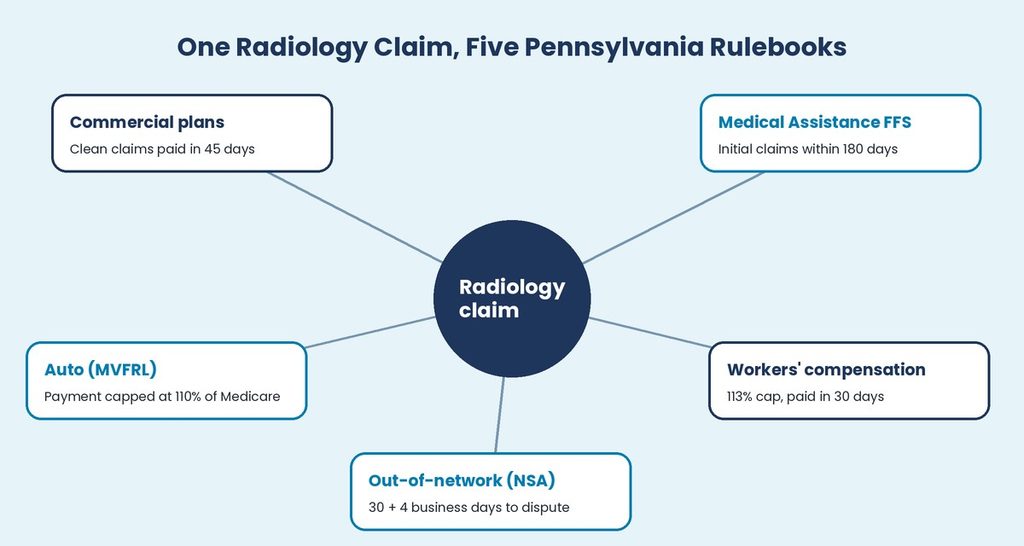
Pennsylvania radiology claims travel through several rulebooks at the same time. Commercial insurers must pay clean claims within 45 days, with 10% annual interest after that. Auto medical claims cap payment at 110% of the Medicare allowance, and workers’ compensation caps fees at 113%. Advanced imaging often needs prior authorization, and Act 146 (40 P.S. §991.2155) sets insurer decision windows of 72 hours for urgent and 15 days for non-urgent requests. Medical Assistance managed care plans have two business days after receiving all supporting information, and federal rules can override these timelines for some plans. Out-of-network claims add federal timing: 30 business days of negotiation, then four business days to start arbitration. Medical Assistance fee-for-service allows 180 days, but managed plans may differ.
Imaging Modifiers and Payment Reductions
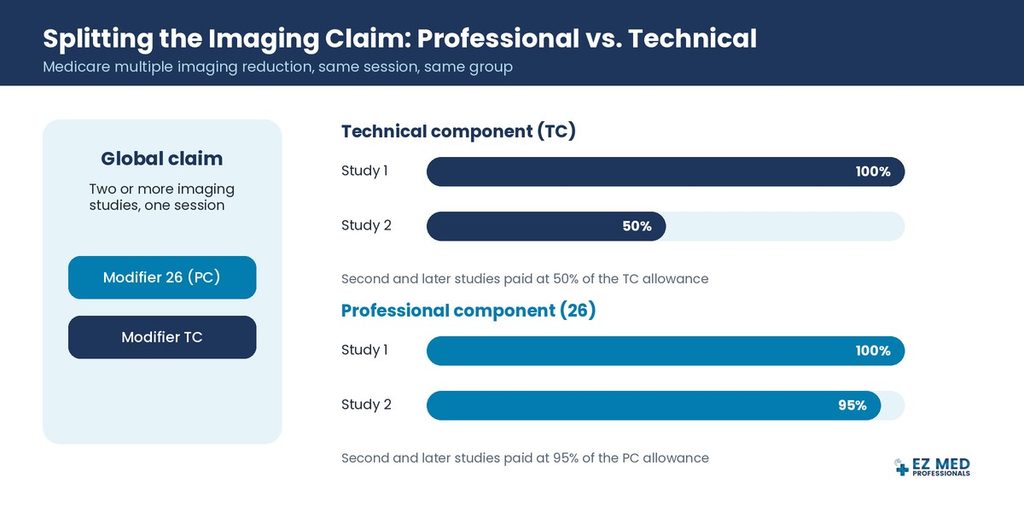
Radiology claims bill the professional component with modifier 26, the technical component with modifier TC, or both globally. Medicare’s multiple procedure payment reduction (MPPR) pays the highest-valued technical component in full, then 50% of later technical components in the same session on contiguous body areas. Later professional components in that session are reduced by only 5%. Highmark’s reimbursement policy applies a similar 50% technical reduction to additional studies on contiguous anatomic areas. The wrong modifier or study order changes payment, so edits should catch both. Documentation must also support medical necessity for each study, including contrast. A guide to CPT modifiers and a coder’s guide to bundling and unbundling help teams verify edge cases.
The 2026 Medicare Squeeze on Imaging
The 2026 Medicare fee schedule set the conversion factor at $33.4009 for most clinicians and $33.5675 for those in qualifying alternative payment models. Part of that rise is a one-year 2.5% increase from federal legislation. Yet a separate 2.5% efficiency adjustment trims values for most non-time-based services, including much imaging. CMS estimates, as summarized by the ACR, show about minus 2% for diagnostic radiology, minus 1% for nuclear medicine, and plus 2% for interventional radiology. Those estimates reflect relative-value changes, so net results vary by service and site of service. Pennsylvania’s auto medical cap follows Medicare allowances, so changes can flow through there too. The ACR’s analysis is a useful starting point for modeling your own mix.
Four Calculations to Run Monthly
| Metric | Formula | Worked Example | Result |
| MA filing deadline | Date of service + 180 days | Service on February 10 (non-leap year) | August 9 |
| Imaging reduction | Highest TC + 50% × next TC | $520 + 0.50 × $410 | $725 |
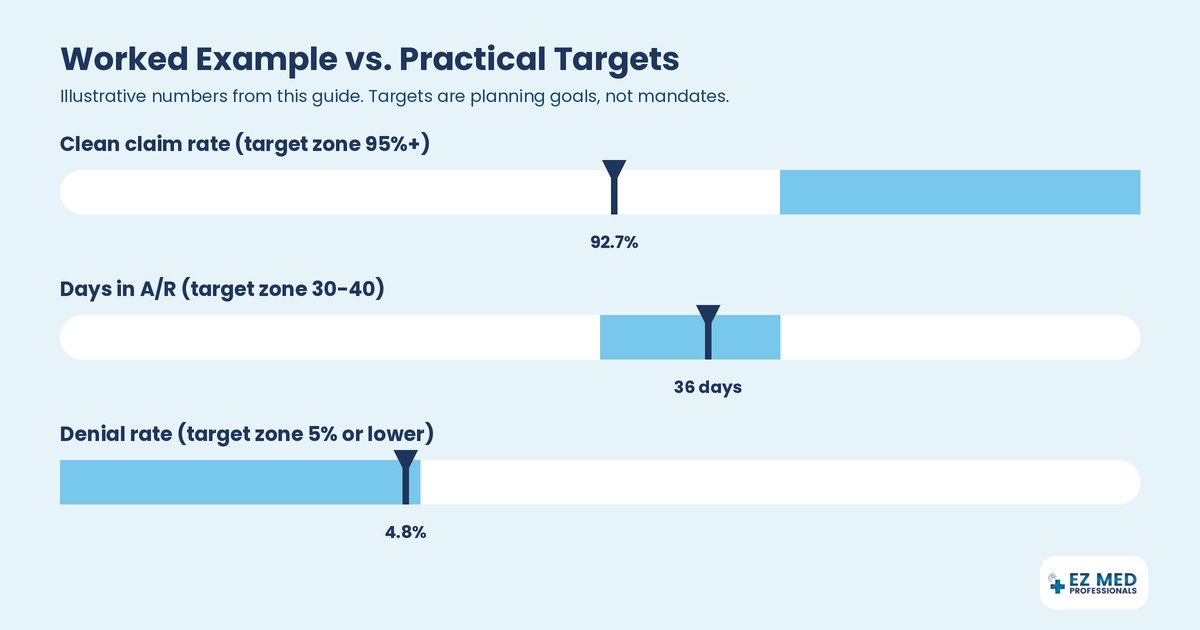
| Clean claim rate | Clean claims ÷ claims submitted × 100 | 1,150 ÷ 1,240 × 100 | 92.7% |
| Days in A/R | Total A/R ÷ (charges in period ÷ days in period) | $1,260,000 ÷ ($3,150,000 ÷ 90 days) | 36 days |
Illustrative scenario (not an actual client record): 1,000 claims in one month, split by payer track.
| Payer Track | Claims | Denied | Denial Rate |
| Commercial | 640 | 22 | 3.4% |
| Medicare | 260 | 9 | 3.5% |
| Auto and workers’ comp | 100 | 17 | 17.0% |
| Blended total | 1,000 | 48 | 4.8% |
Illustrative only. Denial rate = denied claims ÷ claims submitted × 100. Actual figures vary, so verify against your own payer reports.
Read these results together rather than judging each number alone. A 92.7% clean claim rate sits below the commonly cited 95% goal. The 36 days in A/R fall within the commonly reported range. In the scenario, the blended 4.8% denial rate looks acceptable at first glance. Yet roughly one in six auto and workers’ comp claims was denied. A blended average hides that problem, so always split denial rate by payer track. Improving your clean claim rate helps, and workers’ compensation billing delays need their own follow-up.
Using Benchmarks Without Misreading Them
A benchmark only helps when you compare like with like. Hospital-based reading groups, outpatient imaging centers, and interventional practices have different payer mixes and denial patterns. A center with heavy auto and workers’ compensation volume will not resemble a Medicare-heavy group. Compare the same segment, similar size, comparable payer mix, and the same reporting period. One missed benchmark is a signal to investigate, not a verdict on your team. Start by asking which payer, modality, and radiologist drive the gap. Then fix the root cause instead of chasing the average.
How Long Fixes Take to Show Results?
| Improvement | Early Signs | Fuller Results |
| Eligibility and authorization fixes | 30 to 60 days | 3 to 6 months |
| Modifier and PC/TC coding fixes | 1 to 2 billing cycles | 3 to 4 months |
| Denial backlog, appeals, and A/R | 60 to 90 days | 4 to 6 months |
Illustrative planning ranges, not guarantees. Payer speed, staffing, and starting point all matter.
Quick Recap for Radiology Owners
- Radiology medical billing services in Pennsylvania must respect a 45-day prompt-pay standard and a 180-day Medical Assistance filing limit (published).
- Auto payments cap at 110% of Medicare, workers’ comp at 113%, and later imaging studies pay 50% technical and 95% professional (published).
- Clean claim, A/R, and denial targets are practical, not mandated. Split each by payer track.
Self-Check: Is Your Billing on Track?
Answer yes or no, then count your yeses.
- Do you file Medical Assistance fee-for-service claims well inside 180 days?
- Does one named person track imaging authorizations and decision windows?
- Is your clean claim rate near 95% or higher?
- Are your days in A/R about 40 or fewer?
- Is your denial rate near or below 5%?
- Do you review denial rate by payer track, not only overall?
- Do you audit modifier 26, modifier TC, and imaging reductions regularly?
- Do you calendar No Surprises Act deadlines for out-of-network claims?
- Is every radiologist credentialed with each payer before reading its studies?
| Yes Answers | What It Suggests |
| 8 to 9 | On track. Keep monitoring monthly. |
| 5 to 7 | Gaps to investigate. Start with payer-level reports. |
| 0 to 4 | High risk. Consider an audit or outside support. |
Expert Insight
Radiology medical billing services in Pennsylvania work best when payer rules, modifiers, and deadlines stay connected. The firm numbers here are published rules: prompt-pay timing, the Medical Assistance filing limit, the auto and workers’ compensation caps, and Medicare’s imaging reductions. The 2026 conversion factors come from CMS’s final rule. Prompt-pay rules exclude auto and workers’ compensation claims, so confirm the payer type first. Effective dates matter for older services, so verify them before relying on any deadline. The key numbers table near the top lists the source for each figure.
Everything else is a practical or illustrative target. That covers the roughly 95% clean claim rate, the 30-to-40-day A/R range, the 5% denial goal, the payer-level example, and the fix timelines. No standards body or association mandates any of them. Treat them as prompts for better questions about your own data, and compare like with like before drawing conclusions. A blended average can look healthy while one payer track struggles, so split every metric before you act. Small, steady corrections, tracked monthly, usually beat dramatic overhauls.
Frequently Asked Questions
What do radiology billing services include?
They cover eligibility checks, authorizations, coding review, modifier audits, claim submission, payment posting, and denial follow-up. Many also handle credentialing, so ask for a written scope of work.
How much do radiology medical billing services in Pennsylvania cost?
Pricing varies by vendor, practice size, and model, such as percentage of collections or flat fees. Ask for a written fee schedule confirming no hidden fees.
What is a good clean claim rate for a radiology practice?
Many practices aim for about 95% or higher, a commonly reported range, not a mandate. Track it weekly and by payer, since low rates usually signal front-end errors.
What is a good days in A/R for a radiology practice?
A commonly reported range is about 30 to 40 days, though payer mix matters. Auto and workers’ compensation accounts can lengthen it, so review them separately.
What is a good denial rate for radiology claims?
Many practices aim to stay near or below 5%, though 5% to 10% is often reported. These are practical targets, not standards, so review denials by payer.
How long do insurers have to pay Pennsylvania radiology claims?
Licensed insurers and managed care plans must generally pay clean claims within 45 days of receipt. Late payments accrue 10% annual interest, and the rule excludes auto and workers’ compensation claims.
How long do I have to file Pennsylvania Medical Assistance claims?
Fee-for-service providers must submit initial invoices within 180 days of service. Managed care plans may set different deadlines, so check each contract.
What is the multiple procedure payment reduction for imaging?
Medicare’s multiple procedure payment reduction (MPPR) pays the highest-valued technical component in full, then 50% of later technical components in the same session. Professional components after the first study are also reduced by 5%.
When Outside Billing Support Makes Sense?
Outside radiology medical billing services in Pennsylvania make sense when several of these signals appear together:
- Medical Assistance claims approach the 180-day limit.
- The same TC, modifier 26, or bundling denials repeat every month.
- Imaging authorizations have no clear owner.
- Auto and workers’ comp accounts age without follow-up.
- Out-of-network dispute deadlines slip past.
When comparing partners, look for clear structure rather than catchy slogans. Ask whether a US-based team will handle your account, and whether reports are regular and transparent. Request a written fee schedule that confirms there are no hidden fees. Check for hands-on experience with professional and technical billing, imaging authorizations, and auto or workers’ compensation accounts. Be cautious of guaranteed collection percentages that lack a stated measurement method. Weigh the trade-offs using an in-house versus outsourced billing comparison before deciding. Sample reports and a short pilot can help you verify each answer.
EZMed Professionals (EZMedPro) is one example of a partner built around this structure. Its US-based team delivers medical billing, coding, credentialing, and revenue cycle management. The company describes its reporting as transparent and states that it charges no hidden fees. The company serves urgent care, family practice, and multi-specialty groups, and its site includes radiology billing service pages. Its approach links billing, coding, denial management, and compliance support from end to end. Whichever firm you consider, EZMedPro included, compare its written scope and a sample payer-level report against your own Pennsylvania payer mix. Results vary by practice, payer mix, and situation.
Sources and Methodology
- (a) Published standards: 31 Pa. Code §154.18 and 40 P.S. §991.2166 (prompt pay); 55 Pa. Code §1101.68; 75 Pa.C.S. §1797; 34 Pa. Code ch. 127; Act 146 of 2022 (40 P.S. §991.2155); CMS CY 2026 Physician Fee Schedule final rule (conversion factors, efficiency adjustment, and CMS impact estimates as summarized by the ACR); Medicare contractor MPPR guidance; federal No Surprises Act IDR rules.
- (b) Named benchmarking data providers: none used.
- (c) Practical or illustrative targets: clean claim rate, A/R range, denial goal, payer example, and timelines reflect commonly reported industry ranges and planning assumptions.
- (d) Survey data: none used.
Act 146 decision windows are set out in 40 P.S. §991.2155 and may be superseded by federal rules for some plans. Results vary by practice and situation. Figures reflect information available in September 2026; verify current rules with each payer.

